Saturday, March 22, 2014

Howard Hall - underwater Fireworks!

Mobulas (M. eregoodootenkee?) in bait ball. Source.

OWOO continues to deliver.

Beautiful!
And here is an hommage to the unequaled Howard!
Enjoy!


Friday, March 21, 2014

Argentina?

I say, no way!

But great pic.
Opinions?

Thursday, March 20, 2014

Guadalupe Tourism - Impact?

Cage diving in Lupe - good or bad for the Sharks? Source.

Watch this.


Edgar Becerril want to assess the impact of baiting at Lupe.
Methinks that as always, the results will show no effects at the ecosystem level (= the Sharks migrate, mate and pup normally, etc) whereas like in Australia, there will probably be some effects at small spatial and temporal scales. 
As an example of the latter, they may well show that the GWS are being aggregated around the vessels and if so, it may be wise to anchor well away from the beaches frequented by the Elephant Seals lest one would subject them to increased predation risk. Or, aggregating the Sharks may lead to increased brawling among the males like apparently in Moorea.

We shall see.
I'm skeptical that lacking a baseline, anything conclusive can be garnered within a mere three months - but happy to be proven wrong!

Looking forward to the publication!

WESPAC - more about the Marianas Shark Cull!

Micronesia Shark Sanctuary - very much at risk! Source.

Thank you Shark Defenders!

Obviously, mine was merely a heads-up.
Being from Saipan, Angelo is best suited to dig up the gory details - and he sure has!

Case in point, this document.
It makes the case for establishing a Shark fishery in the Marianas.
Prima facie and apart from the obvious "oversights" (e.g. Scalloped Hammers are endangered, highly vulnerable to fishing pressure and also listed under CITES 2 - but they have some of the most sought-after fins), I for one got nothing against well managed Shark fisheries that rely on sound science-based quotas and where monitoring and enforcement are ensured. I've stated multiple times that I consider those Sanctuaries to be stop-gap measures in view of the establishment of  properly designed, implemented, and enforced fisheries management plans, and I stick to that opinion. 
In theory, and provided that proper stock assessments etc indicate the feasibility of establishing a fully sustainable fishery for determined species, I would certainly not oppose a fully certified (!), fully sustainable food fishery for those Sharks.

But of course this got nothing to do with sustainability.
Angelo is perfectly correct - this is a cull, not fisheries management.
It is WESPACs continued attempt to subvert the unequivocal will of the people who have made it amply clear that they want no Shark fishing in those Pacific territories and States. Having that appalling gang of unelected bureaucrats overturning democratic processes is simply intolerable.

Angelo: solutions? 
Or is it already too late?

Wednesday, March 19, 2014

WESPAC - on the Attack!

Soon from Saipan? Source.

Read this shit.

So it looks like I was right after all.
Spurred on by those bastards (and here!) at WESPAC, NOAA is now mounting a full attack on the Pacific Shark Sanctuaries.

This aint looking good.
To be continued.

Monday, March 17, 2014

Great Post by Gary!

Source.

Well said!

But first, watch this.


And here are Gary Stoke's comments.
They very much echo what I posted quite a while ago - this with the difference that back then, I was highly skeptical of the various grassroots initiatives in Asia, and could not have foreseen the effects of the Chinese crackdown on corruption. Now I stand partly corrected - although upon seeing that enormous amount of fins it appears clear that the fin trade may be reeling but is not about to simply vanish anytime soon. And of course the other drivers for the persistent astounding Shark mortality continue, meaning that the fight is far from over.

But I'm digressing as always.
All I really wanted to say is bravo Gary!

Sunday, March 16, 2014

Frisky Reefie!

Feeding a Lionfish to a Reefie - maybe not such a good idea after all! Source.

Watch.


Good reaction by the diver!

Talking of which.
I hear reports from Cayman that visiting liveaboards are encouraging their clients to "teach Sharks to feed on Lionfishes". This equals uncontrolled Shark feeding, and I hear that it is already causing problems for the other aquatic recreationists.
If so - people: Think!

But I'm digressing as always.
Cool video!

PS: One more post here - totally agree!
 

Bravo Demian!


I've been remiss in not posting this earlier.

Demian is one of the good guys.
So I'm particularly pleased to read this announcement.
Impressive bio here, project outline here.

Huge congratulations!

Inverted Trophic Pyramids?

Pristine reef - Shark-dominated. Source.

Hmmm.

Read this.
Top predator biomass in pristine coral reefs is described to be between 54% and a whopping 85%, meaning that the resulting classical trophic pyramid of biomass is inverted, thus seemingly contradicting the rule that the biomass of prey must be larger than that of the predators because most of the energy gets lost whenever it is moving up through the food chain.
The prevailing explanation for this apparent paradox, is that the lower trophic levels have a much higher turnover rate whereas the top is much slower both in metabolism and reproduction. In fact, if instead of simply taking a snapshot and looking at biomass, one were to to plot the same data over time by depicting a productivity pyramid, one would once again obtain a standard, non-inverted shape.

But is this really the whole story.
  • Coral reefs are not closed systems.
    This is specially true for those remote islands that feature important influxes both from the open ocean (= plankton but also larger, often migratory transients) and from the deep, the latter especially at night. This means that the effective available biomass of prey may in fact be much larger than merely the local residents.
  • The range of those predators may encompass multiple ecosystems.
    Research shows that many reef Sharks are resident during the day but disperse during the night, likely in order to forage. Thus, those islands may merely act as anchor points during periods of relative inactivity during the day, whereas feeding may happen both on the reef but also offshore and deeper - once again meaning that for those Sharks, the effective biomass of available prey may well be much larger than what can be deducted by merely observing what lives on those reefs.
And if so, how would the resulting trophic pyramid look like?
Just sayin'! :)

Anyway.
When researching the above, I've stumbled across this inspirational TED talk by Enric Sala.
Oldie but goodie - enjoy!


Friday, March 14, 2014

Heartbeat of the Sea - fantastic!

Source.

Rafa Herrero Massieu is a phenomenal cinematographer.

Case in point.
Enjoy!


Thursday, March 13, 2014

OSAM - public Screening!


Brilliant!

Please read this post by David.
It really looks like all the sacrifice and the enormous effort are being appreciated, which is just great.
Congratulations - I'm really happy for you mate!

And for those that may have missed it the first time.
Here's the latest trailer - wonderful stuff!
Enjoy!


Cyclone dive!

Lusi right now. Beqa is the small dot right to the south of Viti Levu - real time animation here.

This is gonna be an interesting one.

We'll be diving right at the edge of an active Cat3.
The seas will be flat as Viti Levu will keep us sheltered from the northerlies - but I can't wait to see the behavior of the Sharks!

Talk later!

Wednesday, March 12, 2014

Guadalupe Expeditions - last Chance!

Source.

I'm frankly underwhelmed.

9 hours to go, and the bids are languishing.
The normal price for those extraordinary expeditions is USD 3,100.00.

Can we do better than that?

Keeping British Waters for the British!

Lydia track. Source.

Bingo.

Lydia has taken a turn away from the UK.
Looks like for once, UKIP's ever controversial immigration spokesman Mr. Batten will have it his way and keep the infamous Cornish coast entirely uncontaminated by unwanted illegal immigrants - and undoubtedly, much safer for it!

Sorry Richard (and David!).
They may be nomadic - but philopatry rules! :) 

Story here!

Tuesday, March 11, 2014

Howard - Isla Mujeres!

Betcha this is an old pic from the 80ies, when Howard would find these gigantic WS off Cabo San Lucas! Source.

Wonderful stuff!

The man is still unmatched.
And did you notice those Mantas - may this be Andrea's third hitherto undescribed species?

Be it as it may - enjoy!


Fiji - Lusi!

There it is, churning away over Vanuatu!

Finally!

The FMS has started issuing cyclone alerts.
Very likely, it's gonna be a near miss, with the West bearing the brunt of the wind and rain. For us down here, it's gonna be some rain and northerlies which are generally no problem.

But things can change so keep an eye on the forecasts!

Monday, March 10, 2014

Sharks are not Apex Predators - Paper!

Big Fiji Bull Sharks - definitely Apex! Click for detail!

Hallelujah!

This has one of my pet peeves for a very long time indeed.
And now a panel of illustrious researchers are confirming that the vast majority of Sharks are not apex predators but instead, best described as mesopredators, to wit
We might talk of apex size classes rather than apex species in relation to sharks and other marine predators that grow indeterminately throughout their lives. 
Using the criterion of apex size classes, the categorisation of sharks as apex predators would be  restricted mainly to adults of large-bodied and wide-ranging species that influence many species within a community. Use of this definition would limit the term apex predator to large individuals (>3 m) such as older juvenile or adult white, tiger, hammerhead and dusky sharks...
(and adult Bull Sharks!)


Most shark species and size classes are in fact best described in the role of mesopredator. 
The ecological role of sharks within the diverse and impacted marine environment requires careful consideration. 
There you have it.
And the same undoubtedly applies to the terms of keystone and umbrella species that are so liberally bandied about by some quarters within the movement!
You can read the whole paper here.

And there's one more interesting observation, and I cite.
Our size-based view of the classification of predatory roles raises important questions about what objectives to manage, and how these objectives can be best achieved.

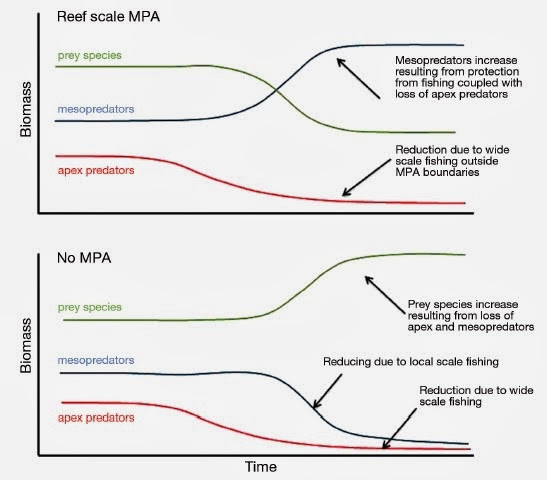
Protection of reef communities through marine protected areas (MPAs) or fisheries regulation (or indeed, naturally on those few locations far from human population centres) would ensure the mesopredator sharks on these reefs are sheltered from fishing pressure. However, the same may not be true for apex predators because their broad movement patterns and large home ranges (Meyer et al. 2009) would expose them to a greater diversity of fishing fleets and gears, and thus a greater overall mortality than the smaller-ranging, reef-dwelling mesopredators. Hence, the apex predators of coral reefs may be silently eliminated by offshore pelagic longline fisheries, unbeknownst to those managing reef diversity and function (Cox et al. 2002).
Therefore, reef-based MPAs are not adequate to protect these species.


296 Fig. 2. Conceptual diagram outlining the loss of apex predators from reef regions and corresponding system responses where a marine protected area (MPA) is present (upper) or absent (lower). Presence of MPAs leads to different states of equilibrium on individual reefs

Avoiding and mitigating these impacts may require consideration of the ecosystem- and jurisdiction-crossing movements of apex species and size classes. Therefore, management needs to consider not only the effect of reef-based spatial closure, but the amount of time these regions provide shelter to large, mobile, apex species.
This of course eminently important for the SRMR
There, the range of the Bulls and especially the Tigers is clearly much larger than the MPA proper - but this is exactly why we did establish the Fiji Shark Corridor that is conferring a solid, albeit not perfect degree of protection to our Bulls. The possibly highly migratory Tigers, alas, probably not so much - tho we will likely never know as the observed competitive exclusion may well end up masking any losses due to fishing.

This is why the river nursery work is so vital.
Compared to the large and relatively inaccessible ranges of the adults, those nurseries are discrete and relatively small areas where conservation measures may well be easier to implement. We know that the Fijian rivers do not only feature juvenile Bulls but also juveniles of the endangered and probably highly migratory Scalloped Hammerhead - and I betcha that upon closer inspection, we'll also find Nurses and Lemons. 
And once we dispose of the necessary data, we will certainly do our darn best to have those habitats protected!

But I'm digressing as always.
Brilliant paper - enjoy!

Fiji - it's gonna be a close one!


Hmmm.

Looks like Lusi  is gonna pass to the West.
Probably - but as you well know, those things can change very fast. Keep an eye on the forecast and on the animation where right now, you can watch it building over Vanuatu.

FMS warnings here.

E-Mail!


E-mail is back up again.
Fire away!

Sunday, March 09, 2014

Mangroves for Fiji - Expansion!


There's people that talk talk talk talk.

Others do.
Case in point: Projects Abroad is picking up where we left Mangroves for Fiji and is now expanding the project all across the country. Obviously this is a long-term endeavor necessitating heaps of preparation - but they've already established several nurseries and started various awareness workshops. And as a real nice spin-off, they've even created a recycling venture that has enabled them to collect over 10,000 plastic bottles that are being used for germinating the Mangrove propagules.
Restoration will start next month, and the volunteers will be able to claim the resulting carbon credits against their individual footprints.

I say, well done - that's how you do it.
To be continued no doubt!

And now, for Something Completely Different!


Intriguing!

Resources here - scathing critique here.
Enjoy!


Comments section is closed!

Sharks filming Sharks!

 
This is simply awesome!

Stories here, here and here.
Who would have thought that those different species coexist so peacefully!
 
Enjoy!


No e-Mail!


I haven't received any e-mails in days.

Turns out that the Connect e-mail server is down.
Chances are that 3+ days worth of e-mails have been lost - so once it's back up, you may want to re-send anything important.

For now, best hold off.
I'll keep you posted.

Saturday, March 08, 2014

Reef Mantas in the Red Sea - Paper!

Reef Mantas or Giant Mantas? Source.

Very Cool.

Reef Mantas are shown to engage in deep dives during the night.
Apparently, they are mostly targeting Plankton that ascends from the deep at night - but the authors speculate that occasional very deep dives to up to 400m are not for foraging but instead, a more efficient way of traveling.

Synopsis here, open access paper here.
Enjoy!

Hammerheads in Mozambique!

Simply outstanding pic - click for detail! Source.

Nice!
Mozambique is of course one of the epicenters of unsustainable Shark fishing, so encountering so many of the endangered Scalloped Hammers is a special treat indeed.

Enjoy!


Friday, March 07, 2014

Shark Volunteer in Fiji!


And here's another one!
My name is Viktor Hesselberg- Thomsen. 
I am 19 years old, live in Fredensborg and graduated buzzer 2013. In my gap year I came to Fiji for six weeks with the organization Projects Abroad to work on a project that aims to protect and conserve sharks primarily here in the South Pacific . We do this by collecting data to hajforskere , develop educational material about sharks , and to train local people in our neighborhood about sharks.I have always been fascinated by the sea and the animals that live in it. When I saw this project , I had to simply join me . I pushed the plans I had at the start of the new year, and wrote me up for the project.

After 35 hours of travel I arrived in this amazing country with a very friendly locals .  

In the project we are 20 volunteers, and the age difference is great. There are about ten , which is between 17 and 25 years. The rest are somewhere between 26 and 63 years. Although there is huge difference in age and background between us is really good atmosphere in the group and I have made friends all around the world.

Two to three times a week we'll go diving .  

Here we collect data by counting how many and which sharks we see. We also an underwater camera with a feed box . In addition, we develop training materials or game / play ( involving sharks) , these we use when we are once a week take off for a school or a local village to give sharks a positive ' image ' of the people especially the children. We also try to catch baby sharks to take DNA samples and to cause them a ' tag ' that makes it easy to follow them.
 
Once a month , we take a dive center out and watch them feed the sharks. 

Here we have 40-45 bull sharks swimming around , you see how easy and elegant grabs tuna heads , as they are fed . This is one of the best experiences of my life , and along with the rest of the project and unity with the other volunteers have it pushed to my view of sharks and the world at large. I really think that those who get the opportunity to see sharks in the wild , must seize it ! 

Viktor diving with sharks in Fiji.
There you have it.

Three Weeks til April!


Remember?

Doesn't get any better than that!
So, what are you waiting for!

Thursday, March 06, 2014

Shark Molesting in Cuba!

Huzzah - we got ourselves a new Shark whisperer! Source.


Well, apparently little has changed.
Alerted by that last picture, I've gone rummaging - and it sure looks like there's a gang of commercial idiots molesting Silky Sharks at the Jardines de la Reina.
Check it out, this is but one of many such videos.


This is so nineties.
Contrary to what happens with Cristina, it's the real tonic.
If memory serves me right, this stuff was started by Stuart Cove who used it to remove hooks from Silkies when diving on FADs. Now it's a stupid macho show for stupid tourists, much like the ever more pervasive wrangling of Tigers at Tiger Beach.

Barf!

Indeed - it is Ridicule!

Alas I fear this is not photoshop. Source. Is it this guy?

Read this.

I fully concur, to wit.
With one caveat that is: there may be situations where the moronic behavior of a few idiots may well end up endangering the public and consequently, triggering a retaliatory backlash against the Sharks.

Anyway, yes, bravo Angelo.

Fiji - another one?

Source.

Quite possibly!

You know what to do!

Tuesday, March 04, 2014

OSAM - Progress Report!

Looking slightly overwhelmed? I would, too!

Wow.

Read this.
Which begs the question, at what point, exactly, does dedication morph into obsession - maybe after two and a half years of editing one and the same movie?

Be it as it may, I just can't wait.
This is gonna be simply epic - in length and judging from the teaser-trailers, in quality as well. My only gripe: I just love my percussion heavy techno and "Arabic wailing music", to wit!

Anyway.
What I really wanted to say is, godspeed buddy.
And to you out there, please do consider making a contribution - I'm sure it will come back a thousandfold!

Shark Molesting - Article!

Source.

Nice job David!

This is a real nice piece of Shark journalism.
My quotes are excerpts from the following short interview, and regular readers will be shocked to notice that I'm being exceedingly civil - but worry not, this is by no means a change of attitude but merely the reflection of the fact that after much soul searching, I've ended up acquiescing to the request that the responses be kept PG-13. :)
Should you have missed what I really think - read this!

So there - enjoy!
1) Please state your name and affiliation/title as you'd like it to appear in the article (and a link to your business website) 

I am Mike Neumann, a shareholder of Beqa Adventure Divers
We are a dive operator specializing in baited shark dives with several sharks, among which our flagship species bull sharks. We are also heavily invested in shark research and shark conservation, the latter both directly and through advocacy. 

2) In general, is shark diving good for sharks? Why or why not?

In general terms, yes. 
Shark diving showcases some of the most charismatic marine species and has a proven track record of furthering shark conservation by enabling the public to acquire a better understanding and appreciation of these magnificent animals. Many reputable shark diving operators are also actively engaged in conservation and research, the latter often in cooperation with the research community to whom they provide access to the animals but also invaluable long-term data, etc. 

The above however with a big caveat. 
Like any other organized wildlife tours, shark diving can also be highly detrimental if conducted incorrectly. E.g. whale shark tourism had to be regulated in order to avoid issues of operator overcrowding and harassment. Baited dives with large predatory sharks carry inherent risks that need to be properly managed in order to avoid accidents that would ultimately reflect negatively on the sharks. 

3) Have you observed (or heard of) customers change their minds about sharks after interacting with them up close? 

Countless times! 
We service clients of all experience levels and it is always inspiring to observe the awe and exhilaration especially of the newbies once they realize that the sharks are nothing like the negative stereotypes but instead simply awesome and beautiful – and badass! 

4) What do you think of recent "daredevil" behavior, ie riding sharks and filming it? Are these divers in danger, even if they have experience around sharks? 

As you know, I hate it and have publicly criticized that practice for many years. 
My main grievance is this: I hope that everybody agrees that riding harmless species like turtles, manatees, nurse sharks, manta rays or whale sharks is totally disrespectful and moronic – so why would riding those predatory sharks be anything else? 
Being in the presence of those wonderful animals is a privilege. We need to admire and respect them – not molest them! 

The risk aspect plays a secondary role – but yes, these close interactions with large predators are always dangerous. Highly experienced people may possibly limit those risks through adequate behavior and safety protocols – but the increasing number of inexperienced copycats makes me fear that somebody will end up having a bad accident. 

5) If someone gets hurt while riding a shark, what will the consequences be for your industry? For sharks in general? 

As long as those remain private undertakings, common sense will likely prevail as the overwhelming majority of people will state the obvious, i.e. that the perpetrator was a fool who got what he was asking for.

What however concerns me are trends in the industry whereby some commercial operators enable ever closer direct interactions between their clients and those large predatory sharks, and this in baited conditions. I am convinced that it’s only a matter of time before this will precipitate a major accident – and if so, it will reflect very negatively on the industry in general and reinforce the already widespread reservations against our activities. This can also not be good for the sharks. 

Having said that, I am equally convinced that the consequences for those operators that are on record for not approving of those developments and for observing stringent safety protocols will be minimal.

6) People say that they are riding sharks to help show others that sharks aren't dangerous. What do you think of this? 

First things first: those large predatory sharks are dangerous and asserting otherwise is both disingenuous and stupid.

It is also a stupid conservation strategy.
Nobody asserts that e.g. the big cats, bears and large and/or venomous reptiles are harmless – and yet we preserve them because we appreciate their beauty and ecological role, and because we believe in preserving biodiversity. Predators have every right to be predators and we need to respect and admire them as such. The best conservation strategy is to concentrate on awareness and education whilst advocating legislative change - not those misleading stunts. 

By the same token, it is at best naive to assert that Sharks are imperiled because the public does not like them. 
Like with all other endangered large predators, the principal risks for sharks are commercial overexploitation coupled with habitat destruction and human encroachment leading to conflicts. Shark fishermen kill sharks because they are trying to make a living, not because they hate them – and I can equally assure you that no fisherman in say, Indonesia will stop fishing because of some scantily clad peroxide piranha swimming loops around a perplexed Oceanic Whitetip! 

And finally allow me one last observation: upon closer inspection, the main motivation of those people appears to be personal gain - be it perceived fame, revenue from selling those images or marketing for their corporate sponsors. Far from being admirable, this is highly hypocritical.

7) Have you observed changes in your industry in recent years? 

Yes I have. 
On the positive side, many operators have become more active in shark conservation because they have witnessed the decline of sharks first hand and decided that something needed to be done. Others have been driven into it by competitive pressure. It is also great to see an increase in the number of shark divers and shark conservationists. 

On the negative side, like I said, I observe the trend towards ever closer encounters with great apprehension. 
And when it comes to shark conservation, I deplore what I call the dolphinization of the shark movement whereby predatory sharks are being depicted as puppy dogs and the media are increasingly being driven by shameless self promoters, cheats and charlatans. 

8) Is there anything else you'd like to share about your business, the broader industry, or your thoughts on this daredevil behavior? 

I wish that the industry were more cohesive, and that we could all agree that we carry a collective obligation to act as stewards of the animals we showcase. That very much includes desisting from enabling those horrible productions by Discovery, Animal Planet and Nat Geo Wild.

Thanks! 

Thank you for this opportunity! 

Monday, March 03, 2014

Sustainable Fishing in the Developing World!

Sustainable - pole-and-line Skipjack fishery in the Maldives.

Watch this.


Yeah I know I know.
Among some quarters, the MSC is highly controversial
Be it as it may, as far as I know it's still the best there is - and those who continue criticizing it should maybe either a) become a part of the process and help reform/improve whatever upsets them, or else b) set up their own perfect seafood certification agency.

I say, well done.
This is precisely the kind of independent proof  I'm advocating here - and the examples appear to show that on top of leading to better management measures, the certification may even result in higher revenues via the establishment of premium markets for the products.


Real Shark Conservation!

Early morning on the river, looking for baby Sharks. Source.

And I cite.
So what can we do to really make a difference? 
First of all, we have to decide what our goal really is. Do we care more about saving sharks, or do we care more about what other "conservationists" think about us.

If your answer is, saving sharks, here are some things you can do. 

I have to warn you though. Nobody on the internet will know what you did. There are not going to be a lot of people slapping you on the back and telling you what a good job you did. Aside from very few people acknowledging your efforts, your only reward is going to be the knowledge that your efforts helped save some sharks.
Indeed.
Here's the nice account by someone who did just that, by taking a trip to Fiji and pursuing hands-on Shark conservation and research with Projects Abroad - sans moldy black-dyed duck wings, simply because she wanted to make a difference.
And make a difference she did.

Kudos!

Science Expeditions to Lupe - Auctions!

Source.

This is great stuff.

Two spots are up for auction.
Sep 9-14 here, Sep 19-24 here.
Should you be interested in GWS research, this is a really great opportunity to engage with one of the authors of this seminal paper, and to get to hear about further really interesting information that has been garnered since its publication.
More details here.

Good luck in bidding!

Sunday, March 02, 2014

Trophic Cascade - Wolves and Rivers!

Source.

Really, really nice!
Story here, in reverse here, paper here!

Enjoy!


And the Sharks?
Re-read this and this!

Saturday, March 01, 2014

Extinction Soup - World Premiere!

Source

Great news from the team!

Dear Friends,
We have very exciting news!  While we push to complete the film in the coming weeks, we have been invited to Premiere at the San Francisco International Ocean Film Festival.  The details follow:
World Premiere of EXTINCTION SOUP
@ 11th Annual San Francisco International Ocean Film Festival
When:  Saturday, March 8, 2014 @ 1:00pm
Where: Bay Theater, on Pier 39, adjacent to the Aquarium of the Bay, Embarcadero at Beach Street, San Francisco, CA
After the screening, please join our Director/Producer Philip Waller and Executive Producer Stefani Brendl for a 3:00pm Panel Discussion: Shark Sanctuaries and Ecotourism.
If not for all of your incredible support, we would not be in this position, and we want to thank you again.
Please let us know if you plan on attending the festival as we would love to meet you in person and say hello.
Best,
Phil, Stefanie, Sidney, & Travis
and the entire Team for Extinction Soup

Be there!

NZ GWS Tourism - the Guidelines!


So here they are.

For the time being, they are only interim guidelines.
I must say that I like the approach as the authorities are not barging in unilaterally but instead trying to work cooperatively with the operators that get one further chance to do things right until a likely final review in 2015.
People in the know tell me that once they get enacted, the rules are likely to be part/condition of the permits (= you breach them, you lose the permit) rather than regulations, this also because this would allow for more flexibility and much easier enactment and/or changes.

I must say, I find them rather good.
Just this: how about some thoughts about best location(s), number of operators and possible rotation to avoid the all-too-common chumming wars, and amount and frequency of berleying. But the first two aspects may well be best legislated elsewhere - and anyway, I'm neither a GWS diver let alone operator and my specific know how is consequently limited.

So you commercial GWS folks out there - thoughts?
You can best e-mail any questions or suggestions to Kristina Hillock who reports to Marine Species and Threats Manager Ian Angus, the gentleman mentioned here. This is a great opportunity to contribute to getting it right from the get-go, so please do take the time to make some constructive comments.

Thank you!