Showing posts with label Shark Provisioning. Show all posts

Friday, September 01, 2017

Bulking up at Shark Reef - Paper!


Great stuff - and I cite,
With provisioning occurring 3–4 times per week at the SRMR and focal individuals consuming an average of ~0.74 heads per provisioning day, we estimate that these sharks consume ~2.6 provisioned tuna heads per week, which is similar to our estimate of food required to meet their weekly energy budget (2.3 heads per week).
As such, it appears that our focal sharks may be fuelling their energy requirements exclusively from provisioning. However, considering that encounter rates vary widely among individuals and between months and that electronic tracking data show that individuals intermittently leave the area for a few consecutive days, weeks to months throughout the year before returning to the feeding site (Brunnschweiler et al., 2010; Brunnschweiler & Barnett, 2013), at the most this may only be the case for some individuals at certain times of the year (e.g. at the beginning of a calendar year).
....
The foremost limitation to this study is that data and inferences are based on 10 individuals observed on 36 days. 
These 10 individuals may be bolder than other bull sharks encountered at the SRMR and thus predisposed to take food and, hence, the patterns found for these individuals may not reflect all the bull sharks in the area. Given the variable number of sharks at feeding events and days individuals are absent from feeding events (Brunnschweiler & Baensch, 2011; Brunnschweiler & Barnett, 2013), further work is needed to determine the importance of tuna heads compared with natural prey in bull shark diets, for example, stable isotope analysis.
So there you have it.
Very surprisingly indeed, those Tuna heads we feed are not at all rubbish but instead a valuable supplement that can help bulk up our Sharks when they come back all exhausted and emaciated after the pupping and birthing season - and I can fully confirm that we've seen many an individual Shark become chubby and happy again after only a few visits!

But what about the potential negative aspects?
Could we be overfeeding them, and could we be subtracting them from the regulatory role they got to play in the environment?
Likely not, as a) the feeding frequency is not uniform but highly individual and determined by individual dominance and/or boldness, b) our observations tell us that those same dominant Bulls do not simply gorge themselves but clearly stop feeding once they got enough and c) our Bull Sharks are not resident but only sporadic visitors whereby individual site fidelity and thus residency is by no means uniform let alone increasing but instead varies greatly from year to year - re-read this post and paper!

But that's obviously not hard evidence but (highly) educated guess.
Hence the suggestion that one examine the Bull Sharks' diet via e.g. stable isotope analysis - and without wanting to preempt anything, I can state with great confidence that you will need to keep watching this space! :)

And this stupidity with its even stupider title?
Re-read this: the actual problem is not the provisioning per se but the disturbance of the Whitetips' diel rhythm, and not the fact that they are being fed but instead, the fact that they are not getting enough food and are incurring a metabolic loss as a consequence! 
Incidentally, much like at those cage dives where in their collective wisdom, the regulators have decreed that the GWS must chase teaser baits without ever being fed - and even more so in e.g. Shark Alley where they are being lured into wasting heaps of energy on fruitless breaches so that the photographers can get their shots!
Detail detail!

But I'm digressing as usual.
Enjoy Juerg's paper (and here)!

Sunday, August 27, 2017

Tiger Shark Movements at Tiger Beach - Paper!

You can visit the iconic Tiger Beach with GSD members Jim Abernethy Scuba Adventures and Epic Diving.

Good one!

Read this.
If I understand it correctly, it appears that the effects of provisioning at Tiger Beach are, if at all, minimal insofar as the Shark diving schedules appear to have an only negligible influence on overall Tiger Shark movements, and as the large majority of individual Sharks did leave for their annual migrations as already described many years ago.

And the four homebodies?
Maybe they just like it there, maybe they're in love with Jimmy or Eli, maybe they're just lazy or maybe that's just the "right" amount of Tigers in that area, who knows - plus, as our own research has shown, residency may be completely different in another year!

Long story short?
This is once again evidence that Shark tourism in general and Shark provisioning in  particular appear unproblematic at the ecosystem level whereas at finer scales, effects are, if at all, clearly sub-lethal. Granted it's merely a data point - but the evidence is certainly mounting!
And our increasingly irritating detractors? Like I never cease to repeat, come up with some fucking evidence or shut the fuck up! 

But I'm digressing as usual.
Enjoy Neil et al's interesting paper!
 

Friday, October 14, 2016

Lupe - Great White Shark Cage Breach Accident !

Source. Methinks, same boat!

Watch.


The caption reads,
This is not our usual kids content and Gabe and Garrett did not go on this trip, this video is from my trip to Guadalupe Island (I'm their dad).

On a recent great white shark cage diving trip we experienced a very rare event, a shark breaching the side of the cage. What might appear to be an aggressive great white shark trying to attack the cage, this is not the case. These awesome sharks are biting at large chunks of tuna tied to a rope. When a great white shark lunges and bites something, it is temporarily blinded. They also cannot swim backwards. So this shark lunged at the bait, accidentally hit the side of the cage, was most likely confused and not able to swim backwards, it thrust forward and broke the metal rail of the cage. There was a single diver inside the cage. He ended up outside the bottom of the cage, looking down on two great white sharks. The diver is a very experienced dive master, remained calm, and when the shark thrashed back outside the cage, the diver calmly swam back up and climbed out completely uninjured. The boat crew did an outstanding job, lifting the top of the cage, analyzing the frenzied situation, and the shark was out after a few long seconds. Everyone on the boat returned to the cages the next day, realizing this was a very rare event. The boat owner, captain, and crew are to be commended for making what could've been a tragic event into a happy ending. I'm sure God and luck had a bit to do with it too!

I want to return next year for another great white shark adventure!
And this is what the Guadalupe regulations state,
6.8 The permit holder shall ensure that the bait line is immediately removed from the water if the white shark following the bait approaches within 6.5 feet (2 m) of the vessel.

6.10 Bait shall be thrown from port side or starboard side at the stern in an angle of 45° from the cages to the outside of the boat. Bait line will not be shorter than 40 feet (12 meters) and it shall not touch the cage or pass over the top of the cage.
And now you know why!

Anyway.
Shit happens, and like in this much publicized, and likely equally preventable case, the crew did react admirably - but it is equally clear that competitive pressure continues to tempt some operators and their crew to push the boundaries of legality and good old common sense, instead of all agreeing on sticking to the rules and offering a safe, sane and sustainable tourism product.
I've said it back here: this is just simply bad business.

Oh well.
Like I said, shit happens - provisioned Shark diving does carry specific risks that will sporadically eventuate, and this despite of one's best efforts to manage and mitigate them - incidentally, just like in, say, the airline industry!

But it is still WAY safer than recreational SCUBA! :)
Let's go Shark diving!

PS: Martin here!
PPS: the operator here!

Thursday, December 03, 2015

Oslob - killing the Golden Goose?

Forbidden interaction - pulled directly from the website of an operator no less! This is just fucking stupid!

Oh FFS - have you seen this paper?
And I cite.
Compliance to the required minimum distance from the shark was investigated during the 1,082 complete focal follows. During 907 focal follows (84%) at least one snorkeler or boat-holder was observed being less than 2 m away from the whale shark, inconsistent with the code of conduct (Table 2). On average there were 1.9 snorkelers or boat-holders (S.D. = 2.6) and 0.2 scuba divers (S.D. = 0.9) within 2 m of the whale shark recorded every 5 min. The maximum number of snorkelers and boat-holders around a single shark was observed on 7 September 2013 when 19 people were recorded within 2 m of a whale shark and, respectively, on 10 December 2012 when 10 scuba divers were closer than 2 m from the shark.

Data on the number of guests within 10 m of sharks was missing from 62 focal follows in 2012, the remaining 1,020 focal follows showed that in 56.1% of the surveys the maximum number of snorkelers allowed per shark (i.e., 6) was exceeded. The maximum number of snorkelers and boat-holders within 10 m of a shark was 33. Records of the number of scuba divers within 10 m of a shark only started in July 2013. During these 406 focal follows, the maximum of 4 scuba divers was exceeded on 79 occasions (19.5%). Twenty-one scuba divers within 10 m of a shark was the highest number of divers recorded per shark.

From May 2012 to January 2013, researchers systematically counted the amount of active touches from guests and feeders on sharks. A total of 4,832 active touches were recorded over 545 focal follows. Feeders pushing away sharks with their feet or petting the sharks with their hands accounted for the majority of these active contacts (97.6%); while guests were observed touching sharks 117 times. During the 2013 and 2014 survey seasons, feeder touches were no longer systematically counted, because of the lack of reaction observed in the whale sharks. On 114 occasions guests were recorded to actively touch whale sharks during this same period...

The assessment of the compliance to the code of conduct revealed very low adherence to the regulations in place in Oslob.
Most worrying was the decreasing trend of compliance from 21.4% in 2012 to only 3.4% compliance in 2014 in terms of minimal distance to the whale shark. Our numbers are conservative because only people within 2 m of the shark were included in the count, whereas the code of conduct regulating the whale shark watching activities in Oslob dictates a minimum distance of 5 m from the side and tail of the sharks, which means that the real compliance might have been even lower. Free swimming, snorkelling guests tended to have lower compliance than guests holding on to the boat while watching the shark underwater. Snorkelers can control the distance to the shark by either actively approaching the animal or swimming away to keep the required distance; nevertheless 85% of snorkelers were too close to the shark in 2014.
Seriously, WTF?
I've been a staunch supporter of Oslob's highly controversial Whale Shark feeding encounters, but this only provided that there are good interaction protocols, and that the rules are being followed - and this is just highly disappointing, and pretty darn stupid to boot.
One may question the usefulness of certain prescriptions - but if so, they can be changed. Simply ignoring them is reinforcing the arguments of the many detractors and will undoubtedly precipitate some unwelcome reactions by the Authorities.
C'mon people!

And the other effects?
Yup, there's conditioning by positive reinforcement, leading to a higher tolerance towards people by the WS, more vertical feeding etc etc. This deviates from the behavior of non-fed, non-conditioned "wild" WS - but that's all one can say at the moment, meaning that the concerns by the researchers about possible associated risks to the WS' well-being are so far undocumented and thus merely speculative.
So far, not to worry.

But the non-compliance sucks big time.
I say, follow the bloody rules or you may spoil it for everybody.
 
This is not rocket science - so just fucking do it!

Wednesday, September 17, 2014

Oslob - the Data!

Remember the despicable Ecoterrorists? Source.

Bingo!

Read this.
I must say that is a great collection of important data, and kudos to the authors for having invested all that energy and time into collating them. I must equally say that the conclusions are rather lousy.

Correct me if I'm wrong, but this is what I read.
  • All whale sharks come and go.

  • All but a very few are males = the females are likely somewhere else = maybe more pelagic?

  • All but a very few that don’t feed are immature, which in combination with the above is consistent with observations made elsewhere = immature male WS form natural aggregations.

  • Some feed, some don’t = this is voluntary behavior, hence the statements that the results of the present study show a significant difference in residency patterns between provisioned and non-provisioned individuals suggesting behavioural modification is quite possibly only partly correct. The increased residency may simply be an individual trait = some immature WS may be simply more resident than others, and since they choose to stay there anyway, they also choose to feed. 

  • The increase in daily individuals is consistent with observations elsewhere, i.e. here in Fiji  where it is however not an indicator for increased residency. Methinks that eventually, the number of daily WS will stabilize as over a determined density, some WS will start feeling uncomfortable and/or start missing out on handouts and leave. And I equally speculate that they will leave once they become adult, see below.

  • Those WS that reside longer are smaller (= younger?) and

  • Those that feed stay longer = possibly conditioning - or may younger WS simply be more resident anyway?

  • I cannot see any evidence that provisioned WS are faring worse than the control group = no difference in propeller strikes. The difference to the WS in Holbox may be due to the fact that the Holbox ones may be more pelagic and thus encounter less vessels? 
Long story short? 
So far, this paper alone does not constitute compelling evidence that provisioning those Sharks is a bad thing. The provisioned Sharks are not being described as having more propeller scars, and there are no statements that they may be otherwise physically impaired.

Leaves the increased residency.
Should it become 100% AND permanent, then those Sharks would be likely prevented from mating = the feeding would have a negative effect at the ecosystem level.
But this is way to early to make that assumption. In fact, methinks that like any other Sharks, those WS will eventually leave what appears to be their immature aggregation site once they become adults, migrate normally and eventually join the females at their mating sites. The latter has certainly been shown for all other places where Sharks are being provisioned. If so, it will be then very interesting to see whether any Sharks will return after the mating season!
But so far, we simply don't know - meaning that we'll have to wait before making any ultimate pronouncements!

The provisioning?
Per se, it appears to have little to no effect - but of course the poor interaction protocols where too many people are being poorly monitored and where, maybe, the total interaction time is too long, see here, need to be reformed. But again, that's a consequence of the protocols, not the feeding - re-read this!
Not easy - but certainly not impossible either!

Or am I missing something here?

Monday, September 08, 2014

Until a group of Western Environmentalists turned up!

 
The video description reads.
Giants of the deep: The fight to save Whale Sharks

They're the biggest fish in the ocean - making them one of the biggest targets for fishermen around the world. The whale shark is massive, magnificent and on the brink of extinction. But in a tiny corner of the Philippines, man and shark have come to a unique compromise. Fishermen, who used to hunt this marine giant, now protect it - reaping a financial bonanza from tourists.

And everything had been going swimmingly, until a group of Western environmentalists turned up.
Indeed.
As in Alessandro Ponzo (che rima con stronzo)!
But watch the video, it is great stuff.


First and foremost, Bravo Mark!
Mark Meekan is a heavyweight in Shark research and conservation in general and Whale Sharks in particular, and his statements could not have come at a better time. Ponzo's continuous vociferating is resonating in the conservation community all the way to some of the biggest and most respectable organizations, and the pressure on Oslob is mounting.

I've said it here, the screeching opposition is total bullshit.
If deprived of the tourism income, the fishermen will revert to what they were doing before and kill those Sharks. Instead of throwing the baby out with the bathwater, the solution lays in investing one's energy into reforming, implementing, monitoring and ultimately, enforcing the interaction protocols. 
Not rocket science is it - that is, unless one is driven by some idiotic Shark hugging agenda or even worse, by one's wish to promote their sites XXX and YYY and shut down the poor people in Oslob without giving them a chance to improve, like a prominent Shark conservation advocate writes.
And it's not only the fishermen and the local economy - this is creating thousands of Asian Whale Shark lovers!

We shall keep an eye on this.
For now, huge kudos and a big THANK YOU! to Mark for having lent his authoritative and unambiguous voice to the debate!

Thursday, March 20, 2014

Guadalupe Tourism - Impact?

Cage diving in Lupe - good or bad for the Sharks? Source.

Watch this.


Edgar Becerril want to assess the impact of baiting at Lupe.
Methinks that as always, the results will show no effects at the ecosystem level (= the Sharks migrate, mate and pup normally, etc) whereas like in Australia, there will probably be some effects at small spatial and temporal scales. 
As an example of the latter, they may well show that the GWS are being aggregated around the vessels and if so, it may be wise to anchor well away from the beaches frequented by the Elephant Seals lest one would subject them to increased predation risk. Or, aggregating the Sharks may lead to increased brawling among the males like apparently in Moorea.

We shall see.
I'm skeptical that lacking a baseline, anything conclusive can be garnered within a mere three months - but happy to be proven wrong!

Looking forward to the publication!

Wednesday, January 15, 2014

NZ - does Shark Diving endanger the Public?


Have you seen this?
And I cite.
About 10 to 15kg of berley was used in a cage dive, he said, which was less likely to attract sharks than the half-tonne of offal dumped by commercial fishermen.

Fishing operators cleaning their catch at the entrance to Half Moon Bay were more likely to attract sharks into the harbour, he said.
Bingo.
Let me once again cite myself.
Fishermen do not only feed Sharks by presenting them baited hooks; many of them attract and often end up feeding Sharks when they drag in struggling fish and when they subsequently clean their catch and throw the scraps into the ocean. Spear fishermen are notorious for attracting, and even conditioning Sharks when they shoot fish and often find themselves embroiled in a competitive struggle over their prey. These people number in the hundreds of thousands and if anybody should be examined for possibly causing an increase of Shark attacks on the public, it should be them - not the few dozen operators conducting baited Shark dives!
Plus,
  • Great Whites are fully protected in New Zealand.
    If that protection is to make any sense, one must assume that consequently, less adult GWS are being killed and that the juveniles and subadults have a better chance of reaching the stage where they switch from a fully piscivorous diet to seasonal preying on Pinnipeds. If so, the number of Sharks sighted in the vicinity of those Sea Lion colonies may well be on the increase. As Stewart Island is slowly being recolonized by New Zealand Sea Lions, its attractiveness for GWS may equally be on the rise.
  • Shark feeding appears unproblematic at the ecosystem level
    All present research into those baited Shark dives appears to concur that those dives have little to no effect at large spatial and temporal scales. It appears pretty clear that far from becoming dependent on the handouts, those provisioned Sharks continue to fulfill their ecological roles and also continue to follow their normal life cycles as in e.g. mating, pupping and migrating.
  • There's no correlation between Shark feeding and Shark strikes.
    Re-read this. In brief and with maybe the exception of SA, the vast majority of Shark strikes occurs in locations where there are no Shark feeding operations - which is even more surprising if one considers that most of those dives have been established in locations that are known for their healthy Shark populations!
    And even if there were some correlation, it certainly does not equate causation!
But of course there are some big caveats.
  • There are certainly effects at small spatial and temporal scales.
    Shark feeding often aggregates the animals, and this can have local consequences. As an example, take the increased aggression of those Lemons in Moorea; or the observed competitive exclusion of other Sharks in Fiji and possibly SA and TB; or those postulated local behavioral changes and marginally increased residency in Southern Australia.
  • Conditioning via positive reinforcement does likely happen.
    Those GWS are certainly smart and it is absolutely plausible to assume that they may have learned to associate the boat noise with a subsequent feeding opportunity - and with the food being presented at the surface, it as equally plausible to assume that they could be popping up next to other boats in the area!
    The assertion that they may be following the boats ashore is however likely to be humbug - provided, that is, that nobody throws bait overboard on the way home!
  • Location matters.
    Many Shark dives have been being established where there are already Sharks, meaning that objectively speaking, the risk profile is unlikely to change - but perceptions matter and like in the case of population centers like, say, Cape Town or Playa, the diving activity and associated increased publicity of Sharks can lead to conflicts with the other local ocean users. Consequently, as a rule, the feeding locations need to be as remote as possible and should definitely not be established e.g. right in the middle of population centers or right in front of popular beaches etc.
  • Feeding protocols.
    Like I often state, it is often not about the what but about the how.
    Shark provisioning creates its own risks, and those risks need to be managed - meaning that all protocols should be chosen in function of minimizing the impact on both the animals and the habitat, and on maximizing the safety for the participants but also the public. E.g., everybody will hopefully agree that creating humongous chum trails or dumping indiscriminate amounts of bait to create feeding frenzies is probably a bad idea. Or as another example, we here go to great lengths to condition the Bulls never to come to the surface, lest we get accused of endangering other aquatic recreationists.
    In brief, we need to be in a position to demonstrate that we are always striving to conduct our dives in the most responsible way possible.
And then, there's this
  • Obtaining the required Social license and stakeholder involvement are crucial.
    The local stakeholders need to become an integral part of these projects - and this not only through regular awareness, education and consultations but also by letting them partake in the financial windfall, both indirectly but very much also directly. Only this will ensure crucial local support when the inevitable problems will arise.
  • Get in the research.
    The best argument against many of the intuitively plausible reservations of our detractors are strong scientific data. As an example, when people got bitten by Bull Sharks in Cancun and everybody tried to blame the Shark feeding operations in Playa, the operators there had the data showing that they were only feeding females whereas the Bull Shark population in Cancun was only comprised of males. Or in our case, our Bull Shark data show conclusively that we are neither causing residency nor any dependency on our handouts, see above.
Long story short?
I ignore the precise circumstances of those cage dives in Stewart Island. Intuitively, I am inclined to assume that they are being conducted responsibly, and that the location is sufficiently remote.

But there appears to be a problem of perception.
If I am correct in speculating that the islands may be attracting more GWS, it follows that  the risk for the Pāua divers may be on the increase. With that in mind, it may be wise to engage in some preventative measures, as in increased dialogue and data sharing with the fishing community all the way to maybe helping fund protective gear like Shark shields etc. And it may also be smart to re-engage with the authorities and the stakeholders, and ensure their support by developing a code of practice everybody can agree with!

But again, I don't know the precise circumstances.
Maybe all of that has already happened, and the current blowback is merely some noise by troublemakers.

But if not, some of the above may be useful.
Good luck!

Thursday, June 27, 2013

Shark Feeding - Part deux!

Helen and Fiji Bull Shark - pic by Michael Sealey of Biodiversidad Ibérica

Bless Helen!

Here is the second installment of her post.
I could not agree more - including the fact that there is a local effect, this however not so much precipitated by the bait that is actually all being eaten and mostly leaving Shark Reef in the stomach of the Bulls.which do not reside there. For them, those Tuna heads are just a snack, and not very nutritious at that, and I have no doubt that they continue to prey naturally and fulfill their ecological role in their habitat.
Like I said elsewhere, we are very mindful of our impact and have completely stopped any indiscriminate dumping of bait a long time ago. As a consequence, the composition of the Fishes has changed from a rather low species count of 260 that was being dominated by small scavengers and predators, to now 480+  that is highly representative of any (non-fished) fringing reef along one of Fiji's principal islands.

The effects I detect are more behavioral.
Juerg is writing a paper on the subject, so I don't want to preempt his findings on the subject, the more as I'm yet to see any draft. 
But apart from the obvious conditioning whereby we are actively teaching our Sharks to behave in certain ways, I believe that I'm observing inter-specific aggression all the way to competitive exclusion among the various Sharks. And also believe that we've interfered with the diel patterns of at least the Whitetips that are usually crepuscular but on Shark Reef, leave their hidey holes to come and feed at midday. 
But at this stage, I'm obviously speculating, and Juerg will also need to answer the question of so what - even if there's an effect, does that necessarily mean that it is bad?

Anyway, thank you Helen!
Her endorsement is far from trivial.
For years, Shark provisioning has been the target of much skepticism from researchers and NGOs alike, and only recently do I detect a slight shift in positions away from outright hostile to at least benevolently intrigued. This is largely due to the realization that baited Shark tourism, whilst certainly presenting its specific challenges (especially when conducted poorly!) is never the less  years ahead of the alternative = Shark fishing. 
And recent research is also showing that whilst local, hitherto unqualified and unquantified effects persist, effects at large temporal and spatial scales are negligible. 

Sharks, it appears, are just different.
Whilst bony Fishes show all the typical negative effects of conditioning that lead to the well known numerous bites by Groupers, Moray Eels all the way to those notorious swarms of pesky Sergeant Majors, Sharks simply don't do that - that is, provided that who feeds them does so responsibly, see the reports about beggar Sharks from, say, Tiger Beach!

Long story short?
Come and see for yourselves - this is still the top season for high numbers!

Tuesday, May 14, 2013

David about Shark Feeding!

Great pic by Sasha - click for detail!

This was the first time I heard about David Diley.
Doug Perrine sent me the article and I thought, very cool - and the rest, as they say, is history.

And David is at it again!
Make yourself comfy, relax, take a deep breath and then read this post. It is as brilliant as it is long, meaning that you should really invest the time to read it in its entirety, and then probably read it once more - and no, I'm really not gonna weigh in, the more as BAD is being continuously mentioned as an example for best practice, which it frankly also is!
Plus, I don't advocate Shark feeding!

Surprised?
You shouldn't be. 
If you've paid close attention to this particular thread within this blog, I'm not at all of the opinion that it MUST be done. On the contrary, I'm very much of the opinion that nothing beats the awesome experience of witnessing Sharks doing their natural thing, like in, say, Palau, Malapasqua, the Sardine Run, Ningaloo, Fakarava or Cocos!

But of course those predictable natural aggregations are rather rare.
Plus, some of those Sharks are very shy, meaning that the encounters, although highly rewarding, can be very brief indeed.
Other than that, encountering Sharks in the wild is difficult for some species and all-but-impossible for others, meaning that in most cases, anybody wanting to showcase them to paying customers will have to resort to some form of baiting.

That's obviously what we do here in Fiji.
There, I'm of the opinion that it is neither harmful to the Sharks and their habitat nor to the humans, a fact that is increasingly being corroborated by recent research, this with the caveat that it only applies to large spatial and temporal scales.
But whereas there are certainly small scale effects like e.g. changes in species composition due to competitive exclusion by the boldest or most aggressive species, or the disruption of diel patterns in provisioned Sharks, there does not yet exist any substantiated evidence that those effects are harmful, at least not in the long term. That is, provided that there are some sensible protocols preventing excesses like those that have been recently documented for the Stingrays in Cayman!

But I said that I wouldn't weigh in.
Please go and read David's post.

Kudos mate, well said!

Sunday, March 31, 2013

Manipulating Sharks?


And talking of not messing with Nature.

Stellar post by Cristina!
When people accuse me of “teaching” sharks to attack divers, I remind them that sharks have learned to feed from human boats, fishing lines and spears from the first day our species entered the water to procure food for ourselves (hear hear!)
If sharks truly associated humans with food, in the Bahamas we would never be able to go snorkeling or free diving. Every single shark in our waters would have learned by now to approach and attack each person in the water. Yet spearfishermen — who often lose their catch to sharks — are the first to tell you that they can be swimming for hours, looking for prey without seeing a shark, and as soon as they spear a fish, a shark appears out of nowhere to steal it. 
Where was that animal all along? 
Doesn't get much better than that!
Of course, and I'm quite confident (!) Cristina will concur, it does not mean that Sharks are nothing but big puppies and that everybody should start feeding them! Rather to the contrary, her post explains that it needs to be done responsibly - and you can read on Cristina's post, and on this one she has penned earlier, what doing so entails.

Anyway, great job - bravissima come sempre!

More about the Cage diving Paper!


I knew it!
Shark Alley could not have come soon enough!

Case in point, this latest post - LOVE the title! :)
It takes a look at Barry Bruce's latest paper on cage diving at the Neptunes, and where my post on the matter was always gonna be limited by the fact that I'm at best a more or less educated naturalist ignoramus, it is quite obvious that Megalobomb brings to the table scientific rigor and a wealth of hands-on experience in Shark research in general and in working with GWS in particular.

So, again, bravo!
GREAT that within the mix of Shark blogs, there's now one more that says it as it is whilst being backed by fact rather than agendas!

Keep them coming Megalobomb!

Saturday, March 30, 2013

White Shark Cage Operations - bad for the Sharks?

Ozzie Sam at the Neptune Islands - pic, obviously, by somebody else! Or not? Sam?

Here we go again.

Barry Bruce et al have recently published three papers on the GWS operations at the Neptune Islands.
  • This one describes that the GWS aggregate around the berleying (= chumming) sites on small spatial and temporal scales but that they still roam locally and then depart for long trips to other locations in Southern and Western Australia in line with "normal" behavior for this population of GWS.
  • This one describes an increase of numbers, and behavioral effects meaning that the GWS show increased residency, duration of visits and shallower swimming patterns, but that they may also become habituated to the berley and teaser bait, much like already mentioned here. All those findings however show high variability among individuals, with different residency pattern between "transients" and "temporary residents", and different individual behavior patterns when on site.
  • This latest one basically summarizes the findings of the previous ones and also mentions that Shark activity varies seasonally but also in between years, the latter likely linked (that is me speculating) to the massive climatic variations of ENSO.
Barry is an excellent researcher and his findings are undoubtedly correct.
They are also not at all surprising because they just show that what the operators do in order to attract and showcase the Sharks does work.
In essence, they confirm the central statement of Juerg's paper that chumming and food provisioning are unlikely to fundamentally change movement patterns at large spatial and temporal scales, and seem to only have a minor impact on the behaviour of large predatory sharks; hence, the creation of behavioural effects at the ecosystem level seems unlikely.

Which brings me straight over to the conclusions.
With all due respect for Bruce who's certainly a good man, I once again find them highly irritating!
There is an all-pervading undertone of, for lack of a better description, don't upset the natural course of things which is rather ridiculous considering the REAL threats facing Sharks and the fact that actually,  the natural course of things and wilderness are alas very much concepts from the past.
The consequence of that mindset appears to be a frustrating unwillingness to look at positives but instead engage in unsubstantiated negative speculation that ultimately discredits the great work by the Shark diving operators, has led to unwelcome intervention by the authorities and has even been used by our detractors to further their anti-industry agendas.

Not good.
But let's look at some of the details.

The increase in numbers.

In essence, the results confirm Juerg's findings about our Bull Sharks, this however possibly with one crucial difference: whereas it is undoubtedly so that the increase in our Bull Shark sightings is a direct result of our provisioning, the Neptune Islands operation follows the global pattern whereby GWS cage dive operations are being set up where GWS already aggregate naturally - and as a consequence, the increase in numbers is more likely to be the result of a general increase of Australian GWS numbers (and those of their prey!) after their protection in the late 90ies.
The researchers state that
An increase in shark sightings at the North Neptune Islands would be consistent with an increase in population size in response to the species protection in Australian waters in the late 1990s (Malcolm et al. 2001); however, there are currently no effective population metrics in Australian waters from which to assess population trends or status. The lack of available measures of population size combined with these interannual variations makes it difficult to conclude population-level changes in abundance from these data.
Well, yes, maybe.
How about if the new Sharks were principally sub-adults and young adults? Would that not be a strong indication that 20-odd years of protection are showing an effect?
This is incredibly important - not only with regards to assessing the impacts of Shark chumming at the Neptune Islands, but also in order to better assess the current mess in Western Australia and mutatis mutandis, the necessity (or more likely not) of increased GWS protection in California!
Yes it is of course fraught with political conundrums as a population increase could eventually mandate a relaxing of conservation measures - but does that mean that researchers should dodge the issue and  risk reaching the wrong conclusions, as quite possibly in the present case?

Other than that, there are concerns that increased numbers (and residency) may lead to over-exploitation of local natural resources and possibly, to more brawling.   
But is that really the case?

Well yes, maybe.
But so far, this is unsubstantiated speculation - tho eminently testable!

But then again, assuming that the Neptunes are a mating site, would higher numbers not also lead to increased chances of mating due to the presence of more potential partners?
Retracted - they are NOT a mating site!

Local behavioral changes

Yes, like here in Fiji, they definitely happen - and so what?
The concern of the researchers is that the change in residency, diel patterns, and their local aggregation at the chumming sites may either harm the Sharks by preventing them from engaging in sufficient predation (but see above - so which is the risk, too much or too little?), or harm the environment at large by subtracting the Sharks and thus preventing them from fulfilling their natural functions there.  
But is that really the case?

Well yes, maybe.
But so far, this is unsubstantiated speculation - tho eminently testable!

And even if so, there is large individual variance meaning that these effects are certainly not relevant at the population level; and the remarks about habituation also signify that the effects are not long term as the Sharks catch on to the fact that they are being duped and eventually stop bothering.

Provisioning.

The papers appear to consider this the ultimate sin.
The reasoning is that allowing the Sharks to feed on the bait would provide them with food that is possibly calorically inferior to the pinnipeds they are supposed to target.

So lemme get this right.
Attracting the Sharks with chum and inducing them to waste time and energy on fruitless "hunts" where they get zero reward is apparently unproblematic - but compensating them for the caloric losses with at least some food is a big no-no?
With all due respect, this is just simply ludicrous!

Long story short?

This is valuable and important research - but I just don't like the gist of it.
Like many (but by no means all - and here!) of his colleagues, Barry appears to be of the general opinion that Shark diving operations are somehow bad because they somehow mess with nature.
In fact a more favorable interpretation of the results of his research may have come to the conclusion that the cage diving operations at the Neptune Islands trigger no fundamental changes at large spatial and temporal scales, that there are no fundamental effects at the population level and that effects at small temporal and spatial scales are likely small and so far unsubstantiated.

In essence, it's about whether the glass is half full or half empty.
Yes it's a matter of interpretation - but with every new paper getting published on the subject, the evidence is increasing that the immediate local effects of chumming and even provisioning are, if at all, very small indeed whereas the effects on the Sharks' life history are quite definitely negligible.

But of course that's only the strictly scientific aspect of the equation.
A more holistic view of Shark diving reveals important economic benefits whereby the industry generates multiples in renewable, sustainable local income when compared to the alternative of fishing. Although I remain somewhat skeptical of the positive effects of caged diving that showcase excited toothy macro predators at their very worst behavior and may consequently appeal more to the adrenaline junkies, it is also a fact that (cageless) Shark diving does create Shark advocates.
The above are important drivers of Shark conservation and in fact, the protection of the GWS in Australia is in large part the result of the incessant advocacy of GWS pioneers Rodney and Andrew Fox, and of Ron and Valerie after whom the Neptune Islands MPA has been named.

Barry Bruce of course knows that.
He is a frequent guest on Andrew's boat who provides help both logistically but also in terms of actual research via his and his father's foundation, and I would have hoped for some more empathy for the situation of the operators and solidarity in exchange?

It's not about changing research results - that would of course be totally uncalled for.
It's about a more positive interpretation - and why not engage in some research in order to at least substantiate one's reservations before concentrating on possible negative aspects and publishing recommendations that substantially impinge on the Shark diving operations!

And in general terms, why not look at that glass again.
It is not half empty - it is three quarters full, and the contents are pure unadulterated goodness!

No disrespect - just my opinion!

Sunday, January 20, 2013

Oslob - Eco-Terrorism?


This is apparently Eco-Terrorism!
Wow!

How I hate that shit!
No not the fashion shoot - the bloody frothy ramblings of the Shark huggers that are once again risking to sink a brilliant eco-tourism venture that is providing for income to communities who would otherwise remain poor and very likely resort to poaching those very same animals!

It's EXACTLY like when they established Whale swimming in Tonga - when the usual NGO idiots started to uhmm and aaah about not wanting people to interact with the Whales, the Tongans said we either eat them or we swim with them - and that was that, making this one of the preferred destinations of the image hunters and establishing one of the very few viable tourism attractions of the kingdom.

I've posted about the Oslob Whale Shark tourism here - and here is once again Shawn's award-winning video.


Shawn's excellent report is here.
There are also this equally balanced report and this report. And finally, please peruse this report by the local NGO that is against the feeding but is nevertheless using this as an opportunity for data collection - the latter a tad hypocritical if you ask me!
Oh and of course, we've got ourselves the usual frothy PETITIONS and APPEALS!

Long story short?
If Shawn's shoot where like all conservation photographers, he tried to raise awareness, and this via a novel approach, and where no Shark was harassed let alone hurt is ECO-TERRORISM,

what, please, is this!


So let's be perfectly clear about one thing.
THAT, not happy Sharks frolicking in the wilderness, or whatever, is the alternative to Whale Shark tourism - and it's once again simply appalling to witness how all that frothy activism is being totally misdirected instead of being invested into fighting the continued poaching of Whale Sharks and the continued legal slaughtering of Mantas in that very same region!

So, is everything perfect in Oslob?
Certainly not!
Like in so many other Whale Shark and Manta tourism destinations like e.g. Hanifaru or Holbox, the real challenge lays in adequate management - and in the case of Oslob, the latter is still evolving and in no way ideal. But that can be fixed!
In a wider context, this touches upon the Anthropogenic Allele Effect and the Rarity Paradox - and from an industry perspective, it's about multi-user sites where competition and one-upmanship ultimately lead to situations harming the very animals the industry relies upon.

In brief, it's often not so much about WHAT one does but rather, about HOW one does it, meaning that there is a requirement for adequate protocols and in many cases, oversight by the authorities.

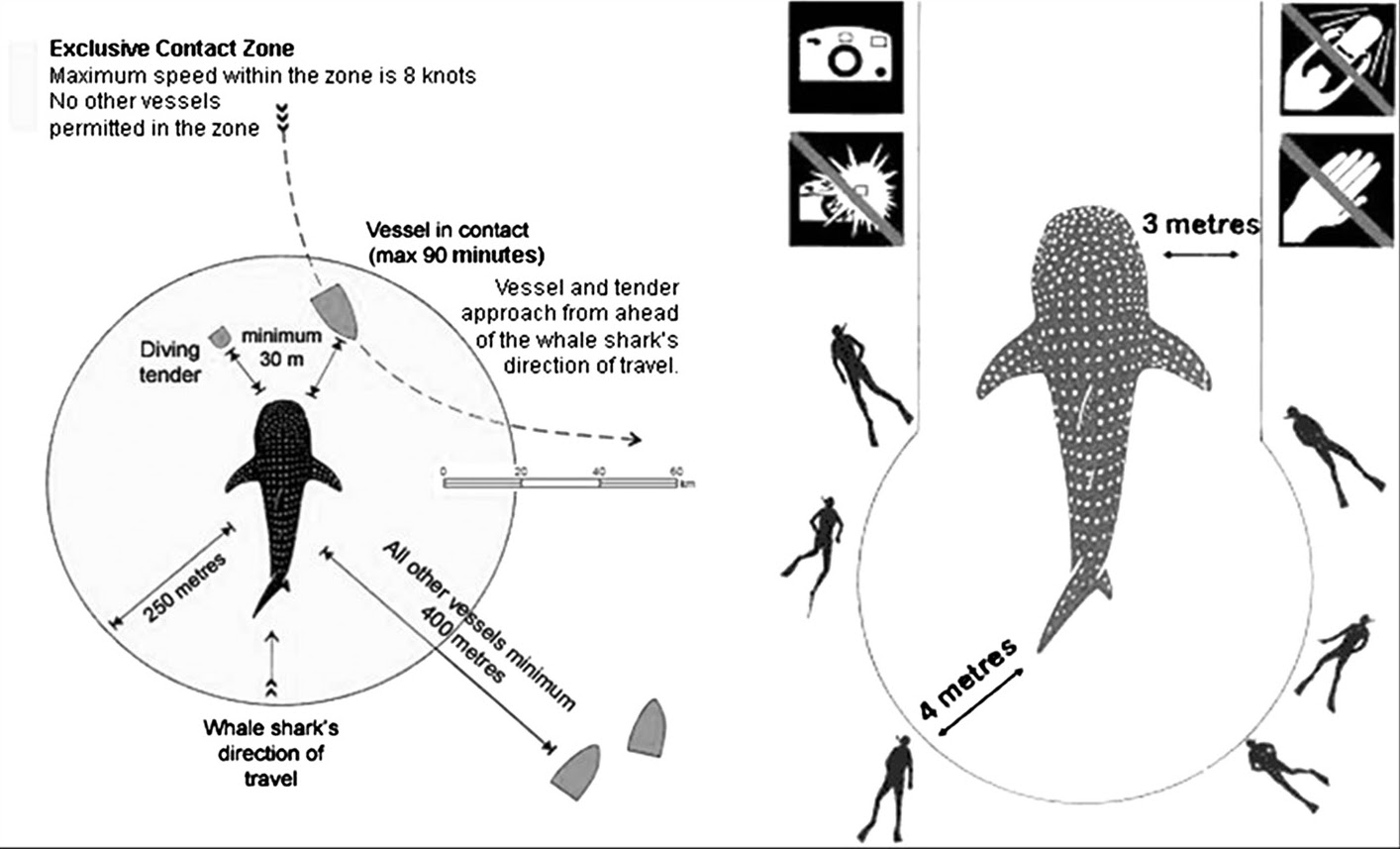
I've just finished reading the new Techera and Klein, and here is an illustration of the Australian Whale Shark swimming regulations from that paper.


I find the flash photography ban crap as flashlight is NOTHING compared to the sun - but whatever, overall the protocols probably make sense.

And these are the procedures in Oslob.
Click for detail. See - they are even MORE stringent than in Oz!

And the feeding?
This very much reminds me of the controversy surrounding the provisioning of predatory Sharks where when put to the test, all of the reservations have ultimately been discredited as Shark-hugging hogwash - that is, provided that the operators had implemented adequate safety protocols!
Once again, it's not about the WHAT but about the HOW!

Case in point, this anti-feeding "info"-graphic - click for detail.


  • 1. Incorrect - those Whale Sharks only consume a small portion of their caloric needs from hand feeding, meaning they get most of their food from natural foraging behavior 
  • 2. Utter balderdash - Whale Sharks spend the majority of their life at or near the surface and are incidentally often seen feeding vertically in natural feeding situations
  • 3. These are subadults that do not (yet?) migrate. They inhabit the general region and incidentally,  most of them do not reside in Oslob but only visit for a few days before moving on.
  • 4. Speculative - much like the infamous "associating humans and food" meme, this needs to be substantiated by research - and BTW, the onus of proving those assertion lays with those who make them! WS are surface dwellers and naturally curious, meaning that accidental boat strikes are frequent everywhere. Incidentally, the boats feeding the Sharks do not have propellers.
And so it goes - see the Infinite Monkey Theorem!

To quote Shawn himself.
Poaching, fast moving large vessels and drift nets are killing whale sharks and driving them toward extinction. Hand feeding is NOT threatening them in such way. What Oslob offers is the opportunity for poor local communities to earn a living from conserving whale sharks, vs killing them. 
That this challenges some peoples idealistic principles of never feeding wildlife is both naive and narrow minded.

Amen brother!
And this shit - let's just hope that the consultations will lead to a change of mind and that the feeding will be allowed to continue. Provided that robust protocols are put into place!

Alas, I'm not terribly hopeful.
The NOISE by the screechy Sharkitarians appears to be pushing the politicos into engaging in populist activism. And if so, I fully expect the consequences to be devastating - for the region and ultimately for those Sharks! 
And whilst this is going down, the operators in Cendrawasih Bay are laughing all the way to the bank!

To be continued no doubt!

Sunday, March 11, 2012

Fiji - Presentation about Shark Feeding!

Hand-fed Bull Shark - great pic by Sasha!

I shall be giving a presentation as follows
  • Shark Reef Marine Reserve: Conservation, Research and Shark Provisioning
  • Venue: IUCN office, Veitiri Conference Room
    5 Ma'afu Street, Suva
  • Date: 15.03.2012
  • Time: 4:30 pm
The topic is just that.
I shall be shortly touching upon our conservation and research initiatives but above all, I really would like to generate a spirited debate about the controversial topic of feeding Sharks.
Especially within the NGO community, there is still widespread aversion against feeding the wildlife & I really look forward to being challenged and to explaining why we have decided to engage in it, and why so far, we feel perfectly OK with what we do.

Please, do attend and tell your friends.
The event is open to anybody so if you care about the topic, this is your one and only chance to hear it from the horse's mouth - and to finally give me a real hard time in public! :)

See you on Thursday!

Saturday, March 10, 2012

Fantastic new paper by Neil!

Neil & Tiger, by Jim.

What can I say, I am deeply impressed!
This is what we in the industry have been waiting for, irrefutable proof that at least when it comes to one species in one location, i.e. the Tiger Sharks that frequent Tiger Beach, the feeding has zero incidence on their overall long term mobility and very likely, none on their life history in general!
Bravo Neil, and thank you!

Summary
  • 1. There has been considerable debate over the past decade with respect to wildlife provisioning, especially resultant behavioural changes that may impact the ecological function of an apex predator. The controversy is exemplified by the shark diving industry, where major criticisms based on inference, anecdote and opinion stem from concerns of potential behaviourally mediated ecosystem effects because of ecotourism provisioning (aka‘chumming’ or feeding).
  • 2. There is a general lack of empirical evidence to refute or support associated claims. The few studies that have investigated the behavioural impacts of shark provisioning ecotourism have generated conflicting conclusions, where the confidence in such results may suffer from a narrow spatial and temporal focus given the highly mobile nature of these predators. There is need for studies that examine the potential behavioural consequences of provisioning over ecologically relevant spatial and temporal scales.
  • 3. To advance this debate, we conducted the first satellite telemetry study and movement analysis to explicitly examine the long-range migrations and habitat utilization of tiger sharks (Galeocerdo cuvier) originating in the Bahamas and Florida, two areas that differ significantly with regards to the presence/absence of provisioning ecotourism.
  • 4. Satellite telemetry data rejected the behaviourally mediated effects of provisioning ecotourism at large spatial and temporal scales. In contrast, to the restricted activity space and movement that were hypothesized, geolocation data evidenced previously unknown long-distance migrations and habitat use for both tiger shark populations closely associated with areas of high biological productivity in the Gulf Stream and subtropical western Atlantic Ocean. We speculate that these areas are likely critically important for G. cuvier feeding forays and parturition.
  • 5. We concluded that, in the light of potential conservation and public awareness benefits of ecotourism provisioning, this practice should not be dismissed out of hand by managers. Given the pressing need for improved understanding of the functional ecology of apex predators relative to human disturbance, empirical studies of different species sensitivities to disturbance should be used to guide best-practice ecotourism policies that maximize conservation goals.
Here is a great synopsis and in line with his usual stellar outreach, Neil has even posted this brilliant video recap.


Kudos once again!

Any parallels to what we see here in Fiji?
Enter Mike's totally speculative hypothesis that goes thusly.
Contrary to the open ocean where food comes in large packages, e.g. schools of Tuna, Billfishes etc, the potential prey for Sharks on a coral reef consists of squillions of small Fishes interspersed with the occasional large prey like Stingrays, Turtles, Dugongs, even other Sharks.
The big Sharks like Tigers and Bulls require quite a lot of food (Neil's paper mentions a daily requirement of approx 4%, this of 400+ lbs in large animals) and it would make no sense for them to engage in catching small prey as they would be likely spending more energy on the hunt than would be coming back through those small meals.
Thus, postulates Mike's hypothesis, evolution would select for those Sharks not to be fussy but to be highly opportunistic when it comes to prey choice, and to be continuously roaming a large home range in search of those elusive more substantial meals - and this individually and not as a group as under that scenario, co-operative hunting and sharing would really make no sense.

Evidence?
Remember the paper by Meyer about the Hawaiian Tigers?
Apart from what I quote in that post, I also remember reading that individual animals would chance upon particularly attractive feeding opportunities (like the fledgling Albatrosses in Midway, or Turtle nesting and mating beaches), remember that experience and return there at the same time in the following years - whereas other Tigers that have not discovered those sites would not, meaning that this behavior is the result of individual learning and not somehow genetically encoded.

Nine years of collecting data about our Bulls shows this.
  • Individual animals (we now have identified approx. 130, with at least the same number that have no distinguishing features and can thus not be named) will come and partake in the feed for 4-5 days, after which they leave again, sometimes for weeks or even months.

  • There are individuals that turn up more regularly whereas other individuals are more sporadic - but we don't have a single resident Bull Shark and we also cannot observe that the frequency of visits by individual Sharks that have been coming for many years has increased, something that one would expect if there were any dependency on our hand-outs.

  • With the exception of a few sub-adults, all the Bulls leave (i.e. don't turn up for feeding) from approx. mid-October to mid-December when the pregnant females leave to give birth in the nurseries and the other Bulls engage in mating, likely in the deeper reaches of Beqa Channel as when they come back, the mating scars are totally fresh and heal within days.

  • Over the years, the number of Bulls has kept increasing, to a temporary maximum of approx 100 individuals on one dive last year - and I say, this year we will count more!
The analogy I use is that of a popular restaurant.
  • people discover it and come back regularly because they like the food
  • because a lot of people like it, the restaurant is increasingly fully booked - but the composition of the patrons changes all the time
  • none of the patrons takes up regular residency there but instead, they continue to come and go as they please, turn up at meal times and obviously eat in other places as well
  • and they certainly don't attack the waiters - well, at least most of them don't! :)
In brief, I strongly believe that we're witnessing the same exact phenomenon here.
But at least for the time being, that's all we can say and barring any telemetric data, much of it will always remain somewhat speculative, the more as we share the Bulls with the guys down the road. From what we hear, Bull Shark numbers on Lake Reef are way lower - but still, we cannot fully exclude that some of the Sharks that leave Shark Reef do not simply go and dine there and then come back to the SRMR.

And what about bolting on a couple of SPOT tags and finding out?
Much to the chagrin of some of my very best friends, I won't have any of that. I absolutely love those tracks but I hate the invasive technology and just cannot bring myself to accept that those tags be deployed on our animals. Hopefully one day, somebody will finally develop a sat tag that is less invasive and can be reliably attached on the fly underwater - but until then, there will be no tagging and we will thus have to continue relaying on visual observations.
So fingers crossed for a technological break-through!

Anyway, I'm digressing as usual.
What I really wanted to do is congratulate Neil for yet another excellent paper and commend him for getting the science out to the public in his usual brilliant way.

As I said, I am impressed - bravo and thank you again! :)

PS compare to Aleks' paper here: there definitely appears to be a pattern!