Showing posts with label Colin Simpfendorfer. Show all posts

Saturday, September 28, 2019

Are we ready for more Sharks?

Good question!

Read this.
It pretty much completely summarizes this timely little scientific article, so no need to write synopses etc. In brief, those Shark conservation successes may turn out to be be fleeting - especially in those highly populated and/or highly tourism-dependent areas where Shark-human conflicts may increase as a consequence, see e.g. the situation in Cape Cod where IMO we're already only a few Shark bites away from the next Shark/Seal cull.

The authors write,
While widespread success in recovering elasmobranch populations is some time away, scientists, advocates and managers need to be prepared for societal conflicts that may arise when and where it does occur. In particular, implications for current and future conservation management need to be considered as part of conservation strategies in the context of how humans will interact and potentially compete with recovering species.

This will require, from the outset, increased public education and outreach regarding the potential future implications of conservation success and strategies to reduce conflict in order to avoid negative responses to successful conservation outcomes or the thwarting of future conservation endeavours.
That is certainly correct. 
But education and outreach can only go so far, and methinks that akin to what is happening in the highly intractable and complex issue of terrestrial human-wildlife coexistence and human-wildlife conflict mitigation, all will have to be highly species-, location- and context-specific.
And in some cases = where and when other less invasive approaches fail, we may well have to accept that some individual animals may have to be sacrificed so that their populations can continue to survive - see the paper's example of the Galapagos Sharks vs the Hawaiian Monk Seals that is highly reminiscent of Eric's Shark profiling proposal.

As always we shall see shall we not.
And anyway, I say, wouldn't that be a nice problem to have = so first and foremost, let's please make sure that Shark populations recover!

But back to more pleasant matters. 
Let's go Shark diving - sustainably!

PS - Michael Domeier here.
Like him I abhor the illegal out-of-cage diving with GWS and especially, the Shark riding and molesting. But unlike him I really do not believe that any resulting bites would have any implications whatsoever on Shark conservation - rather, nowadays the victim would be rightly berated for having been a fool and the news cycle would quickly move on.
 

Sunday, February 03, 2019

Reef Shark Science - the Compendium!

One of our protected Blacktip Reefies. Great pic by Allen!

Wow.

This is just simply brilliant.
Quite the erudite tour de force, and penned by some of the very best minds in the field, it recapitulates the current scientific insights about Reef Sharks, and  charts the way for future research.

No need for synopses as it is thankfully open source.
Just this: among a plethora of valuable information, it also addresses the topic of Reef Shark - mediated trophic cascades along with those infamous postulated inverted pyramids where I also discover this equally unequivocal statement in the cited literature. 
Long story short: both are nothing but breathy myths that need to be binned once-and-for-all! And yes, it's all very much q.e.d (!!!) - and no, I'm not going to repeat myself; instead, please do re-read the part about using spurious garbage when advocating conservation right here!

But I'm obviously digressing as always.
What I really wanted to say is that this is a great paper- and big kudos to the authors!

Required reading - enjoy!

Monday, May 21, 2018

No more Shark Sanctuary in the Marshall Islands?


I was wrong.
The Marshalls are not among the "best" - read the above (= click for detail).

Yes this is not good.
In brief, the Shark protection in the Marshall Islands is quietly being rolled back, and nobody appears to give a rat's ass.
Once again, it's all about the money: the huge earnings, the jobs and the according political clout of the fishing industry versus the money needed for enforcement but also the establishment of  alternative livelihoods.
In fact I remember distinctly how back then, Pew strongly suggested that following the designation as a sanctuary, the Marshalls would become a world-renown mecca for shark tourism like Palau - which has very much unsurprisingly not happened as the logistics for running a dive operation there are just simply totally prohibitive.
And like I said back then, legislation can be reversed - and now it has.

And Pew - anybody anybody?
Yeah, right.

Wednesday, June 07, 2017

Challenges and Priorities in Shark and Ray Conservation - Paper!


Well done, and I cite,
Over-Simplification Can Hinder Effective Shark Fisheries Management 

The general tendency for sharks to grow more slowly, mature later, and produce fewer young than most fished species is fundamental to the appropriate elevation of their conservation priority and the prevention of population depletion. The fact remains, however, that life history characteristics vary widely across shark species, with many capable of supporting a significant level of fishing if such extraction (in all forms) is limited to science-based levels.

After more than two decades of expanding efforts to publicize sharks’ inherent vulnerability, people appear to increasingly believe that sharks cannot withstand any fishing at all.
Similarly, there appears to be a trend toward blanket bans on fishing and trading, with a focus on shark fins. While complete bans are appropriate, and even long overdue with respect to species that are exceptionally threatened (like sawfishes) and exceptionally vulnerable (such as devil rays), in other cases the unequivocal messages and ‘one size fits all’ remedies may serve to hinder policies needed to curb fishing and ensure sustainability.

Under a general perception that sustainable shark fishing is impossible, there is reduced support for the work necessary to formulate comprehensive fishery management policies that allow for sustainable take while addressing unintentional bycatch, and the need for population assessment. Governments convinced that managing shark fishing is a losing proposition and/or publically unacceptable may opt for full protection, but may also shy away from attempting to set any limits at all. Those opting for blanket bans may be reluctant to admit and address significant incidental shark mortality and/or enforcement inadequacies.
However
Sharks Contribute to Food Security in Poor and Developing Nations

While shark meat, in some cases, provides a high value product (e.g. gummy shark in southern Australia, porbeagle in Europe, and skates in Korea), it is more often a cheap source of animal protein. The low value stems from the relatively low quality of the product (due to high levels of urea) and the fact that it is often dried for non-perishable storage and transport. While domestic catch and consumption is common, some countries rely heavily on imports and exports, e.g. Sri Lanka, Uruguay, Brazil, Peru, Indonesia, and India. According to FAO statistics, more than 90% of the world’s reported shark catch is taken by 26 fishing nations (Figure 2), one-quarter of which (7/26) are among the least developed nations (with low or medium Human Development Index scores; Figure 2). Moreover, 40% of the reported global shark catch comes from seven of the major shark fishing nations with the lowest Human Development Indices, most of which border the Indian Ocean (Indonesia, India, Pakistan, Yemen, and Tanzania) and Eastern Atlantic Ocean (Nigeria and Senegal; 
.....
Generally, it is costly to replace fishery losses in countries where seafood provides a high proportion of animal protein. It is understandably difficult for governments in nations facing extreme poverty and food security crises to prioritize shark conservation, particularly when scientific advice for sustainable catch levels is lacking. Similarly, conservationists as well as governments of developed countries are understandably reluctant to press struggling governments for such actions.
Bingo.
Yes in theory, some (but most certainly not all!) Elasmobranchs can be managed and fished sustainably - but in practice, this is currently not possible in many impoverished Shark fishing nations.

Solutions?
Like I never cease to repeat, we are quickly running out of time.
With that in mind, I strongly advocate cheaper and simpler bans now, and costlier and more complicated management at a later stage once it becomes practically feasible. AND, let's not forget that in order to succeed, species protection alone is not gonna be good enough!

Anyway, awesome paper.
Once again, required reading (and understanding!) if you want to be taken seriously when talking about Shark conservation.
Enjoy!

Tuesday, February 07, 2017

Sustainable Shark Fishing?

Sawsharks? Who would have thought... Click for detail!

Bingo, and I cite,
To some, the solution is to simply stop taking them from our oceans, or prohibit carriage, sale or trade in shark fins. Approaches such as bans and alternative livelihoods for fishers (e.g. ecotourism) may play some role in controlling fishing mortality but will not solve this crisis because sharks are mostly taken as incidental catch and play an important role in food security. Here, we show that moving to sustainable fishing is a feasible solution. 
Well - yes and no!
A big YES to sustainable fisheries and certified sustainable fins! 
And of course sustainable fishing for some, comparatively few species is possible, and of course establishing well managed fisheries for those species is very much a feasible goal, and of course, the developed countries should assist the developing ones, and of course full traceability would be great!

But only in the long term - right?
Because short term, it just simply aint gonna happen anywhere besides the USA, Australia, maybe NZ and Canada and hopefully once Europe.
And like I said a squillion times, we simply do not have that time and need fast, stop-gap solutions like fishing moratoria, Shark sanctuaries and even better, those mega MPAs that protect the Sharks, their prey and their habitat - and yes the latter largely work!
Later on, once good management has indeed been established, some countries may decide to relax the prohibition - but right now, it's by far the most practicable solution.

And the bycatch?
Read this - and this!
Long story short, that bloody bycatch is of course a cause of great concern, and mitigation is exceedingly complicated - and this incidentally under any scenario including a managed fishery!
But contrary to what is being suggested, this does not automatically invalidate those Shark sanctuaries, but it certainly greatly impinges on their effectiveness at reducing Shark mortality below sustainable levels.
Methinks they work and Nick does not - but as long as there is no scientific evidence one way or the other, we definitely need to give them a chance!

And one last thought if I may.
Commercial fishermen fish what the traders tell them to fish = it is the traders that drive the fishery and I would argue, it is they who also drive most of the IUU. Methinks we need to much more concentrate on the trade, especially domestically, the more as the traders are far fewer and much more visible (and thus much easier to monitor), and that by the nature of what they do they also dispose of a wealth of data about the fishery.
Think about it.

Anyway, nice paper.
Certainly useful and truthful - but with caveats!
And, do click on, and read the links! :)

Good article here, infographic here!

Monday, March 10, 2014

Sharks are not Apex Predators - Paper!

Big Fiji Bull Sharks - definitely Apex! Click for detail!

Hallelujah!

This has one of my pet peeves for a very long time indeed.
And now a panel of illustrious researchers are confirming that the vast majority of Sharks are not apex predators but instead, best described as mesopredators, to wit
We might talk of apex size classes rather than apex species in relation to sharks and other marine predators that grow indeterminately throughout their lives. 
Using the criterion of apex size classes, the categorisation of sharks as apex predators would be  restricted mainly to adults of large-bodied and wide-ranging species that influence many species within a community. Use of this definition would limit the term apex predator to large individuals (>3 m) such as older juvenile or adult white, tiger, hammerhead and dusky sharks...
(and adult Bull Sharks!)


Most shark species and size classes are in fact best described in the role of mesopredator. 
The ecological role of sharks within the diverse and impacted marine environment requires careful consideration. 
There you have it.
And the same undoubtedly applies to the terms of keystone and umbrella species that are so liberally bandied about by some quarters within the movement!
You can read the whole paper here.

And there's one more interesting observation, and I cite.
Our size-based view of the classification of predatory roles raises important questions about what objectives to manage, and how these objectives can be best achieved.

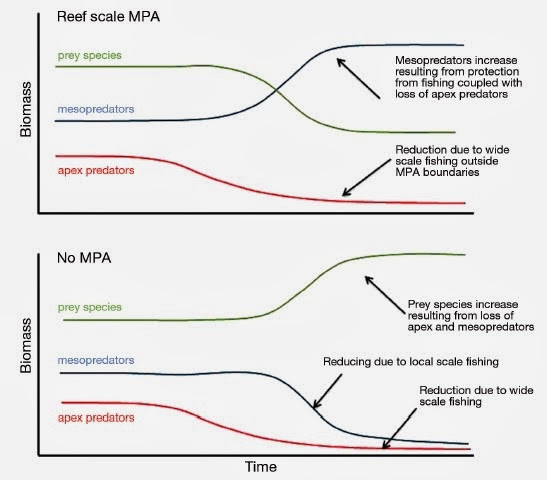
Protection of reef communities through marine protected areas (MPAs) or fisheries regulation (or indeed, naturally on those few locations far from human population centres) would ensure the mesopredator sharks on these reefs are sheltered from fishing pressure. However, the same may not be true for apex predators because their broad movement patterns and large home ranges (Meyer et al. 2009) would expose them to a greater diversity of fishing fleets and gears, and thus a greater overall mortality than the smaller-ranging, reef-dwelling mesopredators. Hence, the apex predators of coral reefs may be silently eliminated by offshore pelagic longline fisheries, unbeknownst to those managing reef diversity and function (Cox et al. 2002).
Therefore, reef-based MPAs are not adequate to protect these species.


296 Fig. 2. Conceptual diagram outlining the loss of apex predators from reef regions and corresponding system responses where a marine protected area (MPA) is present (upper) or absent (lower). Presence of MPAs leads to different states of equilibrium on individual reefs

Avoiding and mitigating these impacts may require consideration of the ecosystem- and jurisdiction-crossing movements of apex species and size classes. Therefore, management needs to consider not only the effect of reef-based spatial closure, but the amount of time these regions provide shelter to large, mobile, apex species.
This of course eminently important for the SRMR
There, the range of the Bulls and especially the Tigers is clearly much larger than the MPA proper - but this is exactly why we did establish the Fiji Shark Corridor that is conferring a solid, albeit not perfect degree of protection to our Bulls. The possibly highly migratory Tigers, alas, probably not so much - tho we will likely never know as the observed competitive exclusion may well end up masking any losses due to fishing.

This is why the river nursery work is so vital.
Compared to the large and relatively inaccessible ranges of the adults, those nurseries are discrete and relatively small areas where conservation measures may well be easier to implement. We know that the Fijian rivers do not only feature juvenile Bulls but also juveniles of the endangered and probably highly migratory Scalloped Hammerhead - and I betcha that upon closer inspection, we'll also find Nurses and Lemons. 
And once we dispose of the necessary data, we will certainly do our darn best to have those habitats protected!

But I'm digressing as always.
Brilliant paper - enjoy!

Friday, February 14, 2014

The Nadi Workshop - Spillover!

Top left-to-right: Api, Ben and Tumbee
Middle left-to-right: Ingrid, Colin, Perry, Juerg and Netani
Bottom left-to-right: Gary and Angelo - click for detail!

Apologies - I'm currently simply too busy to blog.

Just this.
Looks like the big Shark meeting has been a great success as told here by Angelo.

And it has had direct repercussions for us.
Several participants have made time to come and say hi, and most have managed to partake in a  stellar Shark dive with plenty of Fiji Bulls and great viz. It just so happens that our dear friends Juerg and Gary are visiting, resulting in the rather epic picture above where the notable absentee is Demian who merely managed to squeeze in a short cameo before gallivanting off to some other remote destination where he's championing the cause of Sharks.

Fortuitous or not, a meeting like that will always have consequences.
Keep watching this space!

Sunday, January 26, 2014

IUCN - the Shark Paper!

Red List criteria - click for detail!

Wow.
I've finally managed to work myself through the paper.

First things first.
It is simply epic - extremely interesting, extremely exhaustive, extremely erudite and extremely convincing in its conclusions. In brief, it is everything one could have ever expected from that illustrious panel of authors and then some, and I really must commend them for their unprecedented, excellent work.
You can find various (and variously accurate) synopses here, here, here, here, here and here.

These are the principal findings.
  • 24% of all Sharks, Rays and Chimaeras (= the Chondrichtyans) are threatened with extinction.
  • Of those, many of the completely overlooked Rays are at greatest risk
  • The principal threats are overfishing, both through targeted fisheries but also very much bycatch; habitat loss; conflicts with humans leading to persecution; climate change.
  • Extinction risk is greatest for larger species = species that are slower breeding and/or more susceptible to fishing pressure; species that live at shallower depth and whose depth range is narrower = species that we can more easily catch and whose habitat is more exposed to human degradation; species with limited geographical range, especially fresh water endemics.
Evolutionary uniqueness and taxonomic conservation priorities.
Threat among marine chondrichthyan families varies with life history sensitivity (maximum length) and exposure to fisheries (depth distribution). (A) Proportion of threatened data sufficient species and the richness of each taxonomic family. (B) The most and least threatened taxonomic families. (C) Average life history sensitivity and accessibility to fisheries of 56 chondrichthyan families. Significantly greater (or lower) risk than expected is shown in red (green).
Click for detail!
  • The areas with the highest threats are the Mediterranean, Red Sea and some areas of the Indopacific, foremost of which the Golden Triangle of marine biodiversity.
  • Many nations lack the resources, expertise and political will for implementing adequate management and conservation measures - the notable exceptions being the USA and Australia, and this despite of disposing of important commercial Elasmobranch fisheries.
  • Large geographical ranges spanning many different legislations are particularly problematic for enacting effective management and conservation measures.
Solutions?
  • Conduct more research and data collection for i.e. describing life histories, for population assessments, for assessing fishing pressure, etc. all of which is vital for the formulation of adequate management and conservation plans.
  • Establish science based management and conservation plans for both the Chondrichtyans and their critical habitats, with particularly stringent measures (= precautionary principle!) for threatened species.
  • Radically improve implementation, monitoring, enforcement and prosecution.
  • Improve regional and international cooperation.
  • Splash on some makeup, strap on your bikinis and go ride as many as you can - not!
My only grievance?
This is very fisheries oriented.
No mention whatsoever of MPAs and Sanctuaries, and no mention of alternatives like i.e. ecotourism and aquaculture - which of course begs the question, is this (a) beyond the scope of the paper (b) omitted due to the need to remain concise (c) an oversight?
Or  may this be an indicator for, gasp, ideological strife, competition or some other nefarious agenda? :)

Anyway, fabulous job!
Enjoy the paper!

Wednesday, January 22, 2014

IUCN - Media Media!


Wow - and not in a good way!
Wait til Randy sees it!

Watch this.


With all due respect - this is embarrassing.
I've now watched it four times and am still distracted by the amateurish editing, horrible images and clumsiness of the narrators. The shark conservation universe is awash in incredibly talented editing outfits for whom producing this PSA, for free, would have been both an honor and an opportunity - especially considering the importance of the paper and the prestige of the authors!
Seriously, you may want to consider soliciting expressions of interest for producing a v2?

Anyway.
More when I got time to read the paper.

Wednesday, June 02, 2010

Lethal Sampling


There are about 5,000 Tigers left in the wild.
What would you say if some Tiger researcher published a paper claiming that it was OK for scientists to go kill a few in order to collect data that would be essential for their management and conservation. How about Giant Pandas, population 2,000 - OK to go shoot a couple?
No way? Thought so!

Or take a species with a reasonably robust population size.
Orcas, population approx. 50,000: would it be OK for scientists to go kill a few in order to collate better data?
Still not convinced?

And Great Whites, population 3,500?
Perfectly fine to go kill a few!, say Ozzie Shark researchers Heupel and Simpfendorfer - and please read the comments by WhySharksMatter here.

Abstract:

General consensus among scientists, commercial interests, and the public regarding the status of shark populations is leading to an increasing need for the scientific community to provide information to help guide effective management and conservation actions.
Experience from other marine vertebrate taxa suggests that public, political, and media pressures will play an increasingly important part in setting research, management, and conservation priorities.


We examined the potential implications of nonscientific influences on shark research.
In particular, we considered whether lethal research sampling of sharks is justified.
Although lethal sampling comes at a cost to a population, especially for threatened species, the conservation benefits from well-designed studies provide essential data that cannot be collected currently in any other way. Methods that enable nonlethal collection of life-history data on sharks are being developed (e.g., use of blood samples to detect maturity), but in the near future they will not provide widespread or significant benefits. Development of these techniques needs to continue, as does the way in which scientists coordinate their use of material collected during lethal sampling.

For almost half of the known shark species there are insufficient data to determine their population status; thus, there is an ongoing need for further collection of scientific data to ensure all shark populations have a future.

Shark populations will benefit most when decisions about the use of lethal sampling are made on the basis of scientific evidence that is free from individual, political, public, and media pressures.


Don't get me wrong, I'm not disputing the need for Shark autopsies, or whatever - though I sure am amazed at the apparent lack of data: what were those fisheries biologists doing during all those past decades of research and data collection, notabene paid for by public funds - huh???

People who lethally sample (a euphemism for going fishing with the intent of killing) Sharks are generally called fishermen.
There must be hundreds of millions of fishermen and last time I looked, 50-odd million Sharks were being lethally sampled each year: are Heupel and Simpfendorfer really suggesting that scientists must go and kill more Sharks on top of that?
That 50 Million dead Sharks are not providing for enough specimen for them to collate their oh-so-important data??? On top of the many Sharks that die by accident during non-lethal sampling by researchers?

Really???

How pathetic is that!
Two years ago, I blogged about some moron who was squandering scarce research funds by going ice fishing for Greenland Sharks instead of analyzing the thousands of Sharks caught by the fishermen. More recently, I've blogged about an arrogant research dude torturing Great Whites (read this - how true!) for a horrible fishing show - which just happens to be on air at this very moment!


They are but two examples of a particularly disturbing breed of researchers who display a fatal disconnect between the quest for scientific insights and the most basic sense of what is right and what is not.

I've since had countless conversations with scientists and especially, providers of research grants about the need to stop squandering resources and to apply stringent ethical imperatives when bankrolling any further scientific research.
Everybody seems to agree, and I'm being told that the the Shark killers tend to be the older researchers and that the majority of the newcomers oppose those methods - which is a good thing!

This shit must stop, period.
It just so happens that in a few days, the very same Heupel and Simpfendorfer will be hosting Sharks International in Cairns. Will somebody there finally speak up against those intolerable shenanigans and the according display of heartlessness and hubris?

Or is it me who just does not get it?