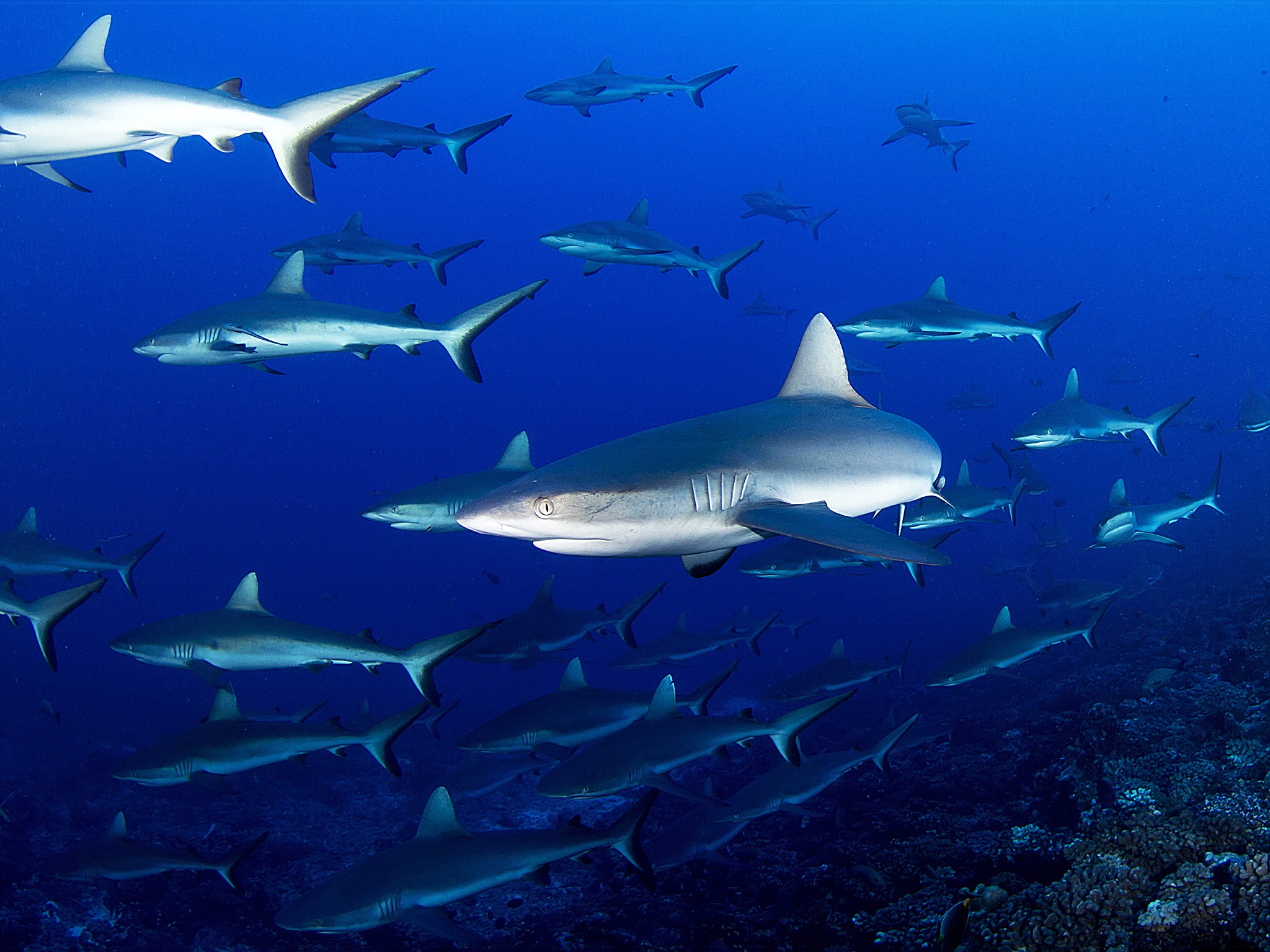
Showing posts with label Shark Behavior. Show all posts

Sunday, June 27, 2021

Do Bull Sharks have Friends? New Paper!


Spoiler: maybe yes maybe not!

In brief, I opined that as their prey is comparatively scarce, evolution would select for large predatory Sharks to be solitary in order not to have to share their kills. 
But whereas that appears to be largely correct for Tigers and Whites, anecdotal evidence and some papers (and here) indicate that Bull Sharks appear to mostly travel in pairs or small groups, and I was eager to see whether our enormous data base could help shed further light on the issue. Yes our Shark feed is obviously an artificial aggregation - but I speculated that if certain individuals would preferentially turn up together, this might be a strong indicator that they might also be traveling together when not attending our dive.

The initial findings were promising.
The data showed some unequivocal, albeit rather weak long-term associations as illustrated e.g. in the following sociogram.
 

Sociogram depicting the social ties between individual bull sharks observed on the study site on ≥34 dives for the time period from 2011 (C). Only GAI values in the highest 30% were included to highlight the strongest associations between dyads, with thicker edges indicating higher GAIs for both individuals observed throughout the entire sampling period (red nodes), and individuals which were not observed throughout the entire sampling period (blue nodes) - click for detail.
 
Impressed? 
Me too, initially - but then came the crux with the bloody interpretation!
Did those Sharks really turn up together because they like each other? Or was it because their core ranges overlap with the Shark Reef Marine Reserve = they just happen to live in the vicinity? Or because they share some behavioral trait that makes them bolder/more curious/more opportunistic/weaker hunters = more prone to visit our feed? Or are they maybe the remnants of a cohort of siblings who stayed together in the river nursery and have traveled together ever since? Questions questions!
Short answer: who knows - which is kinda disappointing!

But, we now have a starting point.
Those numbers in the sociogram all correspond to known individual Sharks, and somebody could now invest some time into observing how they actually interact during the dive - and assuming that the visual observations confirm the initial evidence, one could then try and equip selected individuals with adequate sensors like cameras and/or say, business card tags to see what happens once the Sharks leave Shark Reef and/or take tissue samples to determine their relatedness, etc.
Yes that's a lot of work - but that's what we do, so keep watching this space!

Long story short, so far so good!
Enjoy the new paper
 
PS - Juerg here, courtesy of Tom.
IMO the semantics are a lot of splitting of hairs (= do we KNOW that they're not friends?), the more as I believe that some are, and that some (like Blunt and Maite) are very much the contrary - but then again who am I to say!
So thanks for the publicity, much appreciated!

PPS - another really nice piece here - well done!

Friday, June 18, 2021

Surfing Reefies - Paper!

Source
.
 
Very cool.
But first, watch.


This is DV footage from 2005, from an old edit.
I was staying at Sané and Annabelle's epic Tetamanu Village and was fortunate to catch the magic moment when the sun reflects off the Sharks on an early morning incoming tide - and for you insiders, the first two clips are from the challenging trou aux requins in Apataki.

Notice how the Sharks are barely moving? 
They are literally surfing the current - and here's the according paper courtesy of Yannis, Johann, Serge, Charlie et al, inclusive of how they use a conveyor-belt positioning system to ensure that the groups remain stationary over the most advantageous spots.
Story here.
 
Enjoy! 
 

Monday, June 29, 2020

Selective Removal of Problem Sharks - Paper!

Click for detail!

Hah!

Remember this paper?
Now Eric et al have doubled down with this further publication that specifies possible techniques for first, a) establishing a data base of potential perpetrators and then, b) identifying and removing individual problem Sharks after they have attacked a person.

Well what can I say.
Like I've already stated here, I am absolutely convinced that problem individuals do indeed exist, much like what has been shown with large terrestrial predators. And I'm equally of the opinion that removing them selectively (whatever that means) would ultimately be vastly preferable over indiscriminate broadcast culling - though having said that, there are obviously other solutions (like eg hazing, etc) that would need to be exhausted beforehand!

But that's the theory.
In general terms I remain unconvinced that individual profiling and selective removal is a practicable solution for large geographical areas featuring thousands of potentially dangerous Sharks, like, say, the USA or Australia. There methinks that one will need to continue trying to reduce the risk and mitigate the consequences - but by the same token, one will have to accept that the odd Shark bite is ultimately just simply inevitable and part and parcel of coastal living.

And in comparatively small areas?
Interesting to see Cocos and Reunion mentioned in the paper!
I've said what I wanted to say about both situations back then and really got nothing to add - maybe with the exception that Reunion looks like an ideal testing ground, the more as there is already an adequate scientific infrastructure allowing for the proposed broadcast DNA sampling and visual identification. So by all means, go for it - tho bon courage trying to establish a feeding station like suggested! :)

Anyway, all very interesting indeed!
Knowing Eric, something is likely brewing - and if so, godspeed, Fair Winds and Following Seas and all!

To be continued no doubt!
 

Wednesday, June 17, 2020

Kleptoparasitism in Sharks - Paper!

Click for detail!

Very nice!

Read this.
Following their epic dives in Tetamanu and the many experiments they have made, the team around Laurent Ballesta have published their observations about the interactions between the Grey and Whitetip Reefies when nailing that Grouper spawning aggregation.
Here's what Johann has posted.

Not surprised about the kleptoparasitism by the Grey Reefies
They are just that bit bigger and bolder than the other reefies, and will thus tend to dominate any competitive exchange, much like described in this paper from Osprey Reef.
And here in the Reserve, they will equally try to dominate the other reefies during the shallow feeds, something we try and counteract by hand feeding selectively so that the Blacktip and Whitetip Reefies always get their fair share.

Anyway, all really very interesting.
Enjoy!

Tuesday, October 29, 2019

GWS Clans at the Neptune Islands - Paper!


Very interesting!

Check this out.
Press release here, stories e.g. here and here.
In brief and assuming I understand this correctly, those GWS don't turn up randomly but appear to favor (and hence possibly travel with) determined buddies and even form distinct groups that appear to persist for years. Nice to see Johann, Charlie and Andrew among the authors, and kudos to GSD member Rodney Fox Shark Expeditions for having enabled yet another stellar paper - and incidentally, congrats for the great new boat

And here in Fiji?

Remember Mike's totally speculative hypothesis?
That was obviously several years ago, and today we know quite a bit more. Specifically, we have learned that although our dive has minor local impacts, effects at the ecosystem level remain negligible as our Bulls continue to roam and do neither get conditioned to coming ever more frequently, let alone residing here or changing their migrations or mating cycles, etc; nor do they in any way become dependent on our handouts - tho I was certainly wrong when speculating about the nutritional value of the Tuna heads! But be it as it may, the restaurant analogy remains fully confirmed.

And the part about the Bulls likely being solitary?
I still believe that in the case of those large reef-dwelling Sharks, and barring any cooperative hunting for which we have zero evidence, evolution would have selected against traveling with, and thus having to compete and/or possibly even share meals with conspecifics.

But then again, who am I to say.
I can't divulge too much - but I can say that 10 years after that post, we are finally about to reveal some conclusive evidence!
Fiji Time anybody? You betcha! :)

So keep watching this space.
To be continued!

Sunday, October 27, 2019

Gaping GWS - Video!

This Shark is spy hopping - but it sure looks like RAG is not at all rare in SA!

Watch.


And I cite.
Repetitive Aerial Gaping: A Thwart-Induced Behavior in White Sharks 
WESLEY R. STRONG JR., in Great White Sharks, 1996

Causation

Baits pulled away travelled horizontally, just beneath the surface until they came against the hull at which point the sharks generally turned away. In the vertical baiting configuration, however, the bait could be hoisted directly out of the water as a shark tried to seize it, moving it out of reach more quickly than a bait drawn horizontally. This distinction is important, because 11 of 15 (73%) RAG occurrences were elicited while using the vertical baiting technique, but the technique itself was employed less than 5% of the time.

In each case, RAG followed a series of failed attempts to seize a bait and was immediately preceded by an open-mouthed lunge and miss as a bait was withdrawn. Lack of contact with prey after the feeding MAP was initiated appears to play a role in triggering RAG, but does not solely explain its onset. One factor common to each observation of RAG was that a portion of the anterior buccal cavity was exposed to air before (i.e., during the surface lunge) and during its execution. While failure to obtain food while submerged may eventually evoke a similar response, we never observed an underwater bout of RAG during more than 135 hours of underwater observation. Thus, it appears that contact with air is required to initiate the response.
Now you know - also described e.g. herein, and here.
Story here.

You're welcome!

Sunday, July 28, 2019

Friday, July 12, 2019

GWS Tussle - Video!

Likely a bite by another GWS - source. And yes, Bulls are WAY more peaceful - click for detail!

Very cool!
Story here - enjoy!


Monday, January 07, 2019

Individual Shark Profiling? Yes and No!

Click for detail!

We're stuck inside waiting for Mona to unleash.

So there - have you seen this paper?
In essence and if I understand it correctly, it hypothesizes that Shark strikes are not a function of Shark density but that they are instead caused by specific individuals that are so disposed, e.g. possibly particularly bold  - and that as a consequence, the adequate management response would not consist in broadcast culling but that instead, one should surgically remove such problematic animals, much like what is being done with terrestrial problem predators.
And yes that person mentioned at the end would be yours truly.

So let me clarify where I really stand on this.

I agree with the hypothesis, albeit with caveats.
Ages ago, I penned this post about Shark strikes which I believe is still valid. In brief, the causes for Shark strikes are manifold =  whereas some of the interactions are due to predation or happen out of aggression and/or competition and/or self defense,  others are purely retaliatory or not at all driven by intention but simple mistakes (= NOT mistaken identity which is completely something else and  controversial) - and for these latter two categories, Eric's considerations probably would not apply. 
And anyway, for the large majority of cases, determining the specific intention of specific bites is obviously impossible and possibly also ultimately irrelevant.

But of course we can always speculate, see here.
And as somebody who has named, personally knows and spends an inordinate amount of time diving and interacting with individual Sharks and can thus observe their behavior, I can unequivocally confirm that they display great individual behavioral variability - and this very much including the propensity to bite!
In fact, among our Bull Sharks there is e.g. one particularly haughty lady who does not like to be touched and will always retaliate by trying to bite us when we do so; or there is another one, a small male, who despite of many years of hand feeding, appears just simply too stupid to understand the proper etiquette and always comes in too low and too fast, and is thus a constant safety risk to the feeders. Same-same for a specific Gray Reefie who has repeatedly bitten the hands of our feeders - and thank you for bodyguards and especially, for steel gloves!

And then there is XYZ (name withheld).
This is a very large female Bull Shark who can only be described as being sinister and dangerous, this insofar as she is extremely assertive, will frequently approach us closely and not in what we perceive as a friendly way, and needs to be fended away and dominated.
And one day, and I believe because she was cranky for having lost a dominance confrontation with another big female, she has already bitten one of our staff who was incidentally not in the slightest inconveniencing her; this in what I personally interpret as Ăœbersprungverhalten or displacement behavior, or maybe simply the venting of accumulated aggression. Again, we will obviously never really know - but she is certainly an animal of concern.

And when it comes to those predatory strikes.
They are fundamentally different from the examples above as IMO predation = feeding got nothing to do with aggression and/or boldness, and why would it.
But I absolutely believe that some Sharks will sometimes target and consume a human; and I also absolutely believe that given what we know about their learning capabilities, ontogenetic dietary shifts and their individual behavioral variability, we can also absolutely not exclude that this or that individual may develop an individual propensity (or reduced aversion) for targeting humans, which is what Eric appears to postulate.
Yes this is obviously speculative and so far unproven (and likely untestable) - but it is I believe at least plausible - and as long as it is, and as long as it not actually disproven, it is also not false! 

And remember this shit
It mentions, and even depicts that ominous OWT who has been alleged to have bitten no less than three people - and this by so-called Shark experts in a so-called peer-reviewed scientific paper !

Anyway, back to Eric's paper.
Yes in theory, there could absolutely be individual Sharks with as propensity to bite humans; and yes in theory, selectively eliminating those would absolutely be preferable to indiscriminate culling!
So I absolutely support it as a theoretical approach to mitigating Shark strikes! 

And in practice?
Unfortunately, there prospects for success look totally unrealistic.
In terrestrial habitats, identifying, monitoring and managing individual animals is comparatively easy - but doing so in the ocean is obviously a completely different matter as the territory is immense, there are thousands of Sharks leading a life that is essentially cryptic as for human observers, everything happens "out of sight" - and thus, identifying, monitoring and then eliminating the individual perpetrators as suggested would generally speaking be extremely expensive and logistically extremely onerous if not outright impossible.
With that in mind, the suggested list of measures aimed at identifying problem individuals, albeit certainly erudite, is more pie in the sky than a viable recipe for success. Or should we e.g. really try and catch, tag and tissue sample every single large predatory Shark in Australia - and then try and catch a single individual perpetrator after a strike?

And, when, exactly, would one effect the removal.
After a first bite? After two or even more? Lethal bites or not? Or would one remove the Shark preemptively already upon identifying a problem in behavior, or e.g. undesired levels of testosterone or cortisol?
And before the removal, whatever the latter means, one should obviously first try other approaches akin to e.g.the hazing and/or other deterrents and/or protections and barriers one would be using in terrestrial situations - correct?
Detail detail!

But of course there could be exceptions.
Specific circumstances obviously vary, and there could be individual, albeit probably rare conditions favoring Eric's approach.

Examples?
The situation with our above-mentioned XYZ could e.g. escalate to the point whereby despite of our best efforts in trying to deter and/or train her, we would have to come to the conclusion that she is becoming too much of a safety hazard. 
Then, we could be forced to choose between either closing down our Shark viewing operation or selectively removing her.

Or take e.g. Cocos.
Remember that Tiger and then, this subsequent event?
Yes this is completely speculative - but considering how well the good people of GSD member Undersea Hunter Group know their Sharks: what if they were able to determine that it was the same, individually known individual? 
If so and considering the risk of further attacks vs the tourism income: could this maybe escalate to the point where the park authority would have to make a decision?

And finally, Reunion Island.
There, the comparatively small territory and likely comparatively small number of potentially dangerous Sharks that could thus be potentially identified individually may well warrant trialing Eric's approach - this particularly in view of the ever-persistent calls for more Shark culls!
Or not?

But again, these are rare exceptions.
In the overwhelming majority of cases, Eric's suggestions, albeit intellectually interesting, are just not sufficiently practicable for them to constitute a viable alternative strategy.
Alas!

And finally, what about this beauty?
I can only note that Neff the token Shark attack apologist remains as predictably irritating as always, the more as his arguments are little more than straw men.
  • Yes the hypothesis by Victor Coppleson of there being "Rogue Sharks" has not been proven - but a) as per above, the fact that something has not been proven does not necessarily mean it is false, either and b) Eric expressly differentiates his hypothesis from it. 

  • Yes as per above Eric's hypothesis does not apply to all Shark bites - but that does not invalidate it a priori!

  • Yes often when asked, the public does not support Shark culls - but a) they continue to happen and b) more importantly, Eric does not at all advocate them but on the contrary, he very clearly and unequivocally sees his approach as an alternative to them!
Anyway, all very interesting indeed.
And in the meantime, Mona has come and gone. And we are doing just fine thank you.

Let's go Shark diving!

PS - Bingo...
PPS - Michael here - thanks!
 

Saturday, March 31, 2018

Social Interactions of Sicklefin Lemon Sharks - Paper!

Click for detail!

Very nice!

Check this out.
It describes the behavior of Sicklefin Lemons at two provisioning sites in French Polynesia.
And assuming I understand the paper correctly, the observations coincide to a large degree with what we observe here with our Bulls, i.e. that these largely solitary animals develop a rudimentary etiquette when they aggregate at a provisioning site (and possibly equally at some communal feeding event like a Whale carcass) whereby a) dominance is not necessarily determined only by size and sex but rather, also by individual boldness; b) when there are many Sharks, some particularly dominant individuals react to the  increased competition by monopolizing the food source i.e. the bait cage and in our case, the suspended bin; c) as time goes by, "regular" Sharks appear to become more tolerant vis-a-vis other "regular" individuals of the same species whom they appear to recognize and d) the Sharks appear to tolerate conspecifics with equal ranking but tend to avoid more dominant individuals.
French synopsis here!

I really like it,  and the way they did collect the evidence.
We actually had a masters student do something similar a few years back with the Reefies - but it would be really cool if we were able to replicate this with our Bull Sharks that are our real focal species! The problem is the suspended vertical video camera as per the image at the top, as the rig would be unsightly for the tourists and above all, it would likely be eaten in no time - but I'm sure that we'll figure something out!

With that in mind, keep watching this space!
Enjoy the paper!

Friday, March 16, 2018

Big Sharks scavenging on a Whale!

Another Whale another GWS - source!

Enjoy - story here!


Thursday, December 07, 2017

Friday, October 06, 2017

Gaping Tiger Shark - Awesome!


How cool is this!


He is disturbing a predation event, and this is agonistic behavior = the Tiger is likely seeing him as a potential competitor and clearly telling him to piss off.
Amazing defensive behavior by the Turtle, too! :)
 
Story here.
 

Tuesday, September 26, 2017

Shark Cam!


Awesome, watch.


This is really as good as it gets.
Love the snoozing GWS and love the inspection plus bite - especially this full-length version!


And I also greatly appreciate being able to watch this sans all that breathy Shark Week hoopla!

More details here, additional footage here.
Enjoy!
 

Sunday, August 27, 2017

Tiger Shark Movements at Tiger Beach - Paper!

You can visit the iconic Tiger Beach with GSD members Jim Abernethy Scuba Adventures and Epic Diving.

Good one!

Read this.
If I understand it correctly, it appears that the effects of provisioning at Tiger Beach are, if at all, minimal insofar as the Shark diving schedules appear to have an only negligible influence on overall Tiger Shark movements, and as the large majority of individual Sharks did leave for their annual migrations as already described many years ago.

And the four homebodies?
Maybe they just like it there, maybe they're in love with Jimmy or Eli, maybe they're just lazy or maybe that's just the "right" amount of Tigers in that area, who knows - plus, as our own research has shown, residency may be completely different in another year!

Long story short?
This is once again evidence that Shark tourism in general and Shark provisioning in  particular appear unproblematic at the ecosystem level whereas at finer scales, effects are, if at all, clearly sub-lethal. Granted it's merely a data point - but the evidence is certainly mounting!
And our increasingly irritating detractors? Like I never cease to repeat, come up with some fucking evidence or shut the fuck up! 

But I'm digressing as usual.
Enjoy Neil et al's interesting paper!
 

Tuesday, March 14, 2017

Reefies and SCUBA Divers - Paper!

Grey Reefies in Palmyra - source.

Nice!

Reefies and divers can co-exist!
Darcy and Yannis aka the intrepid slayers of the inverted pyramid myth have penned this nice paper where they show that frequent SCUBA diving does not appear to have any notable long-term effects on the behavior of the Reefies of Palmyra. I must say that I'm frankly not terribly surprised considering that a) particularly the Grey Reefies are feisty and generally show no problem approaching divers - this especially considering that b) those divers in Palmyra are mostly researchers who tend to behave themselves!
But nicely hypothesized and nicely tested!

And this is certainly true elsewhere and with other Sharks!
Like a very wise old man once said, it's not WHAT you do, it's HOW you do it! -  and provided that there's not too many divers, and provided that the divers behave in a respectful way, regular diving with Sharks in un-baited conditions is certainly possible, to wit those Shark aggregation hotspots like e.g. Cocos, the Galapagos, Tetamanu and Malapascua where the Sharks appear largely unfazed, or even, gasp, habituated to divers thanks to many years of responsible Shark viewing tourism!

But the contrary is also true. 
Cattle diving multi-user destinations like Ras Mohammad in Egypt or Richelieu Rock in Thailand that were once famous for their Shark encounters have largely lost their Sharks, and it is only fair to speculate that those Sharks have likely fled the masses and the continuous harassment and have relocated to more peaceful locations.

So folks, be nice to those Sharks, and enjoy!
And, do read the paper - story here!

Friday, September 02, 2016

Surrounded by Bull Sharks!


This is nice - thank you Martin!

And talking about Topsail.
She's been a regular visitor ever since that first sighting in 2007, is as feisty as ever and has developed into one of our most eager hand feeders. With so many Shark competing for those Tuna heads, success depends on a combination of rank which in our Bull Sharks appears to be determined by size, thus favoring the older females; boldness which generally favors the males and selected particularly feisty small females; and finally, timing and skill which favors the best learners.
Being still quite small, Topsail excels in the latter categories and usually manages to bag a few heads - but beware of her temper when she does not!

And now she's got a little sister, see at top.
We always try to choose names that help us with the ID, and have thus decided to call her Sail, the more as she already appears to be as feisty as Topsail was back then.

Welcome aboard little girl!

Wednesday, August 10, 2016

Scavenging by Tiger Sharks - Paper!

Click for detail!

Very nice!
Watch.


Paper here, press release here.
That's quite a handful of prominent authors - but in essence, this is a re-interpretation of some of the data collected by Richard, Adam and Ian whilst on the venerable Undersea Explorer that have already led to this paper from 2012 I posted about here.

Which is why the authors stress that much of the above is speculation.
The experimental design was aimed at deciphering long-term movements, and the present fine-scale analysis is very much based on inference rather than actual scientific evidence; but having said that, Richard and Adam have logged hundreds of man hours at Raine, and tell me that actual predation events on healthy Turtles are very rare and tend to be confined to the start of the breeding season when there are less Turtles and the Tigers are just arriving hungry. On a busy year, Raine will yield up to 2,000 dead Turtles, meaning that after a while, the Tigers are more than sated and really could not care less about chasing after healthy Turtles.

Like I said, very nice - but now things are changing.
BHP the mining giant is giving a lot of money to the Raine Island Green Turtle Recovery Project, and the island is being made more Turtle-friendly by eliminating features that could kill them and by protecting the nests against inundation. This means that less turtles will have accidents, and that any distressed Turtle will be aided by the turtle lovers and consequently, adult Turtle mortality has already been reduced by 50%.

And the Tigers?
What happens at Raine is part of a system - and if you tinker at one end, it stands to reason that there will be consequences at the other.
Will the Sharks predate more on healthy individuals whilst expending more energy in the process - and if predation increases, will that have an effect on the behavior of the Turtles? Or will the Tiger Sharks gradually stop coming? And what are the effects of this diminishing resource on their population?

Here's what I think - and yes I'm totally speculating.
Research in Hawaii has shown that those Tiger Sharks are able to regularly exploit determined ephemeral resources, and our own observations at Shark Reef indicate the same for our Bulls at Shark Reef. In essence, one of those Sharks will stumbles upon an opportunity, is able to memorize the experience and will henceforth come back to exploit it. This is learned individual behavior, not something that is genetically encoded or communicated by conspecifics or the like.
At the same time, our observations and those of the GWS people indicate that individual Sharks will favor determined strategies, e.g. individual GWS will attack the teaser bait consistently in one determined way; and on Shark Reef where we have a hand feeding and a bin feeding tribe of Bulls with very little overlap, those specialized hand feeding Bulls will gradually stop visiting when we temporarily suspend hand feeding,

Could it be the same for Raine Island?
Could there be always the same Tigers, and could those individuals be specialized scavengers that would not switch to outright predation but instead, would eventually stop coming once there are not anymore enough carcasses to feed on? 
Dunno - but that's certainly testable, or not?

And another thought.
If one believes Domeier -and I certainly do- what happens at Guadalupe is essentially a GWS feeding and mating aggregation. Could the food pulse during the pupping season of the Northern Elephant Seals maybe even trigger mating, and could it be important for the success of the ensuing pregnancies?
And could what happens at Raine Island be the same, meaning that if the Shark aggregation slowly disperses, finding mates would become more difficult and reproduction success would be lower?

Questions questions!
Ain't science a wonderful thing! :)

Thursday, August 04, 2016

Breathless!


Remember this paper?

Here it is again in its entirety.
And here's the video from back then in 2002 featuring mon pote Eric
Crazy stuff - the event and the man.

Enjoy!


Ils sont fous ces Gaulois!
 

Thursday, July 21, 2016

Are Bull Sharks particularly aggressive?


Of course not!

In fact, rather the opposite!
Contrary to much more assertive species like e.g. Silvertips, Galapagos' and Grey Reefies that have no qualms approaching, and sometimes even harassing SCUBA divers, Bulls are much more wary and appear to actively avoid us, to the point that they will generally only approach people underwater when attracted by food. I call them shy bodybuilders - but bodybuilders they are, large and immensely strong, and they definitely demand to be always treated with great circumspection and respect!

And the numerous bites?
Like our newly minted sharxpert (my oh my! :) ) Lindsay explains, Bull Shark habitat coincides with the areas most frequented by people, meaning that the chances for encounters are comparatively larger - and then, everything goes, from mostly nothing to mistakes to agonism (= aggression) all the way to outright predation = not aggression! 
But yes - forget the legends about the exceptional aggression, the testosterone and the high territoriality that are nothing but unsupported BS!

Anyway, just saying!
I was away and have only now seen Lindsay's interview, and wanted to state that I very much agree. Nothing beats personal experience - and that she certainly got!

Attagirl - well said!