Showing posts with label Mesopredators. Show all posts

Tuesday, August 16, 2016

Reef Sharks prefer bite-size Meals!

Epic pic by Tom, from The World's Best Safety Stop on The Best Shark Dive in the World!

This is starting to get embarrassing.
From the press release,
"Although black-tip, white-tip and grey reef sharks have long been thought of as top predators, we found that the chemical structure of the sharks' body tissue actually matched closely with that of large reef fishes such as groupers, snappers and emperors,".

"This result tells us that reef sharks and large fishes have a similar diet, but they don't eat each other. So rather than eating big fish, reef sharks are eating like big fish."

"We now know that reef sharks are an important link in the food chain, but they are not the last link in the food chain. In most cases, the top predators are tiger sharks, hammerhead sharks, or people,"
Indeed!
Or as the paper states,
Assignment of species into discrete trophic groups is standard protocol in community ecology and has facilitated unique insights into ecosystem function and alternative management scenarios, which are ultimately used to guide policy decisions.
At present, reef sharks are typically assigned to the apex of food webs, but our results indicate that this practice misrepresents trophic structure among high TP species.

Hence, we advocate a reassignment of reef sharks to an alternative trophic group (such as high-level mesopredators) that better reflects trophic similarities between reef sharks and large predatory fishes. This change is expected to refine our understanding of how reef communities function, and ultimately, improve management of reef sharks.

If indeed reef sharks are high-level mesopredators, who then are the apex predators on coral reefs?
Given their superior size and ability to eat reef sharks, we hypothesise that the role of apex predator is fulfilled by large, roving sharks such as G. cuvier, C. obscurus, C. albimarginatus, N. acutidens and S. mokarran. And surely Bull Sharks - or not?


Although large roving sharks are seldom seen during visual surveys of coral reefs and thus are typically considered rare, their actual abundances may be much higher than currently believed, since they accounted for approx. 9 % of all sharks captured by long-lining at our study sites (excludes N. ferrugineus) and they comprise a high proportion of sightings by baited remote underwater videos on the GBR. Therefore, it is plausible that large roving sharks are present in sufficient numbers to potentially exert top-down control of reef sharks and other high-level mesopredators on coral reefs.

Removal of apex predators such as wolves, lions and dingoes can invoke trophic cascades due to release of numerous prey species and subsequent flow-on effects to lower trophic levels. 
However, trophic cascades induced solely by removal of reef sharks are rare, subtle and/or equivocal, implying that reef sharks have relatively weak effects on community structure and function. 

A potential explanation is that functional redundancy exists among large piscivores, such that equivalent species compensate for any loss of reef sharks and thus buffer potential trophic cascades. This hypothesis is supported by our results, which indicate that (1) reef sharks and large predatory fishes are functionally similar (based on equivalent mean TPs and overlapping isotopic niches, and (2) these two groups of predators are dietary generalists and potentially consume prey in proportion to availability, thereby compensating for loss of species-level interactions. 
It is also noteworthy that large predatory reef fishes are highly diverse (more than 20 species on the GBR) and probably encompass a broader range of trophic niches than those of the four species considered here. 
In view of these results, we contend that functional redundancy exists among large piscivores and is sufficiently high on the GBR to stabilize community structure despite moderate to high fishing pressure and depletion of reef sharks in some areas.

We conclude that large conspicuous predators, be they elasmobranchs or any other taxon, should not axiomatically be regarded as apex predators without thorough analysis of their diet. In the case of reef sharks, our dietary analyses suggest they should be reassigned to an alternative trophic group such as high-level mesopredators.
There you have it.
So let's please stop proffering the same old tired nonsense - it is false in its generalization and as such, it is nothing but bad conservation.

Sunday, August 07, 2016

Reef Shark mediated Trophic Cascades? Not so fast!

Source - click for detail.

Bingo, and I cite,
Resident reef sharks do not sit atop the ecosystem like guardian angels; they dwell among the masses feeding on anything and everything they can.
They’re raccoons, not wolves.


On land, top predators like wolves prey upon large herbivores such as deer and elk, thereby protecting the grass and low-hanging trees from overgrazing. Such knock-on effects through an ecosystem are known as trophic cascades. In this case, those at the very bottom of the food chain—plants—are dependent on those at the top.

But of the 26 key species of sharks on coral reefs, only a few infrequent visitors—namely tiger sharks, bull sharks, and hammerheads—can be placed in the top tier of the food chain. “Shark” isn’t a blanket term for a huge voracious hunter, but a family of fish that encompasses a diversity of diets and lifestyles. The vast majority of species, such as whitetips and grey reef sharks, for example, are more akin to large-mouthed groupers and giant trevally—they are all mesopredators.
Remember this?
There it is suggested that only the adults of a few large-bodied Sharks with vast home ranges truly qualify as apex predators. The reef-associated species among them, like Tigers, Bulls and Great Hammerheads are however mere transients, which is why the evidence for (Reef-) shark-induced trophic cascades that benefit herbivorous fishes is weak or equivocal, or as this paper illustrates
In the absence of suitable long-term empirical studies, comparisons of the trophic structure between protected and fished sites can provide insight into the effects of shark removal on coral reefs. Theoretically, the loss of sharks would result in an increase in mesopredators, with cascading effects towards multiple prey at lower trophic levels. However, a critical evaluation of the available empirical studies finds weak evidence for shark-driven cascades.

Nearly all studies reported simultaneous declines across all trophic levels driven primarily by high levels of fishing pressure in populated and heavily fished locations (bingo again!).

Most studies focused on links between sharks and fish species at the base of the food chain: herbivores. This interest stems from the key ecological role herbivores provide on coral reefs, enhancing coral resilience by consuming fleshy macroalgae that outcompete corals for space. Theoretically, high shark abundance might lead to reduced mesopredator abundance and allow herbivorous fish to escape predation and become more abundant. However, empirical demonstration of trophic cascades involving sharks, mesopredators, and herbivores has proved elusive and nearly all studies find that reductions in shark densities occur in conjunction with reductions in mesopredators and herbivores .
Further, in regions where herbivores are not targeted for fisheries, higher densities of sharks inside marine reserves had no effect on the density or biomass of herbivorous fish.

While a recent study purports to show evidence of a shark-driven trophic cascade following catastrophic reef disturbance, no differences were found in the abundance of lower trophic groups (herbivores, corallivores, or planktivores) among fished and unfished atolls before disturbance, despite mesopredators being more abundant in areas where sharks were depleted by fishing
Increases in herbivore abundance in the area protected from shark fishing were observed only following cyclone disturbance, but the consequences of habitat damage confound interpretation. Because the cyclone caused loss of coral and a concomitant increase in algal resources, food limitation provides an alternative, and perhaps parsimonious, explanation for the positive response of herbivores rather than a shark-driven trophic cascade.
Alas, the last paragraph concerns this paper.
And despite Mark et al having mounted a vigorous rebuttal, I fear that upon reading the riposte by Roff, I remain equally unconvinced.
Alas - because I really liked that paper!

Long story short?
Nah I'm not gonna repeat myself like an old broken record - re-read it here!

Monday, March 10, 2014

Sharks are not Apex Predators - Paper!

Big Fiji Bull Sharks - definitely Apex! Click for detail!

Hallelujah!

This has one of my pet peeves for a very long time indeed.
And now a panel of illustrious researchers are confirming that the vast majority of Sharks are not apex predators but instead, best described as mesopredators, to wit
We might talk of apex size classes rather than apex species in relation to sharks and other marine predators that grow indeterminately throughout their lives. 
Using the criterion of apex size classes, the categorisation of sharks as apex predators would be  restricted mainly to adults of large-bodied and wide-ranging species that influence many species within a community. Use of this definition would limit the term apex predator to large individuals (>3 m) such as older juvenile or adult white, tiger, hammerhead and dusky sharks...
(and adult Bull Sharks!)


Most shark species and size classes are in fact best described in the role of mesopredator. 
The ecological role of sharks within the diverse and impacted marine environment requires careful consideration. 
There you have it.
And the same undoubtedly applies to the terms of keystone and umbrella species that are so liberally bandied about by some quarters within the movement!
You can read the whole paper here.

And there's one more interesting observation, and I cite.
Our size-based view of the classification of predatory roles raises important questions about what objectives to manage, and how these objectives can be best achieved.

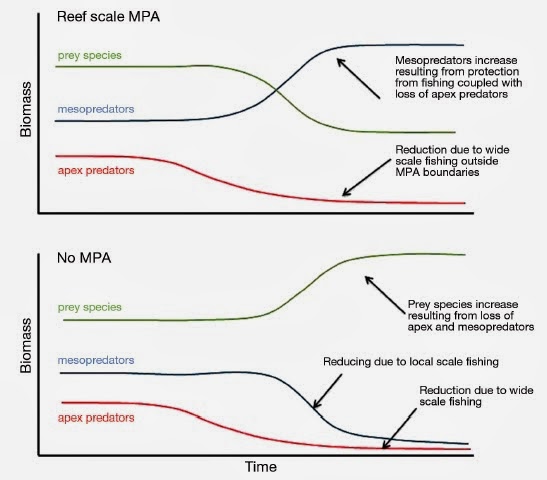
Protection of reef communities through marine protected areas (MPAs) or fisheries regulation (or indeed, naturally on those few locations far from human population centres) would ensure the mesopredator sharks on these reefs are sheltered from fishing pressure. However, the same may not be true for apex predators because their broad movement patterns and large home ranges (Meyer et al. 2009) would expose them to a greater diversity of fishing fleets and gears, and thus a greater overall mortality than the smaller-ranging, reef-dwelling mesopredators. Hence, the apex predators of coral reefs may be silently eliminated by offshore pelagic longline fisheries, unbeknownst to those managing reef diversity and function (Cox et al. 2002).
Therefore, reef-based MPAs are not adequate to protect these species.


296 Fig. 2. Conceptual diagram outlining the loss of apex predators from reef regions and corresponding system responses where a marine protected area (MPA) is present (upper) or absent (lower). Presence of MPAs leads to different states of equilibrium on individual reefs

Avoiding and mitigating these impacts may require consideration of the ecosystem- and jurisdiction-crossing movements of apex species and size classes. Therefore, management needs to consider not only the effect of reef-based spatial closure, but the amount of time these regions provide shelter to large, mobile, apex species.
This of course eminently important for the SRMR
There, the range of the Bulls and especially the Tigers is clearly much larger than the MPA proper - but this is exactly why we did establish the Fiji Shark Corridor that is conferring a solid, albeit not perfect degree of protection to our Bulls. The possibly highly migratory Tigers, alas, probably not so much - tho we will likely never know as the observed competitive exclusion may well end up masking any losses due to fishing.

This is why the river nursery work is so vital.
Compared to the large and relatively inaccessible ranges of the adults, those nurseries are discrete and relatively small areas where conservation measures may well be easier to implement. We know that the Fijian rivers do not only feature juvenile Bulls but also juveniles of the endangered and probably highly migratory Scalloped Hammerhead - and I betcha that upon closer inspection, we'll also find Nurses and Lemons. 
And once we dispose of the necessary data, we will certainly do our darn best to have those habitats protected!

But I'm digressing as always.
Brilliant paper - enjoy!