Big Fiji Bull Sharks - definitely Apex! Click for detail!
Hallelujah!
We might talk of apex size classes rather than apex
species in relation to sharks and other marine predators
that grow indeterminately throughout their lives.
Using the criterion of apex size classes, the categorisation
of sharks as apex predators would be restricted
mainly to adults of large-bodied and wide-ranging
species that influence many species within a community. Use of this definition would limit the term apex
predator to large individuals (>3 m) such as older
juvenile or adult white, tiger, hammerhead and dusky
sharks...
(and adult Bull Sharks!)
Most shark species and size classes are in fact best
described in the role of mesopredator.
The ecological
role of sharks within the diverse and impacted marine
environment requires careful consideration.
There you have it.
And the same undoubtedly applies to the terms of
keystone and
umbrella species that are so liberally bandied about by some quarters within the
movement!
You can read the whole paper
here.
And there's one more interesting observation, and I cite.
Our size-based view of the classification of predatory
roles raises important questions about what
objectives to manage, and how these objectives can
be best achieved.
Protection of reef communities
through marine protected areas (MPAs) or fisheries
regulation (or indeed, naturally on those few locations
far from human population centres) would
ensure the mesopredator sharks on these reefs are
sheltered from fishing pressure. However, the same
may not be true for apex predators because their
broad movement patterns and large home ranges
(Meyer et al. 2009) would expose them to a greater
diversity of fishing fleets and gears, and thus a
greater overall mortality than the smaller-ranging,
reef-dwelling mesopredators. Hence, the apex predators
of coral reefs may be silently eliminated by
offshore pelagic longline fisheries, unbeknownst to
those managing reef diversity and function (Cox et
al. 2002).
Therefore, reef-based MPAs are not adequate
to protect these species.
296
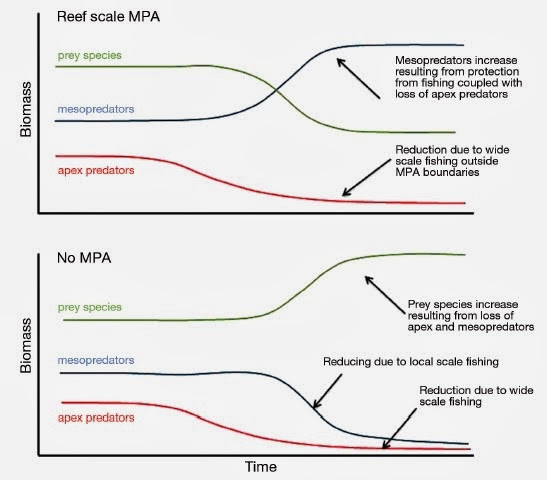
Fig. 2. Conceptual diagram outlining the loss of apex predators from reef regions
and corresponding system responses where a marine protected area
(MPA) is present (upper) or absent (lower). Presence of MPAs leads to different
states of equilibrium on individual reefs
Avoiding and
mitigating these impacts may require
consideration of the ecosystem- and
jurisdiction-crossing movements of apex
species and size classes. Therefore,
management needs to consider not
only the effect of reef-based spatial
closure, but the amount of time these
regions provide shelter to large, mobile, apex species.
This of course eminently important for the SRMR
There, the range of the Bulls and especially the Tigers is clearly much larger than the MPA proper - but this is exactly why we did establish the
Fiji Shark Corridor that is conferring a
solid, albeit not perfect degree of protection to our Bulls. The
possibly highly migratory Tigers, alas, probably not so much - tho we will likely never know as the observed
competitive exclusion may well end up masking any losses due to fishing.
Compared to the large and relatively inaccessible ranges of the adults, those nurseries are discrete and relatively small areas where conservation measures may well be easier to implement.
We know that the Fijian rivers do not only feature juvenile Bulls
but also juveniles of the endangered and probably highly migratory Scalloped Hammerhead - and I betcha that upon closer inspection, we'll also find Nurses and Lemons.
And once we dispose of the necessary data, we will certainly do our darn best to have those habitats protected!
But I'm digressing as always.
Brilliant paper - enjoy!