Showing posts sorted by relevance for query competitive exclusion. Sort by date Show all posts

Saturday, January 25, 2014

Competitive Exclusion at Shark Reef - the Paper!

Thriving Sharks - still one of my very favorite pics ever, by one of my very favorite people!

Bless Juerg!
Despite of an ever increasing burden of obligations from his other activities, he has found the time to go and mine yet another data set from our monstrous data base.

So here are his latest insights!
Whereas the last paper (read it!) shows that feeding our Bull Sharks has no notable effects at the ecosystem level, this latest one documents the existence of small-scale effects, notably a progressive change in relative species abundance that as he postulates is likely due to a combination of competitive exclusion and gradual change of feeding protocols.

The general observation is this.
Over the past ten years, we've been seeing ever more Bulls (!), Whitetips and Blacktips and about the same number of Greys - but the number of Nurses, Lemons, Silvertips and Tigers has fallen precipitously.

And the possible explanations?
Juerg doesn't speculate, and a research paper is also the wrong forum for digressing into the minutiae of feeding protocols - but as I'm not being constrained by scientific rigor, allow me to elaborate some more.
Yes some of it is speculative and difficult to test - but having logged close to 2,000 Shark dives on Shark Reef, I would argue that it is at least plausible.
  • Sharks don't generally like to approach people.
    Hence the necessity of using bait when diving where they don't aggregate naturally. Research has shown that at least the big, long lived species like Tigers are able to memorize the location (and possibly time) of successful feeding events - but the flip side is that they will likely stop bothering to pop by once they are not anymore being adequately rewarded.
  • This may in part explain the decline in numbers of those intermediate Sharks.
    They occupy roughly the same depth profile as the Bulls and once the numbers of the latter did increase beyond some tipping point, the risk/reward ratio simply became too unfavorable - this especially for the Lemons and Silvertips who appear positively scared whenever I see them trying to sneak in, this quite possibly because they may well be on the Bull Sharks' menu.
  • The Nurses are a different matter altogether.
    There, the principal factor may well be food composition and presentation, along with the fact that we don't feed them much as they create too much of a mess.

    Ever since taking on Shark Reef and turning it into a marine reserve, we've been concerned about our influence on the other Fishes. Having noticed an overabundance of small predators and scavengers, we've gradually phased out all Fish scraps and feed nearly exclusively Tuna heads, meaning that the overwhelming majority of bait leaves the reserve in the stomach of a large Shark or gigantic Trevally, as it should be. As a consequence, the Fish biodiversity of Shark Reef has undergone a massive increase from a baseline count of 260 species in 2004 to close to 500 in 2010 which is now highly indicative of a healthy Fish population on a Fijian barrier reef - possibly also because a robust Shark population may favor biodiversity, which would then be a positive small-scale effect!

    Those big Tuna heads are rather unattractive to the Nurses who have small mouths and got no means of cutting out adequate portions. And once we shifted to mid-water dumping as opposed to hand feeding in response to the increased numbers of Bulls, the Nurses were less able to monopolize bait on the bottom and may indeed have relocated to Lake Reef where protocols, I hear, are different.
  • The Tigers?
    From my observations, they are incredibly persistent to the point of obstinacy - but they like to take their time and certainly don't appreciate the stress of having to contend with those frisky Bulls that have become ever bolder with increasing numbers.
    They certainly don't anymore slink away when the Tiger shows up like in the old times, but instead engage in direct competition to the point of where I dispose of footage of them out-swimming and even shouldering away the much bigger Tigers - meaning that in all likelihood, the latter have simply stopped bothering and prefer to try their luck elsewhere!

    And then, there is the fact that recently, the pressure by coastal fishermen on especially the particularly lucrative Tigers has increased substantially.
    If you add that to their risk of running into one of those Tuna longlines during their pelagic migrations, it is quite likely that the Tiger Shark population in Fiji has been depleted by overfishing!
  • Not surprised about the Reefies.
    Like Juerg remarks, they nearly never descend to the lower depths and once there, they never attempt to feed, this likely owing to their inexistent chances of competing successfully for the bait but also, the risk of being predated upon by the Bulls. Conversely, we've conditioned the Bulls never to ascend to 10 meters, this also due to our positioning of the clients who obstruct any direct access to the feeder whereas the small Reefies can access him from the reeftop.
    Hence the Reefies are not subjected to competitive exclusion when they stay shallow.
  • Generally speaking, resident Grey Reefie populations appear to be comprised of juveniles, subadults and adult females and are usually found at reef passes - but ours are predominantly adult males and thus quite possibly much more transient.
    This appears to be confirmed by the fact that they abscond for months on end in mid year, likely to go and visit one or more resident populations during the mating season, meaning that any newborns would reside there and not in the SRMR. With that in mind and considering the risk posed by the Bulls, they will continue to quickly dash in for a snack during meal times but otherwise remain rather wary and nomadic.
  • The Blacktips took forever to accept any bait.
    If memory serves me right, they only started feeding and thus approaching people 6 years ago, and the increase in numbers may well be due to the fact that they are now swimming in from other areas, namely the lagoon side, of Shark Reef during feeding time, to then quickly abscond as soon as the feeding ceases. Like Johann teaches us, they migrate to breed in shallow lagoons, meaning that any juveniles would be found there. But they also disperse, meaning that some may have indeed hopped over from Serua Reef that features similar habitats - but my gut tells me that the majority are resident locals that have simply become bolder.
  • And the Whitetips breed on Shark Reef.
    We know that because we've now observed neonates and juveniles on several years, and the population has increased accordingly - no unsolved mysteries there apart from the question of when we will reach carrying capacity and the population will stabilize.
There you have it.
There have been many changes, some of which massive - the question being, is it good or is it bad?

The answer is probably: rather good to indifferent!
Fish stocks are thriving, meaning that I cannot detect any evidence that those increased number of Reefies are having a negative effect - and when it comes to those other larger Sharks with larger home ranges, evidence suggests that they remain well protected within the Shark Corridor, this with the sad exception of those poor Tigers for whom we however carry no responsibility

And in the vicinity?
Yes like Juerg states, we don't quite know
But what we DO know is that the fishermen in Galoa catch more fish, this likely due to overspilling from the SRMR - whereas further away, stocks are grossly overfished and fishing yields have crashed. We also know that our big Sharks are not resident, meaning that we're not subtracting them from elsewhere where they continue to perform whatever functions they are meant to perform..

So with that in mind, how can I not be happy!
And as always, I'm mighty proud - and so thankful to Juerg for yet again a wonderful job in helping us better understand the animals we love and our influence on their life.

Merci Jürg - sisch jo wie immer e super gueti Sach!

Wednesday, January 15, 2014

NZ - does Shark Diving endanger the Public?


Have you seen this?
And I cite.
About 10 to 15kg of berley was used in a cage dive, he said, which was less likely to attract sharks than the half-tonne of offal dumped by commercial fishermen.

Fishing operators cleaning their catch at the entrance to Half Moon Bay were more likely to attract sharks into the harbour, he said.
Bingo.
Let me once again cite myself.
Fishermen do not only feed Sharks by presenting them baited hooks; many of them attract and often end up feeding Sharks when they drag in struggling fish and when they subsequently clean their catch and throw the scraps into the ocean. Spear fishermen are notorious for attracting, and even conditioning Sharks when they shoot fish and often find themselves embroiled in a competitive struggle over their prey. These people number in the hundreds of thousands and if anybody should be examined for possibly causing an increase of Shark attacks on the public, it should be them - not the few dozen operators conducting baited Shark dives!
Plus,
  • Great Whites are fully protected in New Zealand.
    If that protection is to make any sense, one must assume that consequently, less adult GWS are being killed and that the juveniles and subadults have a better chance of reaching the stage where they switch from a fully piscivorous diet to seasonal preying on Pinnipeds. If so, the number of Sharks sighted in the vicinity of those Sea Lion colonies may well be on the increase. As Stewart Island is slowly being recolonized by New Zealand Sea Lions, its attractiveness for GWS may equally be on the rise.
  • Shark feeding appears unproblematic at the ecosystem level
    All present research into those baited Shark dives appears to concur that those dives have little to no effect at large spatial and temporal scales. It appears pretty clear that far from becoming dependent on the handouts, those provisioned Sharks continue to fulfill their ecological roles and also continue to follow their normal life cycles as in e.g. mating, pupping and migrating.
  • There's no correlation between Shark feeding and Shark strikes.
    Re-read this. In brief and with maybe the exception of SA, the vast majority of Shark strikes occurs in locations where there are no Shark feeding operations - which is even more surprising if one considers that most of those dives have been established in locations that are known for their healthy Shark populations!
    And even if there were some correlation, it certainly does not equate causation!
But of course there are some big caveats.
  • There are certainly effects at small spatial and temporal scales.
    Shark feeding often aggregates the animals, and this can have local consequences. As an example, take the increased aggression of those Lemons in Moorea; or the observed competitive exclusion of other Sharks in Fiji and possibly SA and TB; or those postulated local behavioral changes and marginally increased residency in Southern Australia.
  • Conditioning via positive reinforcement does likely happen.
    Those GWS are certainly smart and it is absolutely plausible to assume that they may have learned to associate the boat noise with a subsequent feeding opportunity - and with the food being presented at the surface, it as equally plausible to assume that they could be popping up next to other boats in the area!
    The assertion that they may be following the boats ashore is however likely to be humbug - provided, that is, that nobody throws bait overboard on the way home!
  • Location matters.
    Many Shark dives have been being established where there are already Sharks, meaning that objectively speaking, the risk profile is unlikely to change - but perceptions matter and like in the case of population centers like, say, Cape Town or Playa, the diving activity and associated increased publicity of Sharks can lead to conflicts with the other local ocean users. Consequently, as a rule, the feeding locations need to be as remote as possible and should definitely not be established e.g. right in the middle of population centers or right in front of popular beaches etc.
  • Feeding protocols.
    Like I often state, it is often not about the what but about the how.
    Shark provisioning creates its own risks, and those risks need to be managed - meaning that all protocols should be chosen in function of minimizing the impact on both the animals and the habitat, and on maximizing the safety for the participants but also the public. E.g., everybody will hopefully agree that creating humongous chum trails or dumping indiscriminate amounts of bait to create feeding frenzies is probably a bad idea. Or as another example, we here go to great lengths to condition the Bulls never to come to the surface, lest we get accused of endangering other aquatic recreationists.
    In brief, we need to be in a position to demonstrate that we are always striving to conduct our dives in the most responsible way possible.
And then, there's this
  • Obtaining the required Social license and stakeholder involvement are crucial.
    The local stakeholders need to become an integral part of these projects - and this not only through regular awareness, education and consultations but also by letting them partake in the financial windfall, both indirectly but very much also directly. Only this will ensure crucial local support when the inevitable problems will arise.
  • Get in the research.
    The best argument against many of the intuitively plausible reservations of our detractors are strong scientific data. As an example, when people got bitten by Bull Sharks in Cancun and everybody tried to blame the Shark feeding operations in Playa, the operators there had the data showing that they were only feeding females whereas the Bull Shark population in Cancun was only comprised of males. Or in our case, our Bull Shark data show conclusively that we are neither causing residency nor any dependency on our handouts, see above.
Long story short?
I ignore the precise circumstances of those cage dives in Stewart Island. Intuitively, I am inclined to assume that they are being conducted responsibly, and that the location is sufficiently remote.

But there appears to be a problem of perception.
If I am correct in speculating that the islands may be attracting more GWS, it follows that  the risk for the Pāua divers may be on the increase. With that in mind, it may be wise to engage in some preventative measures, as in increased dialogue and data sharing with the fishing community all the way to maybe helping fund protective gear like Shark shields etc. And it may also be smart to re-engage with the authorities and the stakeholders, and ensure their support by developing a code of practice everybody can agree with!

But again, I don't know the precise circumstances.
Maybe all of that has already happened, and the current blowback is merely some noise by troublemakers.

But if not, some of the above may be useful.
Good luck!

Sunday, February 19, 2012

Alex - back on Air!

Busy: Shark Reef in 2009!

Whilst I'm ruminating on one of those posts.

This one is easy.
Alex the Sharkman has not only revamped his website and started publishing his epic interviews, he has finally started blogging again.

His first proper post is about us.
To me, it is particularly interesting because so much has changed since, e.g. the fact that we don't anymore feed the Trevally at the surface and that the pit is now really out of bounds. It also reminds me painfully that none of the Tigers turned up for him, something that we interpret as competitive exclusion.

Anyway, it's a great read and a trip down memory lane.
What can I say but that we are really honored.
A big Vinaka Vakalevu my friend!

Enjoy Alex' post.

Thursday, May 22, 2014

Shark Feeding - attack the Unknown!


And attack she did, and know she did little!
And I cite.
Evidence indicates sharks have the capacity to become conditioned. 
As a result, shark ecotourism has the potential to create an association of humans with food, ending in increased attacks.
Right.
Have you seen this crap?
Sarah the student from Wellington has perused a random selection of irrelevant papers (and none of those that are relevant, see the links below!) - and now she thinks she knows something about something and has posted her opines on the university weblog site.

So there, for the umpteenth bloody time.
  • There's no geographical correlation between Shark feeding and Shark strikes.
    Re-read this. In brief and with maybe the exception of SA, the vast majority of Shark strikes occurs in locations where there are no Shark feeding operations (like specifically Western Australia!)  - which is even more surprising if one considers that most of those dives have been established in locations that are known for their healthy Shark populations!
    And even if there were some correlation, it certainly does not equate causation!

  • Shark feeding appears unproblematic at the ecosystem level
    All present research into those baited Shark dives appears to concur that those dives have little to no effect at large spatial and temporal scales. It appears pretty clear that far from becoming dependent on the handouts, those provisioned Sharks continue to fulfill their ecological roles and also continue to follow their normal life cycles as in e.g. mating, pupping and migrating.
But of course there are some big caveats.
  • There are certainly effects at small spatial and temporal scales.
    Shark feeding often aggregates the animals, and this can have local consequences. As an example, take the increased aggression of those Lemons in Moorea; or the observed competitive exclusion (and here!) of other Sharks in Fiji and possibly SA and TB; or those postulated local behavioral changes and marginally increased residency in Southern Australia.
  • Conditioning via positive reinforcement does likely happen.
    E.g., Sharks are certainly smart and it is absolutely plausible to assume that provisioned Sharks may have learned to associate the boat noise with a subsequent feeding opportunity, a fact that is being exploited by several operators - and if the food is being presented at the surface like in the case of GWS cage diving, it as equally plausible to assume that they could be popping up next to other boats in the area!
    But "turning up" does not equate "attacking"!
  • Location matters.
    Many Shark dives have been being established where there are already Sharks, meaning that objectively speaking, the risk profile is unlikely to change - but perceptions matter and like in the case of population centers like, say, Cape Town or Playa, the diving activity and associated increased publicity of Sharks can lead to conflicts with the other local ocean users. Consequently, as a rule, the feeding locations need to be as remote as possible and should definitely not be established e.g. right in the middle of population centers or right in front of popular beaches etc.
  • Feeding protocols.
    Like I often state, it is often not about the what but about the how.
    Shark provisioning creates its own risks, and those risks need to be managed - meaning that all protocols should be chosen in function of minimizing the impact on both the animals and the habitat, and on maximizing the safety for the participants but also the public. E.g., everybody will hopefully agree that creating humongous chum trails or dumping indiscriminate amounts of bait to create feeding frenzies is probably a bad idea. Or as another example, we here go to great lengths to condition the Bulls never to come to the surface, lest we get accused of endangering other aquatic recreationists.
    In brief, we need to be in a position to demonstrate that we are always striving to conduct our dives in the most responsible way possible - but provided that (!) we we act responsibly, yours truly and every single Shark diving operator I've ever talked to have made the observation that the Sharks become positively tame, meaning that the risk of a bite is lower not higher!
And then, there's this.
Anyway.
These stupid allegations are likely to hound us til the end of time - but it's disheartening to see them parroted by a young academic that is obviously a Shark-lover!

To be continued no doubt!

Thursday, June 27, 2013

Shark Feeding - Part deux!

Helen and Fiji Bull Shark - pic by Michael Sealey of Biodiversidad Ibérica

Bless Helen!

Here is the second installment of her post.
I could not agree more - including the fact that there is a local effect, this however not so much precipitated by the bait that is actually all being eaten and mostly leaving Shark Reef in the stomach of the Bulls.which do not reside there. For them, those Tuna heads are just a snack, and not very nutritious at that, and I have no doubt that they continue to prey naturally and fulfill their ecological role in their habitat.
Like I said elsewhere, we are very mindful of our impact and have completely stopped any indiscriminate dumping of bait a long time ago. As a consequence, the composition of the Fishes has changed from a rather low species count of 260 that was being dominated by small scavengers and predators, to now 480+  that is highly representative of any (non-fished) fringing reef along one of Fiji's principal islands.

The effects I detect are more behavioral.
Juerg is writing a paper on the subject, so I don't want to preempt his findings on the subject, the more as I'm yet to see any draft. 
But apart from the obvious conditioning whereby we are actively teaching our Sharks to behave in certain ways, I believe that I'm observing inter-specific aggression all the way to competitive exclusion among the various Sharks. And also believe that we've interfered with the diel patterns of at least the Whitetips that are usually crepuscular but on Shark Reef, leave their hidey holes to come and feed at midday. 
But at this stage, I'm obviously speculating, and Juerg will also need to answer the question of so what - even if there's an effect, does that necessarily mean that it is bad?

Anyway, thank you Helen!
Her endorsement is far from trivial.
For years, Shark provisioning has been the target of much skepticism from researchers and NGOs alike, and only recently do I detect a slight shift in positions away from outright hostile to at least benevolently intrigued. This is largely due to the realization that baited Shark tourism, whilst certainly presenting its specific challenges (especially when conducted poorly!) is never the less  years ahead of the alternative = Shark fishing. 
And recent research is also showing that whilst local, hitherto unqualified and unquantified effects persist, effects at large temporal and spatial scales are negligible. 

Sharks, it appears, are just different.
Whilst bony Fishes show all the typical negative effects of conditioning that lead to the well known numerous bites by Groupers, Moray Eels all the way to those notorious swarms of pesky Sergeant Majors, Sharks simply don't do that - that is, provided that who feeds them does so responsibly, see the reports about beggar Sharks from, say, Tiger Beach!

Long story short?
Come and see for yourselves - this is still the top season for high numbers!

Thursday, February 14, 2019

White Sharks vs Sevengills - Paper!

First image of Sevengills on this blog = as always, great pic by Peter! Source.

Just in case you've missed it.
Watch.


I must say that I really like it.
Obviously, correlation is not causation so we'll never know 100% - but as somebody who has been equally documenting long-term changes in abundance that are likely partially due to competitive exclusion, I can only applaud the authors for advancing an astute and I believe highly plausible hypothesis.

But go see for yourselves.
Paper here, synopses here and e.g. here.

Enjoy!

Thursday, July 31, 2014

Spatial Behavior in Elasmobranchs - Papers!

OCEARCH tracks in SA - so far, highly ambiguous!

Interesting!

I've been remiss in not posting about several new papers.

This one by, among others, (the proudly left-brained, and obstinate) Michelle Wcisel, describes the movements of GWS in the Dyer Island and Geyser Rock system near Gansbaai and observes that they differ substantially from the GWS movements in Mossel Bay. As a possible explanation, it observes that the former Sharks are largely sub-adult to adult (= seasonal hunters of Mammals ) whereas the Mossel Bay Sharks are predominantly juveniles that feed predominantly on bony Fishes and Cephalopods.
Offical synopsis and great infographic here.

This one examines the abundance and sexual composition of GWS in Gansbaai in relation to the season and ENSO, and comes to the conclusion that females appear to favor warmer water whereas males do the opposite, possibly owing to competitive exclusion by the larger female conspecifics.

And this one by, among others, Tiger Shark supremo Yannis Papastamatiou describes the movement patterns of Reef Mantas at Palmyra Atoll with its two immediately adjacent lagoons. Whereas most Mantas in one lagoon alternate between lagoonal and offshore habitats, those in the other lagoon appear to be much more resident, possibly owing to the different hydrology and/or capacity of the lagoons to provide for adequate nourishment.

And the take-away message of it all?
What once again strikes me in all those papers, is how behavior is being mediated by the environment (= climate, geography, habitat but also occurrence and/or migration of prey etc) but also by factors like gender, age and of course, individuality - and this all within one and the same species!
And if Michelle and Yannis can show significant variance across the smallest of geographical areas, and this within one single population - isn't it only logical to expect even bigger differences between distinct populations that are completely separated both genetically and geographically?

Definitely a big yes for Tiger Sharks - and the GWS?
Even discounting the Fischer factor, it seems to me that all those many comments about those tagged GWS are tacitly assuming that all GWS must necessarily follow a life cycle that is analogous, if not identical to what has been documented by Domeier for the Guadalupe population.
But with the above in mind, is that even plausible?

Take the Atlantic.
Its hydrology (think: Gulf Stream), climate and fauna are very different from that of the Eastern Pacific. Other large Sharks like Great Hammers and Tigers have been shown to migrate smack into the middle of the Atlantic, quite possibly following prey - so why not some of those GWS. Other, possibly younger GWS could be following the Bluefin into the Gulf. Consequently, the overall picture is much more ambiguous - incidentally, much like in South Africa with its ENSO-mediated interplay between the Benguela and the Agulhas!

Australia?
There are two genetically distinct GWS populations that both migrate to the Neptunes where they intermingle as they prey on Pinnipeds - meaning that barring the discovery of some highly sophisticated reproductive isolation mechanism, one would have to assume that they mate completely elsewhere. And if so, this would be very different from what is being postulated for Lupe where the Pinniped colony appears to act as a focal point for mating!

Or the Mediterannean GWS.
Much more restricted habitat and quasi absence of Pinnipeds owing to the extirpation of the Monk Seal - surely this must have big effects on both their diet and migration!

Long story short?
We should really refrain from resorting to those very broad generalizations when describing the behavior of those different Sharks. Instead, let's stick to the evidence that keeps reminding us that things are complicated!

Agree?

Tuesday, July 01, 2014

To Feed or not to Feed!


Yawn - right? :)

But this is really rather good.
It's a collection of interviews about the ever controversial topic of provisioned Shark dives - and to my great surprise, it's overwhelmingly pro-industry, and even the reservations by some are well informed and as such, absolutely legit.
So bravo Scuba Diver - considering some of the moronic comments fielded in support of the WA Shark Cull, this was certainly timely!

Oh and they did interview yours truly.
True to her job description, Alice Grainger the charming editor did some brutal editing, and the result is uncharacteristically concise, this probably much to the relief of the readers.

No such luck for you!
Here's the interview, unabridged.

What has you experience been with the provisioning shark dives you run at Beqa?
How do you approach the controversy surrounding this divisive issue?

Let me try to address the second question first.
It touches on two aspects – one ethical and one factual.

Ethical considerations.

Some people oppose provisioned shark dives for ethical reasons, stating that they are inferior to natural encounters, and that they demean the animals.

This may surprise you – but I don't advocate Shark feeding!
On the contrary, I'm very much of the opinion that nothing beats the awesome experience of witnessing Sharks doing their natural thing, like in, say, Palau, Malapasqua, the Sardine Run, Ningaloo, Fakarava or Cocos!

But of course those predictable natural aggregations are rather rare.
Plus, some of those Sharks are very shy, meaning that the encounters, although highly rewarding, can be very brief indeed. Other than that, encountering Sharks in the wild is difficult for some species and all-but-impossible for others, meaning that in most cases, anybody wanting to showcase them to paying customers will have to resort to some form of baiting.

This is what we do in Fiji - not because we are “for” it but because it is a necessity and because we believe that it is neither harmful to the Sharks and their habitat nor to the humans, a fact that is increasingly being corroborated by recent research, see below.

Factual considerations.

People who oppose baited shark dives claim that they are harmful to the sharks and their environment, and that they teach sharks to associate humans with food, which in turn will lead to increased shark strikes on people.

When presented with such opinions, it is best to look at the evidence – and the evidence looks as follows.
  • Shark feeding appears unproblematic at the ecosystem level.
    All present research into those baited Shark dives appears to concur that those dives have little to no effect at large spatial and temporal scales. It appears pretty clear that far from becoming dependent on the handouts, those provisioned Sharks continue to fulfill their ecological roles and also continue to follow their normal life cycles as in e.g. mating, pupping and migrating.

  • There's no geographical correlation between Shark feeding and Shark strikes.
    In brief and with maybe the exception of South Africa, the overwhelming majority of Shark strikes occurs in locations where there are no Shark feeding operations - which is even more surprising if one considers that most of those dives have been established in locations that are known for their healthy Shark populations! And even if there were some correlation, it certainly does not equate causation!
But of course there are some big caveats.
  • There are certainly effects at small spatial and temporal scales.
    Shark feeding often aggregates the animals, and this can have local consequences. Documented examples of those local effects include increased aggression among sharks, competitive exclusion of other species by dominant sharks, or those postulated local behavioral changes and marginally increased residency of Great Whites in South Australia. Those effects however are strictly localized, and none of them has been shown to impinge on the fitness of those provisioned sharks, nor do they unduly alter their environment.

  • Conditioning via positive reinforcement likely happens.
    Sharks are certainly smart and it is absolutely plausible to assume that they may have learned to associate the boat noise with a subsequent feeding opportunity - and should food be presented at the surface, it is equally plausible to assume that they could be popping up next to other boats in the area! Those are certainly considerations any responsible shark diving operator has to keep in mind.

  • Location matters.
    Many Shark dives have been being established where there are already Sharks, meaning that objectively speaking, the risk profile is unlikely to change - but perceptions matter and like in the case of population centers like, say, Cape Town or Playa del Carmen in Mexico, the diving activity and associated increased publicity of sharks can lead to conflicts with the other local ocean users. Consequently, as a rule, the feeding locations need to be as remote as possible and should definitely not be established e.g. right in the middle of population centers or right in front of popular beaches etc.

  • Feeding protocols.
    Like I often state, the problem is not what one does, it is how one does it! Shark provisioning creates its own risks, and those risks need to be managed - meaning that all protocols should be chosen in function of minimizing the impact on both the animals and the habitat, and on maximizing the safety for the participants but also the public. E.g., everybody will hopefully agree that creating humongous chum trails or dumping indiscriminate amounts of bait to create feeding frenzies is probably a bad idea. Or as another example, we here go to great lengths to condition the Bulls never to come to the surface, lest we get accused of endangering other aquatic recreationists. In brief, we need to be in a position to demonstrate that we are always striving to conduct our dives in the most responsible way possible.
Which brings me straight to the first question. 

From the outset, our principal aim was to further shark conservation and research, for which we established the Shark Reef Marine Reserve in Fiji in close cooperation with local stakeholders and the relevant authorities. 
When it comes to the tourism component, we want our customers to experience being in the presence of such awesome animals with a maximum of enjoyment and a minimum of risk, as provisioned shark dives will always remain inherently dangerous undertakings – meaning that we do not allow interactive encounters or what has been dubbed “extreme shark diving”. Instead, we treat them to a carefully choreographed show where they remain essentially spectators, and endeavor to instill a sense of awe and appreciation that will hopefully motivate them to become shark conservation advocates. 

Our experience has been overwhelmingly positive. 
In ten years of operation, our protocols have led to zero incidents with our customers, and only very minor ones with our staff that operate in the front lines, this owing to the fact that the feeders wear protective gloves, dispose of bodyguards and generally follow very rigid safety protocols. The clients appear happy, the reef and the sharks are thriving, and the local community and the authorities are highly supportive, meaning that we are really very satisfied.

Yeah I know I know - same old same old.
But maybe worth repeating, lest we get too complacent!

Monday, March 10, 2014

Sharks are not Apex Predators - Paper!

Big Fiji Bull Sharks - definitely Apex! Click for detail!

Hallelujah!

This has one of my pet peeves for a very long time indeed.
And now a panel of illustrious researchers are confirming that the vast majority of Sharks are not apex predators but instead, best described as mesopredators, to wit
We might talk of apex size classes rather than apex species in relation to sharks and other marine predators that grow indeterminately throughout their lives. 
Using the criterion of apex size classes, the categorisation of sharks as apex predators would be  restricted mainly to adults of large-bodied and wide-ranging species that influence many species within a community. Use of this definition would limit the term apex predator to large individuals (>3 m) such as older juvenile or adult white, tiger, hammerhead and dusky sharks...
(and adult Bull Sharks!)


Most shark species and size classes are in fact best described in the role of mesopredator. 
The ecological role of sharks within the diverse and impacted marine environment requires careful consideration. 
There you have it.
And the same undoubtedly applies to the terms of keystone and umbrella species that are so liberally bandied about by some quarters within the movement!
You can read the whole paper here.

And there's one more interesting observation, and I cite.
Our size-based view of the classification of predatory roles raises important questions about what objectives to manage, and how these objectives can be best achieved.

Protection of reef communities through marine protected areas (MPAs) or fisheries regulation (or indeed, naturally on those few locations far from human population centres) would ensure the mesopredator sharks on these reefs are sheltered from fishing pressure. However, the same may not be true for apex predators because their broad movement patterns and large home ranges (Meyer et al. 2009) would expose them to a greater diversity of fishing fleets and gears, and thus a greater overall mortality than the smaller-ranging, reef-dwelling mesopredators. Hence, the apex predators of coral reefs may be silently eliminated by offshore pelagic longline fisheries, unbeknownst to those managing reef diversity and function (Cox et al. 2002).
Therefore, reef-based MPAs are not adequate to protect these species.


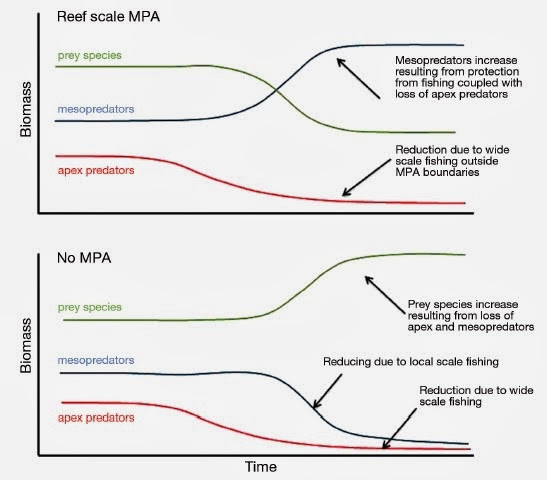
296 Fig. 2. Conceptual diagram outlining the loss of apex predators from reef regions and corresponding system responses where a marine protected area (MPA) is present (upper) or absent (lower). Presence of MPAs leads to different states of equilibrium on individual reefs

Avoiding and mitigating these impacts may require consideration of the ecosystem- and jurisdiction-crossing movements of apex species and size classes. Therefore, management needs to consider not only the effect of reef-based spatial closure, but the amount of time these regions provide shelter to large, mobile, apex species.
This of course eminently important for the SRMR
There, the range of the Bulls and especially the Tigers is clearly much larger than the MPA proper - but this is exactly why we did establish the Fiji Shark Corridor that is conferring a solid, albeit not perfect degree of protection to our Bulls. The possibly highly migratory Tigers, alas, probably not so much - tho we will likely never know as the observed competitive exclusion may well end up masking any losses due to fishing.

This is why the river nursery work is so vital.
Compared to the large and relatively inaccessible ranges of the adults, those nurseries are discrete and relatively small areas where conservation measures may well be easier to implement. We know that the Fijian rivers do not only feature juvenile Bulls but also juveniles of the endangered and probably highly migratory Scalloped Hammerhead - and I betcha that upon closer inspection, we'll also find Nurses and Lemons. 
And once we dispose of the necessary data, we will certainly do our darn best to have those habitats protected!

But I'm digressing as always.
Brilliant paper - enjoy!

Tuesday, January 06, 2015

Shark Diver is coming to Fiji!

Ever-boisterous Martin has already announced that he plans to top this picture he took last year - we shall see! :)

Read this!

Methinks this is a great deal!
And yes you will see heaps upon heaps of Fiji Bull Sharks.
Tiger Sharks however not so much, this due to competitive exclusion. Just for you not to be disappointed - and I promise you, you won't be!

And since we're online.
Yes I'm well, yes I'm busy - and yes as we speak, I'm writing the yearly recap! :)
So keep watching this space - and in the meantime, read the reply by Mark here and especially, Eli's reply here! Both go to show that contrary to the many pathetic public feuds, one can debate without becoming mortal enemies!

And, do read the South African verdict here - thanks Clare!
Talk soon!

Thursday, January 08, 2015

2014 - The Good, the Bad and the Ugly!

No such category this year - but if there were, this would probably be my favorite pic! Source.

OK - let's do this thing.

This time, it's gonna be different.
I'm gonna spare myself the various verbose intros because they would be no different from what I've posted in the past - if yer interested, go and re-read them here!

So there.

For BAD it has been a simply phenomenal year.
This is the first year that we've not had to let go anybody but have instead further expanded our team by hiring our two fabulous trainees from Galoa, Elia and Wase; the first year that we were able to cover all our investments out of cash flow; and most importantly, the first year we've paid out more than 50k in bonuses to the staff. Yes as always, there goes the dividend - but this was never about the money anyway!
And for you fans out there: Silio got married and is becoming our first home-grown instructor; and Nani's little sister Ana is not so little anymore, equally married and mother to a healthy son!

But our biggest achievement was that after 10 year of incessant lobbying, we were finally rewarded for our patient stubbornness when Government declared the SRMR a National Marine Park in September - and having talked to many people, it really is the first NMP in Fiji and probably the first such public/private partnership anywhere!

The scientific work has continued unabated.
Juerg did publish his simply stellar paper about competitive exclusion.
Thanks to PADI Project AWARE, the GFSC  has continued for its third year despite of the rather baffling retraction of SOSF as a sponsor, meaning that we now have enough data for a first analysis that will be published shortly. And our cooperation with Projects Abroad has added two new long term research projects that will eventually result in more papers published but above all, in vital action on the ground. And I know of at least one paper being in peer review, plus two being written as we speak - so keep watching this space!

Talking of Projects Abroad, I must really say that it has been awesome.
This has really been a great cooperation. Yes, like in any marriage, we've had our disagreements - but they've been exceedingly rare, discussions have always been constructive, and we've always come away enriched from them, as did our projects.
On top of conducting their research and various community initiatives, the volunteers did plant thousands upon thousand of Mangroves and as a consequence, the MFF website is currently undergoing a major facelift to better reflect the project's massive expansion along with its changed strategic orientation. 
There too, expect news rather sooner rather than later, this along with the announcement of a substantial expansion and re-orientation of the river tagging work!
Thank you guy and gals - you rock! :)

And I must also thank Broadreach.
This was the seventh year that they've run their summer camps for High School and College with us, and thanks to the leadership of the irreducible Lindsay but also of multi-year leaders like Chris, we've become like family whereby this is undoubtedly the staff's favorite time of the year!

And  then, there was the global stuff!
We've launched Global Shark Diving to a simply overwhelming reception at DEMA, and as soon as everybody returns from the Holidays, the operator page will start populating with further amazing members, more ambassadors an also the bios of the researchers we work with along with their projects. One hundred percent initiated from within our Industry, this initiative aims at elevating Shark diving to a more long-term sustainable model, and it is great to see how the public approves of it and fantastic operators are buying into it. The customer cards are being printed as we speak, so expect to start getting them really soon, and yes they are totally free of charge - and then please show us that you like what we do!
And other really great global initiatives are in the making - and although they are not initiated by us and I'm thus not at liberty of divulging any details, I can nevertheless proudly reveal that BAD will play a role in each and every one of them!

And finally, the Sharks are doing great!
When it comes to our Fiji Bulls, we've witnessed the latest full cycle from mating to pregnancy to pupping, and the arrival of the newest batch of subadults - meaning that with the exception of the riverine YOYs and small juveniles, we're able to showcase every single life stage all the way to the old mamas like Granma and Bulge! With that in mind, 2015 is likely to yet again be a bumper year!
Same-same for the Whitetips that breed right there on the reef, and El Diego tells me that one big pregnant Blacktip has left and come back from its likely nursery on Beqa Island!
Tigers alas a big fat zero. There are just too many feisty Bull Sharks, plus they are likely been drawn away to the nascent Tiger Shark dive by BLR on the fringes of Beqa Lagoon where they usually hang out. One of their feeders has a reputation for being a loose cannon, and the dive looks messy (BTW, that's Adi) -  so here's to a steep and accident-free learning curve, and to loads of success! And, guys, get yerself some steel gloves and aluminum poles - gotta stack the cards in your favor!

Great people we've first met in 2014, in no particular order:
Allen; Mark; Ingrid, Andy, Kira, El Diego, Josh and Ron of Projects Abroad; Serge, Johann, Nicolas, Pierpaolo and the fantastic team of CRIOBE; Adam; Andrew; Riley and Mike; Avi, Mike, and the great Rodney; Nicole; Ciro and Ines, and Celso; Judi; Ian; Mark and Jess;  Elena and Ana - plus probably several more I've forgotten to mention, for which I apologize!
An then there was Shelley - and she has been a total revelation!
Great great lady, with a big heart for Sharks, a great sense of humor, a razor-sharp mind and an incredible wealth of knowledge about what is going on in those obscure pelagic fisheries. Really - very impressed!

And to all our old friends - thank you! :)
And a big shout-out to the traditional DEMA dinner co-conspirators - love you guys!
And a very, very special H/T to Bati!

So what about the Good elsewhere.
Frankly, I'm a bit at a loss. Yes there was plenty of good stuff and some of it was even very good - but it was essentially same old same old, nothing really spectacularly new. The good people remain the good people, the good NGOs continue to deliver good work, and DaMary and Rick continue to be my Shark heroes and continue to impress me with their intelligence, humility and humanity.

But a special H/T goes to Jessica, Ryan and Barry for their invaluable contribution to the scrapping of the WA Shark cull.
Bravo!

And although I'm sure that there are others - Riley, Ana and Elena, see above, are beacons of hope for picking up the torch and introducing intelligent, pragmatic, science- and fact-based Shark conservation to the next generation!

And I want to highlight this.
If you haven't before, please do watch it this time.


This is how all documentaries should be - especially those about Sharks!
Not that tired old, pathetically larmoyant new age eco clap trap; not those TV productions that are tailored for an audience of brain dead morons. Instead, give us real storytelling!, real emotions, beautiful cinematography and sound tracks!
Bravo David!

And finally - there has been progress!
Some of the charlatans have finally been unmasked and pushed into irrelevance - and I detect a clear slowing down, if not reversal of the Dolphinization of Shark Conservation! 
Here's to evolution!

And the Bad and the Ugly?

But first things first.
As a reminder, read this and watch this!


That's the general backdrop.
But there, too, I really can't be bothered much anymore.
Those cheats, charlatans and hypocritical media whores are not reformable, and you can't cure stupid - but I'll sure continue to expose them lest they think that they get away with that shit! But should you wonder whether you may have missed anything: I've WTF'd all my rants, so you can go and re-read what has made my blood boil - some stupid, some really bad and some simply egregious.

Let me mention just a few.

The very worst?
Those fishermen continue to kill Sharks by the tens of millions.
Lets never forget that THIS is the real problem - not the various comparatively irrelevant issues that continue  to inflame the hearts of the do-gooders!
Yes there has certainly been notable, sometimes even stellar progress in Asia that has driven down the price of Shark fins and sometimes even eliminated some local Shark fisheries - but the decline is not as large as asserted and with human populations continuing to grow and out-strip marine resources, Shark meat is increasingly being consumed as a source of protein.
This means that the fight is not only not over, but that a substantial part of the effort needs to be urgently re-directed towards advocating sustainable fisheries. To top that off, we're also hammering the Sharks' prey; and Global Warming, Acidification, Pollution and Habitat Destruction are exerting further pressure on Shark populations.
Not good!

And then there was the WA Shark cull.
Yes the cull proper has been stopped - but the killing continues, and the WA government has made it easier to go out and slaughter more Sharks by redefining the terms of reference. All-in-all, it's eminently disturbing and also, eminently stupid as public safety is not in the slightest being increased. And the recent targeting of tagged Sharks is just simply unacceptable.
And what about our side.
I must say that I was appalled (but by no means surprised) by all those conservation people flocking into WA like fucking lemmings with the sole purpose of showcasing themselves as heroic conservationists, and by the sheer stupidity but also, by the abject lack of compassion of many, many comments posted on social media. And I really was not at all impressed by some of the research community, both for their lack of fortitude in addressing the issue honestly (= when will anybody finally state that there are obviously more big GWS!) but also for playing to the crowd by advancing  some remarkably misleading and stupid arguments.

And Shark Week?
We don't get it here in Fiji so I haven't seen anything - but I hear that some was atrocious and some, rather good. What however did really disturb me was all that frothy incestuous twittering and blogging by the intelligentsia! Talk about a veritable cottage industry of outraged nerds! 
And the worst part? Not only did they offer zero solutions, not only did they bring about zero change - I know for a fact that DC were delighted by all that incremental traffic whilst laughing all the way to the bank!
Guys - next time, THINK!

And then, there was this shit!
Simply appalling - sed scripta manent: this will forever stand in ignominy, for the organization but also very much for the people involved. As a minimum, give your money to others that are more deserving of your respect!

And I was really saddened by the creeping demise of Shark Savers!
Once by far the best of the small Shark NGOs,  it is obviously nothing more than an afterthought in Wild Aid's global strategy.
Really, what a crying shame!

And last!
Remember the story of the junior student that tried to out-Pip the Madi?
Surely, that incident must go down as one of the most bizarre, brazen, stupid and quite frankly sad episodes of Shark conservation!
And the website (.org no less!) is rebuilding - hahahahaha!


Talk next year!

Tuesday, July 02, 2013

Silkies vs Grey Reefs - Paper!


Very interesting!
Abstract here.

Juerg will be delighted.
He is currently formulating his newest paper that deals with the relative abundance of Sharks within Shark Reef, and this is really going to be helpful, albeit maybe more by juxtaposition that by analogy. 
We, too, have experienced notable changes over time but contrary to what has been observed in Jeddah where declines are being attributed to fishing, I believe that what we witness is the result of competitive exclusion, possibly coupled with the effects of the establishment of a (completely different) competing Shark dive in the near vicinity.
But that's for Juerg to analyze, so take it with a grain of salt.

And the other topics?

Boldness vs numbers.
Where our observations coincide is that like in the case of those Silkies we, too, observe an increase in boldness with increasing numbers, this certainly with respect to our Bull Sharks that have become positively pushy during the hand feed, forcing us to continuously adapt our procedures. 
At the same time, when away from the immediate feeding area, they however appear more habituated to humans insofar as they appear less reluctant to approach whilst at the same time behaving way more relaxed all the way to having practically stopped engaging in agonistic behavior like jerky swimming, gulping and bumping. Notable exception: our ever irascible Marlen who will immediately retaliate against any attempt at manhandling her!
This may possibly apply also to the Blacktip Reefies that from being frustratingly shy 10 years ago have become increasingly feisty - this with the caveat that although their numbers have certainly increased, this is most likely attributable to conditioning and learning.

Aggression.
I was intrigued by the observed lack of intraspecific and inter-specific aggression in the Red Sea - especially considering that the Grey Reefs are notorious!
Here, we clearly observe the latter whereby the Bulls will bite and hustle away other species, and when it comes to the former, we observe no overt aggression but never the less detect clear signalling of dominance, this usually by the larger and/or bolder individuals.

Individuality.
This once again confirms the findings of all Shark behaviorists and incidentally, all Shark divers that Shark behavior is context driven but also individually diverse - see also the other Silky Shark paper by the same Chris Clarke et al here that hypothesizes individually diverging foraging strategies.
And since yer at it, read this, too!

And there's a bonus point!
When googling the mysterious Danah Divers, Marine Research Facility, Jeddah, Saudi Arabia where Chris apparently acts as the Operations Manager, I stumbled across this remarkable story by Tom Campbell. So now you know how the SOSF has come about!
And incidentally, have a look at this - now THAT's what I call a dive boat!!! :)

But I'm digressing as always.
All in all, really very nice - kudos!