Showing posts with label Yannis Papastamatiou. Show all posts

Friday, June 18, 2021

Surfing Reefies - Paper!

Source
.
 
Very cool.
But first, watch.


This is DV footage from 2005, from an old edit.
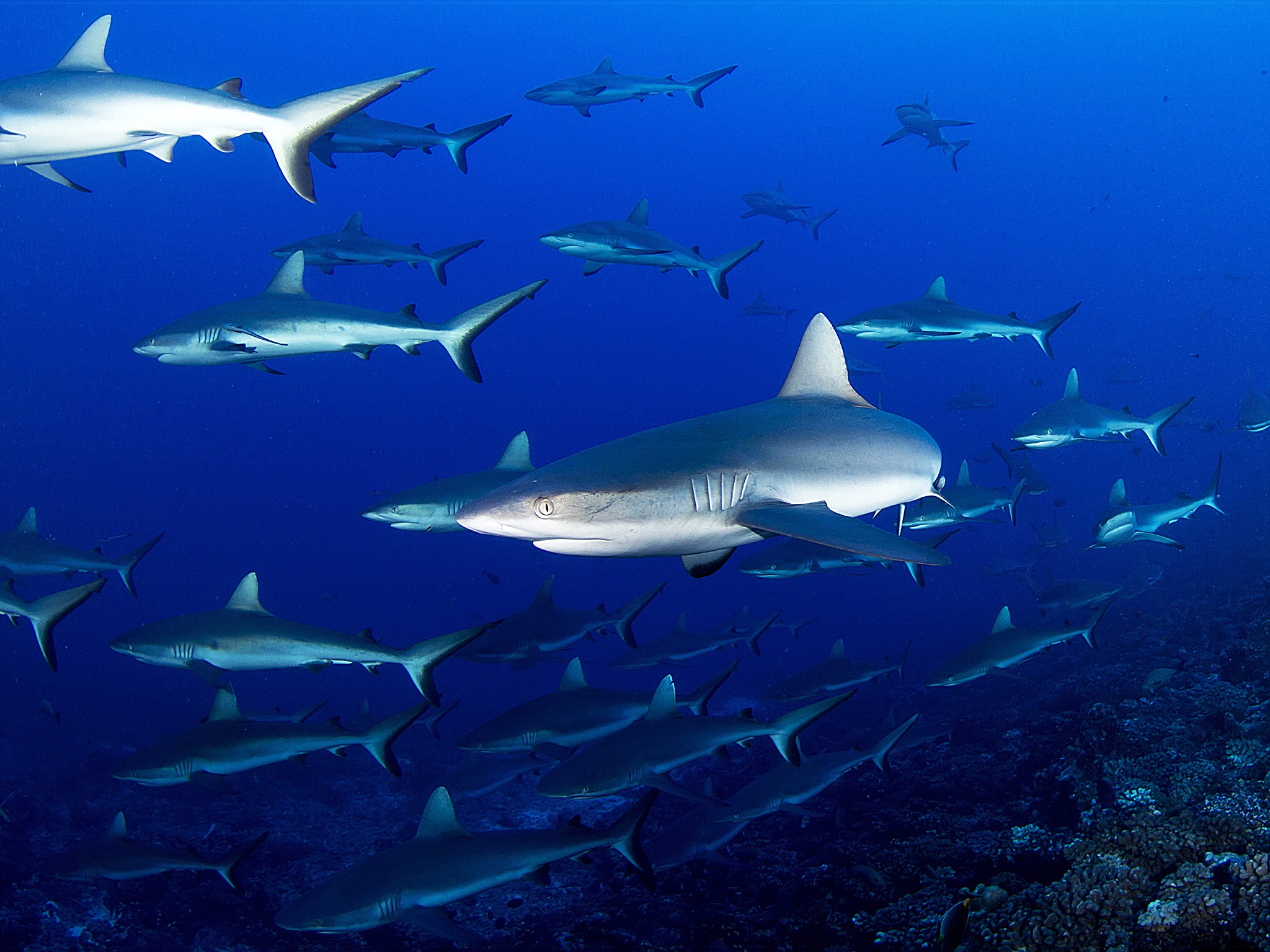
I was staying at Sané and Annabelle's epic Tetamanu Village and was fortunate to catch the magic moment when the sun reflects off the Sharks on an early morning incoming tide - and for you insiders, the first two clips are from the challenging trou aux requins in Apataki.

Notice how the Sharks are barely moving? 
They are literally surfing the current - and here's the according paper courtesy of Yannis, Johann, Serge, Charlie et al, inclusive of how they use a conveyor-belt positioning system to ensure that the groups remain stationary over the most advantageous spots.
Story here.
 
Enjoy! 
 

Wednesday, June 17, 2020

Kleptoparasitism in Sharks - Paper!

Click for detail!

Very nice!

Read this.
Following their epic dives in Tetamanu and the many experiments they have made, the team around Laurent Ballesta have published their observations about the interactions between the Grey and Whitetip Reefies when nailing that Grouper spawning aggregation.
Here's what Johann has posted.

Not surprised about the kleptoparasitism by the Grey Reefies
They are just that bit bigger and bolder than the other reefies, and will thus tend to dominate any competitive exchange, much like described in this paper from Osprey Reef.
And here in the Reserve, they will equally try to dominate the other reefies during the shallow feeds, something we try and counteract by hand feeding selectively so that the Blacktip and Whitetip Reefies always get their fair share.

Anyway, all really very interesting.
Enjoy!

Sunday, February 03, 2019

Reef Shark Science - the Compendium!

One of our protected Blacktip Reefies. Great pic by Allen!

Wow.

This is just simply brilliant.
Quite the erudite tour de force, and penned by some of the very best minds in the field, it recapitulates the current scientific insights about Reef Sharks, and  charts the way for future research.

No need for synopses as it is thankfully open source.
Just this: among a plethora of valuable information, it also addresses the topic of Reef Shark - mediated trophic cascades along with those infamous postulated inverted pyramids where I also discover this equally unequivocal statement in the cited literature. 
Long story short: both are nothing but breathy myths that need to be binned once-and-for-all! And yes, it's all very much q.e.d (!!!) - and no, I'm not going to repeat myself; instead, please do re-read the part about using spurious garbage when advocating conservation right here!

But I'm obviously digressing as always.
What I really wanted to say is that this is a great paper- and big kudos to the authors!

Required reading - enjoy!

Saturday, March 10, 2018

Gallivanting Tiger Sharks - new Paper!


Remember this post?
Sure you do! :)

Now, check this out.
Once again, this is evidence for the massive influence of environmental factors whereby both the coastal abundance and swimming performance of those migrating Tiger Sharks are being shown to be highest at ~22°C. Consequently, they track their optimal temperature and are thus more likely to be found in coastal areas in winter in the tropics; but towards temperate latitudes, they are more likely to be found in coastal areas in summer, see the figure at the top - and as climate change continues to heat up the oceans, those tracks are likely to shift poleward with according potential consequences for coastal communities, see the example of Sydney.

Very interesting!
Incidentally, this is very similar to what we are currently experiencing with our Bulls who have been shown to favor a temperature of ~26°C.
As the water temperature at Shark Reef has recently hovered around 29°C for a protracted period of time,  the number of especially the larger Bull Sharks has been appreciably lower - and whereas we don't dispose of any strong evidence, it is only fair to speculate that they may have retreated to greater depths or even absconded to places like Kadavu where the water temperature has been significantly lowered by Gita.

But I'm digressing as usual.
Great paper featuring numerous people I like and respect.
Enjoy!
 

Monday, January 15, 2018

Breaching OWTs - Paper!

GSD member Epic Diving - best operator to dive with OWTs. Source.

Very nice!

Read this!
It is obviously not only about breaching OWTs, but the breach it describes is totally spectacular - story here
Yannis and Yuuki are quickly establishing themselves as the gurus of small multi-use electronic packages that can be temporarily affixed to the Sharks in varying configurations, and are thus able to help find answers to the most diverse scientific questions.
Way to go Team Predator!

Like always, very impressed.
Kudos!
 

Thursday, November 23, 2017

Reef Shark Competition - Paper!

Reeftop hunters: Blacktip Reefies. Fantastic image by Tom!

And talking of those Reefies.

Here's another great paper.
Assuming I understand it correctly, it illustrates how Grey and Blacktip Reefies segregate spatially and are thus able to partition their habitat and consequently, its resources = prey. 
Whereas I've always believed that the Greys would always outcompete the Blacktips based on size and aggression, the paper conclusively illustrates how the segregation is based on the the fact that each species derives a competitive advantage by being better adapted to specific spatial niches, i.e. the forereef for the Greys and the backreef and lagoon for the Blacktips - incidentally, much like is being illustrated at Shark Reef!

Once again, I'm impressed by the scope and the rigor.
Well done Yannis and Co - and impressive lineup, too! :)

Required reading - enjoy!
 

Friday, October 20, 2017

Gombessa IV - The Science!

Source.

Remember?

So here is Johann's post.
Like I said, totally, utterly and ridiculously amazing!
And Yannis most certainly agrees.


Enjoy!
 

Thursday, July 20, 2017

Yannis!

Yannis is a member of Team Predator at FIU.

Great stuff.

This is one of the good guys.
And contrary to all those media whores in front and behind the camera who will be celebrating themselves on Shark Week, he actually does stuff, and this where it matters - and consequently, much of his research has a direct impact on Shark management and conservation.

Enjoy!


Tuesday, March 14, 2017

Reefies and SCUBA Divers - Paper!

Grey Reefies in Palmyra - source.

Nice!

Reefies and divers can co-exist!
Darcy and Yannis aka the intrepid slayers of the inverted pyramid myth have penned this nice paper where they show that frequent SCUBA diving does not appear to have any notable long-term effects on the behavior of the Reefies of Palmyra. I must say that I'm frankly not terribly surprised considering that a) particularly the Grey Reefies are feisty and generally show no problem approaching divers - this especially considering that b) those divers in Palmyra are mostly researchers who tend to behave themselves!
But nicely hypothesized and nicely tested!

And this is certainly true elsewhere and with other Sharks!
Like a very wise old man once said, it's not WHAT you do, it's HOW you do it! -  and provided that there's not too many divers, and provided that the divers behave in a respectful way, regular diving with Sharks in un-baited conditions is certainly possible, to wit those Shark aggregation hotspots like e.g. Cocos, the Galapagos, Tetamanu and Malapascua where the Sharks appear largely unfazed, or even, gasp, habituated to divers thanks to many years of responsible Shark viewing tourism!

But the contrary is also true. 
Cattle diving multi-user destinations like Ras Mohammad in Egypt or Richelieu Rock in Thailand that were once famous for their Shark encounters have largely lost their Sharks, and it is only fair to speculate that those Sharks have likely fled the masses and the continuous harassment and have relocated to more peaceful locations.

So folks, be nice to those Sharks, and enjoy!
And, do read the paper - story here!

Thursday, February 23, 2017

Inverted Trophic Pyramids? Not so fast!


Bingo - watch.


Those inverted trophic pyramids are bullshit.
Stories here and here: all excellent stuff so no need for synopses and interpretations.
Paper here - read it, it's open access!

Well what can I say.
First and foremost, bless Darcy and Yannis et al, very well done!

But I must also say that for me, this was a given anyway.
I've been a traveling diver for more than 40 years, and some of my friends for decades longer than that; and having once again asked some of those friends, and with the obvious exception of the known aggregation spots: none of us remembers anything even remotely resembling Sala's hypothesized Shark Eden - and lemme tell 'ya, we all have been to some locations that back then were mighty remote and mighty pristine and certainly not overfished!

Don't get me wrong here.
Back then, those reefs were teeming with life, with amazing coral, heaps upon heaps of fishes including numerous large predators among which Sharks, see e.g. here, meaning that the postulated biodiversity loss and the shifting baselines are more than real and cause for great concern - but again, even those absolutely magic spots were nothing like what Sala et al would have us believe!

Long story short?
Prima vista, not to worry.
Re-examining and possibly, falsifying previous scientific findings is quite normal and in fact, dissent is often how science and our knowledge progress.

But this is now a pattern.
Starting with the bloody numbers where some quarters continue to recklessly disregard the latest peer reviewed science (and no you fucking morons, you did not fucking "find" 80 million "missing" Sharks - you know who you are!); to the bloody tourism numbers (and here!); to the bloody oxygen BS; to the bloody exploding Cownose Rays; to all the bloody pseudoscience surrounding e.g the thorny issue of Shark strikes, or those Shark repellents, or Shark feeding, etc; to those bloody petitions - and now those bloody inverted pyramids: all-too-often all that spurious garbage is being commissioned, or outright invented by so-called Shark conservation circles, this sometimes in the misguided opinion that it may constitute good marketing for the "cause".

It is not.
It is just spurious garbage - and like I never cease to repeat, it is bad conservation as the truth will eventually emerge, incidentally often at great expense of resources that could have otherwise been invested in better undertakings. Plus, the reality is already so dire that there's absolutely no need for all that hyperbole!
Can we please stop with this shit and tell it as it is?

Which brings me straight over to this op ed - read it!
I can certainly see where Shelley is coming from. 
Near Threatened (by the conservation-friendly IUCN no less!) equals NOT Threatened, and from a formal standpoint, this outcome was most certainly based on breathy marketing and not fact, and as such the wrong decision - and we can only hope that it doesn't eventually end up biting us all in the arse!
Again, we really need to stop those shenanigans!

But having said that, 
I must confess that given my advocacy for a change of paradigms (and here), I applaud any Appendix II listing because of the mandated NDFs; and I certainly fervently believe the precautionary principle to very much be one of the tools of public policy = e.g. specifically when declaring Shark sanctuaries as stop gap measures pending the implementation of proper Shark fisheries management, especially in lesser developed countries!
But all-in-all, fully agree, especially about the demise of expertise - so well said!

But I'm digressing as usual.
Great paper and great op-ed - and should you have some spare time, you may also want to consult this syllabus about bullshit! :)

Enjoy!

Sunday, January 31, 2016

GWS hunting Strategies - Paper!

Marine Dynamics, serial enabler of good research! Source.

Very nice!

Check this out!
No need to write a synopsis as it is open source and also, because there are really nice ones here and here. Great to see that this is once again brilliant research that has been facilitated by Marine Dynamics, a proud member of Global Shark Diving!


And the take-away message of it all?
What once again strikes me, is how behavior is being mediated by the environment (= climate, geography, habitat but also occurrence and/or migration of prey etc) but also by factors like gender, age and of course, individuality - and this all within one and the same species! 
And yes I'm very much repeating myself!

Incidentally, that's what we very much experience here.
We basically conduct two types of feeding, i.e. by hand and from a suspended wheelie bin - and over the years, we have observed that each feeding modality has created its own Shark tribe, with only extremely few individuals switching from one source to the other. In fact, when we briefly discontinued hand feeding after the passing of Rusi, some of the hand feeders appear to have wandered away, only to slowly start coming back once regular hand feeding was resumed.
Maybe individual Sharks learn a preferred strategy early on and then continue favoring it as long as it works, which would also explain why some of the cage dive operators report that the same individual GWS appear to attack the teaser baits always in the same way.

But of course all is relative.
These are trends and not absolutes, meaning that in all likelihood, behavior happens along a continuum and very likely also evolves as prey wisen up and circumstances changes. Plus, Sharks with wide trophic niches are also likely to dispose of an equally wide array of predation strategies.

But I'm digressing as always.
Great paper, and well done to everybody involved!

Friday, June 12, 2015

Blacktip Reefies in Palmyra - Paper!

Blacktip Reefies in the SRMR - great pic by Allen, click for detail!

Nice!

This is great stuff.
By deploying some cutting-edge gizmos and then, engaging in meticulous data analysis, Yannis et al were able to show some rather surprising aspects of Blacktip Reef Shark diel cycles and predation. I for one have always assumed that they are typical diurnal hunters and definitely stand corrected.
Story here.

Great job, bravo!

Thursday, April 23, 2015

Endothermy and Performance - Paper!


Click for detail! Interestingly, Leatherback Turtles have a warmed body core and Swordfish, a rudimentary heat exchanger allowing them to reduce heat loss.
 
Nice!

Rad this.
Warm-blooded Fishes like Mackerel Sharks and Tuna perform better = swim faster and migrate further. Despite of the high cost of keeping one's temperature elevated, these species appear to derive a comparable advantage over ectothermic Fishes, and I cite.
In conclusion, our comparative analyses indicate that a potential ecological advantage of RM endothermy in fishes is the ability to cruise faster, which not only increases prey encounter rates, but also enables larger-scale annual migrations and greater access to seasonally available resources. We suggest that this advantage, coupled with the previously recognized benefit of thermal niche expansion, could outweigh high energetic costs incurred by RM endothermy and, thus, has facilitated the radiation and diversification of tunas and endothermic sharks. Our analyses also indicate that fishes with RM endothermy are similar to birds and mammals in many respects, including not only high metabolic rates and temperature dependence of muscle function, but also fast cruising speeds and the capabilities of large-scale migrations.
Story here and here.
Now you know! :)

Wednesday, March 04, 2015

Shark Diving Tourism - Paper!

Absolutely agree! 

Finally!

I say, this is as good as it gets!
After years of frustration at the various stupidities about our industry that have been proffered by an motley array of researchers and other bloviators with little personal experience but obvious agendas, here comes a paper written by people who being Shark divers have been there and done it, and obviously understand what they are talking about.
And... nice to see the frankly surprising cooperation! :)
Required reading!

The global code of conduct and scoring system?
Absolutely agree! 
Developing a meaningful code that is not too generic will be a huge challenge in view of the highly diverging circumstances in terms of legal framework, location, species etc. - but on top of the general statements (= e.g. don't harass), one could envision sub-categories (e.g. provisioned or not) that could lead to the necessary specificity. Plus, there will have to be considerable industry buy-in - so guys, talk to us!
And when it comes to the rating which I strongly advocate, the challenge will be to avoid the obvious issues of liability for the rating agency - but again, it can, and should be done.
And guess what - people are already working on both issues! :)

So, does this paper make me 100% happy?
Of course not! :)

Precautionary approach?
Like I continue to state, we've been enduring decades of unsubstantiated slander despite of having built one of the safest tourism activities anywhere - and I am really sick an tired of that.
Our track record speaks for itself and with that in mind, I do not at all buy into the recommendation that we need to adopt a precautionary approach on all those assumed potential risks pending more in-depth analysis by the intelligentsia.
E.g. Ben and Cristina have been hand feeding those Reefies for what feels like time immemorial, and this with zero documented side effects and owing to their protective gear, zero incidents. With that in mind, it makes zero sense for them to discontinue anything only because somebody proffers some hypothetical caveat - but at the same time, should somebody come up with hard evidence, I am equally convinced that Cristina would be the first to implement the necessary changes!
So once again - stop speculating but show me the fucking evidence instead!

Or the bloody ban of flash photography!
This stupidity has been the "mainstay" of sustainable Whale Shark snorkeling procedures, see e.g. here. Methinks it was likely once developed by some tree hugging do-gooder and then simply copy/pasted uncritically, and it has been my pet hate ever since. 
I mean, seriously: eye trauma? How does the intensity of an electronic strobe compare to those gasquillions of bursts of UV-saturated sunlight that are hitting the eyes of a WS when it basks at the surface? 

And no - regulation is the very last resort!

But yes I'm digressing.
Not 100% happy - but 99.5% I am!
This is spot-on both in scope and content, and I cannot but applaud the authors for an exhaustive, thorough, unbiased and what is more important, accurate analysis of the issues at hand.

Bravo - job well done!
Thursday, July 31, 2014

Spatial Behavior in Elasmobranchs - Papers!

OCEARCH tracks in SA - so far, highly ambiguous!

Interesting!

I've been remiss in not posting about several new papers.

This one by, among others, (the proudly left-brained, and obstinate) Michelle Wcisel, describes the movements of GWS in the Dyer Island and Geyser Rock system near Gansbaai and observes that they differ substantially from the GWS movements in Mossel Bay. As a possible explanation, it observes that the former Sharks are largely sub-adult to adult (= seasonal hunters of Mammals ) whereas the Mossel Bay Sharks are predominantly juveniles that feed predominantly on bony Fishes and Cephalopods.
Offical synopsis and great infographic here.

This one examines the abundance and sexual composition of GWS in Gansbaai in relation to the season and ENSO, and comes to the conclusion that females appear to favor warmer water whereas males do the opposite, possibly owing to competitive exclusion by the larger female conspecifics.

And this one by, among others, Tiger Shark supremo Yannis Papastamatiou describes the movement patterns of Reef Mantas at Palmyra Atoll with its two immediately adjacent lagoons. Whereas most Mantas in one lagoon alternate between lagoonal and offshore habitats, those in the other lagoon appear to be much more resident, possibly owing to the different hydrology and/or capacity of the lagoons to provide for adequate nourishment.

And the take-away message of it all?
What once again strikes me in all those papers, is how behavior is being mediated by the environment (= climate, geography, habitat but also occurrence and/or migration of prey etc) but also by factors like gender, age and of course, individuality - and this all within one and the same species!
And if Michelle and Yannis can show significant variance across the smallest of geographical areas, and this within one single population - isn't it only logical to expect even bigger differences between distinct populations that are completely separated both genetically and geographically?

Definitely a big yes for Tiger Sharks - and the GWS?
Even discounting the Fischer factor, it seems to me that all those many comments about those tagged GWS are tacitly assuming that all GWS must necessarily follow a life cycle that is analogous, if not identical to what has been documented by Domeier for the Guadalupe population.
But with the above in mind, is that even plausible?

Take the Atlantic.
Its hydrology (think: Gulf Stream), climate and fauna are very different from that of the Eastern Pacific. Other large Sharks like Great Hammers and Tigers have been shown to migrate smack into the middle of the Atlantic, quite possibly following prey - so why not some of those GWS. Other, possibly younger GWS could be following the Bluefin into the Gulf. Consequently, the overall picture is much more ambiguous - incidentally, much like in South Africa with its ENSO-mediated interplay between the Benguela and the Agulhas!

Australia?
There are two genetically distinct GWS populations that both migrate to the Neptunes where they intermingle as they prey on Pinnipeds - meaning that barring the discovery of some highly sophisticated reproductive isolation mechanism, one would have to assume that they mate completely elsewhere. And if so, this would be very different from what is being postulated for Lupe where the Pinniped colony appears to act as a focal point for mating!

Or the Mediterannean GWS.
Much more restricted habitat and quasi absence of Pinnipeds owing to the extirpation of the Monk Seal - surely this must have big effects on both their diet and migration!

Long story short?
We should really refrain from resorting to those very broad generalizations when describing the behavior of those different Sharks. Instead, let's stick to the evidence that keeps reminding us that things are complicated!

Agree?

Sunday, September 08, 2013

Tiger Shark Migrations - it's complicated!

This is Adi.

Very interesting!

Check out this latest paper by Yannis Papastamatiou!
It's quite complex and you can find excellent synopses here, here and here. Quite understandably, those articles focus on the immediate practical implications, i.e. the possible correlation between some of those migrations and the higher risk of Shark strikes in the principal Hawaiian islands during the same period.

But that's not all.
Having read the whole paper, my take-away message is that the reality is far more differentiated as there appears to be great individual behavioral plasticity. Like our Bulls, some of those Tigers are more resident and some, more transient; and the purpose of those inter-island migrations appears to be twofold, i.e. seasonal pupping but also foraging, with the latter highly dependent on external factors like water temperature and chlorophyll concentration = likely availability of prey.
This is a great follow-up on the research by Meyer et al about those Tiger Shark movements and the subsequent papers about cognitive maps by both Meyer and Papastamatiou, explained here.
Fascinating stuff, and kudos to the authors for having collected this impressive body of evidence!

But is this the whole story?
For Hawaii, the answer is quite possibly yes.
But in other locations, those movements may be identical in principle (= due to foraging and reproduction) but different in practice, and I cite.
Tiger sharks (Galeocerdo cuvier) are large (maximum size 5.5 m) generalist foragers, which may function as keystone predators in some areas (Lowe et al. 1996, Heithaus et al. 2009). 

In high latitude locations such as Australia, tiger sharks demonstrate seasonal utilization of bays within larger home ranges, with water temperature being a likely driver of seasonal habitat use (Heithaus et al. 2007, Wirsing et al. 2007). 

However, within tropical areas with milder seasonal changes in environmental characteristics, tiger shark movements appear more ambiguous (e.g. Meyer et al. 2009a). 
Within the Hawaiian archipelago individual tiger sharks will frequently swim between islands of the chain using straight directed walks, although their movements lack any clear overall pattern, seasonal or otherwise (Meyer et al. 2009a, 2010, Papastamatiou et al. 2011). The exception appears to be remote French Frigate Shoals atoll (FFS) where some individual tiger sharks seasonally aggregate to take advantage of fledgling albatross chicks, although other individuals appear to remain at FFS year round (Lowe et al. 2006, Meyer et al. 2010).
Hence, tiger sharks have somewhat unique spatial ecology in that they demonstrate home ranging behavior over large spatial and temporal scales and perform both seasonal/directed and more aseasonal/ambiguous movements within this home range.
In brief, geographical location may have a huge influence.
In fact in places with large temperature swings like Florida and the Bahamas, Guy's and Neil's research shows that those Tigers engage in huge seasonal migrations smack into the middle of the Atlantic (possibly following equally migratory prey?) whereas in tropical Australia where the temperature swings are not so big, the migration activity is indeed much more ambiguous

And in Fiji? 
Dunno - but my hunch is that due to the big difference in our seasons, they would be behaving more like the Atlantic ones, however possibly with large yearly variations due to the ENSO!

Anyway, great stuff!
And with Domeier and Meyer having started a new Tiger Shark research cycle in Hawaii where they will deploy modern SPOT tags that will deliver multi-year tracks, we may be in for further surprises!

To be continued no doubt!

Friday, December 21, 2012

Carl Meyer - thank you!

Carl Meyer and Yannis Papastamatiou from the University of Hawaii at Manoa. Source.

This is as good as it gets.
Another issue which has generated a lot of heat here in Hawaii and elsewhere is shark cage diving ecotourism. 
These activities have proven hugely controversial
We’ve done a fair bit of work on the one here on Oahu, including a meta analysis of logbook data and tracking long-term movements of sharks captured at the cage diving sites -
the takeaway message is that there’s absolutely no scientific evidence whatsoever that the existing operations off Oahu are a threat to public safety, which has been people’s major concern.
Full interview here.
It's a great read that touches on many sometimes controversial topics and is garnished with many useful links - much too exhaustive and also, much to good to be synthesized in an abbreviated synopsis.

Once again - required reading!
Enjoy!

Tuesday, August 17, 2010

Sharks are People just like you and me!


Talking of Tiger Sharks.

Here's a recent paper from Hawaii.
It once again contributes very interesting insight into how Tiger Sharks forage for food.
If I understand it correctly, it tells us that the behavior of every single individual Tiger Shark is different, a fact that we Shark divers have known all along.

Tiger Sharks are long lived and are obviously (and unsurprisingly) able to learn from their personal experiences.
And when it comes to how and where to they travel, they appear to be able to remember information about any good feeding grounds they may have chanced upon during their previous walkabouts. Having stored both a sort of map and also a time frame, they are then able to replicate the experience by turning up again at the right place at the right time, as witnessed by the Tigers that prey on the Albatross chicks in Midway.
This information is strictly personal and is not being passed on among individuals or through the generations, meaning that there are individuals who travel a lot between food sources whereas others engage in a much more localized and quasi-territorial life cycle. This could be a mechanism by which Tiger Sharks may be able to handle intra-specific competition by focusing on different prey items.

From the paper - abridged for excerpts concerning Tiger Sharks, italics are mine.

A multiple instrument approach to quantifying the movement patterns and habitat use of tiger (Galeocerdo cuvier) and Galapagos sharks (Carcharhinus galapagensis) at French Frigate Shoals, Hawaii
Carl G. Meyer, Yannis P. Papastamatiou and Kim N. Holland


Abstract


We equipped individual tiger (Galeocerdo cuvier Péron and Lesueur, 1822) and Galapagos (Carcharhinus galapagensis Snodgrass and Heller, 1905) sharks with both acoustic and satellite transmitters to quantify their long-term movements in the Papahanaumokuakea Marine National Monument (Northwestern Hawaiian Islands).

Tiger sharks exhibited two broad patterns of behavior.
Some individuals were detected at French Frigate Shoals (FFS) year round, whereas others visited FFS atoll in summer to forage on fledging albatross, then swam thousands of kilometers along the Hawaiian chain, or out into open ocean to the North Pacific transition zone chlorophyll front, before returning to FFS in subsequent years.

These patterns suggest
tiger sharks may use cognitive maps to navigate between distant foraging areas.
Different patterns of spatial behavior may arise because cognitive maps are built up through individual exploration, and each tiger shark learns a unique combination of foraging sites.
Results show reef-associated sharks utilize a wide variety of habitats ranging from shallow atoll lagoons to deep reefs and open ocean and may provide important trophic links between these habitats.

Discussion

Previous studies have shown tiger sharks alternate between wide-ranging behavior and more restricted movements and use a broad variety of habitats ranging from shallow coral reefs to open ocean (Polovina and Lau 1993; Holland et al.1999; Meyer et al. 2009a).
In this study, we used a multiple instrument approach to determine how these behaviors and habitats are linked for individual sharks over multi-year time scales.

For example, distinctive clusters of acoustic detections at East Island indicate some tiger sharks (e.g. TS4 and TS5) visited FFS for several weeks in summer to forage on fledging albatross and left when this prey resource ran out.
A combination of satellite and acoustic telemetry revealed these sharks then swam thousands of kilometers along the Hawaiian chain, or out into open ocean, before returning to FFS in subsequent years.
SPOT tracks suggest several tiger sharks navigated between distant patches of high resource availability. For example, TS3 and TS5 made highly directional movements between a succession of submerged banks and seamounts located between FFS and Pearl and Hermes Reef.

This behavior indicates these sharks knew the locations of the bathymetric features from previous experience and were navigating between them.
Tiger shark movements became more localized
around these features, and although we do not know whether foraging occurred at these sites, seamounts are often hotspots of resource availability (e.g., Rogers 1993). Open ocean SPOT detections of TS4 in late fall 2006 were associated with the transition zone chlorophyll front (TZCF), an area of high productivity and important oceanic foraging habitat for apex predators (Polovina et al. 2001).

Long-term, reciprocal movements between distant locations suggest
tiger sharks possess detailed cognitive maps of resource availability.
The precise, seasonal arrival of certain tiger sharks at FFS in time for albatross fledging indicates these sharks may also use internal clocks to guide their movements (Olding-Smee and Braithwaite 2003).

Unlike mammalian apex predators such as bears (Gilbert 1999),
there is no evidence of social transmission of foraging traditions in sharks, hence locations of good foraging areas must be uniquely learned by each individual.
Tiger shark movements presumably include some element of exploration enabling them to discover new foraging locations (Meyer et al. 2009a). Sharks are long-lived animals which, over time, could build up detailed spatio-temporal maps of productive prey patches.


In contrast to tiger sharks TS3, TS4 and TS5 which were only present at FFS for short periods, tiger sharks TS1 and TS2 were detected at FFS at all times of the year and showed more extensive use of shallow lagoon habitats.
Similar inter-individual variability in long-term movement patterns has been previously described in tiger sharks in the Main Hawaiian Islands (Meyer et al. 2009a). These different patterns of behavior could result from unique individual learning experiences (i.e. each shark learns to exploit a different combination of prey patches) and serve as a mechanism for intraspecic resource partitioning, giving rise to prey specialization.

Albatross fledgling predation at FFS provides strong evidence of prey specialization in tiger sharks.
This directly observable phenomenon produces a characteristic cluster pattern of acoustic detections of tagged sharks at fledging sites. Our results indicate a subset of tiger sharks present at FFS during summer intensively target these fledging birds (e.g. TS4 and TS5), while others (e.g. TS1 and TS2) apparently do not. Thus, although overall this species has a very varied diet, this may be due to the contributions of many individuals each focusing on a narrower range of prey (e.g. Tinker et al. 2008).

The ability to directly observe tiger sharks feeding on albatross fledglings at FFS enabled us to interpret the tight clusters of tiger shark detections recorded at albatross nesting habitats during fledging season.
In most other cases, direct observations of foraging are not possible, but determining when and where sharks are feeding is essential for advancing our understanding of their ecology.

The timing and location of other ecologically important behaviors such as mating are also completely unknown for most shark species.
Future studies could shed light on shark
feeding and mating by combining instruments which tell us about spatial behavior with other devices which directly measure feeding or inter-animal interactions (e.g. Papastamatiou et al. 2008; Holland et al. 2009).

Which of course appears very pertinent to what we see here in Fiji - not so much in our Tigers but very much in our Bulls!
We now keep track of close to 100 named individuals and many of them, like Whitenose, Crook, Bum and Hook, have been around ever since I started to keep tabs in 2003 - and I can tell you that we know each other very well, all the way to knowing the peculiar behavioral traits of every single individual Shark - and undoubtedly, vice versa!

Over time, we've learned that there is a clear differentiation between those individuals which we call regulars and who are extremely well acquainted with our routine and thus highly predictable (Bum for instance always takes 3 heads back-to-back), and others that are much more transient, turn up at irregular intervals and are much more difficult to handle.
And then, there's the rather stunning case of Long John that we've named after crippled Long John Silver of Treasure Island 7 years ago: he inevitably skips the first half of the year but then turns up exactly between July 25 and August 3 and stays until December! And after all these years, he never takes food from the feeders!
Go wonder!

Surely, we must be witnessing the same cognitive faculties!
Long John is of course an extreme example, but just think of the females that all come back in January after having gone to the rivers to give birth: they all very obviously remember the location of Shark Reef and also, the required etiquette - and we hope that they don't only do it for the food, but because they like us, too!

But whatever the ultimate explanation, and yes I'm undoubtedly speculating as usual - isn't this just fascinating stuff!