Showing posts with label Johann Mourier. Show all posts

Friday, June 18, 2021

Surfing Reefies - Paper!

Source
.
 
Very cool.
But first, watch.


This is DV footage from 2005, from an old edit.
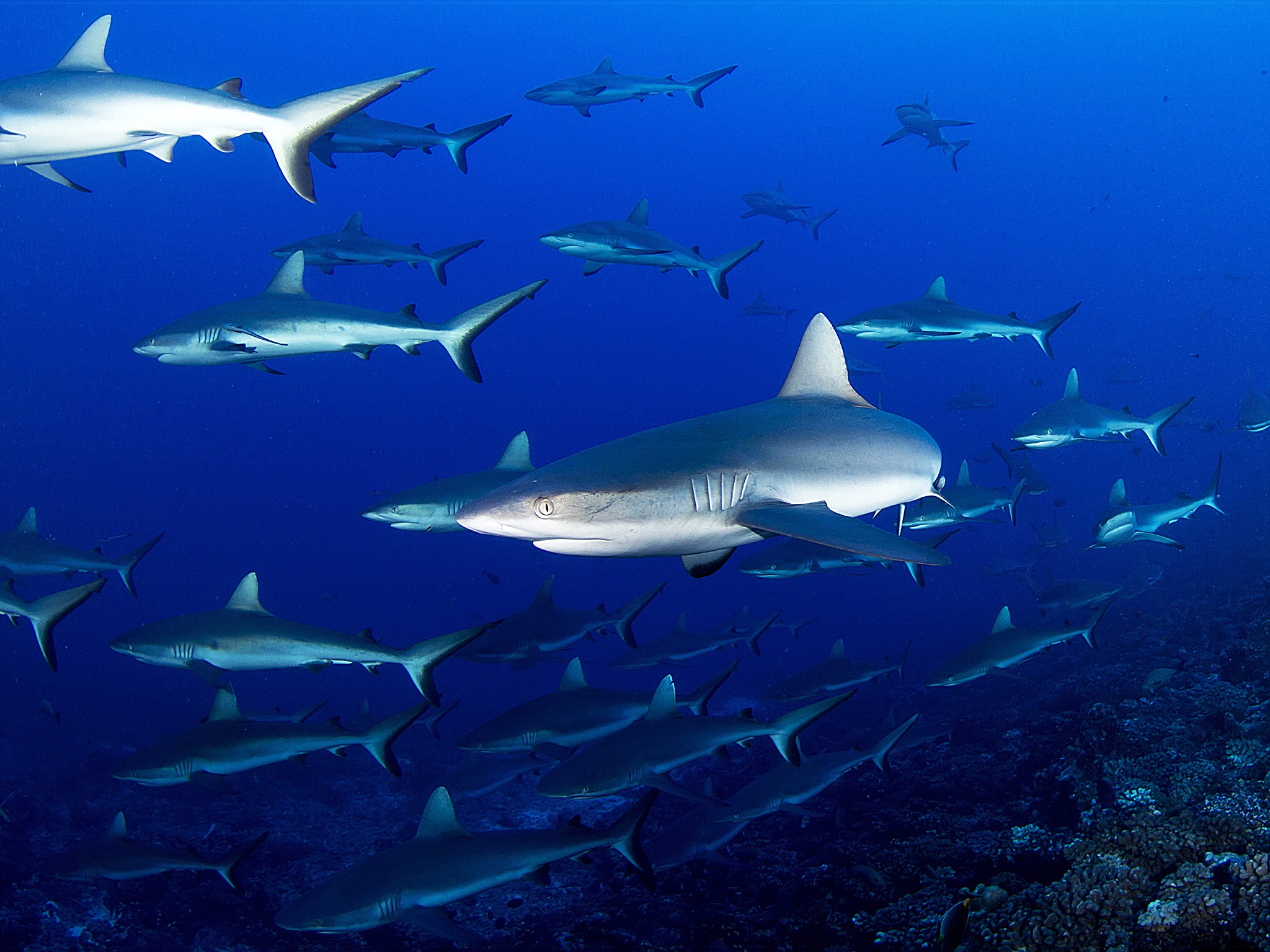
I was staying at Sané and Annabelle's epic Tetamanu Village and was fortunate to catch the magic moment when the sun reflects off the Sharks on an early morning incoming tide - and for you insiders, the first two clips are from the challenging trou aux requins in Apataki.

Notice how the Sharks are barely moving? 
They are literally surfing the current - and here's the according paper courtesy of Yannis, Johann, Serge, Charlie et al, inclusive of how they use a conveyor-belt positioning system to ensure that the groups remain stationary over the most advantageous spots.
Story here.
 
Enjoy! 
 

Wednesday, June 17, 2020

Kleptoparasitism in Sharks - Paper!

Click for detail!

Very nice!

Read this.
Following their epic dives in Tetamanu and the many experiments they have made, the team around Laurent Ballesta have published their observations about the interactions between the Grey and Whitetip Reefies when nailing that Grouper spawning aggregation.
Here's what Johann has posted.

Not surprised about the kleptoparasitism by the Grey Reefies
They are just that bit bigger and bolder than the other reefies, and will thus tend to dominate any competitive exchange, much like described in this paper from Osprey Reef.
And here in the Reserve, they will equally try to dominate the other reefies during the shallow feeds, something we try and counteract by hand feeding selectively so that the Blacktip and Whitetip Reefies always get their fair share.

Anyway, all really very interesting.
Enjoy!

Tuesday, October 29, 2019

GWS Clans at the Neptune Islands - Paper!


Very interesting!

Check this out.
Press release here, stories e.g. here and here.
In brief and assuming I understand this correctly, those GWS don't turn up randomly but appear to favor (and hence possibly travel with) determined buddies and even form distinct groups that appear to persist for years. Nice to see Johann, Charlie and Andrew among the authors, and kudos to GSD member Rodney Fox Shark Expeditions for having enabled yet another stellar paper - and incidentally, congrats for the great new boat

And here in Fiji?

Remember Mike's totally speculative hypothesis?
That was obviously several years ago, and today we know quite a bit more. Specifically, we have learned that although our dive has minor local impacts, effects at the ecosystem level remain negligible as our Bulls continue to roam and do neither get conditioned to coming ever more frequently, let alone residing here or changing their migrations or mating cycles, etc; nor do they in any way become dependent on our handouts - tho I was certainly wrong when speculating about the nutritional value of the Tuna heads! But be it as it may, the restaurant analogy remains fully confirmed.

And the part about the Bulls likely being solitary?
I still believe that in the case of those large reef-dwelling Sharks, and barring any cooperative hunting for which we have zero evidence, evolution would have selected against traveling with, and thus having to compete and/or possibly even share meals with conspecifics.

But then again, who am I to say.
I can't divulge too much - but I can say that 10 years after that post, we are finally about to reveal some conclusive evidence!
Fiji Time anybody? You betcha! :)

So keep watching this space.
To be continued!

Saturday, March 31, 2018

Social Interactions of Sicklefin Lemon Sharks - Paper!

Click for detail!

Very nice!

Check this out.
It describes the behavior of Sicklefin Lemons at two provisioning sites in French Polynesia.
And assuming I understand the paper correctly, the observations coincide to a large degree with what we observe here with our Bulls, i.e. that these largely solitary animals develop a rudimentary etiquette when they aggregate at a provisioning site (and possibly equally at some communal feeding event like a Whale carcass) whereby a) dominance is not necessarily determined only by size and sex but rather, also by individual boldness; b) when there are many Sharks, some particularly dominant individuals react to the  increased competition by monopolizing the food source i.e. the bait cage and in our case, the suspended bin; c) as time goes by, "regular" Sharks appear to become more tolerant vis-a-vis other "regular" individuals of the same species whom they appear to recognize and d) the Sharks appear to tolerate conspecifics with equal ranking but tend to avoid more dominant individuals.
French synopsis here!

I really like it,  and the way they did collect the evidence.
We actually had a masters student do something similar a few years back with the Reefies - but it would be really cool if we were able to replicate this with our Bull Sharks that are our real focal species! The problem is the suspended vertical video camera as per the image at the top, as the rig would be unsightly for the tourists and above all, it would likely be eaten in no time - but I'm sure that we'll figure something out!

With that in mind, keep watching this space!
Enjoy the paper!

Friday, October 20, 2017

Gombessa IV - The Science!

Source.

Remember?

So here is Johann's post.
Like I said, totally, utterly and ridiculously amazing!
And Yannis most certainly agrees.


Enjoy!
 

Sunday, July 31, 2016

Fakarava - Inverted Trophic Pyramid?

Bingo!

Remember Michael Domeier's comment to this post?
Turns out that the man was prescient - and this literally: being one of the authors, he undoubtedly knew that this was coming!
Watch.


The paper is here - read it!
And here and here are some synopses - and since I find them partially misleading, here's what I understand.
  • Fakarava Atoll has two main passes, Garuae in the North and Tetamanu, where this research happened, in the South.
    Like in other atolls in the Tuamotu archipelago like e.g. the spectacular trou au requins in the pass of Apataki, they are home to aggregations of resident (and semi-resident) Grey Reefie comprising, if memory serves me right, adult females and numerous juveniles/subadults of both sexes. The passes are great Reef Shark habitat because the Sharks can remain quasi-stationary by lazily riding the currents whilst engaging in ram ventilation, and because especially Tetamanu with its comparatively mild currents supports a good numbers of resident Fishes and acts as a migratory corridor for other prey species that regularly enter and leave the lagoon in line with the tides and the seasons.

  • Yet, the researchers postulate that since the pyramid of productivity inside of Tetamanu is inverted, the available prey biomass would not be sufficient to sustain even only the local population of highly resident Sharks. This means that in order for the Sharks to be able to reside there without having to forage farther afield, their food/energy requirements would somehow need to be subsidized.

  • That subsidy happens over several months during the Austral Winter.
    Then, huge numbers of several species of bony Fish successively aggregate in the passes in order to spawn = in essence, as the prey representing the productivity of the adjacent lagoon travels to the Sharks, the Sharks don't have to travel to the prey.
    This opportunity attracts the majority of transient Reefies (= likely the adult males) along with the less resident ones, meaning that the Grey Reef concentration in Tetamanu nearly triples. Still, during that time, the biomass of prey is vastly larger than that of the Sharks and all Sharks have ample opportunities to feed.

  • Once the spawning season is over and water temperatures, and consequently, the Sharks' metabolic requirements increase, the Reefies gradually disperse again, and residency at Tetamanu decreases as even the highly resident individuals are forced to sometimes roam in search of prey.
My takeaway?
  • There is no inverted trophic pyramid in Fakarava Atoll.
    Yes in the passes there are local Shark aggregations and because of that, the trophic pyramid is locally skewed -  but just like in the case of Sala's remote islands, there are external subsidies and the Sharks also roam, meaning that the relevant area one has to consider is far, far larger than the mere area of the passes. And over that whole area that comprises the lagoons but also the outer slopes, the pyramid is clearly normal as the biomass of Sharks is orders of magnitude smaller than that of lower trophic levels.
    Incidentally, that's not that dissimilar from our feed on Shark Reef where the astounding temporary predator biomass is in no way representative for the trophic pyramid of Beqa Lagoon let alone the whole of Fiji!

  • For me, these latest findings mean that until somebody comes up with solid evidence in line with the data collected by Johann et al, I will continue to call BS on Sala's hypothesis of there being inverted trophic pyramids on pristine reefs!
Enjoy Johann's paper!
 

Saturday, December 26, 2015

Healing in Sharks - Paper!

Click for detail!

Love it!

Check out this new paper.
Much like we continue to document the miraculous healing power of our Bulls, the authors describe the same faculties in Blacktip Reefies, often equally through observations in the field.
Very nice!

And I like the part about releasing hooked animals!
Our Sharks regularly steal bait and fish from the local fishermen, and we get to see countless individuals sporting hooks, with and without lines; and with the notable exception of Pointer that got hooked in the throat and had a rope trailing from her gills for several years, we could not discern any notable reduction in the Sharks' fitness, with all hooks disappearing within weeks to as couple of months.
With that in mind and considering the substantial fragility of some species, I totally agree that it's probably best to forego hook removal in favor of minimizing handling time and thus potentially lethal stress for the animals, and that all unwanted Sharks should be released even if mechanically injured.

Anyway, very well done indeed.
Enjoy the paper!

Sunday, November 01, 2015

Feeding Sharks and Rays - Paper!

One of the many stupidities found here!

Johann alerts me to this new paper.
It comes to the conclusion that ecologically, provisioning can have effects at the individual, group and population level, and that those effects are generally neutral to negative.

Well what can I say - probably that's true!
It just so happens that every single one of the authors is a pal of mine - and because I know them, I also suspect that on top of the science that is probably pretty much irrefutable, the paper also has a political agenda, and that is, to obliquely address the mess that is Shark diving in French Polynesia, see the link at the top.

Now don't get me wrong here.
Shark diving in French Polynesia is nothing short of stellar.
But when it comes to the feeding dives, most local moniteurs appear to believe that they're god's gift to Shark diving, meaning that they are entirely impervious to accepting even the most common-sense advice (steel mesh gloves anybody?) - and as a consequence, bites are rife. So far, most of the accidents did involve the comparatively harmless reefies - but now that everybody and his dog is flocking to the new, completely unregulated and multi-user Tiger Shark dive just outside of Papeete, the risk profile has risen astronomically and once again, it's really only a matter of time til things will end up in tears. Same-same for the stupid idea of having snorkeling tourists hand feed the small reefies - seriously, WTF?
It's same old same old, so I'm really not gonna dwell, the more as having been there, the discourse is way too ego-driven and frankly leads to nowhere, meaning that the situation appears pretty much hopeless unless the regulator decides to finally regulate.
Hint hint! :)

But I'm digressing.
I can't really say that I love the paper because its conclusions are pretty much obvious, and because it does not really address the principal cause of most of the enumerated problems = bad procedures. As an example, the much-cited disaster at Stringray City is entirely the consequence of piss-poor management and regulations!

Anyway - worth reading!
My take-away: better procedures and more research into those possibly negative effects - pretty much done on the former (tho always learning and always adapting!), and very much working on the latter, so keep watching this space!

And one last thought if I may.
The problem is not Shark diving - not for the animals and not for the people.
Compared to the overfishing and the habitat degradation, the inconvenience caused by the industry is nothing. And yes there have been many, mostly accidental bites - but as far as I know, during literally innumerable provisioned Shark dives, there has been a grand total of ONE documented fatality. Compare that to the same time spent engaging in ordinary SCUBA and ask yourself the question, which is by far the safer activity? 

Just sayin'!
So, lets please keep things in perspective - and let's also never forget to always mention the industry's enormous contribution to both conservation and research that outweighs any of those possible minor deleterious effects by far!
 

Tuesday, April 21, 2015

Blacktip Reefies vs Surgeonfish!


Love love love this kind of stuff!

Story here - PDF here.
Here in Fiji we may be possibly witnessing something similar - at least, that is our working hypothesis although we're still debating about how to test it. Maybe you remember this paper, and this picture.


It is an old graph of Bull Shark sightings.
In essence, it shows how the Bulls disappear at year end for pupping and mating, and how they then return for the Running of the Bulls in late December/January.

But there's also another detail - see it?
Every March/April, an this usually around the Full Moon, we get a notable temporary dip in the number of Bull Sharks. Our hypothesis is that they are being drawn away by some event that is likely linked to predation - and it just so happens that many Fishes like incidentally those Surgeonfish form spawning aggregations around the Full Moon, this because the associated strong tides favor maximum dispersion of the fertilized eggs. 
Obviously, so far, this is only a correlation and thus merely speculative - but it is a testable hypothesis and if certain things come to pass like we plan them to, we may soon be nearer to solving that riddle!
So keep watching this space! :)

Anway, real interesting observation from Moorea.
Nice job Ornella, Johann and Serge

Tuesday, March 24, 2015

Johann about Shark Provisioning!


But first.
Mike did not set up BAD but only became a shareholder later, after bailing them out following a shareholder dispute. And Mike did not set up the Shark dive on Shark Reef.
 
The dive was already in existence but the site was not protected.
Mike mediated the talks between the Fijian government and the village of Galoa that led to the establishment the SRMR, a locally managed MPA, and where BAD were simultaneously appointed as trustees and the only dive op allowed to conduct baited Shark dives there.
Last year, the SRMR was then designated Fiji's first National Marine Park.

Also, Rusi and Manasa are not BAD's only Shark feeders.
They are the original feeders but since then, we've trained several new feeders among which Rusi's son Mavoa and Manasa's son Tumbee.
But the gist of the story is correct! :)

But I'm digressing.
Johann is an experienced Shark diver and knows what he's talking about. Of course there are localized effects but the principal statement as I see it is
Si l'activité est bien gérée et j'insiste, si elle est bien gérée, il n'y a pas de risques majeurs pour l'homme.
Echoed by Rick who correctly states
Hand feeding data from the studies that have been done do not show any long-term changes in behavior. There are temporal changes in activity around feeding, but after feeding sharks appear to go back to biz as usual. I'm not an apologist for shark feeding... I remain skeptical as well. But the data to date does not appear to indicate negative behavior change IF STRINGENT PROTOCOLS ARE FOLLOWED.
Indeed!
As people are regularly and painfully reminded of, it's not WHAT you do, it's HOW you do it!
And I repeat my assertion that Shark dives may well be safer than normal dives, this because we in the industry know of the risks and are extra vigilant!

Anyway.
Bravo Johann, nice job! :)

Tuesday, February 17, 2015

Johann - counting Sharks in Moorea, and a new Paper!


Nice article!

This is quite obviously something we need to explore.
We do keep a census of our Blacktips and Whitetips at the 4m feeding station but it may be interesting to compare that with an aerial survey (see some of those Sharks in the drone footage here!) and also test our hypothesis that when the tide is very low, the Blacktips retire to the back of the reef.
So much to do so little time! :)

And there's this new paper!
I found the abstract an absolute abomination of technical hieroglyphic gibberish, and said so - but it really does appear that some aspects of science remain reserved for the initiated only, as even Johann's "popularization" remains rather obscure, at least to me.
I guess the whole exercise was aimed at finding out how fast those neonate Sharks evolve from drawing energy from reserves that have been provided by their parents (in this case = from the yolk sac and later, via the placenta) and are being stored in the liver and fatty tissue, to feeding independently. And later, the same analysis could shed light on shifts in diet as they progress from neonates to juveniles to subadults to adults.
And I gather that the paper comes to the conclusion that a) those shifts happen and that b) there are, unsurprisingly, differences among species, locations and even individuals.

Or maybe I didn't understand anything at all!
Johann? :)
 

Friday, August 16, 2013

Moorea Lemons - one more Piece of the Puzzle!

 (A) Map of the study location. (B) The genetic network of adult lemon sharks. Each individual is indicated by a node labelled by shark ID. Circles and squares indicate females and males respectively and symbol size is indicative of the body length of the shark. Node colour corresponds to the three defined residency groups. Dyads sharing a first-order genetic relationship are connected by a line, with line thickness indicating the strength of the genetic relationship (proportional to R values). (C) Genetic degree (number of first-order genetic relationships an individual has) distribution within the population - click for detail!

Very nice!

I was somewhat underwhelmed, and said so - which led to a personal visit by the very charming Eric Clua, and to a real interesting ongoing dialogue with Johann Mourier. And despite of a toothy (!) public debate between Juerg and Jon and the authors, everybody remains on best terms and is eager to share and discuss. That's how science advances and as Eric stated, everybody agrees that nous jouons dans la mĂªme Ă©quipe and that everybody profits by sharing ideas and engaging in spirited discussions.

And here is strike two - read it!
The feeding paper did raise the concern that the observed increased residency of some Lemons might lead to increased inbreeding - and from what I understand, this paper comes to the conclusion that it probably does not.
Whereas there are only about two dozen resident adult Lemons in Moorea, the species has evolved patterns to mitigate the according risk of inbreeding insofar as the Sharks will travel to both mate and pup (= migration), and that some individuals will travel to take residence in other islands (= dispersal), all of which is conducive to gene flow. Having said that, the degree of inbreeding of the Lemons in French Polynesia remains never the less relatively high, this likely due to small overall numbers and the relatively high isolation between islands and between archipelagos.

And the take away message after this rather epic 5y investigation?
I believe it boils down to this - and I trust that Johann will correct me if not.
  • Like Juerg's Fiji paper, it once again confirms that provisioned Sharks appear to disperse normally, or as Juerg puts it, that
    Chumming and food provisioning are unlikely to fundamentally change movement patterns at large spatial and temporal scales, and seem to only have a minor impact on the behaviour of large predatory sharks; hence, the creation of behavioural effects at the ecosystem level seems unlikely.
    Obviously, this is the one aspect I'm most concerned about - and I sure hope that Johann will agree with this conclusion!
  • That said, Lemons are not Bulls and French Polynesia is not Fiji.
    There remain some local effects that are a possible cause for concern, foremost of which the observed increased residency that could eventually result in lower numbers of Lemons dispersing which in this generally small population might have a significant negative effect on gene flow and thus the fitness of that local population.
  • The second possibly negative effect is the observed increased aggression.
    I continue to question whether the observed increased brawling among male Lemons is really relevant in view of the animals' quasi magical healing powers. But what is certainly worrisome are the reports of increased strikes on humans, see the testimony by  Moorea Natural Diver Lover in the comments section here.
    To me, they are the direct result of poor procedures, foremost of which the surface feeding mentioned here. However Johann tells me that there's only one remaining operator that feeds the Sharks, so maybe that problem has been resolved - that is, provided that the operator is taking the necessary precautions which is not necessarily a given and certainly worth keeping an eye on!
All-in-all, a really brilliant job, and big kudos to everybody involved!

Tuesday, August 13, 2013

Shark Tourism Valuations - straight from the frothy Piranha Tank!


Love it!
This is how real science happens - by means of toothy debates!

Remember the Catlin paper?
Obviously Gabe was less than amused by the negative references to his Palau paper - the more since what was being criticized is not even in the paper proper! I'm not gonna ask you to fork out an extortionate 32 bucks for a mere letter, so here's what he states.
Valuing individual animals through tourism: Science or speculation? – Reply to Catlin et al. (2013)

In their recent article, Catlin et al. (2013) point out that there are challenges in placing an economic value on individual wild animals based on benefits to the tourism industry, and argue that it should not be done. 
While they are right to highlight the difficulties, the authors have failed to clarify the relevant economic questions or identify the appropriate economic theory. For certain economic questions, individual valuations are legitimate and, given sufficient data of an adequate quality, can be estimated rigorously. As a result, their conclusion that, ‘‘The fundamental characteristics of wildlife tourism activities do not lend themselves to valuation at the individual animal level’’ is incorrect. 

Catlin et al. fail to make the crucial distinction between average valuations and marginal valuations. 
The marginal value (for tourism) of a single individual wild animal is the answer to the question, if one animal was removed, by how much would the net revenues of the tourism industry fall? The average value is the answer to a question such as, if the whole population of animals of concern was removed, by how much would the net revenues of the tourism industry fall per animal removed? Assuming that both questions could be answered, the answers are likely to be very different. 

In reality, as Catlin et al. point out, the effects of removing an individual animal on the whole population and on the tourism experience would be extremely difficult to anticipate and quantify.
However, this is not of great concern because (unusually for economics) the marginal value is not relevant to the key policy questions. Questions such as ‘‘should a shark sanctuary be created?’’ are not about marginal changes in the shark population, but about large changes – potentially from none or almost none to a large population. In such cases, it is theoretically sound to compare the average value of sharks for tourism with the average value of sharks for fishing. Indeed, the comparison is simply a scaled down version of comparing the value of a whole shark population for tourism with its value for fishing. 

Catlin et al. criticise Vianna et al. (2012), stating that we calculated an annual (US$179,000) and lifetime (US$1.9 million) value for individual reef sharks’’. 
No such data were presented in Vianna et al. (2012). Given this error by Catlin et al. it is ironic that they criticise the ‘‘. . .tendency for these figures [individual valuations] to be referenced without much care’’. However, we did include these individual values in an unpublished report on the shark ecotourism industry in Palau (Vianna et al., 2010). Our estimates were possible because of a definitive understanding of the number of sharks present in the population and their interactions with the tourism industry. Data were obtained through a comprehensive tagging and community monitoring program that returned more than 2 million detections of tagged animals and >3000 sighting logs over seven years at all the major dive sites in Palau. We chose not to present any individual valuations in Vianna et al. (2012) primarily in order to avoid the need for a detailed explanation of the difference between marginal and average values. Instead we provided results at the population level, which would have been functionally identical to results based on average values. 

Commenting on our conclusion that sharks in Palau are worth much more alive than dead, Catlin et al. state that ‘‘whilst this may be true, such a conclusion cannot be drawn for the reasons outlined above’’. 
We refute this statement on the grounds that our analysis uses a theoretically sound economic framework, is based on high quality data (including precise knowledge of the number of animals that underpin the tourism industry), and does not violate any of the other concerns raised. We found that the value for tourism of a population of live sharks was five orders of magnitude larger than their value for fishing. Even allowing for uncertainties in our study, no plausible scenario could reduce the tourism value to make it remotely similar to the fishing value. 

Catlin et al. also insinuate that, because our study was financially supported to a small extent by an NGO, our results may have been influenced to meet the advocacy agenda of the funder. We refute this offensive suggestion. We note that of 51 recent articles with funding disclosures in BC (volumes 153 and 155), nearly a third were supported by NGO contributions. 

Although we agree with Catlin et al. that calculations of individual value can be problematic, and we do not vouch for the quality of the other studies cited, nor for the usage that others may make of our results, it is clear that average individual values can be estimated soundly.
To which Catlin replies as follows.
And yes you've just spared yourselves another 32 bucks - adopt a Fiji Bull Shark instead!
Keeping perspective on using tourism values for conservation – Reply to Vianna

In response to Valuing individual animals through tourism: Science or speculation? – Reply to Catlin et al. (2013).
 We welcome this further discussion of studies that use wildlife tourism revenue to determine the economic value of individual animals. No single study critiqued in our article (Catlin et al., 2013) makes every mistake that we noted nor does any one study overcome all the problems that we identified. While Vianna et al. make some interesting and useful points in response to our paper, we still contend that, in order to ensure that the ascribing of tourism valuations has a positive influence on conservation goals, valuation at an industry, location, or other higher scale is a more robust and reliablemeasure than is the valuing of individual animals.

For instance, in Palau the sharks that interact with the tourism industry would only make up a very small portion of the country’s shark population. Therefore we argue in our paper that comparisons such as the one put forth below are potentially irrelevant and misleading.
If these fishers were engaged in shark-fishing activities, the maximum revenues that they could obtain for the once-off capture and sale of the sharks interacting with the tourism industry would be around US$196, or only 16% of the annual income each one would have earned by keeping these sharks alive. (Vianna et al. 2012 p. 275) 
Despite this, Vianna et al. continue to suggest, in response to our article, that ‘‘it is theoretically sound to compare the average value of sharks for tourism with the average value of sharks for fishing’’.

Vianna et al. do make an important point – one which we acknowledge was not well explained in our paper, or indeed in any other paper on the issue of individual valuation of wildlife. Studies of individual value based on tourism revenue measure average value rather than marginal value. Average tourism value is the total estimated (usually) or measured (more rarely) tourism revenue averaged across the population, while marginal value is the additional value that one more animal might bring, or that would be lost if one animal were to be removed.

While valuation studies based on tourism measure average value, market prices for extractive uses of wildlife, such as fishing, are marginal. Our article is trying to point out that the two values are often confused. Many articles, including Vianna et al. (2012), compare these values without explaining that they are not directly comparable.

In their response to our paper, Vianna et al. claim:
. . .this is not of great concern because (unusually for economics) the marginal value is not relevant to the key policy questions. Questions such as ‘‘should a shark sanctuary be created?’’ are not about marginal changes in the shark population, but about large changes – potentially from none or almost none to a large population. 
We suggest that policy situations where such a black and white decision about an individual or a small number of animals is being made are actually rare. More subtle policy questions relating to issues such as hunting offtakes, allowable fishing catch, or whaling in international waters are far more common. In many policy situations consumptive and nonconsumptive uses of animals are not mutually exclusive. In such situations confusing the use of average values with marginal values could easily mislead and thereby produce poor conservation and policy outcomes.

We categorically do not suggest that researchers are producing these individual animal valuations corruptly, at the behest of sponsoring organisations. Our concern is that these results are generally obtained at least imprecisely if not unscientifically and can then be easily misinterpreted. We feel that Vianna et al. have not properly comprehended our criticisms of the poor data obtained and the even worse assumptions and extrapolations made in the majority of studies and articles that have attempted to value individual animals for tourism purposes.

We therefore reiterate our original contention ‘‘The fundamental characteristics of wildlife tourism activities do not lend themselves to valuation at the individual animal level.’’
Wonderful stuff! :)
IMO, both are correct - Catlin in principle but Gabe in the specific context of his Palau valuation paper.

Because in Palau, the tourism Sharks are essentially Grey Reefies.
From what I've observed, this species forms natural aggregations with high (but not absolute!) site fidelity that are comprised of subadults and adult females, whereas the adult males are believed to roam further and deeper and all the way into the open ocean, and to thus provide for gene flow. 
Thus, those aggregations could be considered to be semi-closed populations where the removal of individuals would not easily lead to replenishment from outside - the more as any foreign females would be residing in their own aggregation sites! As a consequence, the valuations for those Sharks are likely to be highly accurate - especially considering the staggering amount of data that have been collected! By the same token, if the Sharks in e.g. Blue Corner were to be fished out, this would have a devastating effect that would likely linger for a very long time and severely impact tourism revenues.
This is in stark contrast to, say, our Bulls that are known to roam over very large ranges, with site fidelity hovering around 50% see e.g. here. Over time, it is quite possible that most Bulls in Fiji will have discovered the SRMR, meaning that whilst we're showcasing up to 100 per day, the possible total number of visiting Sharks could once reside in the thousands!
Or take e.g. Cocos and the Galapagos where the Hammers are highly migratory and where the rampant fishing and poaching has dramatically reduced numbers but not (yet?) led to the collapse of Shark tourism.
There, assigning valuations to individual Sharks would be highly misleading!

But the take-away message I believe remains the same.
Those individual valuations are fluff that will generally not stand up to scrutiny.
What however is totally valid are nation- and sector-wide valuations, and this especially when based on original research like the Fiji Shark Tourism Valuation as opposed to meta-analysis, uncritical citations and outright hearsay like some other publications  - like especially this one!!!

What is equally valid is to state that a live Shark is more valuable than a dead one - especially if considering its ecosystem services, something that somebody really ought to finally analyze!
Ambitious but not impossible!

So be careful when using those numbers.
They sound great - but in essence, they are not true and as such, bad conservation.

Sunday, April 21, 2013

Reef Sharks - new Papers!

Grey Reef aggregation - likely in Apataki's Trou aux Requins - stellar pic by Chip!

Great stuff!

This first paper is about Grey Reefies.
It's by the authors of the Fiji Shark tourism paper and really a nice piece of research - and kudos to Gabe on the first authorship!
Rather surprisingly, it caused quite a kerfuffle on Patric's blog - but as I said there, Patric's comments are a tad harsh, the more as that particular species is not a frequent target of the long liners. 
But the general gist, i.e. that publishing data about philopatry carries some inherent risks is of course correct. I did blog about it here and came to the conclusion that such data should be used for conservation and management purposes and only be shared widely if there is robust and above all, fully enforced local protection - something that certainly pertains to Palau, especially for the popular and highly visited stretch between Siae's and New Dropoff!

Nice re-cap here
And yes Patric - Palau lays east of the Philippines (not north, south or west)! 
And... ? :)

This paper is about Blacktip Reef Sharks.
Inter alia, this one is by the authors of that Lemon Shark paper who continue their observations and in-depth analysis of the Shark Population of French Polynesia as part of the ORP and CRIOBE.
It investigates the genetic makeup of the Blacktip population in several of those islands and describes that it is highly fragmented, meaning that gene flow (= Sharks traveling between populations) is low. The conclusion it draws is that in order to protect Sharks, it is better to establish Shark Sanctuaries rather than to try and protect them via MPAs.

Well, yes, that is certainly true in general - the bigger the better!
On the other hand, as a staunch lumper, I cringe at the recent trend of splitting everything. There are several ignominious examples from Avian, Amphibian and freshwater Fish taxonomy where the designation of many sub-species hast resulted in a plethora of tiny local populations, and subsequently, in the squandering of scarce public resources in the quest of preserving every single one of them - and this fatally reminds me of those occurrences. 
With Shark conservation being as difficult as it is, I'd be quite happy to see progress at the species-complex level - the more as otherwise, most of those tiny populations would succumb to the requirement of prioritizing one's resources by applying conservation triage!
But yes those Sanctuaries are great - at least for as long as Shark fishing remains so poorly managed!

And what about the implications for us here in Fiji?
The first one is that with such high residency levels, the Shark Corridor offers a substantial degree of protection much like in the case of our Bulls.

Other than that, we don't know - yet!
In Juerg's research, we've so far concentrated almost exclusively on the Bulls. But we have also recorded many observations about the other species, and our data base undoubtedly contains the answers to several of the same questions - that is, if somebody had the time to analyze them! But fear not, Juerg's next paper is already in the works, and it will contain much more info about the other species!
Of interest and contrary to all other Grey Reef aggregation sites I have visited, the SRMR harbors more males than females who however also appear more transient much like the Bulls and also leave for what we believe is the mating season in mid year. 
The Blacktips on the other hand appear to be very much resident, and it will be interesting to explore whether the females go walkabout to some nursery area like those in Moorea - which is highly likely as contrary to the Whitetips that appear to give birth in situ, we see zero small juveniles!

Anyway, I'm digressing as always.
Read the papers - it's great stuff, and kudos to the authors on a job well done!

Friday, December 07, 2012

Biggest Shark Sanctuary in the World?

Finally protected - Shortfin Mako, stellar pic by Ozzie Sam!

Bloody excellent news!
After protecting all Sharks but the Shortfin (not the Longfin) Mako in 2006, French Polynesia has just abolished that exception. Not that it really matters: but with slightly less than 5million square kilometers, this may well be the world's largest Shark sanctuary.

Great kudos to everybody involved.
Especially the good people at the Observatoire des Requins de Polynésie that have worked for years to make this happen!

H/T: Johann!

Thursday, November 08, 2012

Paper: Philopatry in Blacktip Reef Sharks!

Blacktip Reef Shark, by Johann Mourier.

Excellent job!
I must say, this paper is as good as it gets.

And totally fascinating and unexpected as well!
Turns out that contrary to being strictly confined within rather limited reef habitats, (some) Blacktip Reefs in Moorea are embarking on a rather perilous inter-island crossing to Brando's Tetiaroa in order to give birth in the nursery there - and vice versa!  Is that because they were born there? Very possibly, the more as it appears that the females always visit the same nursery!

I'm literally off to DEMA so this will have to be short.
But once again, the paper demonstrates the importance of investigating philopatry for formulating good Shark conservation measures.

Bravo Johann!

PS no more posts for the next two weeks!

Friday, November 02, 2012

Great Hammerhead vs Grey Reef!


Remember this video?


Like I hinted then, the scavenging scene was staged.
The pictures above, likely screen grabs, are however most probably genuine.
Johann is a very serious researcher and I am sure that he has done all the required due diligence before publishing his take.
Stellar stuff!

Short paper here.