Showing posts sorted by relevance for query terry. Sort by date Show all posts

Wednesday, November 23, 2011

Congratulations Terry!


Bravo Terry Goss!
He has just won the Grand Prize in the Marine Photobank Ocean in Focus contest and will be visiting the Galapagos with a friend on a Lindblad Expeditions cruise. I did once join the venerable Lindblad Explorer ages ago and can attest to the fact that it will be the adventure of a lifetime!
Very, very cool indeed!

Very cool picture as well!
You can read more about it, and Terry in this interview and you can view more pics of the same Blue Shark on Terry's website. Terry is of course a veteran of the Shark Dive where he has been able to capture what remain some of the best shots ever of our Sharks, including this iconic portrayal of Scarface and Rusi.

Click for detail - seriously!

But that was ages ago!
Things have changed and we got more Sharks than ever, tho the visits by Scarface & Co are becoming ever rarer, likely due to competitive exclusion - in fact, we haven't seen Scarface all year and can only hope that she's embarked on one of her usual walkabouts like in the past!
Still, the dive is getting better and better, with Bull Shark numbers literally exploding!

Whatya think Terry - time for an encore?
And the answer to your question (just saw it now!) of course is yes in late May, early June! :)

Saturday, March 21, 2009

Lill!

Photo pros, beware of this lady!

Lill Haugen is a Norwegian UW photo pro and Dive Journo who is on a one-year stint in the South Pacific. After she became a regular fixture on our boats, we asked her whether she would be willing to help us establish an image inventory of our 70 named Sharks (the one above is "Bumphead") and she graciously accepted.

She is now allowed to sit in the infamous and much-coveted "pit", a special high-traffic area where selected (and very experienced) Industry Professionals have the chance of capturing those "killer images" that end up populating the dive mags.
Having seen the first results, I fully expect Lill to quickly accumulate a Shark portfolio that will be very hard to match and impossible to beat!

And what about our camera-toting clients?
Well, if you were planning to turn up with your super-duper-ultra wideangle lens in the hopes of pushing it into the face of a large macro predator, you will be disappointed. We just don't do that and "those" pics will always elude the discerning amateur visitor to Shark Reef.

No need for that anyway, just go a little tighter and we can practically guarantee that you will have the opportunity of going home with some world-class images!

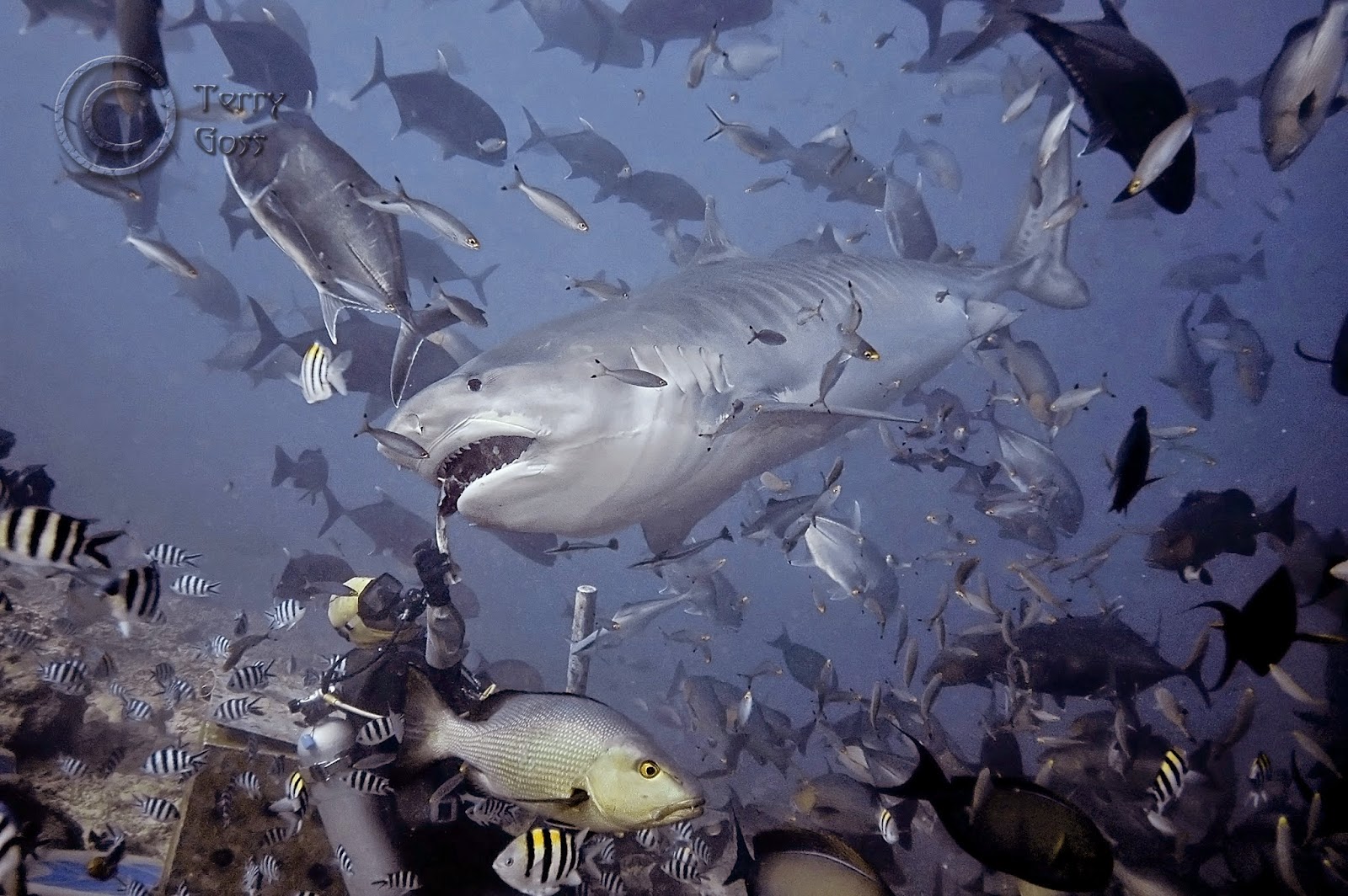
Case in point: the following image that Terry Goss (or here) took from the client viewing area.
It's my favorite picture of Scarface and probably one of the best Human-Shark pics ever! Yes I know I'm biased but that's what I believe! Terry has kindly given us a good hi-res edit and I invite you to click on the image in order to explore the amazing detail.
Terry has entered the Dream Assignment Competition and I invite you to go vote for him - great initiative!

Enjoy!

Sunday, November 23, 2008

BAD Publications!


Speaking of DEMA, I was finally able to catch up on several published features about the BAD Boyz & Girls.

Apart from Bill Fisher's flattering article and Terry Goss' unmatched pics in Shark Diver #17 (thank you Bill! kudos Terry!), there is an equally flattering honorable mention in PADI's Sport Diver October issue (thank you Kate Siber!) and I found yet another pic of one of our Bulls in the latest AustralAsia Scuba Diver, equally a PADI-affiliate.
Plus, Russia's premier Octopus Magazine is about to publish a fantastic multi-page spread, courtesy of our friend Sasha. As so often, спасибо Vakalevu my friend - and привет Julia!

Last but certainly not least, I had the pleasure of viewing a brand-new piece of Bijou Entertainment by Stan Waterman and Nancy McGee featuring Rusi and Manasa (in one of his last feeds prior to the incident) interacting with Scarface and the ever-feisty little Adi.
Killer footage and as always, wonderful narration by the Great Man himself - not to be missed! It's a bonus feature on Nancy's DVD "Rajan, the Swimming Elephant"(not quite pictured above), to be ordered at Nancy's website.

All-in-all very rewarding and an indication that we seem to be doing something right.
Go get yerself a copy!

And to all authors and image hunters, my heartfelt thanks!

Tuesday, October 18, 2011

Australia - WTF?


Patric is right.
If you are a Shark, take a left in Sydney and get the hell outta there!

Examples?
We've blogged at length about the appalling decision by the NSW minister for primary industries Katrina Hodgkinson to lift the fishing ban at the Grey Nurse aggregation sites Fish Rock and Green Island which are still enumerated in the Ministry's pamphlet but now acutely threatened.
The submission period (this one is excellent - read it!) has closed on August 26th - and what has happened since? So far, I hear, nada de nada de nada, meaning that the Ministry has given no feedback whatsoever and that the sites are still open for fishing.
Sadly, I'm not at all surprised.

Then, much like in SA, there's the shark nets and drumlines.
They are hopelessly antiquated and ecologically unsustainable (and here) and in other countries, they have been widely replaced by equally effective modern beach safety techniques. But when the public continues to advocate culling "rogue" Sharks after somebody gets attacked, rolling back those perceived protective measures may be politically impossible. Read this excellent feature from the Save our Seas Foundation on the problems of coexisting with Sharks and the various measures implemented - an here's a good one about Shark nets in Oz.
Incidentally, I was particularly appalled by this article. In it, one Terry Peake has the audacity to make the following statements.

“There’s a lot of ‘green money’ tied up in shark research.
Certain organisations are given money to protect something, so they do whatever it takes to say they’re protecting it, then at the end of tenure they present facts saying protection must continue so they receive more grants,”


As fishing stocks deplete, sharks are starting to adapt their food sources.
“Sharks need food with a high fat content and in the past humans wouldn’t provide that. However they’re getting desperate. Now we’re hearing stories about people completely disappearing, not just being bitten. It’s not a case of mistaken identity anymore, sharks are adapting out of necessity.”


Yes, this would be totally Vic Hyslop redux!
Shocking - but then again, maybe not so much. One could put it away as the ramblings of merely yet another unhinged Shark hating lunatic, were Terry not the Australian investigator of the GSAF, a bogus Shark Attack database closely affiliated with the equally bogus Shark Research Institute, the home base of other luminaries like Ritter, Collier and Amos - and I spare you the links to posts on this blog, the more as you can search for them yourself!
I say, quousque tandem - and Jupp, should you read this, get the hell outta there - ehrlich, in Freundschaft!

But I'm digressing as always.
Back to the Ozzie Shark fiasco and we find the Queensland East Coast Inshore Fin Fish Fishery ECIFFF that is taking 600 tons (or maybe more) of Sharks from the GBR Marine Park each year.
Yes read that again - from a Word Heritage Area!

I mean, seriously!
It has been known for years that any such fishery is completely unsustainable and that reef Sharks in the GBR are in big trouble - last confirmed by this open source paper as recently as last month.
And now, Fisheries Queensland has made a submission to have this abomination declared an approved Wildlife Trade Operation, this based on a rather problematic (!) report and this in diametrical contrast to the aspirations of the dive industry.
And the Federal Government is asking for comments.

Enter Madi Pip Stewart.
I must say, I am increasingly impressed by this very young underwater cinematographer, by her passion, by her product, by her outreach, by the quality of her statements. Anyway, you want to check out her blog where you will find a template for a comments letter and also, an assessment of Elasmobranchs caught in the GBR. Once again, very impressive indeed!
The consultation period closes on October 21 - and alas, I once again fear that the end result will not be in favor of Sharks, Pip passion or no Pip passion!

But the conservation fiasco not only limited to Australia's Sharks.
South Australia and NSW are bowing to the pressure by the anglers and other ocean recreationists and re-zoning their marine parks.

Furthermore, the Commonwealth is completely ignoring unanimous scientific advice, and that of the community, when defining its marine parks in the South West Bioregion that features an exceptionally high concentration of iconic marine species, many of which are endemic and can thus be found nowhere else on the planet. And worse than that, it is now actively muzzling and censoring dissenting researchers, Texas style.
Bravo to Corey for speaking up - and having talked to a few friends, it is exactly like he says!

So, WTF is going on?
Ever since the fratricide of Rudd and the subsequent botched elections, the Labour-led government there has been nothing but an appalling joke whereby anything and anybody, let alone useless baggage like ideals and principles are being sacrificed on the altar of self serving political survival - and yes I'm trying to be polite!
Gone are the days where Australia was a shining beacon of visionary conservation, gone the days where it could lecture the Pacific Island States who are now showing Big Brother the way forward.

Solutions?
Alas, short term, I am rather skeptical.
The political trend appears to be pointing towards a shift to the right where Big Mining and Big Oil are calling the shots - and obviously, those entities could not care less about Australia's ecosystem, marine and otherwise. But as long as there are young passionate people like Madi, there is hope, at least in the long term.

Fingers crossed!

Friday, September 12, 2014

Scarface and Rusi!

Terry-fic pic by Terry Goss.
 
No don't get too excited.

This is footage from 2010.
We haven't seen Scarface in years and although a very experienced videographer on rebreather reports seeing an enormous Tiger Shark, I fear that she has become the victim of all those pelagic long lines out there. The most interesting bit is at 3:17 where the Bulls, far from being intimidated, are actually shouldering her away.

This brings back many inspiring moments.
Enjoy - with a bit of melancholy!


Wednesday, December 05, 2012

Shark Expert from Hawaii!

A 10-foot Galapagos Shark? Right! 
Pic by Terry Lilley.

Terry Lilley is absolutely correct.
As a spearo, he knows that spearfishing does attract Sharks to the coast - and where have I heard that one before?
But is the man a Shark expert as claimed?

Don't get me wrong.
The man is probably a real nice, personable dude who wants to do good - but why does he have to bloviate, let alone educate others about stuff he obviously hasn't got the slightest clue about?
Case in point.


See?
No not the Reef Whitetips - Rambo or Rambette the psycho-Shark, i.e. the horizontally striped species that is apparently an aggressive 10-foot Galapagos Shark that Lilley has been studying for months! Wow!
Opinions - the more as it is unequivocal and easy?

And so it goes...

Thursday, April 28, 2011

Undercurrent on Shark Feeding!

Yes we feed Sharks - Terry-fic pic by Terry Goss!

Gotta hand it to the folks at Undercurrent.
Starting with the idiotic title, they have managed to post the by far most preposterous piece of utterly stupid anti Shark feeding shit published by a dive magazine, ever.

WTF has happened?
What has possessed Ms Richardson to provide a platform for the ramblings of the anti industry zealots instead of trying to remain impartial like in the past? Tell you what happened: she clearly doesn't have the slightest clue about Shark behavior (poor innocent Cristina's Caribbean Reefs are not solitary but gregarious) or the Shark diving industry and its protocols, and is obviously increasingly believing and parroting what the clowns she is interviewing are feeding her.

Case in point, Ralph Collier.
No Vanessa, Ralph is neither a researcher, nor a scientist.
He is the prototype of what the Swiss call a Sesselfurzer, as in "someone who farts from a couch", very much reminding me of the Shark-hating voyeuristic parasite. His claim to fame is to head his Shark Research Committee (are there any other members?) whose only research consists in recording GW attacks on the Pacific coast of the US and publishing the statistics in a series of forgettable amateur publications. Like Ritter with whom he shares an affiliation, or whatever, to the SRI and the GSAF, he is the ultimate Shark pornographer who professes to be furthering Shark conservation but then ultimately reduces Sharks and their life history to one single aspect, that of Shark/human interactions, meaning Shark attacks.
Having been elevated to rank of "Shark expert" by the misguided invitation of the Egyptian authorities, he is now obviously basking in the limelight and being invited to run his mouth on topics about which he obviously doesn't have the slightest shred of knowledge, let alone expert competence.

What Collier spouts is not new.
It's basically a textual rehash of his interview on the atrocious Red Sea Jaws where he asserts that feeding Sharks will lead to attacks on innocent bystanders. The "proof": one single video showing divers hand feeding one single OWT with Fish stored in a fanny pack - which according to Collier has led that Shark to subsequently attack the hands and buttocks of two victims, leading the great researching scientist to derive a general rule pertaining to all Sharks in the Red Sea!
Howz that for taking intellectual and methodical shortcuts!

So we're looking at a shark habituated to human beings for getting food, and humans had taught the shark where the food was. And this occurred frequently in the Red Sea. With overfishing in the area, sharks have to come up to the reef area to feed, and now associate food with the human form. It's very much like training your family dog. When it sees your hand, it sits up to get a bite of that treat.

Right!
That's EXACTLY what trained family dogs do: they sit up whenever they see a hand (notabene, a hand that does not hold any food!), meaning all the time, and when hungry, they run out of the house and randomly bite the hands (and very possibly even the ass!) of passers by!
Which obviously begs the question, does Collier own a completely crazy dog - or may he be simply pompously bloviating without the slightest knowledge about the behavior of either dogs or Sharks.
You be the judge of that.

The rule is simple.
To know about the specific behavior of an animal, you need to observe that animal when it is engaging in that specific behavior, and this over an extended period of time. If you unable to do so (and I betcha that Collier's personal experience with Sharks is limited to maybe a few cage dives with GWs at best), you need to talk to the people who do, or read what they publish on the subject.
The people who feed Sharks and who observe Sharks that are being fed are some divers, several Shark diving operators and a handful of Shark researchers - and thousands upon thousands of fishermen and spear fishermen!

Surprised about the latter?
Fishermen do not only feed Sharks by presenting them baited hooks; many of them attract and often end up feeding Sharks when they drag in struggling fish and when they subsequently clean their catch and throw the scraps into the ocean. Spear fishermen are notorious for attracting, and even conditioning Sharks when they shoot fish and often find themselves embroiled in a competitive struggle over their prey. These people number in the hundreds of thousands and if anybody should be examined for possibly causing an increase of Shark attacks on the public, it should be them - not the few dozen operators conducting baited Shark dives!

But I'm not here to deflect and obfuscate.
I'm certainly not about to give you the spiel about how we, the Shark diving operators educate the public and contribute to Shark conservation, as it got nothing to do with the issue at hand. The issue at hand is whether divers feeding Sharks leads to an increase of attacks on people who do not partake in those events, like Collier asserts.
That is a testable hypothesis.

The first of the possible tests is simple.
A. Are there more Shark attacks on the public at or around Shark feeding sites compared to similar control sites.

Let me start with a pathetically trivial statement.
In order for there to be a Shark attack, a person and a Shark will have to be in the same place at the same time. Thus the incidence of attacks will inevitably depend on the following variables: the number of Sharks and the number of people present in a determined location; and also, the activity and behavior those people and the Sharks are engaging in.

With that in mind and considering that feeding Sharks will aggregate some species, one would indeed expect an increase in Shark attacks in the vicinity of Shark feeding sites - but when one analyzes the details, it is not quite that unequivocal.
In 12 years of feeding Sharks here in Fiji, we have witnessed
  • a staggering increase in the number of Bull Sharks that roam wide ranges but regularly visit Shark Reef once they have discovered that it's a good place;
  • a negligible increase in the number of the much more resident Greys, Whitetips and Blacktips, a species that does not roam and is thus not likely to be attracted from locations afar;
  • but then, a decrease in the number of intermediate Sharks like the Silvertips, Lemons and Nurses, and possibly even Tigers;
  • and with the exception of one single fly-by by a spooked Great Hammerhead, zero sightings of any other species, this despite of the fact that we regularly introduce 2-300 kilos of yummy bloody bait and despite being situated on the fringes of 300m deep Beqa Channel and of Beqa Lagoon that are all being prowled by a plethora of other Sharks like Zebras and Hammerheads but also pelagics like OWTs, Silkies and Duskies.
And what about Shark attacks?
There are only two Shark feeding operations in the country, Beqa Adventure Divers and the guys down the road, and we both conduct our Shark dives on the southern coast of Viti Levu facing Beqa Lagoon. Documented Shark attacks in the vicinity: a big fat zero, ever.
The few documented Shark attacks have happened in Taveuni where Tigers Sharks prowl the coast of the current-swept Somosomo Straights; in the mouth of the Sigatoka River where surfers insist on frolicking on a break despite of murky water and the occurrence of large Bulls and Tigers; and in various locations where spear fishermen have defended their catch, often at night.

Anybody wanting to venture a guess about the results from elsewhere?
More importantly, would any of the bloviating Shark attack experts please care to comb his collection of data in order to prove or disprove a causal connection? Maybe for once act like what they purport to be, forgo their idiotic ad hoc speculation and engage in the onerous task of following the scientific method instead?

B. What about the risk of Sharks biting people during Shark dives?

Let's go back to the above trivial statement and variables.
When it comes to baited Shark diving, the obvious, and equally pathetically trivial rule is this.
  • the more Sharks are present, the higher the risk of a Shark bite
  • the more divers are present, the higher the risk of a Shark bite
  • the more dives are being conducted, the higher the risk of a Shark bite
  • the closer the divers and the Sharks interact, and the more frequently those interactions occur, the higher the risk of a Shark bite
So, yes, unequivocally, Shark diving increases the risk of a Shark biting a person!
And the question of baiting versus non baiting? Yes, of course baiting increases the risk, as it draws in more Sharks and leads to closer interactions!
Duh!

The consequences? Please re-read this.
Some divers are happy to experience Sharks when and where they occur naturally. Others wish to predictably experience other species that are highly skittish and/or do not aggregate naturally and thus need to be attracted with bait. Assuming that baiting does not harm the animals, and so far, nothing indicates it does, it's not a matter of prohibiting baited Shark dives, it's a matter of ensuring a maximum of safety by adopting the best possible safety protocols!
Is there a residual risk - yes of course there is, especially for us in the front line!

But what about the motivation for those bites?
Please re-read this. It is, to the best of my knowledge, what we know about why Sharks bite people - and please correct me if you think I'm wrong.

With that in mind, I assert that nearly all of those bites are not predatory in nature.
Contrary to the plethora of bloviating Sesselfurzer, I look back on nearly 40 years of diving and on thousands of Shark dives, most of which in baited conditions. In all those dives with dozens of different species in different situations world wide, I have never been in a situation where I had the impression that a Shark was sizing me up as potential food, not one single time - and incidentally, everybody in the industry I have talked with shares the exact same observations.

I have however been subjected to multiple threat displays, this by Grey Reefs exhibiting agonistic hunch displays, by Silvertips becoming stiff and jerky and more recently, by large dominant Bull Sharks gulping and ramming me with their snout.

I have also witnessed several Shark strikes.
All but two were by Sharks biting the people directly handling the bait. All of them were characterized by one or more of these factors: competitive, frenzy-like situation; bad visibility; lack of concentration/distraction of the feeder; feeder being bitten in his left hand which was holding more bait; non-dominant, sub-adult animal barging in.
The two remaining strikes were retaliatory bites by Silvertips on people denying them access to bait, very much like the famous incident where a Silvertip bit Dinah Halstead in PNG.

Consequently, our procedures include the following
  • all divers wear dark full body wetsuits and especially, dark gloves as pasty white hands sticking out of dark wetsuits may be mistaken for bait, especially in low visibility
  • we maintain a clear separation between the customers and the Sharks
  • the feeders wear chain mail gloves to minimize the effects of accidental bites
  • we hand feed in order to always control the bait and to be able to withhold food once we deem that the animals are starting to behave competitively. In situations that become too tense, we temporarily interrupt our routine, retreat and wait for the animals to calm down again - which incidentally, they always do
  • the feeder is flanked by bodyguards monitoring any dead angles and gets rotated out after ten minutes in order to prevent lapses in concentration
  • there is only one feeder acting as the focal point for the animals, and he only ever holds a single piece of bait
  • we do not feed in bad visibility of less than 10 meters and are particularly alert when the visibility drops, as we have observed that this is when the Sharks (who do not see through murky water any better than we do) tend to be particularly edgy as they have to rely on their other, less precise senses when approaching the feeder
  • nobody but us approaches the bait bin, ever
Which brings me straight back to Richardson's stupidity.
It mentions two Shark attacks, that on Groh and that on Jimmy.

Jimmy was apparently bitten by a Caribbean Reef, a competitive, edgy and strictly piscivorous species, whilst handling bait in murky conditions. These to me are perfect preconditions for a mistake by the animal.

Groh was apparently positioned right next to the bait cage, meaning that the Bull Shark that bit him may have been engaging in behavior aimed at deterring a perceived competitor.
Furthermore, once the Shark destroyed the bait container and a lot of sand was kicked up in the process, it was trying to navigate in very reduced visibility and water saturated with fish juices, thus losing its sense of orientation and possibly mistakenly biting the first solid object it came across, i.e. Groh's leg. Was it really exactly so - dunno but it is certainly plausible.

And the Ritter attack?
The interpretation of what triggered it (= a stupid guy doing stupid things with macro predatory Sharks) keeps changing but to me, it's rather irrelevant anyway: this is clearly a predatory attack where the animal first tested and then devoured Ritter's calf.
Accident my ass!

C. Last query: are Sharks that are being fed by divers (and what about those that are being fed by fishermen and spearos?) more prone to bite people than unfed Sharks.

This is what Collier is asserting and Richardson is parroting - and of course what is being really asserted, is that fed Sharks will not engage in just any attack, but that they will be conditioned to perpetrate predatory attacks on humans.
This is of course a tricky one to document - notabene one way or the other!

There is of course no such thing as a generic "Shark" engaging in generic "Shark behavior".
Instead, Sharks are very different behaviorally both when it comes to species but to complicate matters, even when it comes to sex and age within the same species, all the way to pronounced individual character traits that can be shaped by individual experiences.
Also, the behavior of a species can be very different in different locations or at different times of the day, etc.

But having said that, I can share the following.
Our flagship species, i.e. the Bull Sharks that frequent Shark Reef have been fed for the past 12 years and are undoubtedly one of the most conditioned population of predatory Sharks on the planet.

Bull Sharks are very timid and hardly ever approach divers.
But we want our customers to experience them, and this is the reason why we resort to luring them in with bait, and to reward them whenever they approach one of our feeders in the way we like, i.e. from the left and slowly.
This is called training by positive reinforcement and I can assure you that contrary to all the pledges to the contrary that are meant to appease the tree huggers, all Shark diving operators feed the Sharks when trying to attract species that are shy and in locations where those species do not aggregate naturally. Teasing only just does not work long-term as the animals are not being rewarded and will simply stop coming.

It is thus fair to state that by feeding our Bull Sharks, we are conditioning them to approach people and thus engage in behavior they would not normally display.
But here's the catch: we observe that unlike Collier's demented family dog, our Bull Sharks will not simply approach just anybody: instead, they will only approach determined people, and this mainly only when those people are proffering food!

Example?
Look no further than when we are training a new feeder. For weeks on end, he will be standing next to the bin brandishing his treats - and the Sharks will look him up but never take a single bite! Talk about an exercise in total and utter frustration!
Eventually, a single animal who is very likely not one of the old-timers but instead a newbie who doesn't yet know anybody else will take a first offering and be forever linked to this one particular feeder. Only over time, some of the other Sharks will deign to come in for a snack, however really only when they have no other choice because their favorite human happens to have a day off.
Incredible - and yet, it's totally true!

Or here's another example.
I've been diving the Fiji Shark Dive since 2003, first twice and now, up to five times weekly.
I never feed the Sharks. What I do, is to observe and film them as part of our ongoing long-term monitoring. Over a very long period of time and by proceeding in very small increments, I have been able to attain a status whereby the Sharks appear to tolerate and at times largely ignore my presence, allowing me to roam freely among them without any discernible effects on their behavior.
But when people other than me or Rusi venture in front, the Sharks will inevitably retreat - unless we accompany them, and even then, their behavior will be decidedly more diffident!

And lastly, we observe this.
We frequently dive Shark Reef for other reasons, be it in order to service our moorings or because we are monitoring its health and changes in the composition of its population of Fishes.
The Bulls live deeper in the channel and when we don't carry any bait, chances of seeing them are extremely slim and limited to occasional fly-bys by single individuals. We have even mimicked the exact dive profiles of our Shark dives, as a control, and thus without any bait - again with the exact same result that the Bulls were simply not interested.

So much for the assertion that fed Sharks will approach and attack people - and this after 12 years of conditioning them to the presence of divers!

Granted, this only applies to the specific Bull Sharks that frequent the SRMR.
But until somebody comes and proves that a specific individual Shark that has been fed has increasingly attacked people in un-baited conditions, nothing will ever convince me that what I'm experiencing in Fiji does not apply to all Sharks that are being fed by divers anywhere!

There you have it, that's my take - thanks for your patience in trying to follow my rant.
Still think that Collier is an expert on Shark attacks in the Red Sea?

And what about Undercurrent?
Looking forward to reading Part number two - and very much hoping that Ms Richardson will start talking about the real problem that is besieging Sharks, i.e the global fishery targeting their fins! Not that I believe she will after this total fiasco.
But then, as they say, hope springs eternal!

Sunday, March 07, 2010

Bravo, Bravo, Bravo!


Sorry for neglecting the blog!

It's just that we're currently incredibly busy with projects and then, I got sidelined into trying to formulate a major policy post in an acquired language. Challenging and time consuming to say the least!
In any case, there's much to report - this week, promise!

But first things first.

See the pic above? Click on it! Fabulous!
That's the Best of Show of the 2010 iDiveSharks Imaging Festival - and did, or did I not tell you that we needed to keep an eye on Sasha? Did you click on the last link: is that a photo blog - or what?
Well, with us being the sponsors of that prize, we'll have the pleasure to welcome him back sooner rather than later - the more as he now lives in Hong Kong and will thus be able to profit from Air Pacific's newest direct flight at unbeatable prices!
Can't wait, it's been far too long!

And more than that: the Best Wide Angle is a portrait of a Fiji Bull Shark, Nick, by our friend Sam, and the Best Portfolio includes my favorite pic of Scarface, by our friend Terry!

Bravo guys - yer making Fiji proud!

Wednesday, April 07, 2010

I still like them - very much!


Epic: award-winning GW portrait by Terry Goss.

Well, here's the clip!

I still like those guys and I just love the general pro-Shark and anti-stereotype message!
Kudos to both: to Mike, for his insightful comments (I totally agree!!!) and to Cooper, for having had the guts to do it and above all, for providing a fabulous global platform for pro-Shark messaging - again! And: great marketing for South Africa's Shark diving industry!
Very very well done!!!

The difference to this?
Listen to the commentary: Mike does not conduct cageless dives commercially.
This is a targeted film shoot - along with research, one for the accepted reasons for deviating from standard commercial Shark diving protocols.

Did it maybe include some (and I would add: extremely mild!) macho posturing like some of the comments here suggest? Sure did - but let's be honest, much of the attraction, and fun of Shark diving consists in the adrenaline rush of being in the presence of apex predators. Doing what those two guys, and the cameraman did takes some mighty cojones and being amped up before the plunge is the most natural of reactions.
I say, not to worry, no harm done whatsoever!

And as to who conducted the first cageless dive with GWs, it was either Ron or Giddings, and the first ride, Jeremiah, not Hartman - which in no way detracts from the fact that Andre is one of the true Shark diving icons! Now it's Mike's turn to shine and I say, good on him!

But I'm digressing as usual - Enjoy!


Thursday, September 18, 2008

Great Set!


Whilst busily munching on my fair share of humble pie for my repeated failure to mention Terry Goss as the author of, among many others, some of the most amazing images from Shark Reef, I've literally stumbled across a new set of his pictures that were used to illustrate a feature in Shark Diver Magazine's issue number 17.
This one was used to illustrate the Magazine's online description of our main attraction, the Bull Sharks.

I haven't seen the article and just hope Bill Fisher has been kind to us.

Anyway, great pix as always!

Enjoy!

Friday, March 05, 2010

Dear Mary

Bravo Terry: great Photography amidst a deluge of forgettable pics from Lupe!

I must apologize for the delay in answering your comments.
Thing is, we’re currently incredibly busy (95% doing, 5% ranting) - and I felt that I needed to devote some time to formulating a more exhaustive response.
So there.

First of all, I really want to thank you for having raised your voice in protest - and I commend you for having done it openly.
I know who you are and admire you for your passion, commitment, eloquence and intelligence. We’re clearly not on the same page on this one – but I very much welcome this discussion as I strongly believe that we will only progress by engaging in dialogue, some of which needs to be controversial and robust. And yes, that sometimes includes ranting, especially in the context of a blog like this one!
Let’s however never forget that in the big scheme of things, we’re on the same side and that this is a squabble between friends, not foes!

Let me try to put things into context.
As you know I’m basically a full-time Shark conservationist. I do what I do the way I do it , and I say what I say based on a specific set of assumptions.
Please bear with me if I try and describe them as follows.

Assumption 1

The Big Gorillas are Population Growth and even more problematic (and largely overlooked), the fact that everybody is striving to attain a “better” life which in practical terms translates into increasing one’s Ecological Footprint.
That is simply not sustainable and if left unchecked, the future looks grim indeed – as in: there will be no future!
If so, we will descend into Chaos and Anarchy, and Conservation will be the least of our concerns.

Assumption 2

One of the immediate consequences of the above is that Life expressed in terms of Biodiversity is experiencing a severe bottleneck, especially when it comes to terrestrial habitats where anthropogenic extinctions are rampant.
Hopefully, we will come to the conclusion that this is not what we want (Ed Wilson’s Biophilia) and if we do, the future will consist in some form of less diverse “Nature” which will however not just “be”, but which we will have to actively manage.
Yes that includes Shark stocks, too!

Assumption 3

When it comes to the Oceans, I believe that the situation is somewhat different.

I believe that we generally grossly under-estimate the size, fecundity and regenerative powers of Marine ecosystems.
Yes there’s widespread pollution, habitat degradation and blatant overfishing: but despite of our best efforts, it appears that we’ve “only” managed to exterminate a small number of Marine Mammals, no Marine Cetaceans and, possibly with the exception of some obscure deep-sea Sharks, zero Marine Fishes!

Yes the Cod, Orange Roughy and Chilean Sea Bass fisheries have collapsed and the Northern Bluefin Tuna appears to be critically endangered – but there are still Cod, Orange Roughies and Chilean Seabass and Northern Bluefins and if we just leave them alone, populations will very likely recover. We may pollute and bomb a Reef to smithereens: but just leave it alone, and it will miraculously recover within the shortest period of time.

Those, I understand, are the facts – I’m not saying that this is great and that we should thus feel free to continue to reap and pillage: but anthropogenic terrestrial and marine extinction rates are clearly very different.

Consequently, I advocate the creation of a multitude of MPAs (the more and bigger, the better) where Biodiversity can shelter in order to re-colonize the surroundings once we finally decide to just leave them alone.
That’s the good news.

Assumption 4

The bad news is that anthropogenic Climate Change and especially, its ugly cousin Ocean Acidification (read this!) may indeed tip the scale towards a total collapse of Marine habitats and related widespread Marine extinctions.
If so, all for which we so valiantly fight (and rant) will have been for naught.

But one has to choose one’s fights and like in the case of the Big Gorillas, this is not where I’ve chosen to be active. We at BAD are however certainly trying to make a (ridiculously small) contribution by always trying to reduce our Carbon footprint and advocating a greener lifestyle.
Let’s just hope that a Nobel Prize and an Oscar will prove sufficient to sway the masses (and the politicians!) to do the right thing – tho after Copenhagen, I’m far from believing that this is anywhere close to being a done deal…

Assumption 5

Species protection does not work. What works is habitat protection.

Assumption 6

I believe that the totality of resources (as in people, brain power, time and money) available to Conservation (and incidentally, to Research) is finite.
And not only that: the sum has been decreasing due to the global recession and also due to the plethora of other competing “worthy” causes, as in Haiti, AIDS, teenage pregnancies, poverty alleviation and-so-on-and so forth – many of which, alas, are directly contributing to making the Big Gorilla even bigger!

If the above is true, and I believe it is, we are looking at a classical zero sum game whereby if we invest any resources into a particular project, we are automatically crippling other projects.

To me, the inevitable consequence of the above is that we must define our priorities and invest those resources prudently and with a view to attaining the best possible results in the most effective and efficient way – very much like the ROI in the “real” world.
And like in the “real” world, we have an obligation to question the efficiency and effectiveness of those different projects and to hold the project leaders accountable - for their success but also for their failure, and this in absolute terms but also, in relative terms when compared to possible alternatives!

Take The Cove: all that hype and praise irritates me!
The movie decries the fact that some Japanese trap some Dolphins, a non-endangered species, in Japan. Some are exported for Dolphin shows; some are killed in unethical ways and then eaten. Certainly all very disturbing - but that's a (legitimate) animal welfare and not a conservation issue!

Did I hear: "sentient being"? And the Vaquita? Please read the link!
Couldn’t all those resources have helped in trying to reverse the decline of the Vaquita, maybe the most critically endangered Cetacean – the more as its demise is very much happening just south of the border? And who, please, is fighting for the Yangtze Dolphin?

Am I entitled to ask those questions?

I also believe that in this day-and-age, the only justification for investing those scarce resources into biological Research is that it directly benefits Conservation and that it satisfies the most stringent ethical imperatives.
And, we must strive to avoid redundant duplications (please, no more tagging of Pacific GWs!), we must oblige scientists to collaborate (which they mostly do) and we must ask that those scientists we finance produce regular results as expressed in scientific publications, etc.

As an example, I’m highly distressed when I hear that Taxonomy, the science that documents Biodiversity, is on the decline, to the point that an increasing number of Institutions are dropping it from the curriculum, that the current Taxonomists have issues of succession and that funding for expeditions is drying up.
Did you know that Jack Randall, the greatest Fish Taxonomist in history, is currently unemployed and unfunded? How is that possible???

And why are there so many competing research projects, NGOs and initiatives targeting the very same issues and incidentally, squandering so much money on aggregate overhead? How can that be beneficial to the cause?
In that regard, Kudos for having established the SSN – very much the way to go!

Now when it comes to Shark Conservation, which is what I do.

Assumption 7

I believe that apart from the doomsday scenarios of Climate Change and Ocean Acidification, the biggest threat to Sharks is overfishing.
In that, I’m partly contradicting my previous argument about the Ocean’s unbridled regenerative powers. I do this in view of the fact that Sharks have a much lower fecundity than most Fishes and that some populations seem to be quite small, as in, apparently, 3-4,000 in the case of GW and maybe even less for some deep-water species.

Assumption 8

I however also believe that the status of Shark stocks is not uniformly catastrophic but that it varies according to species and to regions.
The consequence is that in order to be credible and efficient, we should prioritize our resources in order to direct them to the preservation of those species that are most threatened.
Trivial – but are we doing so?

Assumption 9

The ultimate solution to overfishing is not prohibition, it is to fish sustainably.
This is a central theme of this blog.
The sooner we accept that, the sooner we'll be able to help the Sharks.

In a nutshell, I believe that killing Sharks for food is OK as long as it is done sustainably.
This means that where they are depleted, stocks must be allowed to recover and after that, fishing quotas must remain below the rate of replenishment. I believe that to be true of all fisheries, be it for Sardines, Tuna, Sharks or, yes, Whales!

The practice of finning however is a completely different topic: it is ethically reprehensible for being both wasteful and extremely cruel and needs to be stopped.

Assumption 10

I believe that the fisheries for Sharks (i.e. mainly for their fins) is supply limited, meaning that the demand for Shark Fins greatly outweighs the supply. This is why Shark fins remain one of the most expensive marine commodities.

No clue why the soup has gone down-market.
Maybe because the Shark fishermen catch more Sharks? Maybe because they have reduced their overhead/fin by becoming more efficient? Maybe because cheaper soups contain less desirable and thus cheaper fins? Maybe because there are less fins in one unit of cheap soup?

Anyway, if that is true, I believe that targeting the demand is a very very long shot indeed!
Take your example: 200 posters were noticed by 19% of Beijingers, of which 82% said that they would forego the soup – gives a penetration of 16%.
Now, as I said, if the demand were 4 times the supply, you would need a penetration of more than 75% before a single Shark (!!!) would be spared! How many eaters of soup are there? How many is 75% of that? How many posters would have to be deployed where? How much would that cost?
Is that realistic? Is that the best possible way of investing those resources?
And if it is not – may I criticize it?

One common friend sent me a message stating that when Shark conservationists squabble, no Sharks are being saved.
I disagree! “Squabbling” about the most efficient strategies does save Sharks if it improves the strategies and saves more Sharks! And again, this is never meant ad personam, at least not by yours truly – tho I understand that it may come across as such, which is deplorable but sometimes inevitable!

Anyway, with that in mind, I believe that Shark Conservation should target the supply side by concentrating on the Countries where the Sharks are being caught and exported from and where their demise is creating the biggest negative impact.
Yes that may sometimes be a long shot, too – but I strongly believe that given the right amount of resources and flanked by education and alternatives for the fishermen, it still is the better strategy.

I believe this to be true because it is in the ultimate interest of those Countries to preserve their stocks at sustainable levels and to avoid the collapse of their Marine Ecosystems.

The bulk of the consumers, on the other hand, must only contend with issues of availability and price, and if you’re lucky, with ethical considerations - IMO, not a very strong motivator for changing one’s habits.
Sure did nothing for Rhinos and Elephants, another supply limited commodity – whereas protecting them in Africa seems to work.

And talking of ethics: this is why I did propose the certified Shark Fin soup as an alternative to changing habits altogether.

With that in mind, I believe that the way to go is as follows – and yes, think “Rhinos and Elephants”.

A. The establishment of MPAs in order to preserve the Sharks’ habitats.
Here, I believe that we already dispose of a global network that needs to be activated, and that is us in the Dive Industry. Every single dive operator should be held accountable for protecting the resource he derives his sustenance from – this not only because it’s only fair and ethical, but also because it’s good business!

As an example, the single most photographed, filmed and loved Shark in the Universe is Emma.
So, why are all those countless Emma- and Shark-loving bigwigs not actively engaged in getting Emma and Tiger Beach protected – or are they, very much silently, petition-less and behind the scenes? Yes the “political” situation is complicated and some feathers may well get ruffled – but then, when was Conservation easy? And how much sweeter could success possibly be?
Or am I just ranting – again?

B. The establishment of pro-Shark legislation.
No widespread conservation is possible without the adequate legislative framework.
Achieving this is not trivial but certainly not impossible. Most Governments are open to good arguments, the principal one being that the indiscriminate slaughter of Sharks has devastating effects rippling down through the trophic chain, all the way to the demise of entire Marine ecosystems.

Generally, this consists in advocating sustainable fisheries and ideally, moratoriums (all the way to Shark Sanctuaries) as long as some stocks are too depleted or until there are sufficient data to determine sustainable levels.
The recent protection of Lemon Sharks in Florida is an excellent example of the former and the Honduran moratorium, an excellent example of the latter.
Kudos!

Can this be replicated in, say, Yemen? I betcha it can – but somebody has to go and do it! Who, and who’s going to pay for that?
And how about Ecuador, Colombia, Costa Rica and Mexico where the fishermen are slaughtering “our” Scalloped Hammerheads? Don’t know if it has: but if not, shouldn’t Sharkwater rather be translated into Spanish and be shown there, where it happens?

How many Shark fishing countries have no pro-Shark legislation and what can be done to change that?

C. Which leads me straight over to the need for effective enforcement.
Now this is really the biggest challenge of them all. Here, we are confronted with a lack of resources, often coupled with indifference and corruption, especially in lesser developed countries. This I believe is where we need to direct the bulk of our resources, be it in terms of personal efforts, funds and hardware but also, education and the establishment of alternatives for the fishermen.

In Fiji, we currently compensate the fishermen for not fishing in the MPA but also employ Fish Wardens who have the authority to enforce the law.
And we’re pretty big in outreach, via the local media all the way to a local PSA but also, our youth sponsorship program and presentations to local communities.
In the future, we would like to expand Shark awareness to the school curriculum – but we simply lack the necessary time and manpower and are thus currently trying to outsource it to one of the local NGOs.

D. We should also sponsor research so that our decisions are backed by objective data.
As you know, this is one of the cornerstones of our Fiji Project.

E. "Other"?

Shark Free Marinas Initiative anybody?
Yes the initiator may, or may not be the Antichrist – but is it saving Sharks? Incredibly efficiently so, as signing up costs precisely zero?
21 in Fiji – and how many in the USA? Australia? South Africa? Asia?
How about that for petty squabbling and tribalism huh.

Petitions?
My hunch is that they only make sense when coupled with real action “on the ground”.
Thus, I believe that the Florida Lemon Shark petition and the Hawaii Shark Preservation letter campaign were useful in reinforcing the arguments of the people pursuing those local projects. I believe that the Discovery petition was largely a flop because nobody really cared to go and pursue any direct follow-up with the network – though having said this, I hear that things there may be changing, hopefully for the better.
The other petitions, to me, are just a total waste of time – especially all those competing “stop finning” gigs! More than happy to be proven wrong though!

Activism?
Not convinced!
Conservation is about hard facts, hard and often tedious work, perseverance and commitment, often difficult negotiations.
Yes, and of course passion – but passion alone just aint good enough!

All-to-often, activism is just too hopelessly amateurish, too emotional, too little fact-based, too confrontational and too little solution-oriented. Too often, I fear that it harms rather than being helpful. Too often, I get the impression that the perpetrators are mainly interested in personal aggrandizement and that the initiatives are nothing but marketing stunts – and this includes many of those pro-Shark websites which are so long on pontificating and petitions and so short on results!

And what about our own ideologies and stereotypes. Very unhelpful.
“Sharks” are not “misunderstood”, at least not by the people who take the time to learn about them! People who don’t take the time to learn about dogs “misunderstand” them – wow, what a profound message!
Which species are we talking about anyway: Whale Sharks? Cookie Cutters? Swell Sharks?
Do we “understand” them?

Yes I’m being facetious - but seriously: our biggest capital is to be honest and objective, especially when we are trying to counter the anti-Shark stereotypes!
Romanticizing interactive encounters with large predatory Sharks is stupid and as such, bad marketing. Using numbers that are based on conjecture and untested (although certainly plausible) hypotheses is counter productive. Right now, the only verified number is approx. 30 to 70, which is 50 and not 100, full stop – and that’s just a number, it says nothing about sustainability which is all that counts!

Can we maybe just be a little more humble and less righteous, the more since Conservation is so complicated? Maybe progress towards more facts and less truthiness (read this!)?
Can we maybe just open our eyes and wonder at the magnificence of what is instead of trying to make things up?

In a way, it is the very deluge of platitudes, pseudoscience and exaggerated doomsday scenarios in all those pedestrian wannabee Sharkwater clones that has helped spawn rubbish like Shark Con – and I’m certainly gonna leave it at that, the more as I firmly believe that we should just ignore it and not contribute to its marketing by engaging in the usual vociferous con-troversies!

We are the amateurs.
Can we please listen to what the professionals are telling us – the principal message being that extreme positions (on both sides!) are inhibiting Conservation and appropriate Management measures?

There you have it Mary!
This is basically where I personally come from - and yes, alas, it includes a lot of skepticism!
But having said this, we’ve certainly come a long long way and I remain very hopeful that we will succeed in turning things around!

Dunno if I’ve managed to adequately address your reservations.
But I’m thankful for having been given the chance to put things into context.

You too, take care!

Thursday, March 24, 2011

GW Biology - totally fascinating!

One of the best GW ever, by Terry Goss (yes this is a link!)

Found the following by pure happenstance.

Very informative and at the same time, very entertaining indeed!
Keeping it Green is a program by Debbie Klughers who just won a scholarship by the Women's Hall of Fame. The lecturer is Dr. Demian Chapman, according to my sources one of the good guys - as evidenced by the fact that he has obviously worked with Doc, Mahmood and Mrs Pikitch. And may G.H. Harvey be the Guy, and may the paper be related to Guy's work in Cayman?

Anyway, enjoy!
AND: check out the third video, 10:15 - that was in November 2010, now we know more!


Tuesday, October 27, 2009

If you have a Heart


Somebody just sent me this link.

The title of the message was if you have a heart, these images will disturb you - and yes, they do! Very much so!

It's a local tragedy affecting a colony of Laysan Albatross - but much more than that, it's a terrible tragedy affecting the Oceans in their entirety.
I googled plastic ocean pollution and came up with 1,500,000 entries, among which this list of articles. And please read this about the findings of a vessel crossing the Great Pacific Garbage Patch (this is Wikipedia with a multitude of links and resources).

Or if you're not into reading, there's of course YouTube with a seemingly endless list of videos dealing with the issue, like the following one, an impassioned speech that has also made it onto TED.


This is Capt. Charles Moore of the Algalita Marine Research Foundation and having checked out their website, I'm impressed by their research page featuring yet another list of useful resources. If you live in California, you may want to join them as a volunteer. If not, you may want to become a supporter.

Alas, from what I read, I fear that it's way too late.
All the King's horses and all the King's men will never gather up all the plastic and put the Ocean back together again - so true. There are no easy solutions here, no likely happy end.
All-in-all, very, very sad.

Thank you Terry for having me look into this.

Wednesday, January 02, 2019

Elusive White Sharks - Paper!

Still one of the very best: iconic image by Terry Goss - click for detail. Source.

Great stuff!

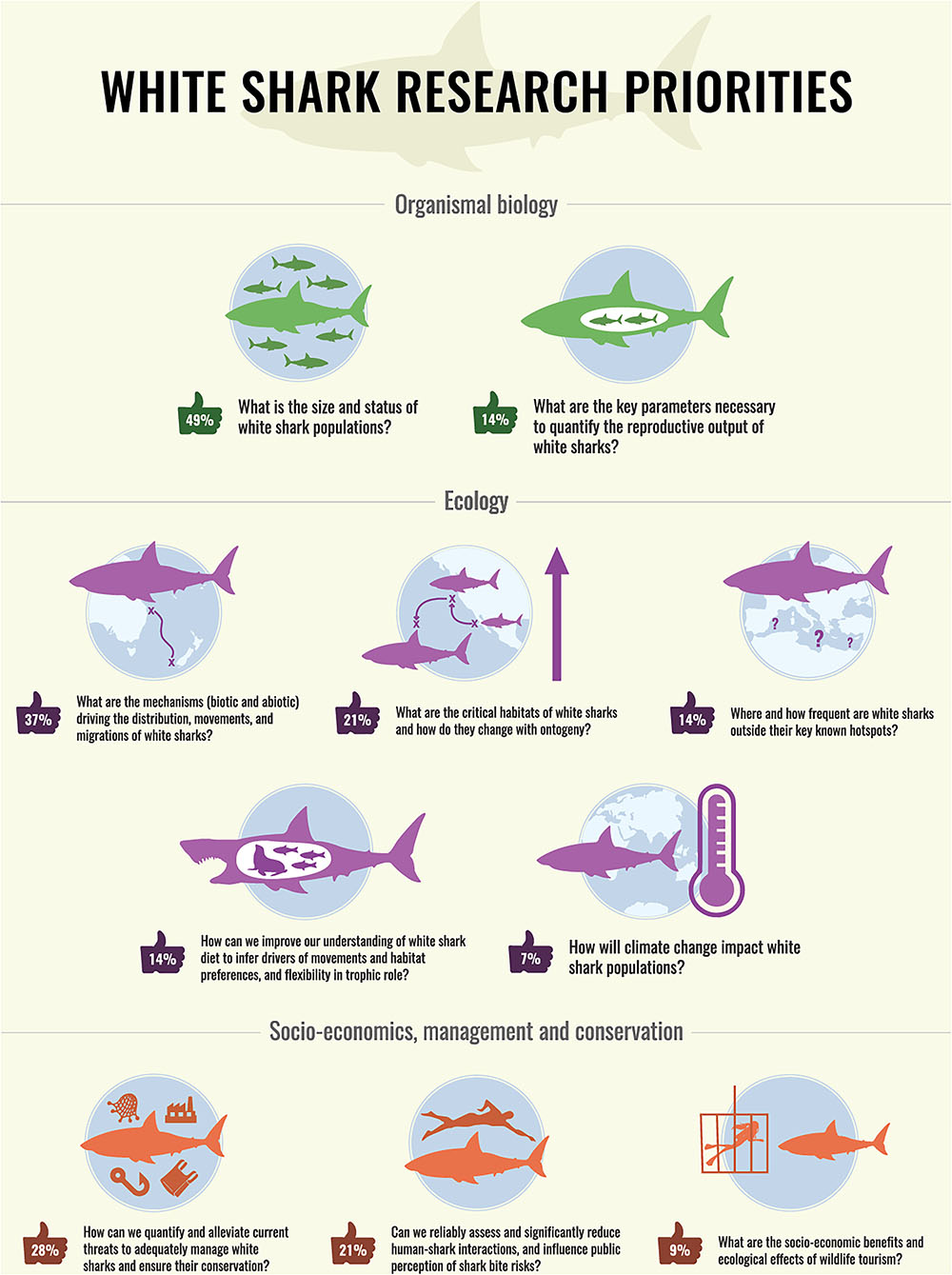
If you're into GWS, this is a must read.
Great job by Charlie in getting feedback from the quasi-totality of GWS researchers, which sure makes for an interesting assortment of names; great questions that  obviously also pertain, mutatis mutandis, to other Shark species;  and last but not least, great bibliography for further reading!
So well done folks, and thank you!
 
Enjoy!

Friday, June 19, 2009

Well done Bill!


Remember Bill Fisher?

He was with us in 2006 and wrote a glowing report of his experience in Shark Diver Magazine, garnished with great pictures by Terry Goss.

Bill and Joe Romeiro have teamed up to form 333 Productions and judging from their page on YouTube, they've literally been "everywhere".

I was really excited to find this 2006 video featuring not only a feisty (and much smaller) Scarface (the one with the crooked mouth), but also our biggest Lemon Whitetail. See the black dot on her nose? That's typical for Sicklefin Lemons - check out yer pics from Tiger Beach!
And there's also footage of Adi, or Princess, one of our smaller Tigers, filmed on Aqua Trek's dive (we don't grab).
Very cool!

Fiji Sharks-2006


But the real reason for this post is that 333 Productions have just won the Emerging Underwater Filmmaker category in this year's BLUE Ocean Film Festival!
Here's the trailer of their winning submission Death of a Deity.


Well done guys, and keep up the good, pro-Shark work!