Showing posts with label Marine Protected Areas. Show all posts

Sunday, March 24, 2019

Do MPAs improve Climate Change Resilience?


Spoiler: they do not!

Surprised? Me not at all.
Over the years there has been a plethora of irritating scientific studies wanting to link climate change mitigation to a whole host of factors ranging from somewhat plausible like the present MPA theory to outright outlandish like the ridiculous Whale poo theory - and let's not forget the infamous Sharks and Oxy Myth that STILL reverberates in some of the stupidest Shark conservation circles!

So kudos for setting the record straight.
And in analogy to the conclusions of the paper (read them!), let me re-post what I wrote back then, slightly abridged.
Want to combat Global Warming?

Stop faffing around about irrelevant topics and work on reducing the anthropogenic carbon emissions that cause it!
Reduce your own emissions! Vote for politicians, parties and government that advocate global reductions! Educate others! Do something to enhance carbon sequestration, like we do!

In closing.
Like a broken record and Erik the Mad Hatter, let me quote myself.
The facts and numbers?
Science is in continuous flux and the data do indeed change – but until they do, the latest peer reviewed science remains the best approximation of the truth. Thankfully, there are now plenty of resources where anybody can consult the latest insights and data, meaning that those who continue to operate with inflated statistics and outlandish assertions lack any excuses and credibility whatsoever. The facts are plenty horrible as it is – so let’s please stick to those and refrain from the usual stupid inflated hyperbole!

Conservation is never happening in a vacuum - it is being used to advocate legislation that in its marine context will deprive fishermen of income and quite possibly, of their livelihoods. With that in mind, we owe it to them, but also, to ourselves not to cheat and to use misleading perceived "marketing", or whatever, but to be truthful and fact based instead.

The situation is really, really dire and there's absolutely no need whatsoever to inflate numbers and to come up with ludicrous propositions.

And then there's this.
Assume we succeed in having laws enacted based on misleading data - what would prevent the legislators from repealing them once we got caught out?
Think we would ever get a second chance after such a fiasco?
And there you go.
Paper here, synopsis here.

Enjoy!

Sunday, March 11, 2018

Recovery of Sharks within a well enforced MPA - Paper!


Very nice - watch!


Paper here, synopsis here.
I must say that contrary to other papers looking at different aspects of those reefs off Western Australia where I am weary of some of the conclusions, I am quite impressed by this one as the evidence for the rapid recovery of those Sharks appears to be rock solid as e.g. evidenced by the video below.


This is good news indeed.
Provided that there is strict enforcement, MPAs appear to be an effective tool in the protection of at least those comparatively less migratory coastal Sharks - and if so, there is certainly reason for hope.

Of course for us this is nothing new.
But good to see our data (and here!) confirmed by research from other parts of the word.

Enjoy the paper!

Sunday, April 26, 2015

Management vs MPAs - Paper!

Click for detail!
Bingo.
And I cite.
The reefs in Guam and Papua New Guinea are near collapse, with only 10% of the historical estimate of fish biomass present.
Although these declines seem dire, an equally important finding is that fisheries management works. This is a message of hope to those working in conservation.

Over the past decade, many have given up on fisheries management because it is perceived as being too difficult, expensive or beyond the capacity of academics and non-governmental organizations. Many instead turned to MPAs as a blanket solution to marine-conservation challenges.
But to be effective, MPAs need to be protected and enforced, which requires them to be large, old and isolated. Effective MPAs can halt declines, but the build-up of biomass to historical levels takes time. MacNeil and colleagues show that recovery takes at least 35 years, twice as long as previous estimates. Patience, persistence and continued financial investment will be essential to the success of the ocean’s increasing number of MPAs.

As MacNeil and colleagues recognize, MPAs are simply not an option in areas where people depend on fish from reefs.
Coral reefs lie in the waters of more than 100 developing countries, many of which have dense, rapidly growing coastal populations. Enforced MPAs might not be viable because of the burden of displacing fishers, the unknown effects of redistributing fishing and the time it takes for biomass to recover. But the authors show that those reefs that had some form of management, such as restrictions on fishing equipment, species or access, had 27% more fish biomass than reefs open to fishing. Even in depleted reef communities, regulations protecting key species can promote ecosystem resilience and recovery. For example, prohibiting specific equipment can allow herbivorous fishes to recover, promoting coral resilience.
Indeed - there is no silver bullet!
MPAs do work and are actually the better conservation tool.
But in the real world, they cannot always be implemented - and u got to monitor, manage and especially, enforce them, too, which is often even more difficult!
Or as the paper states,
The continuing degradation of the world’s coral reefs underscores the need for tangible solutions that promote recovery and enhance ecosystem functions.
Our results demonstrate that well-enforced marine reserves can support a full suite of reef fish functions given enough time to recover. However, for reefs where marine reserves cannot be implemented, we find that ecosystem functions can be enhanced through various forms of fisheries management. Addressing the coral reef crisis ultimately demands long-term, international action on global-scale issues such as ocean warming and acidification, factors that may diminish recovery potential by approx. 6% over the coming decades.  Despite these challenges, a range of fisheries management options is available to support reef resilience and it is likely that some combination of approaches will be necessary for success. Having benchmarks and timelines within an explicit biomass context, such as those provided here, increase the chances of agreeing on, and complying with, a mix of management strategies that will achieve conservation objectives while sustaining reef-based livelihoods.
And what about Fiji?
Fiji is just such a place where unilateral action is just simply impossible, and where any solution will have to be a compromise where all stakeholders feel that they get something, and nobody gets everything.
Hence my advocacy of both improved management and MPAs here.
Synopses here and here.

To be continued no doubt.
And that's a promise! :)

Sunday, April 05, 2015

Cocos Island - a Paper Park?


Remember this paper?

The authors are weighing in, and here's another piece.
And I cite.
The declines in the number of sharks and rays restricted to the waters surrounding Cocos are a clear indication that the protected area isn’t working.
and
New research led by researchers at the University of Victoria raises serious concerns about the ability of marine protected areas (MPAs) to effectively protect wide-ranging iconic species, such as sharks and rays.
I say, not so fast!
There is an increasingly irritating cabal of vociferous researchers that instead of being preoccupied with the 99.97% of oceans that are not being protected, continue to snipe against the 0.3% that have been designated as MPAs - and these statements are playing right into their hands.
So, was protecting Cocos and for the matter, the other hot spots Malpelo, Gorgona and the Galapagos nothing but an exercise in futility?

Yes of course there have been declines!
When it comes to the wide-ranging pelagic species like the Hammers that regularly leave protected waters when they migrate between Cocos, Malpelo and the Northern Galapagos it was to be expected. It's exactly the same here in Fiji when the Bulls leave the Fiji Shark Corridor, and over the past decade, we too have lost several individuals. BUT, by the same token, many more have survived because like Juerg's paper shows, our Bulls spend approx 1/2 of their lives in protected waters!
And the same of course applies mutatis mutandis to those Hammers - or does anybody believe that you could still see those iconic schools if we had not protected those sites, and if the dive boats had not been there as witnesses that did certainly discourage the worst of the poaching? If so, think again, as in comparable places like the El Bajo in the Sea of Cortez where there is no local protection, the Hammers have all but disappeared!
In brief, the protected area is by no means not working, it is merely working imperfectly!

And the resident Elasmobranchs?
Although I'm clearly speculating, some of those Rays and Whitetips that are being predated upon by the increasing numbers of Tigers and the Galapagoses may well have decided to depart for greener pastures much like we are witnessing here in Fiji.
But chiefly, they have been the victims of insufficient enforcement - which incidentally is the principal reason why many full no-take MPAs are failing globally! In brief, the failure of many declared MPAs is not a failure of the concept per se, it's a failure of their implementation - meaning that we got to improve the implementation and stop sniping against the concept! 
And anyway: show me a better way to protect marine biodiversity in the developing world where there are simply not enough resources for enacting proper management - and since yer at it, how about proving your point by enacting your miraculous recipes in those remaining 99.97% and leaving us alone! 
And yes I'm being uncharacteristically polite! :)

Solutions?
The researchers write,
Although management efforts have increased in the past decade, illegal fishing still occurs within the island’s waters (Arias et al. 2014). It is unclear if the Cocos Island MPA is even properly designed (Botsford et al. 2003) to protect such large and wide-ranging species (Hooker and Gerber 2004; Gr¨uss 2014). 

Conservation efforts at Cocos Island cannot be focused simply on expanding the protected area (Arias et al. 2014); rather, efforts should be put toward increasing enforcement and management (Kelaher et al. 2015). Costa Rica’s efforts to increase their MPA coverage are admirable, but the establishment of MPAs cannot be the end point. Explicit plans and dedicated funding for monitoring and enforcement must be in place to prevent the creation of a network of paper parks. These plans need to include using both theory about MPAs and empirical data (White et al. 2011). Further, there must be stronger penalties for noncompliance with MPA rules to offset the potential gains of illegal fishing (Arias et al. 2014). 

We recommend that monitoring and enforcement of Costa Rica’s MPAs be increased substantially and that international environmental NGOs and foundations contribute to these efforts. Such efforts are urgently required if Cocos Island is to recover its elasmobranch populations and claim its status as a truly successful MPA.
Could not agree more!
And if I may venture a suggestion, apply Fiji's new concept of public/private partnerships in marine conservation and deputize the local crews of the liveaboard vessels that could then help Costa Rica enforce the MPA!

But above all.
Let's continue to celebrate Cocos Island as one of the most iconic Shark diving destinations, and let's commend and thank the Undersea Hunter Group for the pioneering and selfless work they continue to do there on a daily basis! 

Yes there may be Trouble in Paradise.
But it's still Paradise, and the trouble can certainly be overcome!

And since we're at it.
Enjoy - very nice! :)


Tuesday, May 06, 2014

Guam's Great Marine Preserves - Video by Timbo!

Manta in Guam's Tumon Preserve - source.

Bravo Timbo!

Not too shabby for an old fart!
Incidentally, this is what Manny Duenas and WESPAC want do destroy.

Anyway, enjoy!


And, there is a book, too!

Sunday, March 30, 2014

Well managed MPAs support Fisheries - Infographic!

Source - click for detail!

Fully agree - case in point!

But (of course, there has to be a But!)
For this to work, there needs to be more on top of the five principles advocated in the infographic.

Source - click for detail!

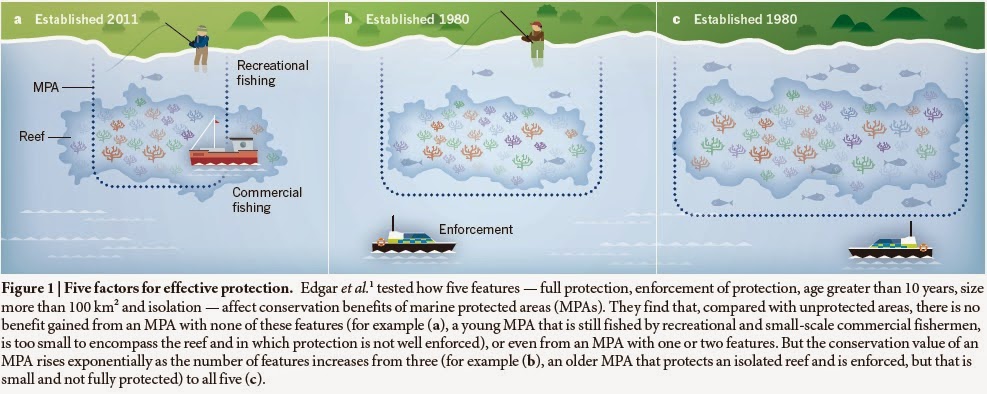
Edgar et al postulate 5 key factors that greatly enhance success.
They are 1) full no take, 2) well enforced, 3) old (>10 years), 4) large (>100 km2), and 5) isolated by deep water or sand - and guess what, the SRMR fits the first three and possibly even criterion # 5!

There you have it! :) 

Friday, October 25, 2013

Pew - more Sanctuaries in the Offing?

Possible Pitcairn MPA - four times the size of the UK!

Something's brewing!

Yes once again that would be Pew.
I just had a conversation with a fellow activists about those Shark conservation orgs, and why IMO Pew continue to stand head and shoulders above the rest: because they are fact and consensus based and pursue policies, MPAs and Sanctuaries that translate immediately into less Sharks being killed which in my book is the only metric for success.

Now it appears that we're in for some more victories.
Experience tells me that with the infamous exception of Fiji, once they go public, negotiations are already well underway and the deal is essentially all but done. So behold Bermuda and Panama - and Pitcairn that will further close the Pacific to Shark fishing, and further point to us as being the odd man out.

Enjoy the video!


Friday, October 18, 2013

Bermuda - Action alert!

Source

Quick quick.

This is great
Bermuda is pondering the establishment of the Atlantic's biggest marine reserve in its offshore waters, and is soliciting comments.
Great overview here.

Please do this
  • Open the link here

  • Answer Yes to the first Question

  • Choose OPTION 1 (Protect three quarters (3/4) of our Exclusive Economic Zone) in Question # 2

  • Copy/Paste this into Question # 3: "If we made the marine reserve from 50 miles to 200 miles then the new Marine Reserve would be larger than the Great Barrier Reef, and there is considerable evidence to suggest that the tourism benefits would increase significantly without any impact on current fishing or recreational practice." - and then add whatever you want to say about why you are in favor of large MPAs.

  • Done! :)
Please, just do that.
Do not post verbose platitudes, or philosophical reflections about humankind or greed or whatever the latest fad may be. Any polite comments pertaining to the matter at hand will be useful - the others may even be harmful.

Thank you!

Thursday, October 10, 2013

Fish Banks - nice!

Just beautiful: Predator at the SRMR - epic pic by Klaus, click for detail!

Read this.

Great stuff, way to go.
When designed, implemented and managed correctly, MPAs are simply phenomenal. 
Case in point, where everybody wins.

And this?
I must confess that when I first saw it, I was simply livid.
But these are of course good, intelligent people and passionate conservationists, and many of the concerns that are being raised are absolutely legitimate.

But here's the rub.
Last time I checked, only approx 1% of the ocean was being protected via MPAs, with full no-take zones accounting for only approx 1/3 of that, or 0.3%  - so may we maybe missing the big picture here, ie. the remaining 99%?
  • If many MPAs are badly managed - then go and bloody fix the bloody management and stop questioning the principle!
  • And then by all means, go and knock yerself out with your pet alternative management approaches in those 99.7% where you can. Show us how to do it better - and no cheating and no shifting  of the 1960ies baseline!
OK?

Sunday, June 17, 2012

Australia: excellent News!

Fantastic: Australia's proposed networks of MPAs. Click for detail - detailed maps here.

And talking about leadership.
Check this out.


Bravo Tony Burke - this is really bold and visionary!
As one of my smart Ozzie friends explains

The decision is fantastic for a couple of reasons:
  • A vast area of the ocean has been afforded protection at various levels – I don’t know the exact pre-Aussie announcement numbers but I think as of 2011, about 7.5M km2 were protected globally so this adds another 40% ish
  • It includes a significant backbone of highly protected sanctuary zones in which no extractive activities are allowed (fishing, mining, oil and gas) of some 800,000 km2. This is the largest network of SANCTUARIES in the world.
  • Australia is the first country to demonstrate its commitment to marine sanctuaries throughout its EEZ. This sends a clear message globally that highly protected marine “national parks” are recognized as an important strategy in ensuring healthy oceans. Our challenge to date has not been that sanctuaries don’t work, but that we have too few of them globally.
Story here, here and here, official details here.
Like in any good compromise, both the more radical environmentalists and the fishermen are unhappy, and the opposition is trying to use this for political gain. I say, screw them all, this is just simply brilliant!
Kudos to Burke and everybody else involved, especially once again Pew under the leadership of Barry Traill, Michelle Grady who lobbied for the South-West Network and Imogen Zethoven of the Coral Sea campaign!

Now..
What about the Grey Nurse in NSW, the Shark fishing within the GBR and the abominable slaughter in Queensland!
Leadership please!

Sunday, March 18, 2012

Sharks and MPAs!

Our Whitetip Reef Sharks - clearly resident and doing great. Stellar pic by Lill.

Nice to see our intuition confirmed!
It may sound trivial, but recent research finally confirms that Sharks thrive within Marine Protected Areas. There may be more, but these are the two new papers I know about.

Evaluating marine protected areas for the conservation of tropical coastal sharks.
Danielle M. Knipa, Michelle R. Heupel, Colin A. Simpfendorfer

Abstract

Global declines in shark populations have created uncertainty in the future status of many species and conservation efforts are urgently needed.
Marine protected areas (MPAs) are used increasingly as conservation tools around the world, but how they benefit mobile and wide ranging species like sharks remains unclear. To evaluate the degree of protection MPAs may provide for sharks, we used an array of acoustic receivers to examine the movements and spatial use of two tropical coastal species within two MPAs in the Great Barrier Reef Marine Park, Australia. Juvenile pigeye (Carcharhinus amboinensis) and adult spottail (Carcharhinus sorrah) sharks were fitted with acoustic transmitters from 2009 to 2010. Both species displayed long-term use of MPAs, with some individuals detected for longer than 600 days. The mean percentage of time C. amboinensis and C. sorrah spent inside MPAs was 22% and 32%, respectively. MPA use varied seasonally, with C. amboinensis spending a higher percentage of time inside MPAs in summer (mean = 28%) and C. sorrah spending a higher percentage of time inside MPAs in winter (mean = 40%). Although sharks used large areas inside MPAs, most individuals tended to use only half of the available protected space. In addition, all sharks made excursions from MPAs and individuals exited and re-entered at consistent locations along the MPA boundaries.
These results demonstrate that MPAs have conservation benefits for shark populations by providing protection across different species and life stages, and tracking studies can be used to help tailor MPA design to maximize effectiveness.

and

Reef Sharks Exhibit Site-Fidelity and Higher Relative Abundance in Marine Reserves on the Mesoamerican Barrier Reef
Mark E. Bond, Elizabeth A. Babcock, Ellen K. Pikitch, Debra L. Abercrombie, Norlan F. Lamb, Demian D. Chapman


Abstract

Carcharhinid sharks can make up a large fraction of the top predators inhabiting tropical marine ecosystems and have declined in many regions due to intense fishing pressure.
There is some support for the hypothesis that carcharhinid species that complete their life-cycle within coral reef ecosystems, hereafter referred to as “reef sharks”, are more abundant inside no-take marine reserves due to a reduction in fishing pressure (i.e., they benefit from marine reserves). Key predictions of this hypothesis are that (a) individual reef sharks exhibit high site-fidelity to these protected areas and (b) their relative abundance will generally be higher in these areas compared to fished reefs. To test this hypothesis for the first time in Caribbean coral reef ecosystems we combined acoustic monitoring and baited remote underwater video (BRUV) surveys to measure reef shark site-fidelity and relative abundance, respectively. We focused on the Caribbean reef shark (Carcharhinus perezi), the most common reef shark in the Western Atlantic, at Glover's Reef Marine Reserve (GRMR), Belize. Acoustically tagged sharks (N = 34) were detected throughout the year at this location and exhibited strong site-fidelity. Shark presence or absence on 200 BRUVs deployed at GRMR and three other sites (another reserve site and two fished reefs) showed that the factor “marine reserve” had a significant positive effect on reef shark presence. We rejected environmental factors or site-environment interactions as predominant drivers of this pattern.
These results are consistent with the hypothesis that marine reserves can benefit reef shark populations and we suggest new hypotheses to determine the underlying mechanism(s) involved: reduced fishing mortality or enhanced prey availability.

Very cool!
The latter paper is thankfully open access so you can read it in its entirety. There are also excellent synopses, one by Juliet right here and others here, here, here and here. What is particularly interesting here is the deployment of totally non-invasive bait cams and the correlation to the lack of fishing pressure (and thus, increased fish density) within the MPA.
Helen tells me that she has observed that Fish appear to know and take refuge within the confines of her Waitabu MPA, and from my days as roving underwater image hunter, I've learned to recognize whether a particular reef is being visited by spear fishermen by observing the behavior of the Fishes, particularly the Groupers - so it comes as no surprise that the Sharks who would be following their prey would also aggregate within the protected areas where they would be equally sheltered against any fishing pressure, find plenty of prey and thus thrive.

And what about the Shark Reef Marine Reserve?
Well we did set it up in the belief that in order to conserve a species one needs to preserve its habitat - but as always, it's complicated.
The Blacktip Reefs and Whitetips live, mate and give birth to plenty of babies right there so the conclusions of the papers are being fully confirmed.
Maybe even when it comes to the Grey Reefs but even there I'm less confident. From all I know, your typical resident aggregation of Greys consists of mature females plus juveniles and sub-adults of both sexes, whereas I thought that the adult males were non-resident and always roving, thus assuring gene flow - but on Shark Reef, most of the adults are males and then, like right now, we see a lot of juveniles. And in May/June, everybody leaves for a month or so, something we believe is correlated to mating opportunities somewhere else. But in reality, we don't quite know what's really going on there, so the whole scenario certainly warrants more investigation.
But when they are here they sure look perfectly happy!

The Silvertips, Nurses and Lemons?
As I stated somewhere else, they are increasingly being displaced by the assertive and ever more numerous Bulls, likely due to competitive exclusion - so although I'm sure that much like they've done in the past, they would love to turn up much more frequently, I equally fear that the deterrent is currently much too big for us to ever witness an improvement in numbers, MPA or no MPA.

And the Bulls and Tigers?
Mike's hypothesis stipulates much larger home ranges that have been confirmed by Juerg's telemetric studies - but they sure love to come visit for a juicy snack and maybe, even for some good company! :)

Anyway, all very interesting!

H/T: Demian and Rick!

Tuesday, October 18, 2011

Australia - WTF?


Patric is right.
If you are a Shark, take a left in Sydney and get the hell outta there!

Examples?
We've blogged at length about the appalling decision by the NSW minister for primary industries Katrina Hodgkinson to lift the fishing ban at the Grey Nurse aggregation sites Fish Rock and Green Island which are still enumerated in the Ministry's pamphlet but now acutely threatened.
The submission period (this one is excellent - read it!) has closed on August 26th - and what has happened since? So far, I hear, nada de nada de nada, meaning that the Ministry has given no feedback whatsoever and that the sites are still open for fishing.
Sadly, I'm not at all surprised.

Then, much like in SA, there's the shark nets and drumlines.
They are hopelessly antiquated and ecologically unsustainable (and here) and in other countries, they have been widely replaced by equally effective modern beach safety techniques. But when the public continues to advocate culling "rogue" Sharks after somebody gets attacked, rolling back those perceived protective measures may be politically impossible. Read this excellent feature from the Save our Seas Foundation on the problems of coexisting with Sharks and the various measures implemented - an here's a good one about Shark nets in Oz.
Incidentally, I was particularly appalled by this article. In it, one Terry Peake has the audacity to make the following statements.

“There’s a lot of ‘green money’ tied up in shark research.
Certain organisations are given money to protect something, so they do whatever it takes to say they’re protecting it, then at the end of tenure they present facts saying protection must continue so they receive more grants,”


As fishing stocks deplete, sharks are starting to adapt their food sources.
“Sharks need food with a high fat content and in the past humans wouldn’t provide that. However they’re getting desperate. Now we’re hearing stories about people completely disappearing, not just being bitten. It’s not a case of mistaken identity anymore, sharks are adapting out of necessity.”


Yes, this would be totally Vic Hyslop redux!
Shocking - but then again, maybe not so much. One could put it away as the ramblings of merely yet another unhinged Shark hating lunatic, were Terry not the Australian investigator of the GSAF, a bogus Shark Attack database closely affiliated with the equally bogus Shark Research Institute, the home base of other luminaries like Ritter, Collier and Amos - and I spare you the links to posts on this blog, the more as you can search for them yourself!
I say, quousque tandem - and Jupp, should you read this, get the hell outta there - ehrlich, in Freundschaft!

But I'm digressing as always.
Back to the Ozzie Shark fiasco and we find the Queensland East Coast Inshore Fin Fish Fishery ECIFFF that is taking 600 tons (or maybe more) of Sharks from the GBR Marine Park each year.
Yes read that again - from a Word Heritage Area!

I mean, seriously!
It has been known for years that any such fishery is completely unsustainable and that reef Sharks in the GBR are in big trouble - last confirmed by this open source paper as recently as last month.
And now, Fisheries Queensland has made a submission to have this abomination declared an approved Wildlife Trade Operation, this based on a rather problematic (!) report and this in diametrical contrast to the aspirations of the dive industry.
And the Federal Government is asking for comments.

Enter Madi Pip Stewart.
I must say, I am increasingly impressed by this very young underwater cinematographer, by her passion, by her product, by her outreach, by the quality of her statements. Anyway, you want to check out her blog where you will find a template for a comments letter and also, an assessment of Elasmobranchs caught in the GBR. Once again, very impressive indeed!
The consultation period closes on October 21 - and alas, I once again fear that the end result will not be in favor of Sharks, Pip passion or no Pip passion!

But the conservation fiasco not only limited to Australia's Sharks.
South Australia and NSW are bowing to the pressure by the anglers and other ocean recreationists and re-zoning their marine parks.

Furthermore, the Commonwealth is completely ignoring unanimous scientific advice, and that of the community, when defining its marine parks in the South West Bioregion that features an exceptionally high concentration of iconic marine species, many of which are endemic and can thus be found nowhere else on the planet. And worse than that, it is now actively muzzling and censoring dissenting researchers, Texas style.
Bravo to Corey for speaking up - and having talked to a few friends, it is exactly like he says!

So, WTF is going on?
Ever since the fratricide of Rudd and the subsequent botched elections, the Labour-led government there has been nothing but an appalling joke whereby anything and anybody, let alone useless baggage like ideals and principles are being sacrificed on the altar of self serving political survival - and yes I'm trying to be polite!
Gone are the days where Australia was a shining beacon of visionary conservation, gone the days where it could lecture the Pacific Island States who are now showing Big Brother the way forward.

Solutions?
Alas, short term, I am rather skeptical.
The political trend appears to be pointing towards a shift to the right where Big Mining and Big Oil are calling the shots - and obviously, those entities could not care less about Australia's ecosystem, marine and otherwise. But as long as there are young passionate people like Madi, there is hope, at least in the long term.

Fingers crossed!

Friday, March 04, 2011

Marine Extinction - four

白鱀豚

John C. Briggs in 2001.

In this article, I argue that the species changes at the K-T boundary were neither sudden nor catastrophic. They were most likely caused by a regression of seal level that led to a decrease in primary production.

The catastrophic extinction under way today as the result of human destruction of the biosphere is far faster and greater than the events of 65 million years ago.

J. C. Briggs ten years later.

Marine extinctions and conservation

Abstract

In contrast to the large number of terrestrial extinctions that have taken place over the past 12,000 years, there have apparently been very few marine extinctions.
But these small losses should not be reason for complacency. During the past 50 years, government supported, commercial fishing has resulted in the collapse of about a thousand populations that once supplied most of the world’s seafood.

For the collapsed species, now existing as small remnants of their former population sizes, the future is bleak.
They suffer from loss of genetic diversity, inbreeding depression, and depensation. Because marine species were eliminated by historic climatic changes, continued global warming is likely to result in the extinction of small populations that already have a precarious existence. They may be considered evidence of an extinction debt that must be paid as the climate change becomes more severe.

For some of the remnant species, extinction can be avoided if there is a rapid management conversion to the use of more marine protected areas (MPAs) and extensive ocean zoning where fishing is prohibited.

From the Introduction

Ceballos et al. (2010), in their article on the sixth extinction crisis, observed that extinctions caused by human activities are thousands of times greater than the background rate.
Indeed, many other articles have also concluded that we are in the midst of the world’s sixth, great mass extinction. Most such articles, in discussing the rate of global extinction, are actually referring to the terrestrial (and freshwater) habitat and not the marine waters that cover 71% of the earth’s surface.

What about the marine environment?
Does the alarming rate of land extinctions also extend to marine species?

From Species at Risk

Although extinctions have been few, this should not detract from the fact that uncontrolled exploitation (overfishing) has drastically reduced most populations of large marine animals from their sizes prior to human exploitation (historic baselines).
Hutchings and Reynolds (2004) examined data from 230 marine fish populations and found a median reduction of 83% in breeding population size from known historic levels. Lotze and Worm (2009) similarly investigated records of 256 exploited populations and found an 89% decline. In the latter study, the groups most severely affected were
(1) diadromous fishes (salmon and other species that migrate to and from freshwater),
(2) ground fishes (large demersal species such as cod and halibut),
(3) reef fishes,
(4) deep sea fishes, and
(5) sea turtles.
All of these groups had suffered declines of 90% or more from their pre-exploitation abundance.

As noted, most of the major global fisheries are severely stressed, but in some areas, the situation is demonstrably worse.
For example, in the western North Atlantic, the populations of almost all the large-sized, predatory fishes have collapsed (Essington et al. 2006). Included are the ground fishes such as the cod, flounder, haddock, and halibut as well as pelagic species such as blue marlin, sailfish, bluefin tuna, and albacore.

All of the fishery crises, demonstrated by a thousand or more collapsed populations that are presently at risk, have occurred with the past 50 years.

Overfishing still continues, often due to scientific advice being ignored by politicians in charge of setting the fishery regulations. But the main drivers are generally identified as an oversupply of fishing vessels and, perhaps more important, government subsidies to fisheries estimated at about $30 billion per year (Pauly 2009).

From Extinction Later?

Of all the reef denizens, the fishes are by far the best known, and, in places such as the Florida Keys or Hawaii, any extinctions occurring during the past 50 years would have been noticed.
Worldwide, only two marine fishes are known to have become extinct (Dulvy et al. 2008): the Galapagos damselfish, Azurina eupalama, last recorded in 1982, and the Mauritius green wrasse, Anampses viridis, missing since 1839. (But please re-read this!)
The New Zealand grayling, Prototroctes oxyrinchus, is also extinct, but it resided primarily in freshwater. Each of the extinct marine species had been found only around a small, oceanic island and was probably represented by a small population. Species with small geographic ranges and low population densities are likely to have an enhanced extinction risk (Purvis et al. 2000).

Aside from the fishes, a few other marine species are known to have become extinct during the past 12,000 years:
four mammals, eight birds, four mollusks, and one algae (Dulvyet al. 2008).

When these losses are considered against the total marine species diversity of at least one million, the rate of species extinction has been exceedingly low.

From Conservation

The conservation movement needs to focus on the small populations that are currently at risk.

In the marine habitat, the greatest risk is borne by about a thousand small populations produced by overfishing over the past 50 years.
They have demonstrated a remarkable tenacity in being able to hang on, despite handicaps such as the loss of genetic diversity, depensation (Allee effect), and inbreeding depression.Although some populations that have collapsed may have lost the capability to rebound, those that still consist of many individuals, thousands rather than hundreds, may be able to recover.

There are two conservation alternatives for fishery science and management, one is to continue business as usual and the other is to convert to an ecosystem-based management program (Pauly 2009).
The transformation will require extensive use of ocean zoning, spatial closures, and no-take marine protected areas (MPAs). MPAs presently cover only 0.7% of the world’s oceans, but international agreements have called for at least 10%. If we wish to re-establish functional ecosystems where uncontrolled exploitation has obliterated them, these changes must take place more rapidly than is currently envisioned.
MPAs that are appropriately supervised would benefit most species, while broad no-fishing zones would help the wide-ranging species.


The current pace of global warming indicates that another global extinction is on the horizon.
This means that our small marine populations, remnants of once larger ones, are at risk because, among other handicaps, they may no longer possess the genetic diversity necessary to cope with environmental change, i.e., they represent an extinction debt that has been built up during the past 50 years.

We cannot afford to sit back and lose several hundred of the large fish species that provided the bulk of our seafood only 50 years ago.
In addition, there is now a myriad of smaller fish and invertebrate species that have also been overfished and need to be restored to the food web.

Conclusions

Marine species extinctions are spasmodic, occurring primarily in response to drastic environmental changes.
Over the long run, most extinctions have taken place in the temperate zones, probably because these areas have been subjected to more climatic changes than the tropics. But there is also contemporary evidence that extinction patterns have originated in the high diversity center of the tropics, even though the final elimination of the species concerned may eventually take place in peripheral areas.

After a quiescent period of 1.5 million years, global warming has taken the world to the edge of another precipitous extinction episode.
In the marine environment, there are a thousand species or more that overfishing has reduced to small remnants of their former population sizes. These species are already at risk because of the handicaps of small populations and that risk will greatly increase with the environmental change that lies ahead. As things now stand, they represent an extinction debt that almost certainly will be paid as warming proceeds.

But many of them can still be saved if management of marine fisheries is shifted to an ecological basis.
MPAs must be at the core of a new management philosophy, but at present, they cover only 0.7% of the world’s oceans when they should cover at least 10%. But MPAs cannot solve the entire problem because some species, especially those that are wide-ranging, will need to be protected by broad ocean zones where fishing is prohibited.

Amen to that, brother!

Wednesday, December 08, 2010

There’s no Business to be done on a dead Planet!


Doing the right thing for the environment makes for good, financially sound business.
Government, the private sector, and science need to come together and cooperate to find ways of solving the major environmental challenges we face.

More thoughts by Yvon Chouinard, the founder of Patagonia here.
And here are the direct consequences of his credo for his company.

I am impressed!