Blog about "The World's best Shark Dive" by Beqa Adventure Divers.
Featuring up to eight regular species of Sharks and over 400 different species of fish, Shark diving doesn't get any better!
Soft spoken and humble, he really is a pleasure to host. And after a squillion trips to Fiji to dive Beqa Passage (only!), his Shark photography is getting better and better, in line with his understanding of the animals. Case in point: the above picture of Nick that won him Best Wide Angle at the 2010 iDiveSharks Imaging Festival and and Best Shark Image at the Underwater Photography Photo Contest 2009/10 – and you can check out plenty more of Sam’s pictures here !
Now, it appears, he has struck again. Mark of iDiveSharks is currently working on the 2011 iDS calendar and three of Sam’s pics have made the coveted bucket list! And guess what: although Sam alternates between Shark diving operators, it just so happens that all three were taken on the Fiji Shark Dive at Shark Reef – and yes, before you ask, being a multi-multi-multi return customer and a great guy on top of that, Sam is being accorded special privileges! Anyway, how cool is that!
“Bully”, from Sam’s latest 2010 crop – very very nice indeed!
Sam Cahir aka Ozzie Sam has always being talented - but his tenacity and dedication are progressively tuning him into one of today's great Shark photographers.
And I'm not alone in having that opinion!
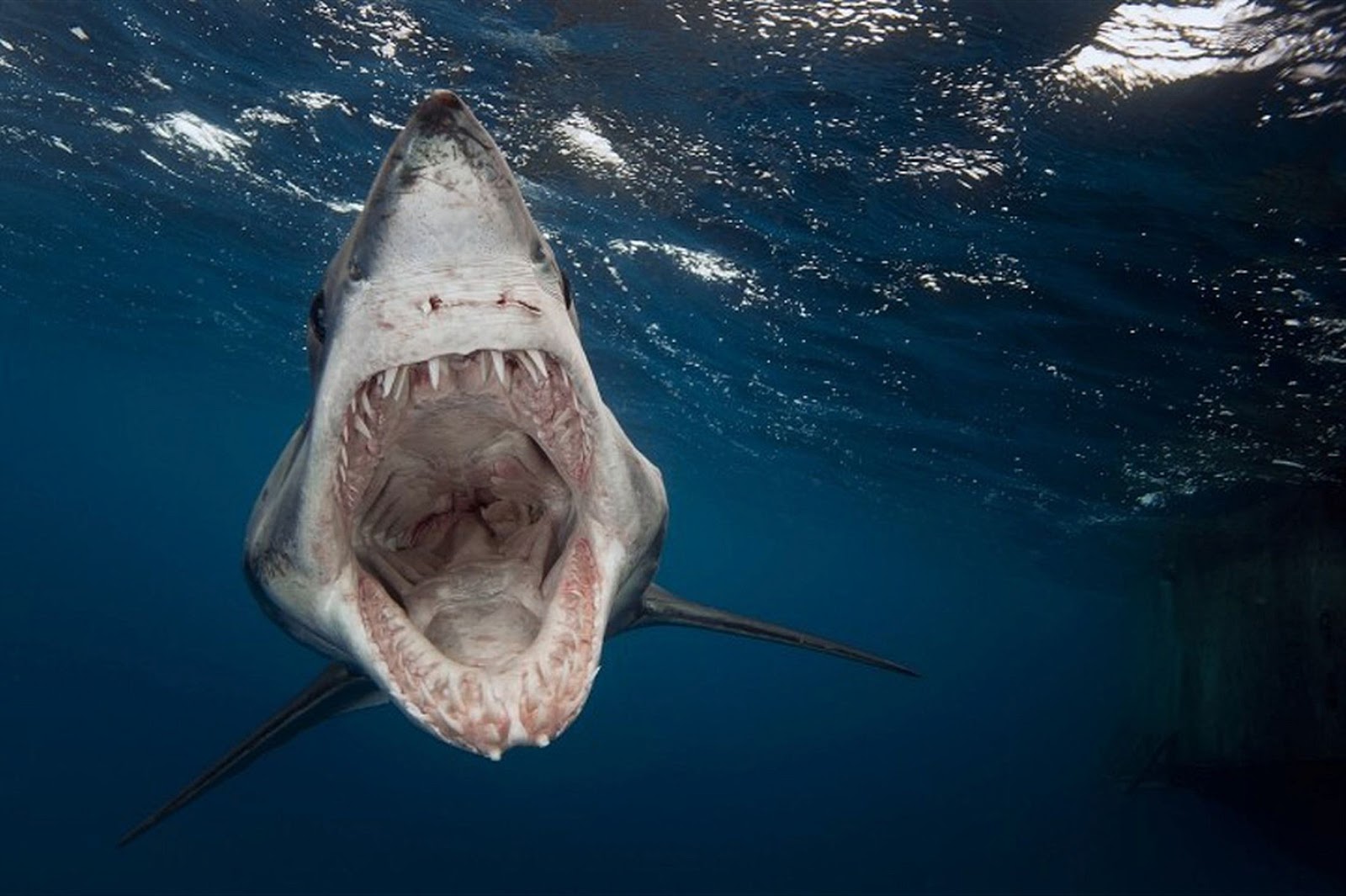
His stellar Mako shot (here's an even better one!) has bagged him the coveted Best of Show award in the prestigious Our World Underwater international underwater photography and video competition!
Huge congratulations mate - and it could not have happened to a nicer guy!
Check out the pic! Yes that would be a Shortfin Mako and a Great White in the same frame - possibly a world first?
Sam is one of the good ones and I'm happy he got the shot. He is extremely dedicated, to the point that he must have amassed hundreds of dives between us and the guys down the road - and obviously, the quality of the pics has improved accordingly, especially those from Shark Reef were he has been gradually allowed to get ever closer to the action.
This pic is from Oz with the incomparable Andrew Fox. We regularly talk and I understand that it is the result of the same dedication - and like always, of a huge helping of luck!
And because it's so nice, here's another stellar shot of that Mako. Both are highly compressed as the hope is that he'll be able to translate the originals into some well deserved income - fingers crossed! Well done Sam!
I had another look at the video and did grab a few more screen shots: turns out that that Tiger was not BRAT but our old nemesis Adi, aka Princess!
Adi goes back all the way to 2005 when she turned up on a dive with Michael. Check out his pic on the website, and Andrew's description: she was tiny but already with a huge attitude - and lemme tell you, the latter has only gotten worse! Case in point, Klaus' rather epic dive a few years ago where he managed to somehow snap the picture on top whilst fending off several attempts to chew on his strobes, and my screen shot for comparison.
Ozzie Sam agrees. He diplomatically writes, this tiger is smaller than BRAT and I agree that she is almost over friendly and yes, after she thankfully took it onto herself to bump the housing a grand total of 8 times, camera running, on that dive alone, I would have to agree that she definitely is! Here's one of Sam's usual stellar portraits, again with my screen shot for comparison - check out the pattern in the corner of the mouth.
And the pic on Juerg's blog? Unequivocally the true BRAT, equally by Klaus - compare with the pictures here!
Thanks Sam, as always your assistance is greatly appreciated!
If only all Shark photographers would care as much!
Sam Cahir does combine brilliant, and always improving photographic skills with the genuine wish to do something for the animals he loves. He demonstrates this by enabling great pro-Shark stories like here, but also by donating all of the proceeds from his pictures sales to the GWS research and conservation efforts of the Fox Shark Research Foundation.
She turned up three years ago and remains a more occasional visitor. You can recognize her by the large lump, quite possibly a tumor on the right hand side behind the gills and above the pec, and by the many wrinkles around the gills that are totally unique (not even Granma has those) and likely a sign of protracted age.
Sam's visit has been a pleasure as always.
And as always, he got skunked by the weather that turned sour the day he arrived and is only slowly improving now that he is leaving - go wonder! Thus and despite of solid numbers, the elusive Bull Shark wallpaper shot has remained just that - the good news being that he'll have to come back and try again!
Ozzie Sam at the Neptune Islands - pic, obviously, by somebody else!Or not? Sam?
Here we go again.
Barry Bruceet al have recently published three papers on the GWS operations at the Neptune Islands.
This onedescribes that the GWS aggregate around the berleying (= chumming) sites on small spatial and temporal scales but that they still roam locally and then depart for long trips to other locations in Southern and Western Australia in line with "normal" behavior for this population of GWS.
This one describes an increase of numbers, and behavioral effects meaning that the GWS show increased residency, duration of visits and shallower swimming patterns, but that they may also become habituated to the berley and teaser bait, much like already mentioned here. All those findings however show high variability among individuals, with different residency pattern between "transients" and "temporary residents", and different individual behavior patterns when on site.
This latest one basically summarizes the findings of the previous ones and also mentions that Shark activity varies seasonally but also in between years, the latter likely linked (that is me speculating) to the massive climatic variations of ENSO.
Barry is an excellent researcher and his findings are undoubtedly correct.
They are also not at all surprising because they just show that what the operators do in order to attract and showcase the Sharks does work.
In essence, they confirm the central statement of Juerg's paper that chumming and food provisioning are unlikely to fundamentally change movement patterns at large spatial and temporal scales, and seem to only have a minor impact on the behaviour of large predatory sharks; hence, the creation of behavioural effects at the ecosystem level seems unlikely.
Which brings me straight over to the conclusions.
With all due respect for Bruce who's certainly a good man, I once again find them highly irritating!
There is an all-pervading undertone of, for lack of a better description, don't upset the natural course of things which is rather ridiculous considering the REAL threats facing Sharks and the fact that actually, the natural course of things and wilderness are alas very much concepts from the past.
The consequence of that mindset appears to be a frustrating unwillingness to look at positives but instead engage in unsubstantiated negative speculation that ultimately discredits the great work by the Shark diving operators, has led to unwelcome intervention by the authorities and has even been used by our detractors to further their anti-industry agendas.
Not good.
But let's look at some of the details.
The increase in numbers.
In essence, the results confirm Juerg's findings about our Bull Sharks, this however possibly with one crucial difference:
whereas it is undoubtedly so that the increase in our Bull Shark
sightings is a direct result of our provisioning, the Neptune Islands
operation follows the global pattern whereby GWS cage dive operations are being
set up where GWS already aggregate naturally - and as a consequence, the increase
in numbers is more likely to be the result of a general increase of
Australian GWS numbers (and those of their prey!) after their protection in the late 90ies.
The researchers state that
An increase in shark sightings at the North Neptune Islands would be consistent with an increase in population size in response to the species protection in Australian waters in the late 1990s (Malcolm et al. 2001); however, there are currently no effective population metrics in Australian waters from which to assess population trends or status. The lack of available measures of population size combined with these interannual variations makes it difficult to conclude population-level changes in abundance from these data.
Well, yes, maybe.
How about if the new Sharks were principally sub-adults and young adults? Would that not be a strong indication that 20-odd years of protection are showing an effect?
This is incredibly important - not only with regards to assessing the impacts of Shark chumming at the Neptune Islands, but also in order to better assess the current mess in Western Australia and mutatis mutandis, the necessity (or more likely not) of increased GWS protection in California!
Yes it is of course fraught with political conundrums as a population increase could eventually mandate a relaxing of conservation measures - but does that mean that researchers should dodge the issue and risk reaching the wrong conclusions, as quite possibly in the present case?
Other than that, there are concerns that increased numbers (and residency) may lead to over-exploitation of local natural resources and possibly, to more brawling. But is that really the case?
Well yes, maybe.
But so far, this is unsubstantiated speculation - tho eminently testable!
But then again, assuming that the Neptunes are a mating site, would higher numbers not also lead to increased chances of mating due to the presence of more potential partners?
Retracted - they are NOT a mating site!
Local behavioral changes
Yes, like here in Fiji, they definitely happen - and so what?
The concern of the researchers is that the change in residency, diel patterns, and their local aggregation at the chumming sites may either harm the Sharks by preventing them from engaging in sufficient predation (but see above - so which is the risk, too much or too little?), or harm the environment at large by subtracting the Sharks and thus preventing them from fulfilling their natural functions there. But is that really the case?
Well yes, maybe.
But so far, this is unsubstantiated speculation - tho eminently testable!
And even if so, there is large individual variance meaning that these effects are certainly not relevant at the population level; and the remarks about habituation also signify that the effects are not long term as the Sharks catch on to the fact that they are being duped and eventually stop bothering.
Provisioning.
The papers appear to consider this the ultimate sin.
The reasoning is that allowing the Sharks to feed on the bait would provide them with food that is possibly calorically inferior to the pinnipeds they are supposed to target.
So lemme get this right.
Attracting the Sharks with chum and inducing them to waste time and energy on fruitless "hunts" where they get zero reward is apparently unproblematic - but compensating them for the caloric losses with at least some food is a big no-no?
With all due respect, this is just simply ludicrous!
Long story short?
This is valuable and important research - but I just don't like the gist of it.
Like many (but by no means all - and here!) of his colleagues, Barry appears to be of the general opinion that Shark diving operations are somehow bad because they somehow mess with nature.
In fact a more favorable interpretation of the results of his research may have come to the conclusion that the cage diving operations at the Neptune Islands trigger no fundamental changes at large spatial and temporal scales, thatthere are no fundamental effects at the population leveland thateffects at small temporal and spatial scales are likely small and so far unsubstantiated.
In essence, it's about whether the glass is half full or half empty.
Yes it's a matter of interpretation - but with every new paper getting published on the subject, the evidence is increasing that the immediate local effects of chumming and even provisioning are, if at all, very small indeed whereas the effects on the Sharks' life history are quite definitely negligible.
But of course that's only the strictly scientific aspect of the equation.
A more holistic view of Shark diving reveals important economic benefits whereby the industry generates multiples in renewable, sustainable local income when compared to the alternative of fishing. Although I remain somewhat skeptical of the positive effects of caged diving that showcase excited toothy macro predators at their very worst behavior and may consequently appeal more to the adrenaline junkies, it is also a fact that (cageless) Shark diving does create Shark advocates.
The above are important drivers of Shark conservation and in fact, the protection of the GWS in Australia is in large part the result of the incessant advocacy of GWS pioneers Rodney and Andrew Fox, and of Ron and Valerie after whom the Neptune Islands MPA has been named.
Barry Bruce of course knows that.
He is a frequent guest on Andrew's boat who provides help both logistically but also in terms of actual research via his and his father's foundation, and I would have hoped for some more empathy for the situation of the operators and solidarity in exchange?
It's not about changing research results - that would of course be totally uncalled for.
It's about a more positive interpretation - and why not engage in some research in order to at least substantiate one's reservations before concentrating on possible negative aspects and publishing recommendations that substantially impinge on the Shark diving operations!
And in general terms, why not look at that glass again.
It is not half empty - it is three quarters full, and the contents are pure unadulterated goodness!
Awesome pic - click on it! May we deduce that Sam must have been pretty close to that Shark? We may indeed! :)
Yes the Bulls are running fast and furious! We're currently hosting some of the usual suspects who have flocked in to witness the spectacle, and the inevitable socializing schedule has been keeping me away from the blogosphere - so here's a brief re-cap before I mosey over to the next event.
Sasha has come and gone (and yes, Aleksey and Olga did make it out of Moscow in time!) and I very much look forward to a massive dose of Russian heroism once he gets home! Suffice to say that some of his dives have been, for lack of a better word: quite spicy, and that he could write whole dissertations about the electric signature of a particular brand of underwater strobes! Meaning that I also expect him to post a whole new crop of terrific sharky pics!
Ozzie Sam is still here - and about to get rained in as always! :) But not to worry: as witnessed above, he's already gotten the shot! Plus, the man lives just a stone's throw away and I have no doubt that he shall be back for more (Sharks and rain!) very very soon indeed!
Which cannot be said of Juerg! Viewed from Fiji, Switzerland is about as antipodean as it gets and ever since becoming a pater familias (yes, Marlen may beg to differ!), his visits have alas become a rare treat. This is to be savored, the more as like always, he has come bearing gifts - and not in the Greek way! The goodies: heaps of inegschmuggletiMettwuerscht vom Bell!
But I'm digressing. As always, we got plans - and as always, ah aint telling you quite yet! Suffice to say that we're about to start something new and that Juerg is profiting from the unequaled (!) Fijian tranquility to put the final touches on a whole array of new papers - so as always, keep watching this space!
Ozzie Sam has finally released his epic Mako shots, e.g. here, here and here - and being the consummate Shark diver he is, he was never at risk and is doing extremely well, thank you very much!
And not only that.
This amazing shot of the Mako with a GWS is probably a global first, and insiders know that he's got a whole suite of simply stellar new GWS pics that he'll hopefully publish real soon.
Nothing spectacular mind you: but things are ticking along very nicely indeed.
The
research has once again yielded one great paper, see below, with three
more (!!!) due in the immediate future - and when it comes to the field
work, we've successfully completed a massive and (so far) secret
project that will complement the hugely popular GFSC, and are about to embark into a rather monumental research endeavor with Projects Abroad that will undoubtedly result in more useful insights allowing us to ever refine our conservation strategies.
Other than that, business is good, the staff are healthy and happy and the SRMR is thriving - and we will turn 10 in April which is nothing short of a miracle!
I've decided that I'm gonna spare myself the lengthy intro.
More and more, I find myself repeating what I've already stated ages ago, so why bother. Should you really not know where I'm generally coming from, feel free to peruse the last recaps here and here, and maybe read the post about Shark diving, that old post about Shark conservation and finally, the post about the need for a change of paradigms - the latter with many links that you should equally peruse!
Granted, some of the data (e.g. the extent of the Shark fishing mortality) are now obsolete owing to new insights - but in general terms, that's what I believe.
Too far out there? No worries, I'll continue carrying the moniker of Judas Conservationist with the greatest pride and satisfaction - and let's then talk again next year! :)
So without further ado.
Remember these are opinions - not the truth!
Most impressive Shark Conservation Org:The Pew Environment Group
This time, I'm not only nominating the Shark Campaign because there is their Global Ocean Legacy Campaign that is increasingly overlapping and complementing the Shark-centric sanctuaries effort, see e.g. Bermuda and Pitcairn. Talking of which, I also hear that we may be witnessing the reappearance of Matt which would be a great blessing indeed!
Be it as it may, they just simply stand heads and shoulders, and then some, above everybody else - and the unofficial list of their achievements in 2013, foremost of which the CITES win, is once again unparalleled and deserves our admiration and gratitude.
With caveats mind you. The principal one being that rightly or wrongly, they continuously stand accused of walking away once they achieve legislative change and leaving the long term implementation = heavy lifting to others, namely to the RFMOs and local governments that often lack adequate resources, and to the local NGOs. Of course that's partly pernicious sniping by less successful competitors and partly factually misleading, as the implementation of legislation is obviously a prerogative of governments - but there's certainly also a kernel of truth and more importantly, it's bad publicity that Pew would be well advised to vigorously address, both in words and in deeds!
Best Shark Conservation Advocacy Group: Shark Savers
Once again, in their own category, they are simply without peer - especially when compared to the con artists in California, NYC and Jersey! Yes they don't only engage in advocacy but also pursue research and hands-on conservation at the legislative level - but especially now that their merger with WildAid is about to be sanctioned, I expect an even bigger focus on curbing the demand side in Asia, a strategy that is clearly showing positive results.
But that's the future - for now, huge kudos to DaMary, Shawn, Michael, Sam, Jonn and Jennah for an extremely impressive job, see below!
Best Shark Conservation Campaign at the Grassroots Level: Pelagic Life
Now this is obviously highly subjective as I'm sure that there are many other groups doing stellar stuff on the ground - but these gals and guys happen to have caught my eye both with their México Pelágico project but above all, with their work in Baja that will result in a stellar ecotourism venture. So keep watching this space and by the same token, keep an eye out for Saving Our Sharks, equally from Mexico - it's gonna be challenging but by no means impossible!
Most
impressive individual Shark Conservation Advocate: DaMary
Well what can I say. It's her second nomination and she deserves every bit of it, and then some! Red her laudatio here, and here is a newer version highlighting the simply brilliant and in many ways pivotal role she has played in getting the Mantas listed at CITES. Bravo!
Best Marine Conservation Videos: Shawn Heinrichs
Well, Shawn is of course much more than just a video producer - foremost of which an eco-terrorist! :) The correct technical term is probably, indefatigable - and I must confess that I'm simply incapable of enumerating all of his activities that see him hopping around from one remote corner of the globe to the other like a maritime Energizer Bunny! And whereas others (not Shawn!) may sometimes get a tad tired of all that unbridled energy, one thing's for sure: the heart is very much in the right place and whether you like those mermaids or not, the outreach is simply phenomenal! Kudos!
Best Shark Defender: Angelo Taotaotasi aka the Saipan Blogger
He is of course long transcended being a mere person but is instead a brand - and as such, he very much eludes definition! :) Pointers for why I like him include smart, innovative, extremely well informed, analytical, pragmatic - and above all: very very witty! Pointers for why he is actually an asshole controversial: all of the above!
And the performance? Look no further than the rather epic rolling out of the Shark Stanley campaign for CITES, and the continued progress of Pew in closing down the Pacific to Shark fishing! Those are very much his babies - and whereas I have sometimes questioned his strategy and methods, the successes clearly speak for themselves! Here's to clever sheepherders! :)
Ocean Hero: RickMac
And it's not even my own accolade - unsung no more! One of my very favorite people, Rick had a traumatic first half of the year that culminated in his resignation from CORAL. The end of the year finds him greatly diminished physically but greatly enhanced both privately and professionally - and generally speaking simply happy, which is simply great! Buddy, can't wait for you to come diving again - this time with bated breath! :)
Most
impressive Shark Conservation Achievement: CITES 2013
This has been simply epic. Even I got caught up in the frenzy and partook vicariously with a barrage of posts. Once again, huge congratulations to everybody involved, foremost of which Pew and the Manta Ray of Hope project - and, and I cite, just a hint of a slow hand clap for those who will always believe that they know better, foremost of which the bickering Mobula lovers!
Best Citizen Science Project: Great Fiji Shark Count.
This is the only such nation-wide citizen science project and my hope is that it will be only the first of a whole array of similar endeavors. Huge thanks to the team, partners and donors who have successfully cooperated during the past four counts, with many more to come! And a special tip o' hat to the irreducible Sam and Shark Savers for the great cooperation during the Adopt-a-Bull-Shark project - it has been loads of fun, and the funds are highly welcome! Thank you! :)
Best Kids Education Project: Sharks4Kids
I missed the launch due to absence and have since failed to mention it: but this is the baby of Jillian the one, only and very much original Shark Girl - and it is great! Godspeed - and c'ya in Fiji sooner rather than later!
Best Shark Diving Paper: Bull Shark Provisioning in Fiji
What else! :) But seriously, this is really great stuff, and based on a huge amount of data that we have collected over many, many years. Please read it, understand the implications and then share your knowledge wide and far!
Yes obviously there has been more (but Guttridge et al is from 2012...) - so apologies for any involuntary (and voluntary) omissions!
Best Shark Movie: Of Shark and Man
Yes I know, it's not quite yet completed. But the teasers are simply stellar, and having seen what I've seen and knowing what I know, I for one look forward to David delivering something absolutely fantastic and unique. No pressure!
Best Resource for Shark Divers: Shark Angels
Yeah I know I know - but one gotta give credit where it is due. Excellent job!
Best Debunkers of Pseudoscience: Southern Fried Science
That's really where they excel, and in the propagation of important research. Alas, I cannot really say the same about some of David's opinion pieces. Yes many of views expressed by the movement are shameful in their ignorance and frustrating to the max - but not everything in Shark conservation pertains to fisheries management in the US, and Sharks are much more than simple objects of research and management! Come Shark diving buddy! :)
Most inspiring Visitors: Kerstin, Taryn and Jaap, Martin, Jero and Ana, Mary and Lupo, Bruno et Antonia, Warren, Ozzie Sam, Ingrid, Mike, Kris and Helen
You know who you are! And Mike: thank you so much mate - that was really, really nice of you! :)
Special Thanks: Gary and Brenda, Juerg, Drew, Nani, Tuma and Rusi
Ten years of friendship and adventure, and counting! :) You are the glue that holds it all together - thank you!
Special Mention: Scamsters, Vampires and Poo Pads, see at top!
I could elaborate but I shall not - for now! :)
And here endeth the ominous list!
The juicy part will follow in due course - keep watching this space! :)
PS - dang I forgot to mention Sharknado!!!
You choose the category!
Humblest apologies.
We had been at the Neptune Islands for 1 day and we had heaps of sharks, 18 in fact. We went down in the cage at the end of daylight (4.30pm) and I was just hanging out taking shots when I saw a shark in the distance. As she come closer I couldn't believe my eyes. This girl was absolutely mammoth and made the other sharks (some of which were 5m+) look like goldfish.
Her mouth was so big I genuinely think she could have swallowed me whole. Without doubt in the 6m class, Andy thinks she is possibly the biggest girl he has seen in 35 years of diving with White sharks. You will see from the pics that she is not near full weight and may have dropped pups last year her ribcage (for the want of a better term) sticks out so her liver is not engorged.
Enjoy.... Obviously the highlight of my short diving and photography career.
Wow - awesome!
That's what I call a GREAT White Shark!!!
Also, nice to see that at least one has survived the likes of Hyslop et al and grown to become one of those elusive submarines!
Mind you it is by no means terrible, the more as it correctly states that
The strict self-imposed management actions and limited number
of shark feeding operators at Shark Reef in Fiji, has resulted in
minimal long-term effects on bull shark (Carcharhinus leucas) behaviour
and diet, and is likely to have had no effects on health and fitness,
and that
Provisioning elasmobranchs, the activity deemed to have the most risk associated with it, can be effectively undertaken if appropriate management is in place (e.g. bull shark feeding at Shark Reef Reserve, Fiji)
But the paper is certainly also not good, either.
Like some of its equally irritating predecessors, it suggests that there is a problem urgently requiring third-party management = regulation, something I most strongly disagree with, especially when it comes to those forever maligned provisioned Shark dives.
It's same old same old.
Over the many years, I've blogged about the latterat nauseam and am actually tired tired tired of the bloody useless controversy - but here goes, just because this nonsense cannot remain unanswered.
Read the links!
1. Threats to Sharks and Rays (and their Habitats)
At risk of stating the obvious: the biggest threats to their populations are:
Overfishing (Targeted and Bycatch) Globally, overfishing of Elasmobranchs remains rampant due to widespread IUU and inadequate management, monitoring, enforcement and prosecution. Specifically, this equates to a yearly mortality of roughly 100 million Sharks that are being killed for the fins, their meat but also other products like e.g. squalene. That is clearly unsustainable and also means that whereas some local conservation efforts
have been highly successful, Elasmobranch conservation appears to be
largely failing at a global scale. And to add to the problem, we are additionally threatening Shark and Ray populations by equally overfishing their prey.
Global Warming and Ocean Acidification whose impacts are both direct but above all indirect (= just a small example) as every single marine ecosystem in general and all Elasmobranch habitats in particular are being severely affected, and this generally negatively. And of course no Shark or Ray will survive if we destroy their habitat!
Pollution Need I elaborate? And it's by no means only the plastic!
Human Encroachment This results in habitat change and degradation, and also in conflicts all the way to triggering large and indiscriminate responses that may indeed threaten some local populations like e.g. in Australia, South Africa and possibly, Reunion Island.
And Shark and Ray tourism?
Yeah, right.
Think that in comparison, tourism is in any way a relevant factor?
Actually, on the contrary!
Not only does Elasmobranch tourism not endanger Shark and Ray populations - but in the overriding majority of cases, it contributes substantially to their protection all the way to being its principal driver!
Of course not, see e.g. above - but it is certainly not catastrophic, either!
Specifically:
A.Overcrowding and Competition.
This can be a cause for concern.
Especially in multi-user sites, the competition between too many uncoordinated and/or unmanaged tourism
operators can lead to excesses that can inconvenience or even harm the
animals.
And if so, and only if the industry itself is not able, or willing to cooperate and to self-regulate, then the authorities may indeed have to step in
with some common-sense regulations, like limits in the numbers of
tourists and/or operators and/or vessels, or e.g. licenses so that the
authorities can obtain some data and/or income for monitoring, or common sense codes of conduct, etc.
But regulation should always be the exception and not the rule lest it becomes stifling or even counterproductive!
B.Shark Feeding.
This is what we have learned over the many years.
Shark feeding appears unproblematic at the ecosystem level All research into those baited Shark dives appears to concur that those dives have little to no effect
at large spatial and temporal scales. It appears pretty clear that far from becoming dependent on the handouts, those provisioned Sharks
continue to fulfill their ecological roles and also continue to follow
their normal life cycles as in e.g. mating, pupping and migrating = there are no described major negative effects impinging on the viability of those populations.
However, there are certainly effects at small spatial and temporal scales. Shark
feeding often aggregates the animals, and this can have local
consequences. As an example, take the increased aggression of those Lemons in Moorea; or the observed competitive exclusion
of other Sharks in South Africa and possibly Fiji (= much has changed since that paper, and many of the intermediate Sharks are back, for reasons unknown); or those postulated
local behavioral changes and marginally increased residency in Southern Australia. That said, the effects are clearly rather minor and don't appear to at all threaten local populations.
And some of the other marine life may be affected insofar as they, too, may aggregate and partake in a meal = incidentally much like they do in countless other occasions ranging from organic waste being pumped into the oceans by discharges and e.g. rivers all the way to targeted feeding - and now please do tell me which has the by far greater impact!
Plus, let's not forget
the impact of the thousands upon thousands of people who feed and condition Sharks and other Fishes on a
daily basis, i.e. the fishermen and spearos! Case in point:
And this is being repeated, mutatis mutandis, countless times wherever there are fishermen = always and everywhere!
--> C'mon, seriously: do you really believe that the incremental effect of a few dozen Shark feeding operators is in any way relevant to the health of Elasmobranch populations?
So let's please be crystal clear about the following:
Elasmobranch tourism does in no way threaten the survival of the populations of the Sharks and Rays it showcases - period!
2. Threats to People
Again, this is obviously about Shark Feeding.
As per the below table, the authors considers it to be extremely dangerous, and also postulate the urgent need for regulation
owing to widespread lack of management.
Click for detail!
But if so and Shark feeding is so damn dangerous - how come that actually, we are not drowning in horrible injuries and fatalities?
There is no geographical correlation between Shark feeding and Shark strikes. Re-read this.
In brief and with maybe the exception of SA, the vast majority of Shark
strikes occurs in locationswhere there are no Shark feeding operations
(like e.g. Florida, California, Western Australia, Reunion or Recife, Brazil) - which is even more surprising if one considers that most of those
dives have been established in places that are known for their
healthy Shark populations! And even if there were some correlation, it certainly does not equate causation = there is a grand total of zero evidence that Shark feeding endangers the public at large!
And again, let's not forget the fishermen and spearos, see above! Re-read this (yup that would be more than 10 years ago!) - case in point e.g. here, and then e.g. here and here for the spearos, among many, many such examples! Think that in comparison, a few Shark diving operators are in any way relevant ?
But of course there are some caveats.
Location matters. Many Shark dives have been being established
where there are already Sharks, meaning that objectively speaking, the
risk profile is unlikely to change - but perceptions matter and like in
the case of population centers like, say, Cape Town or Playa, the diving
activity and associated increased publicity of Sharks can lead to
conflicts with the other local ocean users. Consequently, as a rule, the
feeding locations need to be as remote as possible and should
definitely not be established e.g. right in the middle of population
centers or right in front of popular beaches etc.
Obtaining the required social license and stakeholder involvement are crucial. The
local stakeholders need to become an integral part of these projects -
and this not only through regular awareness, education and consultations
but also by letting them partake in the financial windfall, both
indirectly but very much also directly. This will help avoid unnecessary risks (eg by having locals avoid the feeding sites), help protect the animals and ensure crucial
local support when the inevitable problems will arise.
Get in the research. The best argument against many of the
intuitively plausible reservations of our detractors are strong
scientific data. As an example, when people got bitten
by Bull Sharks in Cancun and everybody tried to blame the Shark feeding
operations in Playa, the operators there had the data showing that they
were only feeding females whereas the Bull Shark population in Cancun
was only comprised of males. Or in our case, our Bull Shark data show
conclusively that we are neither causing residency nor any dependency on
our handouts - which right now is helping us make the argument that the present reduction in Shark feeding due to Covid-19 is not endangering our beachgoers!
B. Safety of the Participants.
This is a different matter altogether.
Contrary to the public at large that may be unaware and/or unsupportive of, and thus be subjected to Shark provisioning, anybody partaking in Shark feeding dives knows what they are getting themselves into, and is thus implicitly approving of the activity and possibly even assuming the associated risks.
Still, we strongly advocate that the operators of commercial divesneed to keep their clients (and their employees!) safe - and if not, they need to be held accountable.
The following considerations apply.
Feeding protocols. Like I often state, it is often not about the WHAT but about the HOW. Shark provisioning creates its own risks, and those risks need to be managed
- meaning that all protocols should be chosen in function of minimizing
the impact on both the animals and the habitat, and on maximizing the
safety for the participants but also the public at large. E.g., everybody will
hopefully agree that creating humongous chum trails or dumping
indiscriminate amounts of bait to create feeding frenzies is probably a
bad idea. Here at BAD, we run a tightly choreographed dive with stringent safety protocols that is often hailed as a template for sustainable Shark feeding, see the citations at the top. Or as another example, we go to great lengths to
condition the Bulls never to come to the surface, lest we get accused of
endangering other aquatic recreationists. In brief, we need to be
in a position to demonstrate that we are always striving to conduct our
dives in the safest possible way - think, Airline Industry!
Shark bites will nevertheless happen. As Sharks feeding is risky, the risk will sometimes eventuate - and there is really nothing whatsoever we can do about it apart from protecting ourselves (= steel mesh!) and then dealing professionally with the consequences - and if we do, I am convinced that the consequences will be minimal. Case in point: it didn't quite happen like that - but a client did get bitten
despite of arguably the industry's most stringent protocols, and no
degree of management would have prevented it. And he obviously survived
because we were prepared in terms of training, medical supplies and evacuation protocols, as everybody should be!
There are Shark strikes and Shark strikes. Whereas
Shark provisioning is certainly a dangerous undertaking requiring skills and circumspection, everybody in
the industry agrees that the cause for bites during provisioned dives is
either a) self defense, b) competition or c) mistakes - not predation = those bites can be serious, but the consequences of a fully fledged predatory attack would be something else altogether! Exception - but the guy was certainly asking for it!
Yes we certainly condition the Sharks, and yes they learn, and this very fast indeed - but they learn to eat bait, not humans!
It is also absolutely plausible to assume
that provisioned Sharks may have learned to e.g. associate the boat noise
with a subsequent
feeding opportunity, and will thus aggregate when they hear the vessels, or when the operators rev the engines in order to "ring the dinner bell". But "turning up" does not equate "attacking"!
And finally, with one single fatality (or possibly two) recorded in thousands upon thousands of Shark feeds, baited Shark dives are many orders of magnitude safer than SCUBA! This is because contrary to ordinary diving where people are routinely being thrown into situations that can prove to be treacherous, baited and provisioned Shark dives are nearly always supervised and choreographed = help is always quickly at hand. Also, and provided that
(!) we act responsibly, yours truly and every single Shark diving
operator I've ever asked have made the observation that the conditioned Sharks
become positively tame, meaning that the risk of a bite is lower not
higher! Case in point: look no further than Florida and Tiger Beach, home of troglodytes, Shark molesters and media whores, and scene of ever stupider shenanigans by self-promoting Shark whisperers and awareness raisers - and yet nobody is being killed as those poor Sharks are quite obviously unendingly tolerant and forgiving!
And there you have it.
When it comes to those Shark feeding dives, I remain convinced that regulation makes only sense in those multi-user sites suffering from overcrowding, and this only when the industry is not able, or willing to cooperate and self regulate, like what is quite possibly happening in Playa.
Other than that, any incidents are already suitably covered.
Since the participants are most certainly willing, those ubiquitous liability waivers should be allowed to stand in minor cases. And any grossly negligent harm to customers can be adequately prosecuted under existing local legislation, whereas existing OHS regulations will suffice to deal with any failure in training and protecting one's employees.
Free diving with large predatory Sharks in baited conditions used to largely be private undertakings but it is now being increasingly offered commercially. From this vantage point, this is bringing about a whole new set of specific risks (= foremost of which the great vulnerability of the customers at the water surface) that the paper appears to completely neglect.
This is novel territory that needs to be closely monitored, the more as those operations are mostly shoestring and largely improvised (and IMO highly sketchy), and with no relevant assets = nothing much to be had should the obvious risks end up eventuating.
But then again, nobody so far has died despite of all the stupid shenanigans, so who am I to say!
3. Long story short?
What really disappoints me is this.
We are in the middle of the sixth, anthropocene mass extinction requiring all hands on deck in order to try and stem the ongoing catastrophic loss of biodiversity - and yet some quarters find it fit to continue wasting scarce resources in terms of time, brain power and possibly also money on these irrelevant trifles.
The actual physical footprint of our industry is tiny.
And yet, we punch way above our weight in terms of outreach but also Shark and Ray conservation and research, and as such are an important agent for positive change = far from being a problem, we are very much part of the solution!
So why this exasperating fixation on wanting to meddle with what we do?
Yes, sure: we need to operate responsibly.
As ecotourism operators, all of us need to strive to have the smallest possible negative impact on the animals and their habitat, and we also need to operate safely - and the vast majority of us actually do!
Furthermore, we continue to learn from our mistakes, and continue to improve and refine our procedures, like we always have. In fact, we now even have an association of industry pioneers, leaders and trend setters that routinely discuss issues and develop solutions - like right now, we are developing Covid-19 protocols!
And if not, the market will do what markets do.
This is a small community where there are no secrets, and notorious transgressors will be
quickly weeded out as no travel agent and/or tourist will book dives with operators that are
known to be unsustainable and/or exploitative and/or life threatening =
which is why I continue to strongly support the establishment of a rating system
akin to what has been proposed here!
But enough said - like I said, I'm tired of this shit.
We did not ask for this - and all this incessant nagging and lecturing
by people who ultimately have no clue about, and zero investment into
our industry is frankly becoming terminally irksome.
There is now a
whole cabal of incidentally mainly female researchers whose academic
niche (and thus career and thus income) is predicated upon being
considered ecotourism experts, or whatever, and who appear to be
operating with questionable agendas and also appear to desperately want
to meddle instead of waiting to be asked.
Anyway.
When it comes to the global Shark diving industry in general, there are now one excellent paper and one good one (both, incidentally, by experienced Shark divers!) and several that are not, see e.g. here and also here, and here with links. And now there is this.
That's plenty enough, thank you very much. And now, please, why don't you just fuck off - because we actually got work to do, salaries to pay and tourists to wow!
No hard feelings, love you all! :)
2025 - PS!!!!: Talking of Tiger Beach, you may want to research this and watch this.
In brief, a SharkSchool participant was literally ripped to pieces in a Shark feeding frenzy.
In my professional judgement, the tragic incident was 100% due to the lousy procedures, blatant incompetence and gross negligence of the operator(s) - and yet from what I can discern, there has been zero introspection by the local industry, and the same lousy procedures continue completely unchanged, and this despite of an ever-increasing complement of demented Tiger-redirecting free-diving sharkitarians, courtesy of the teachings of Ramsey & Co!
 Here’s to Sam Cahir!
 “Bully”, from Sam’s latest 2010 crop – very very nice indeed!