Tuesday, October 15, 2019

Galoa Village: Plastic Repurposing Workshops!


Behold!


Well, what can I say.
Officially, this is being presented as a spinoff of our stellar My Fiji Shark initiative - but in reality, all the spinning has led way, way off course - to the point that this really got nothing to anymore do with Sharks and marine conservation, let alone Shark adoptions like originally envisioned. 
And yes, it is what it is - and I can certainly leave it at that!
 
Anyway.
This is now strictly a standalone project by the UNDP, SPTO and local artiste and serial waste-to-art workshop supremo Warwick Marlow where BAD and MFS play no role and also get zero benefit - but as long as this is not just an exercise in BS, and the women from our partner village Galoa are happy and get to earn an extra buck, that's perfectly fine with us!

And My Fiji Shark?
Going strong as ever, and then some! 
And as chance would have it, we're about to celebrate our one-year anniversary - and Tashi Blue has decided that this momentous occasion warrants some special celebratory offers!
So keep your eyes peeled on the MFS website and above all, on the MFS Facebook page where some announcements are forthcoming!

And most importantly.
Please, Adopt Your Shark Now!
Thank you!
 

Bubble-Net Feeding - Video!

Source.

Awesome.
Story here - enjoy!


Monday, October 14, 2019

NZ Cage Diving - the Saga continues!

Source.

Well well.

Read this.
Looks like the NZ GWS tourism industry has been granted a new lease on life. My sources tell me that  of the two operators, Shark Experience are by far the better - so good on them for having persevered and ultimately prevailed!

And Peter Scott's Shark Dive NZ? 
Thankfully they appear to have thrown in the towel for good. So here's to this being the start of smarter, more sustainable and more inclusive Shark tourism, and to the end of the horrible Shark porn those people have enabled - and worry not, they read this blog and the distaste is 100% mutual! :)

Anyway.
Let's go Shark diving - sustainably!
 

Sunday, October 13, 2019

Pyjama Shark vs Octopus!


Behold!

Yeah I know it's a tad old.
But many have not yet seen it, so there.
Story here - enjoy!


Saturday, October 12, 2019

Terrifying Moment?

Source.

Really?

It is about this encounter (and incidentally, it is 100% a GWS), and the Shark could not have been more peaceful, much as per Nina's original description here.

Shame on you Daily Mail!
 

Thursday, October 10, 2019

Mystery Sharks from Myanmar?


Check out the above - click for detail.

So, what Sharks are those?
I took the pic at Black Rock way back then in 1998. Back then there was no digital = this would be a so-called "professional scan" of the 35mm Kodachrome 64 slide - and yes those would be fucking hairs!
Anyway, there was a massive El NiƱo that was cooking the reefs in the Indian Ocean and beyond - but the hot water there was somehow causing a freezing cold upwelling in the Andaman Sea, and we were seeing plenty of deeper water Fishes like e.g. this rather rare Pterois mombasae we found at Richelieu Rock.
Check it out, it's an awesome Fish!


In brief, we were freezing our asses but having a blast.
Richelieu Rock was pumping with the usual Whale Sharks and a whole array of unusual critters among which mating Guitarfish, Kho Bon had dozens of Zebra Sharks and the Burma Banks, the usual assemblage of Tawnies and large territorial Silvertips;  and Black Rock was overrun with Manta Rays, to the point that we decided to turn off the engine of the dinghy and use the oars for fear of hitting one. 
We put down a few fish heads and had a few Grey Reefies come nosy about, only to be scared away by these two much larger Sharks. Both females and both likely shredded by mating, they came in hot and put up a short but awesome display of strength and assertiveness, only to quickly abscond with the bait.

There was quite some debate about the species.
Ron who was obviously way more experienced thought they may have been Graceful Sharks; I was more inclined towards them being unusually large Blacktips, and actually still think they are - and if so, they would most certainly be the largest such Sharks I've ever seen as they were clearly above 2 meters long. Or could they have been large Spinners - tho if so, where are the pinnae brevis?

Thoughts?

PS - Will confirms that they're most likely Blacktips. They look identical to Australian Blacktips (C. tilstoni) who are however strictly endemic to Australia - but thank you Julia! :)
 

GWS vs Kayak!


Watch - story here.
Scary as hell for sure - but getting those teeth in exchange is simply awesome!


Friday, October 04, 2019

Catching GWS in California!

Source.

Oh for crying out loud - watch.


Yup that would be a juvenile GWS.
White Sharks are protected in the USA in general and specifically, in California where this is happening, and one would think that this is unlawful and would warrant prosecution.
Regulations here.

Well, think again. 
Very much like what has been happening until recently in Florida, the authorities are apparently choosing to not intervene, or to drop the charges or levy ludicrous fines when they do - and the fishermen know that and continue to target and reel in the Sharks in quasi total impunity. 
Kudos to the indefatigable Mr. Bland for having meticulously researched the topic and published this excellent essay.

Anyway.
I say, it's time for some kicking of lazy bureaucrat asses - like in Florida!

Kim?
 

Tuesday, October 01, 2019

Stegostoma tigrinum?

The sandy morph of S. tigrinum: transitional (A–D) and adult (E–H). Close up of the skin pattern on the right lateral flank of a transitional specimen (B–C) and of remnants of the transitional pattern on flank and caudal-fin tip of adults (F–G). Click for detail.


Oh well

After the demotion of the Manta Rays, now this.
Looks like they've changed the species name of the mimic Zebra Shark. I first thought it was just a bad joke - but having asked my Zebra Shark guru, she replies,
Yes. I reviewed it as did Will White. 
They did a pretty thorough job with the taxonomy, though whether it’s worth changing the species name is open to debate me thinks.
Methinks, too.
But then again, they really did do a thorough job so this may indeed be it.

Le fasciatum est mort - vive le tigrinum!
 

Saturday, September 28, 2019

Are we ready for more Sharks?

Good question!

Read this.
It pretty much completely summarizes this timely little scientific article, so no need to write synopses etc. In brief, those Shark conservation successes may turn out to be be fleeting - especially in those highly populated and/or highly tourism-dependent areas where Shark-human conflicts may increase as a consequence, see e.g. the situation in Cape Cod where IMO we're already only a few Shark bites away from the next Shark/Seal cull.

The authors write,
While widespread success in recovering elasmobranch populations is some time away, scientists, advocates and managers need to be prepared for societal conflicts that may arise when and where it does occur. In particular, implications for current and future conservation management need to be considered as part of conservation strategies in the context of how humans will interact and potentially compete with recovering species.

This will require, from the outset, increased public education and outreach regarding the potential future implications of conservation success and strategies to reduce conflict in order to avoid negative responses to successful conservation outcomes or the thwarting of future conservation endeavours.
That is certainly correct. 
But education and outreach can only go so far, and methinks that akin to what is happening in the highly intractable and complex issue of terrestrial human-wildlife coexistence and human-wildlife conflict mitigation, all will have to be highly species-, location- and context-specific.
And in some cases = where and when other less invasive approaches fail, we may well have to accept that some individual animals may have to be sacrificed so that their populations can continue to survive - see the paper's example of the Galapagos Sharks vs the Hawaiian Monk Seals that is highly reminiscent of Eric's Shark profiling proposal.

As always we shall see shall we not.
And anyway, I say, wouldn't that be a nice problem to have = so first and foremost, let's please make sure that Shark populations recover!

But back to more pleasant matters. 
Let's go Shark diving - sustainably!

PS - Michael Domeier here.
Like him I abhor the illegal out-of-cage diving with GWS and especially, the Shark riding and molesting. But unlike him I really do not believe that any resulting bites would have any implications whatsoever on Shark conservation - rather, nowadays the victim would be rightly berated for having been a fool and the news cycle would quickly move on.
 

Sunday, September 22, 2019

Surfer and GWS!

Please click for detail.

Wow - stories here and here.

Human Impact on the World’s Ocean - Paper!

Click for detail - you can download a list of the stressors here!

Check this out.

Prima vista, it sure doesn't look good.
But if you explore the graph at the top, there are also a few success stories where some countries like e.g. South Korea appear to have substantially reduced domestic commercial fishing (Really? Maybe only to fish more abroad...?) and also pollution.
Stories here.

The graph also clearly shows the principal threat. 
We can try and continue tinkering at the edges and reduce, recycle, innovate and manage, etc etc etc - but unless we successfully tackle Global Warming we're all going to be fucked. And yes little Swedish girls and global strikes, or whatever, are nice - but let there be no doubt that ultimately, the only way to achieve positive change is at the ballot box = and who needs to vote is not them but YOU.

Anyway.
Please do your due diligence, and go and kick vote the wrong people out of office, and vote the right people in!
And no I'm not particularly hopeful.
 

Saturday, September 21, 2019

GWS in Indonesia!

Awesome - and thank you Serena for the heads-up!

This happened today in Nusa Penida.
I hear it was in 22m and that there was a  13 degree thermocline - but who knows whether that is relevant.
But the cold water sure brings in the Mola Molas, see at top.

Anyway - enjoy!


Tuesday, September 10, 2019

GWS vs Spearo!


Behold!

This is scary shit.
Then again, the dude appears to be hanging on to some Fish, see 00:32 in the video here?


Anyway, glad he got away unscathed!
Enjoy!
 

Monday, September 02, 2019

Bloody Pumice!


Oh for crying out loud!

They've discovered a bloody pumice raft.
This is how it looks up close and apparently, it's quite huge.


No, it ain't gonna be saving bloody anything, sorry.
Instead, it may well bloody drift over here like last time - and if so, we're in for weeks upon weeks of bloody nuisance as the bloody pumice pebbles fall to bloody buoyant sand and then dust, and keep on clogging the bloody water intakes of our engines in the process.

Oh, and read this.
Now you know!

Anyway.
Let's go Shark diving - hopefully, sans pumice!

PS - and here it bloody comes... :(
PPS - bingo - and here!

Sunday, September 01, 2019

Friday, August 30, 2019

High Seas: Sharks vs Fishing - Epic Paper!

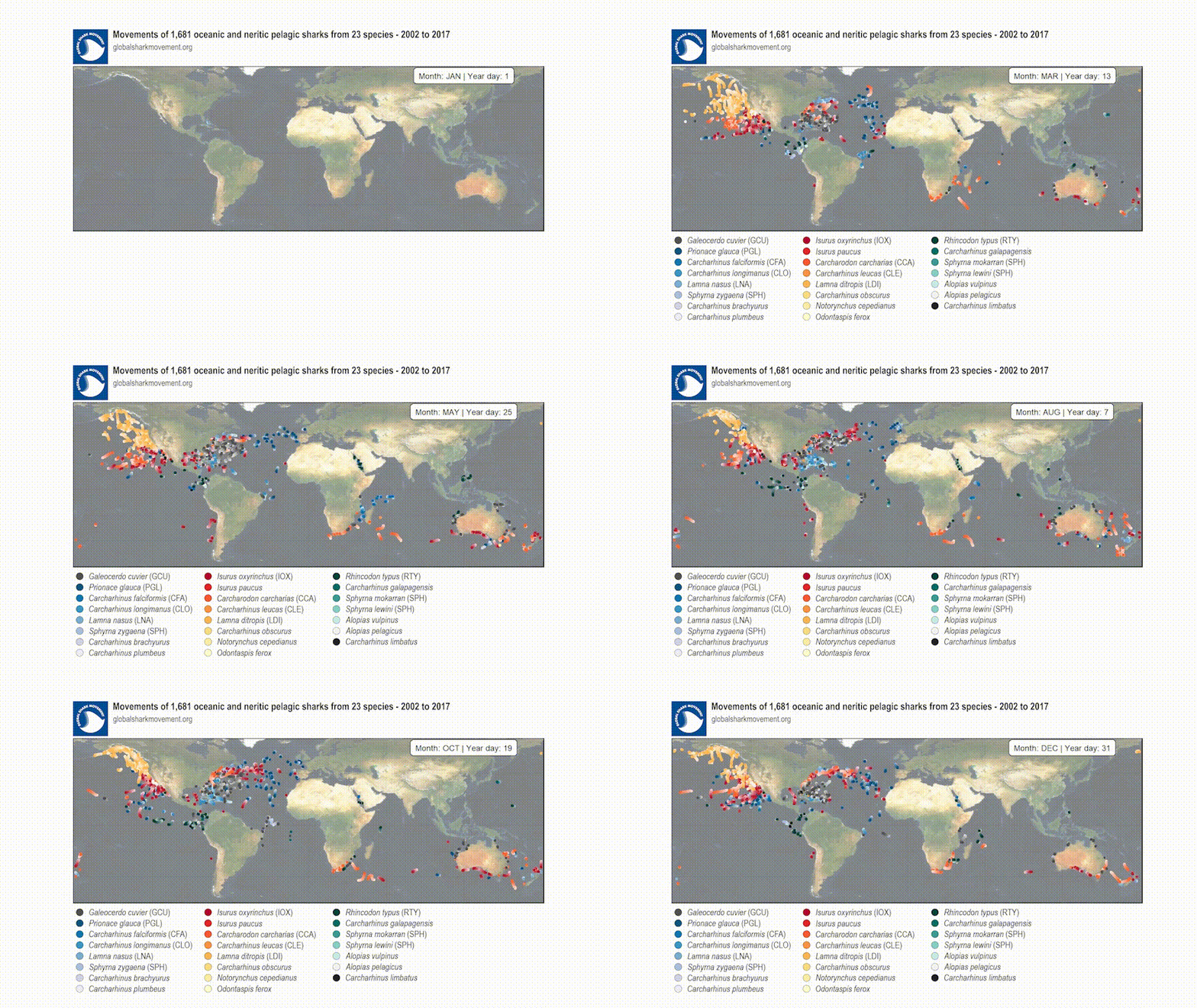
Posted with kind permission - thank you! Click for detail!

Story here, here and here!

This is really beyond phenomenal - especially the tracks!
Just look at the GIF at the top - I mean, seriously, how bloody awesome is that!
Philopatry anybody? 

And the overlap with the fishing fleets?
Having spent countless hours looking for birds when trolling offshore, I know all too well that the prey is not distributed evenly but instead comes in patches, and that consequently, predators converge - and it only stands to reason that as we are supplanting the Sharks as the top predators on the high seas, their footprints will increasingly overlap with that of our commercial fleets, leading to high mortality rates both due to targeted Shark fishing but very much also due to (more or less) unvoluntary bycatch - see this rather recent report about the status of pelagic Elasmobranchs in the SoPac.
Earlier papers e.g. here and here - and here is also an important paper describing the grotesque irony of those fisheries being increasingly unprofitable, story here.
Anyway, huge kudos to Nuno and David - this has truly been a titatic endeavor!

Solutions?
Possibly the postulated well-placed (and well-enforced!) pelagic MPAs but that sure ain't gonna be easy (and here!) - and read this about the need to better identify, and then include those few remaining marine predator refuges! And what about the continued Climate Change-induced poleward shifts (and here!): shift accordingly?
Detail detail! :)

Yeah I know I know.
That's a lot of links - but they are simply a must as things are complicated!

Enjoy the paper and the links!
 

Tuesday, August 27, 2019

CITES - so far so good!

Source.

Great.

Now everything will need to get formally ratified in the plenary session, and I got little doubt that it will. So well done everybody - and well done El Diego and Debbie for continuing to shed a light on the trade!

And what about Fiji?
As always, we are working on something - and should it eventuate, it will be good news.

Keep watching this space! 

PS - all have been adopted, and some endangered Sea Cucumbers, too!
 

Saturday, August 24, 2019

Shark Reef - it's working!

Forget Tumbee and the Bull: we got Fishes, too - click for detail! Great pic by Jayne!

Great News!

The SRMR is continuing to be a success story.
We had heard rumors about poaching in the Reserve, and did embark in a series of aggressive, and also successful patrols together with the good people of the new Department of Inshore Fisheries - and although we are still missing some of the once ubiquitous larger Groupers and Sweetlips, and although some total asshole has poached our biggest Giant Clams, the effects on the reef are nevertheless quite encouraging.

Here is the evidence.
The indefatigable Helen of Marine Ecology Consulting has been tasked to do a survey of several reefs in Serua and Beqa, see the below map - click for detail.


The results are pretty much unequivocal.
The following are unpublished excerpts of her report, reprinted with kind permission.
Discussion 

General reef condition in the area 

Overall, from the perspective of coral cover and diversity, most of the reefs in the Beqa and Serua area are in good condition, and have both a history, and the future prospect, of having some of the highest coral cover in Fiji, showing resilience to, and swift recovery from, crisis events such as elevated water temperatures and cyclones. 

However, the numbers of fish and macro-invertebrates targeted by the subsistence and small-scale commercial fishing industries are much lower than seen in many other comparable areas of the country, and, particularly on the west side of Beqa, near Yanuca Island, were quite starkly low, some of the lowest populations this surveyor has seen in over 20 years of carrying out reef surveys in Fiji.

Algal cover on the reef floors of the west Beqa reefs also correlates with the extremely low number of herbivorous animals such as sea cucumbers, surgeonfish and parrotfish. Such algal films can retard new coral settlement, and suggests that the extreme levels of overfishing in Beqa may very soon be at the point where the overall health of the reefs may become impacted in an irreversible way. 

Effects of Marine Protected Areas  

There were four MPAs within the surveyed reefs, of which two are regularly patrolled and enforced (Shark Reef Marine Reserve SRMR, and the Kauvala Tabu at Lawaki Beach House). The other two are larger, and more distant from the managing communities, so the level of observation and enforcement is uncertain. 

Coral cover and diversity did not seem to be affected by marine protection over fished reefs. Fish and invertebrate levels were low at all sites except the SRMR and, to a lesser extent the Lawaki MPA and one of the two survey sites within the Cavity MPA behind Yanuca Island. The other three MPA survey sites were no better, or in one, case worse, than fished sites, indicating the importance of proper management and enforcement on the success of marine protection.
Please click on the below for detail. 
Of interest, the results for the SRMR are merely from the shallow back of the reef where we actually expect to encounter less Fishes compared to the highly productive frontal reef slope to the deep Beqa Channel where we dive - and yet the Reserve is still a clear standout!


Bingo - remember what I said here?
Convincing some village to declare a tabu is the easy part - but that it is only a start, and after that comes the real heavy lifting. One needs to train fish wardens (we have sponsored 5 courses and trained dozens of people so far), and then one has to engage in regular long-term monitoring and enforcement which is both expensive and bloody frustrating as it consists of tedious night-long patrols where little to nothing ever happens, and this often on the weekends where poaching is traditionally worst. And when you catch someone, the evidence collection and the prosecution are equally time consuming and laborious.
But it simply must be done - especially where one aggregates Fish and Sharks for tourism and has the moral obligation to assume their stewardship as a consequence!

So again, stop lying talking and start doing!
And to you out there: please do your due diligence - especially you clueless and frankly, terminally irritating  foreign chicks who fancy yourselves some sort of thought leaders and commentators of the local shark feeding scene!

Anyway. 
Let's go Shark diving - sustainably!