Showing posts with label Global Warming. Show all posts

Sunday, September 22, 2019

Human Impact on the World’s Ocean - Paper!

Click for detail - you can download a list of the stressors here!

Check this out.

Prima vista, it sure doesn't look good.
But if you explore the graph at the top, there are also a few success stories where some countries like e.g. South Korea appear to have substantially reduced domestic commercial fishing (Really? Maybe only to fish more abroad...?) and also pollution.
Stories here.

The graph also clearly shows the principal threat. 
We can try and continue tinkering at the edges and reduce, recycle, innovate and manage, etc etc etc - but unless we successfully tackle Global Warming we're all going to be fucked. And yes little Swedish girls and global strikes, or whatever, are nice - but let there be no doubt that ultimately, the only way to achieve positive change is at the ballot box = and who needs to vote is not them but YOU.

Anyway.
Please do your due diligence, and go and kick vote the wrong people out of office, and vote the right people in!
And no I'm not particularly hopeful.
 

Sunday, March 24, 2019

Do MPAs improve Climate Change Resilience?


Spoiler: they do not!

Surprised? Me not at all.
Over the years there has been a plethora of irritating scientific studies wanting to link climate change mitigation to a whole host of factors ranging from somewhat plausible like the present MPA theory to outright outlandish like the ridiculous Whale poo theory - and let's not forget the infamous Sharks and Oxy Myth that STILL reverberates in some of the stupidest Shark conservation circles!

So kudos for setting the record straight.
And in analogy to the conclusions of the paper (read them!), let me re-post what I wrote back then, slightly abridged.
Want to combat Global Warming?

Stop faffing around about irrelevant topics and work on reducing the anthropogenic carbon emissions that cause it!
Reduce your own emissions! Vote for politicians, parties and government that advocate global reductions! Educate others! Do something to enhance carbon sequestration, like we do!

In closing.
Like a broken record and Erik the Mad Hatter, let me quote myself.
The facts and numbers?
Science is in continuous flux and the data do indeed change – but until they do, the latest peer reviewed science remains the best approximation of the truth. Thankfully, there are now plenty of resources where anybody can consult the latest insights and data, meaning that those who continue to operate with inflated statistics and outlandish assertions lack any excuses and credibility whatsoever. The facts are plenty horrible as it is – so let’s please stick to those and refrain from the usual stupid inflated hyperbole!

Conservation is never happening in a vacuum - it is being used to advocate legislation that in its marine context will deprive fishermen of income and quite possibly, of their livelihoods. With that in mind, we owe it to them, but also, to ourselves not to cheat and to use misleading perceived "marketing", or whatever, but to be truthful and fact based instead.

The situation is really, really dire and there's absolutely no need whatsoever to inflate numbers and to come up with ludicrous propositions.

And then there's this.
Assume we succeed in having laws enacted based on misleading data - what would prevent the legislators from repealing them once we got caught out?
Think we would ever get a second chance after such a fiasco?
And there you go.
Paper here, synopsis here.

Enjoy!

Saturday, November 25, 2017

Don't eat the Reef Fish!


Bingo!

Remember this post?
Now I discover that Palau is planning to build an offshore fleet in order to fish for Tuna and other pelagics within 20% of its EEZ - and that is a good thing, and this not only economically but also ecologically! 
With the Pacific Islands running out of Fish due to a combination of rampant overfishing, habitat destruction and climate change (read it - this is truly frightening shit!), reducing the consumption of coastal Fish in favor of pelagic species becomes increasingly important - and this by both locals and visitors.

Really interesting paper here.
Required reading!

Thursday, November 23, 2017

Second Alert!


Have a good look at the above - click for detail.

Yes it is shocking.
Article here, paper here - read them, and then go and fucking do something!

And no I really got nothing to add.

Friday, May 06, 2016

Pacific Islands - more People, less Water!

Source - click (twice) for detail!

Not good.
Paper here, synopses here - and flying blind pigs here!

Friday, January 08, 2016

CO2 and Sharks - Paper!


Read this.

Bingo.
Granted it's only one species, and the tests have been performed in a lab - but it stands to reason that under the same environmental conditions, those effects will be at least similar in the wild, and this for all Sharks.

Long story short?
Where many Shark conservationists are still stuck in species conservation (or god forbid, in finning bans), we really need to shift to a more holistic view that takes into consideration all the major threats to the marine ecosystem. Like Jaguars will not be able to survive without jungles, even the best protected Sharks will not survive if we continue to destroy their habitats and annihilate their prey.

You may want to re-read this.
It's old and thankfully, there has been progress on several fronts; and still, I believe it to be correct in its broad outlines - especially when it comes to the part about sustainability, and the need to refrain from uninformed activism and radical positions!
As in e.g. Jupiter - boy has that been an education!

Anyway.
I'm digressing as always.
Enjoy the paper!

Friday, October 03, 2014

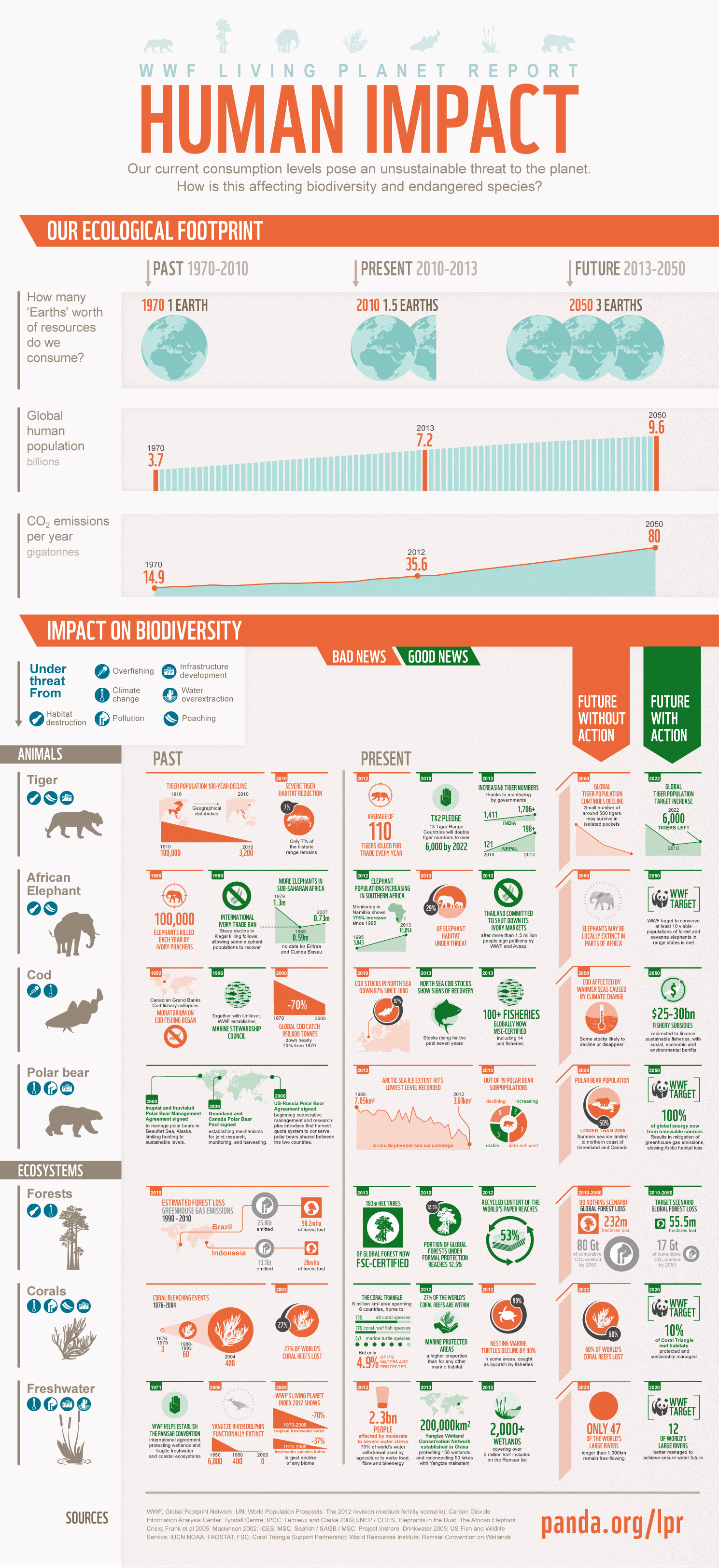
Living Planet Report, 2014!

Click for detail or explore here!

Watch.


From the article.
Currently, the global population is cutting down trees faster than they regrow, catching fish faster than the oceans can restock, pumping water from rivers and aquifers faster than rainfall can replenish them and emitting more climate-warming carbon dioxide than oceans and forests can absorb.
Just great isn't it.
Living Planet Index here, Ecological Footprint here.

Difficult choices here.

Thursday, September 11, 2014

It is not only Overfishing - Paper!

Click for detail.

Remember this post?

For Sharks, the principal threat is overfishing.
But the other threats are of course equally a cause of great concern, plus our increased encroaching into their habitats that is leading to conflicts and persecution. And now for possibly the first time, this paper is examining the likely effects of Global Warming and Acidification on a tropical Shark.
Synopsis here, so I need once again not elaborate.

Though this is perplexing.
From the Discussion.
Although the vulnerability of tropical sharks to climate change is species-specific, factors such as temperature, sea level rise and freshwater input are assumed to elicit the greatest effects upon estuarine, coastal inshore and reef species. Such effects are likely to be expressed through changes in species abundance and distribution (e.g. poleward movements and migrations to deeper waters).

Until now, ocean acidification was not considered as a primary climate-related threat to elasmobranchs; only indirectly through habitat and community changes (e.g. reef sharks).
Experimental approaches such as those shown in the present study are critical to directly assess risk and vulnerability of sharks to ocean acidification and warming, and can ultimately help managers and policy-makers to take proactive measures targeting most endangered species. 
Proactive measures?
As in...? Suggestions welcome!

Thursday, January 30, 2014

Evidence!


Story here!


Sunday, July 15, 2012

Zombie Ecosystems!

Painting of intact coral reef - increasingly becoming science fiction.

Please read this.

Not much to add is there.
I know that Rick the Mac and others are attending, so expect more informed analyses to hit the blogosphere soon.

After the folly of Ipanema the question remains.
Where is the f&%@ing leadership?

PS great post by RTSea here!
PS2 dissenting opinion here!

Tuesday, February 14, 2012

Marine Conservation - the principal Issues!


Just in case we lose sight of the context here.
Barring cataclysmic cosmic or geological events, these are the biggest threats to marine biodiversity - once again, very simplified.

First and foremost: there are too many people!
We are seven billion now and probably we will get as high as 9 billion, both of which is just not sustainable.
Moreover, billions of people are attempting to attain what they consider to be better life conditions, meaning that their ecological footprints are increasing as they progressively consume more resources and produce more waste. Even if we managed to stabilize or even turn around population growth, this will continue to exert tremendous pressure on biodiversity.
Those are monumental challenges indeed - solutions???
These are the root causes of all that follows.

The biggest anthropogenic threats to marine biodiversity are.
  • Global Warming
  • Ocean Acidification
  • Pollution
  • Habitat Degradation
  • Overfishing including Bycatch & Discards
When it comes to Overfishing.
As far as can be ascertained, anthropogenic extinction rates so far have been substantially lower in the oceans than in terrestrial ecosystems. In fact and despite of our best efforts, there is probably not a single documented case of us having fished a marine Fish to extinction - and should there be one, it would be the exception and not the rule.
This is cause for hope.

But that's of course not the whole story.
Several Fishes have become locally extinct and the populations of many marine Fishes that have been targeted commercially are severely depleted and but a shadow of what they used to be.
There is a line of thought stipulating that those populations have accumulated extinction debt and that they could be driven into extinction by an environmental catastrophe.
That environmental catastrophe could be Global Warming.

Sharks?
They are obviously subjected to the same pressures.
In particular, several larger species are being severely overfished and although to my knowledge this has not been specifically documented, it also stands to reason that Shark populations will be affected by the overfishing of their direct prey or of even lower trophic levels like forage Fishes.
Some of those larger Sharks are also apex predators and keystone species and there is research documenting that their removal can ripple down through the trophic levels via cascading effects, hence exacerbating the ecological consequences of their demise.

This as far as I can see are the principal issues.
The problems are enormous and eminently intractable as documented by the frustratingly slow progress of conservation and above all, by the many conservation setbacks and defeats. Yes there have been many successes - but alas, everything points to the fact that in the big scheme of things, those successes are simply too small and the pace, simply too slow. Especially if we don't get a handle on Global Warming, the future for marine biodiversity looks very bleak indeed.

Solutions?
If we so wish, there is a role for each of us to play - the most basic one being that it behooves all of us who live in relative opulence to reduce our ecological footprint, including limiting our carbon emissions! And those of us who want to do more and get involved in advocacy will find unlimited opportunities to make a difference as e.g. discussed here in the case of Shark conservation.

Orgs I personally like: Shark Foundation and Save our Seas Foundation for sponsoring research; Shark Trust, Shark Savers and Shark Defenders for advocacy; Pew Environment for all of the above.

But please, let us be rational and credible.
Let's please stop the esoteric balderdash and the pseudoscience.

The sooner we do that, the sooner we will be able to effect real, positive change.
Yes?

Thursday, August 25, 2011

She's beautiful!


I usually don't like pathos - but I did like this.
Excellent cut, powerful images, great soundtrack.
Enjoy!


But... don't forget: the Planet could not care less!

Friday, February 25, 2011

Reefs at Risk - Fiji?

Click for detail.

It sure aint looking good!
I was alerted by this article stating that 75% of Coral Reefs are at risk and went rummaging for more detailed info about the situation in Fiji.

Turns out that this country is particularly vulnerable.
According to the report, it fatally combines High to Very High Threat Exposure (see picture on top) with High to Very High Reef Dependence with Low to Medium Adaptive Capacity (see below).
Click for detail: Fiji is the cluster of larger islands north of New Zealand.

And what about Shark Reef?
Pretty grim if you ask me! Since the reef is situated within a highly vulnerable coastal belt where the usual global threats like Climate Change and Acidification are compounded by high population pressure, predictions are dire.

Present2030

Not nice!
Solutions? I haven't got the slightest clue!
Old timers tell me that Shark Reef has always been pretty barren, and this is why the villages were more than happy to agree to its protection and to exchange their fishing rights for monetary compensation. So far, their gamble has more than paid off as on top of jobs and regular income for the villages at the tune of over FJD 40,000 per year, the fish population has miraculously recovered, with many fish spilling over to other reefs were the local fishermen are welcome to harvest them.

The corals however have never quite managed to recover.
Whilst 20% of Shark Reef is heavily frequented by our clients, the remainder is not at all. Especially the fragile shallow coral gardens are very much off limits - and yet , especially for the Acropora, it has been a long and frustrating cycle of growth and demise, the latter owing to several explosions of Crown-of-Thorns Starfish and the occasional cyclone. Although those would appear to be "natural" causes, people in the know tell me that in Fiji, the Starfish invasions appear to be correlated to ENSO events - and these in turn are likely to be (oh, yes, of course it's complicated!) accelerated and exacerbated by anthropogenic Climate Change. With that in mind, the future of Shark Reef does rather look grim indeed, with totally unknown consequences for its Shark population.

But having said this: we'll continue trying never the less!
All I can say is so far so good, as we're seeing ever more Sharks and continue to identify ever more Fishes - with some likely excellent news to be published soon, so keep watching this space! And when it comes to the big picture, Mangroves for Fiji remains our very own contribution to Climate Change mitigation, both locally where there is now a huge belt of restored Mangroves lining the shores of our partner village Galoa and neighboring Culanuku; and Fiji-wide, where a veritable explosion of sites will enable us to become completely carbon neutral very, very soon indeed - again, keep watching this space!

And on this happy note (is it?): have a good weekend everybody!

PS should you be intrigued by the Google Earth pictures: download the KML files here (scroll to bottom of page) and have a look for yourself - very interesting and alas, equally disheartening!

Friday, January 21, 2011

The Heat is on!


2010 ranks as one of the warmest on record.
There were also a large number of extreme weather events (including some record cold spells), with more happening as we speak in 2011.
This, the UN says, is the result of Global Warming.

Not convinced?
Please read this and also, please look at the revealing comments section and the hilarious rebuttals by Danny Richter. As always, in the end, bullshit walks - that is, provided that there's a fact based discussion!
And finally, test your skepticism against this great website.

Then, please, go out there and become part of the solution.

Saturday, December 11, 2010

Climate Change. Right here. Right now.


This is really hard to watch.
Story here, blog post here.


About Shark Attacks

Undoubtedly, one of the Mossad Sharks!

Time for a preliminary post mortem.
Like everybody interested in Sharks, I’ve been closely following the news tidbits trickling out from Sharm El Sheikh and the various opines in the media and the blogosphere.

There’s much of the usual fluff and idiocy - but there’s also some stellar stuff.
Take the “experts”. Whilst many prate and pontificate, I found this remarkable interview with Avi Baranes. Now THIS is the kind of person you gotta consult, a highly reputable Shark researcher who has been investigating those very waters for a very long time – and accordingly, the interview brims with factual information and quietly addresses and dispels the usual myths. Bravo!
Equally noteworthy are the posts by Richard, by the SOSF and by Michael Scholl - however with some caveats that I’d like to address below.

The way I see it, in this specific case, one needs to try and answer the following queries

  • What species are involved. Apparently, the species implicated are Oceanic Whitetip(s) and Mako, both pelagic as opposed to coastal species, which is certainly surprising. I’m particularly surprised to hear about the Mako, because this is very much a specialist predator of fast pelagic Fishes like Tuna and Billfishes, features a very specialized dentition aimed at grabbing rather than cutting, and is exceedingly rarely implicated in attacks on humans. OWTs on the other hand appear to have a much broader feeding spectrum and have the typical generalist dentition of “grabbers” in the lower jaw and “cutters” in the upper jaw, like the equally pelagic and generalist Blues and most Carcharhinids in general. Consequently, OWTs (not Makos) are frequently found feeding on floating carcasses, mainly of cetaceans, where they are able to cut out chunks of meat. They have a well deserved reputation for being highly inquisitive to the point of chasing people out of the water, and have been implicated in a plethora of attacks mainly on shipwreck victims.
  • What induced those pelagic Sharks to come close to that coast where the attacks happened. In the Red Sea, OWTs are normally regularly sighted hundreds of miles further south and I would have expected them to move north, if at all, following their preferred temperature gradient, often in line with migrations of their habitual pelagic prey. Yes they are also known to follow ships but with the above in mind, my gut tells me that the most likely explanation might be environmental, as in weather/temperature/currents/movements of prey rather than the much cited paucity of natural food due to overfishing or selected anthropogenic interventions like chumming and baiting that would only draw in Sharks from a much smaller radius. Of note, the cited dumping of sheep carcasses happened at the end of September and cannot be credibly considered to be causal for events occurring in December.
  • The cause for the attacks, and their interpretation. This may sound trivial but to me, the immediate causes are obviously location, opportunity and stimulus. Firstly, it has to be noted that the coastline drops off precipitously, meaning that snorkelers and swimmers venturing away from shore quickly find themselves in very deep water indeed. Secondly and due to the massive increase of the local tourism infrastructure, the ocean is teeming with aquatic recreationists, greatly increasing the chances for such an encounter. Thirdly, people splish-splashing at the surface send out the exact stimuli that predatory Sharks will consider worth investigating. As to the interpretation of what happened once the Sharks encountered the victims, see below.
  • What can be done so that this will never ever happen again. Barring the complete prohibition to swim and snorkel, or the complete fencing off of areas where people swim and snorkel: nothing at all! As long as people will frequent the Ocean and Sharks will hopefully exist, occasional attacks will continue to occur - but one can certainly minimize the risk by following a set of sensible recommendations, the first one being don't be stupid!
Which leaves the interpretation of those attacks.
Whilst the mainstream media revel in the image that all Sharks are indiscriminate man hunting killers, the pro-Shark faction claims the exact opposite, that Sharks never prey on humans and that all attacks are the result of mere investigation or mistakes.
Both I believe are wrong.

Shark attacks can be defined as incidences where Sharks bite people.
The term thus covers a very wide spectrum of species, behaviors, motivations, triggers etc and any generalizations will inevitably lead to mistakes – thus, please correct me if you think I’m wrong!
Also, barring a personal interview with the perpetrators, the exact causes for these specific attacks will never be known, so whatever conclusions will emerge will only be (hopefully) plausible but ultimately always untestable hypotheses.

In very general terms, Shark attacks can be divided into the following categories.

1. Attacks associated with feeding events, i.e. predation and scavenging.

The most notorious species implicated in this category of attacks are the large predatory Sharks Great White, Tiger, Bull and Oceanic Whitetip.
Whilst large adult GWs appear to be specialist hunters of mammal blubber, the other species are generalists with a broad spectrum of prey and consequently, hunting techniques. It should thus not come as a surprise that the track record here is unequivocal: these Sharks will sometimes attack and prey on humans!

Granted, these events are exceedingly rare.
It is obvious that humans are not the primary prey of any Shark species and let me spare you the long winded and pathetically trivial explanations as to why evolution could not possibly have selected for it. Also, granted, sometimes the Sharks appear not to like (whatever that may mean) what they have attacked and either spit it back out or not bother to come back to completely consume the meal. In GWs, this may be linked to the fact that we may indeed be too lean for a specialized hunter of blubber. In other species, it may be an indication of the fact that the Shark was not very hungry, or that something disturbed it whilst it may have hung off waiting for the victim to stop struggling.
But when limbs go missing and Sharks hang on, those are predatory attacks, period!

Which brings me straight over to the whitewashing.

Yes we love Sharks, yes Sharks are much maligned and we need to work at improving their reputation: but the fact is that large predatory Sharks are dangerous and that they need to be treated with respect and with circumspection!
That makes them neither bad, nor good – that just makes them large predatory Sharks! I’ve said it before – we need to remain fact based and refrain from creating our own unhelpful stereotypes!

The common pattern of predatory Shark attack has been called Sneak Attack whereby a Shark suddenly turns up (in fact, many survivors claim that they never saw the Shark prior to the attack) and persistently attacks, very much like what happened in Sharm is being described. This is not surprising and only consistent with most attacks by terrestrial predators who relay on the element of surprise in order to approach their prey.

Great Whites sometimes attack Seals and Sea Lions which are close to the surface by sneaking up close to the bottom and then attacking more or less vertically at high speed, resulting in the much publicized predatory breaches.
Some surfers have been attacked in the same way, leading John McCosker to develop the hypothesis of Mistaken Identity, meaning that the GWs attacking a silhouette at high speed may have mistaken a surfer for a Pinniped, especially in murky water. This is certainly plausible, the more as GW are being routinely induced to attack decoys in the same manner.

BUT: this is strictly GW lingo!
This cannNOT just simply be applied to other species! Specifically, this is not how Tigers prey on Turtles (and no film maker goes potting around Hawaii towing Turtle decoys) and it does not apply to each and every “mistake” a Shark may make! Thus, asserting that most Shark attacks are due to Mistaken Identity is a fallacy and as such, nothing more than pseudo-science!

The same applies to Investigative Bites.
Once again, this is GW lingo, as Great Whites are known to test objects and people by (more or less, see Rodney Fox) gently nibbling at them. Rather than being a strictly predatory behavior, this is probably linked to testing food when scavenging and may, or may not result in subsequent feeding.
Other species known to investigate people, snorkelers and divers alike, by mouthing are Tigers and I hear, Lemons – yes, as in TB!

Not Oceanic Whitetips!
They are the picture child for investigation via bumping. They will circle ever closer, the frequency of bumps will increase and if not countered vigorously or if the affected person does not leave the water, this will likely result in a predatory attack, sometimes referred to as Bump and Bite attack. Check out the video here: this is typical behavior and it is pretty obvious that this Shark would not suddenly slow down to apply a gentle test bite! The same apparently applies to Bull Sharks.
Of note, this is different from the ramming with snout mentioned in Martin 2007 that is related to aggression, not predation. Incidentally, Martin does not cite ramming with snout as an agonistic display in OWTs, a further confirmation that in this species, that behavior is linked to predation!

Once again, attributing Investigative Bites to species other that GWs, Tigers and maybe Lemons is mere whitewashing and pseudo-science! It also looks like an attempt to exonerate the Shark from having had bad intentions or the like, something that I find rather peculiar to say the least!

2. Attacks associated with self defense

You may want to go and re-read this: several species of Sharks display behavior that is called agonistic and is linked to self defense. Failure to identify and adequately react to that behavior may lead to what are generally open-mouthed, slashing bites that result in cuts rather than missing tissue.

Attacks on surfers and bathers by small piscivorous Sharks like Blacktips and Spinners (see Volusia County) or the frequent nips on the feet of waders by subadult Blacktip Reef Sharks are commontly referred to as Hit & Run attacks and generally result in mere harmless cuts. They, too, are believed to be the result of self defense as the Sharks may simply have been startled and may have wanted to fend off a perceived attack, or may have previously displayed agonistic behavior that was never noticed by the victims.
These are, by far, the most frequent Shark attacks on people.

Finally, there are the Provoked Attacks, where the people have touched the Sharks, as in the retaliatory bites by Wobbegongs and Nurses that get dragged out from their covers by the tails.

3. Attacks associated with competition

Typically associated with spear fishing, Sharks may bite people when competing for the speared fish. These attacks are thus not aimed at preying on the person but rather, at chasing away a perceived competitor.
Incidentally, the same happens between different Shark species (but apparently not between individuals of the same species): I’ve personally witnessed a Silvertip biting a Nurse to dislodge him from some bait, and filmed one of our Bulls biting away a Lemon who wanted to approach a feeder.

Consequently, when referring to site fidelity in Sharks, one should always talk about residency as opposed to territoriality. The latter implies defense against conspecifics, a behavior that has been observed in many Fishes but apparently, never in any species of Shark!

This is again different from aggression associated with rank.
Sharks do display behavior that may be interpreted as “posturing” and there are even anecdotal accounts of actual bites on conspecifics in the context of social interactions.
Yes, it’s complicated!

4. Attacks associated with mistakes

Sharks make mistakes.
Considering the impressive array of senses they dispose of, this may seem surprising: and yet, they hunt, attack and bite a vast array of objects like boat propellers, metallic structures, decoys, and ingest completely inedible items like the famous number plates and car tires - and most often and fatally, they will be fooled by fishing bait and lures!

Mistaken attacks on humans are mostly associated with Shark feeding and baiting.
Many species of Sharks (and Fish!) are highly competitive and uncontrolled Shark feeding events can quickly develop into Feeding Frenzies where the animals get highly agitated and may end up biting other Sharks or the human spectators by mistake. Equally, Sharks may accidentally bite the feeders’ hands during hand feeding shows, etc.
Again, these are genuine mistakes and neither competitive nor predatory in nature – the latter much contrary to the opinion of the anti-feeding lobby.

Talking of which, you may want to check out these latest statements by Burgess: apparently, the perpetrator of at least two attacks is one and the same Shark! Amazing!
Plus, there’s this: "These are open-ocean sharks that are living in an environment that is food-poor," says Burgess. "So when you do find food, you darn well better take advantage of it. Do they remember things? Sure, they remember where the good places to eat were, and they'll come back." Surprise surprise: I happen to totally agree - re-read this! But... Sharks that may have been conditioned to come and feed on Tuna heads learn to… feed on Tuna heads! Not humans!

There you have it I believe - and again, if I'm factually wrong, feel free to correct me!
Long story short: if we want to be credible Shark advocates, we got to do our homework and first of all, be informed about the animals we love!
Science is always in flux and today’s insights may quickly become tomorrow’s fallacies, meaning that we must keep abreast of the latest research results and not base our knowledge on old publications and approximate hearsay. Most importantly, we the amateur naturalists should never make up things on the fly, nor should we idly re-interpret what is considered to be the accepted consensus.

This does not mean that we should not challenge the current status quo, as that is precisely the process by which knowledge is being advanced!
BUT: the only accepted technique for doing so is the Scientific Method and as always, let me warn against the siren calls and intellectual shortcuts of the self promoters, quacks and charlatans!

All researchers I’ve ever met have always been eager to engage in informed discussions and to entertain different hypotheses, if adequately supported by according observations. Those researchers are not omniscient and also, not omnipresent and often, observations by common mortals like us have greatly contributed to the advancement of scientific insights - so even if you have no academic background, don’t be shy and speak up!
But do your home work first!

In diesem Sinne!

PS read this brand new report - so, how do you interpret it? :)

Monday, November 01, 2010

Awesome Video!

Forget the detractors - this is what is happening!

Once again, excellent work by the BBC!

This, I believe, is a must-see.
It is about the recently completed Census of Marine Life, Climate Change and Ocean Acidification, and Overfishing - all the stuff anybody interested in marine conservation needs to know about.
This could have very easily precipitated into utter gloom and doom but as always with the BBC, it is a compelling presentation featuring the usual amazing footage and fantastic editing.

Lean back, relax and enjoy!


Friday, April 23, 2010

Kiss your Oysters goodbye!


Well, here we have it.

The Oyster industry in the Pacific Northwest appears to be the first spectacular casualty of Ocean Acidification, the sinister cousin of Anthropogenic Climate Change.
You can read the full sad story here.

When following the links, I came across this informative video by the NRDC who have also published this fact sheet along with a list of publications providing for the scientific evidence. More related videos can be found here.

This is truly frightening stuff, stuff the could very much end up by wiping out all the advances we've made in Marine Conservation - if the building stones of Oceanic habitats are literally being dissolved, all life that depends on them is doomed.

Yes it is long - still, please take the time to watch, this is really important.


Thursday, December 10, 2009

Scanning the Horizon

Caribbean Lionfish Hunter (yup this is a link)

A large group of smart people have gotten together this September and defined some nascent conservation issues for 2010, both threats and opportunities.

The resulting paper is called A Horizon Scan of Global Conservation Issues for 2010 and you can download it here, and yes, as you should, you would have to pay for that. Or, you may want to consult the useful synopses posted on Conservation Bytes and Planet Earth Online.

It spans a list of 15 topics, some of which surprising like International Farmland Acquisitions by foreign governments, some somewhat obscure and eclectic like the effects of Nanosilver in Wastewater, some visionary as in Synthetic Meat or releasing Aerosols into the Stratosphere to combat Global Warming to outright scary as in Artificial Life.
In very general terms, they all illustrate the complexity of our environment and the vast, and often totally unexpected ramifications of our actions upon it.

As in the case of the Lionfish invasion of the Western Atlantic.
Likely the progeny of aquarium pets that escaped or were discarded in Florida during the early nineties, they have completely overrun the Caribbean and are inexorably threatening South America.

You can check out the progression here.

This what the paper says (links are mine).

Invasive Indo-Pacific Lionfish.
Small numbers of predatory Indo-Pacific lionfish (mainly Pterois volitans) were first recorded in waters along the eastern coast of the United States in 1992 .
The source of introduction is uncertain. The rate of lionfish range expansion was initially slow, but increased markedly after the colonisation of Bahamian coral reefs in 2004.
Lionfish are now established throughout most of the northern Caribbean and have been recorded as far north as Rhode Island and south to Colombia. Where they are established, lionfish are found at densities far exceeding those reported for their native range (e.g. > 390 lionfish/ha in the Bahamas compared to about 80/ha in the Red Sea).
Lionfish grow to a maximum length of about 45 cm, and prey on a wide variety of fish and invertebrates. On experimental reefs in the Bahamas, young lionfish reduced the recruitment of native coral reef fish by nearly 80%; the effects of lionfish on natural reefs are still unmeasured.
Lionfish are protected by venomous spines, and while small lionfish can be eaten by large groupers,
such predators are rare throughout the Caribbean.
Lionfish are, however, now being fished and offered on the menu of some Bahamian restaurants.

The pests obviously have no "natural" predators in the Caribbean and the local predators that could fulfill the role of regulating their population, like the larger Groupers and the Sharks, are severely depleted. I fear that despite of the valiant efforts of those who promote fishing and eating them (nice collection of recipes here), they are there for good, like, say, the cane toad in Oz (and alas, in Fiji as well).
Maybe, eventually, the Lionfish populations will somewhat balance out, the more as there is evidence that all individuals are the descendants of very few females and that, at least in theory, after experiencing such a severe population bottleneck, they would eventually have to crash back to their effective population size, like the Cheetahs. Maybe, some local predators, parasites or pathogens will learn to exploit the new resource and thus keep the numbers in check.
But it sure is a very very long bet and not likely to happen anytime soon, at least not soon enough to be of real practical use.

Thing is that ever since we've "evolved" to become a global nuisance, these migrations and infestations have become so frequent to constitute the norm rather than the exception.
Just think about our animal baggage, be it domesticates, many of which have gone lethally feral, stupidly introduced species like Fiji's ubiquitous and invasive Minah and Mongoose, or unwanted followers like the Norvegian Rat or the Bedbug. Or the plants, be it agricultural or ornamental, like the Traveller's Palm I'm looking at whilst writing this is Fiji - originally, endemic to Madagascar!

And recently and as always, mostly unwittingly, we've started meddling on a truly epic scale.
By building canals we've created highways for marine invasions between the Med and the Red Sea and between the Pacific and the Caribbean. By heating up the planet, tropical pests like disease-bearing Mosquitoes, Rodents and Fire Ants and pathogens are ever expanding (and check out this example of how anthropogenic marine invasions are affecting Great Britain) and according to the above mentioned paper, there's a risk that as the Arctic melts, it will lose its function as a barrier between the Atlantic and Pacific Oceans, with unknown consequences for those two ecosystems - as in: adios Deadliest Catch!

Anyway, I'm ranting as usual.
All I wanted to say is that it sure is complicated and always interconnected - and that we should never forget that Marine, and Shark Conservation are but one facet of a much bigger and alas, equally bleak picture.

OK, back to the Sharks.

Saturday, September 26, 2009

"Are we screwed?"

Yes these are boats! Click on pic!

See for yourself.

I've blogged about it before: if you thought that the main consequence of CO2 emissions will be Sea Level Rise, think again.
Remember Cleopatra's wager?

And no, it's not a conspiracy! Ask the Pacific oysters!
Movie review here.


Want to watch a lecture about the whole disheartening fiasco?
Grab a bag of popcorn and sit back - yes, it's half an hour long!
Things have certainly not improved since then in 2005!
Scary, scary stuff!