Showing posts with label Helen Sykes. Show all posts

Sunday, February 16, 2020

Great Fiji Shark Count - Paper!


Yeah I know I know.
39 dive operators doing 30,668 dives and making 146,304 shark observations on 592 dive sites, and then collating, triaging and analyzing those data is a lot of effort - and the concrete results are comparatively lean. BUT, it was always meant to be long term monitoring in order to detect trends and not a population census, and 5 years are really not that long - so there. 
In any case, thank you and congratulations to everybody involved, be it the participating dive ops, the tourists = citizen scientists, the donors, the project management and finally, the scientists: this has been quite impressive.

The good news?
Compared to other places, our Sharks populations appear to be faring OK - but despite of the recent fin export- and import ban, there is equally still ample room for improvement, especially when it comes to the continued fishing in the Shark nurseries.

As always we shall see.
Fiji's Shark Commitments are due by the end of this year..
Having looked, I notice that last year's mandated progress report is overdue which is not good - but methinks that as always, there will be some frantic last-minute activity to push matters over the finish line, the more as there is simply no way that Frank will accept any failures in an initiative he very much personally and publicly chaired.
So, our fingers are crossed and we continue to be hopeful - at least for now.

But back to the paper.
We have terminated the GFSC as it is just too much work and the management team was frankly getting increasingly frustrated at the lack and quality of participation and data. Also, this is merely a pre-print pending the tedious peer review process - but the raw data will not change, and this is now a great baseline from which one will be able to measure any future developments, be it progress or lack of.

So consider this an important intermediary step.
Should we get the feeling that matters have changed be it for the better or the worse, we will most certainly organize a recount and report about developments. And in the meantime, we here have already initiated new efforts to monitor some important sub-populations about which we shall be reporting shortly.

In the meantime, enjoy the paper.
To be continued no doubt.

Saturday, August 24, 2019

Shark Reef - it's working!

Forget Tumbee and the Bull: we got Fishes, too - click for detail! Great pic by Jayne!

Great News!

The SRMR is continuing to be a success story.
We had heard rumors about poaching in the Reserve, and did embark in a series of aggressive, and also successful patrols together with the good people of the new Department of Inshore Fisheries - and although we are still missing some of the once ubiquitous larger Groupers and Sweetlips, and although some total asshole has poached our biggest Giant Clams, the effects on the reef are nevertheless quite encouraging.

Here is the evidence.
The indefatigable Helen of Marine Ecology Consulting has been tasked to do a survey of several reefs in Serua and Beqa, see the below map - click for detail.


The results are pretty much unequivocal.
The following are unpublished excerpts of her report, reprinted with kind permission.
Discussion 

General reef condition in the area 

Overall, from the perspective of coral cover and diversity, most of the reefs in the Beqa and Serua area are in good condition, and have both a history, and the future prospect, of having some of the highest coral cover in Fiji, showing resilience to, and swift recovery from, crisis events such as elevated water temperatures and cyclones. 

However, the numbers of fish and macro-invertebrates targeted by the subsistence and small-scale commercial fishing industries are much lower than seen in many other comparable areas of the country, and, particularly on the west side of Beqa, near Yanuca Island, were quite starkly low, some of the lowest populations this surveyor has seen in over 20 years of carrying out reef surveys in Fiji.

Algal cover on the reef floors of the west Beqa reefs also correlates with the extremely low number of herbivorous animals such as sea cucumbers, surgeonfish and parrotfish. Such algal films can retard new coral settlement, and suggests that the extreme levels of overfishing in Beqa may very soon be at the point where the overall health of the reefs may become impacted in an irreversible way. 

Effects of Marine Protected Areas  

There were four MPAs within the surveyed reefs, of which two are regularly patrolled and enforced (Shark Reef Marine Reserve SRMR, and the Kauvala Tabu at Lawaki Beach House). The other two are larger, and more distant from the managing communities, so the level of observation and enforcement is uncertain. 

Coral cover and diversity did not seem to be affected by marine protection over fished reefs. Fish and invertebrate levels were low at all sites except the SRMR and, to a lesser extent the Lawaki MPA and one of the two survey sites within the Cavity MPA behind Yanuca Island. The other three MPA survey sites were no better, or in one, case worse, than fished sites, indicating the importance of proper management and enforcement on the success of marine protection.
Please click on the below for detail. 
Of interest, the results for the SRMR are merely from the shallow back of the reef where we actually expect to encounter less Fishes compared to the highly productive frontal reef slope to the deep Beqa Channel where we dive - and yet the Reserve is still a clear standout!


Bingo - remember what I said here?
Convincing some village to declare a tabu is the easy part - but that it is only a start, and after that comes the real heavy lifting. One needs to train fish wardens (we have sponsored 5 courses and trained dozens of people so far), and then one has to engage in regular long-term monitoring and enforcement which is both expensive and bloody frustrating as it consists of tedious night-long patrols where little to nothing ever happens, and this often on the weekends where poaching is traditionally worst. And when you catch someone, the evidence collection and the prosecution are equally time consuming and laborious.
But it simply must be done - especially where one aggregates Fish and Sharks for tourism and has the moral obligation to assume their stewardship as a consequence!

So again, stop lying talking and start doing!
And to you out there: please do your due diligence - especially you clueless and frankly, terminally irritating  foreign chicks who fancy yourselves some sort of thought leaders and commentators of the local shark feeding scene!

Anyway. 
Let's go Shark diving - sustainably!

Sunday, April 12, 2015

Great Fiji Shark Count - a Message from Helen!


Helen Sykes our irreducible GFSC manager has just issued the following statistics - click on the pictures for detail!

Results of Three Years of the Great Fiji Shark Count
 April 2015 

Over the past three years, dive operators across the Fiji Islands and their diving and snorkeling guests have been recording their Shark, Ray and Turtle sightings over the months of April and November. Thanks to those dedicated divers, we now have some interesting facts to share about Shark populations in Fiji.

The data is analyzed by the number of Shark/Ray/Turtle sightings recorded on every dive by every diver who takes part. This is called number of sightings per observation. Because there are usually many divers on each dive, we have thousands of observations every month.

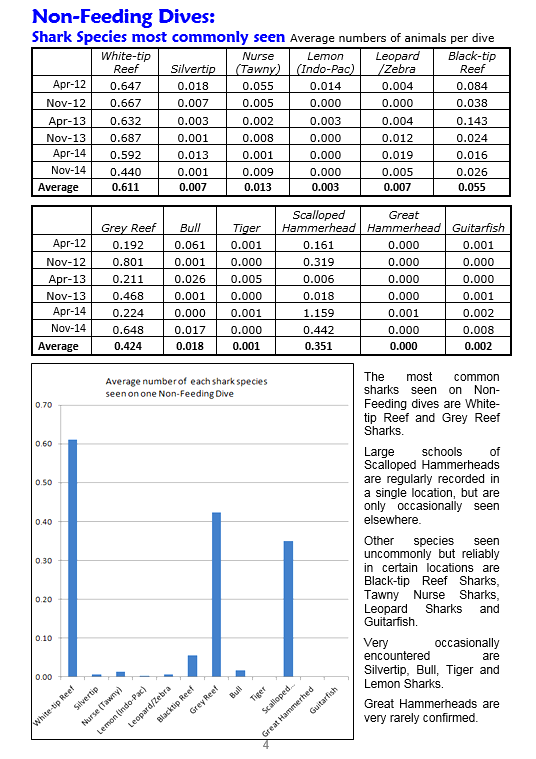
We have separated dives where feeding was carried out from those where no feeding was done.


From a very enthusiastic start in April 2012, the number of participating dive operators has dropped to our reliable core team, representing operators on Viti Levu, Beqa, Taveuni, Vanua Levu, the Mamanuca and Yasawa islands, and the Lomai Viti / Vatu-i-Ra area. We'd like to thank those operators who have stuck by this project and worked hard to get the data to us in a useful format!

Even though the number of dive operators has decreased, the number of dives and of observations (every diver who takes part makes one observation per dive) has remained in the thousands, with the highest total of 4,278 observations in November 2013.

Highlights:

There have been some unexpected and exciting sightings recorded over the past three years.
  • Guitarfish, previously very rarely recorded in Fiji, have been regularly seen on sites along the Coral Coast. 
  • A Leatherback Turtle was seen during a dive (a very rare occurrence) in the Yasawas in November 2014 
  • Schooling Hammerheads have been regularly recorded on a dive site on the South Coast of Vanua Levu 
  • Mobula Rays have been recorded in the Pacific Harbour/ Beqa region and also in Namena, south of Vanua Levu 
  • Tahitian Rays (Himantura fai) were recorded in the Yasawas 
  • Hammerheads and Guitarfish have only been recorded on non-feeding dives 
  • Rays and Turtles are more common on non-feed dives than on baited feeding dives 
  • The most common sharks seen on baited feeding dives are Bull, White Tip Reef, Grey, and Black Tip Reef Sharks 
  • Some sharks species, including Bull, Grey Reef and possibly White-tip Reef Sharks, exhibit seasonal patterns of higher and lower numbers, which are probably related to breeding behaviour. 
  • So far no significant decrease in coastal shark populations has been seen, good news for those of us fearing that shark-fin fishing was continuing to damage shark stocks, but we can only confirm this one way or the other by continuing these surveys over the long term 
Non-Feeding Dives:

Over the years, across Fiji, divers have seen an average of 1.22 to 2.03 Sharks on every dive, plus one Ray and one Turtle every 5 to 10 dives. Shark sightings varied year by year, but the general trend appears stable or slightly increasing. Ray and Turtle sightings appear to be very stable.


Baited Dives:


You, our Contributors!

Continuity of data is vital if we are to make our case for Shark Conservation, and we'd like to recognise and thank our contributors, especially those who have been with us from the start, and continued every six months. Others have joined us recently, and are welcomed to the ranks. 
Here is our honour list: 

Six Counts 
  • Beqa Adventure Divers 
  • Nai'a Cruises 
  • Dive Tropex Tokoriki 
Five Counts 
  • Waidroka Bay Surf and Dive Resort 
  • Lalati Resort 
  • Taveuni Ocean Sports (Nakia Resort) 
  • Dive Tropex Tokoriki • Wananavu Dive 
Four Counts 
  • Taveuni Dive 
  • Dolphin Bay Divers 
  • Koro Sun Dive
  • Reef Safaris - Barefoot Island 
Three Counts 
  • Matava Eco Resort - Mad Fish Dive Centre 
  • Wakaya Club and Spa 
  • Viti Watersports 
  • GVI - Global Vision International Two Counts 
  • L'Aventure Cousteau Dive Centre 
One Count 
  • Pacific Harbour Fishing Group 
  • Paradise Taveuni 
  • Volivoli Beach 
  • Reef Safari - Shangri La Fijian Resort 
  • Castaway • Adrenalin Watersports 
  • Captain Cook Cruises 
  • Storck Cruises 
  • Reef Safari - Crystal Blue 
Great job Helen, Vinaka vakalevu!
Some ulterior comments from my side tomorrow!

Thursday, May 03, 2012

Fiji: don't mess with the Defenders!

.. and especially, don't mess with the Ueber-Shark-Defender in the center!

Big kudos to Rick and Angelo, and Helen!

I hear that the consultation went really well.
They were able to rally the troops despite a prohibitively short lead time, and from what I hear (we weren't there as it was simply too short notice), the few detractors were faced with a capacity crowd of proponents. From those metrics alone, the result of the consultation could not have been more unequivocal.
There's this report in the Fiji Times and this one on the Shark Defenders page and it really does appear like the interminable process of establishing a Fiji Shark Sanctuary is well on its way towards completion - but it aint over til the fat lady sings, so fingers crossed!

So, it appears, there is some consensus.
Both the tuna fishing industry and the conservationists agree that the coastal fishing for Sharks needs to be stopped. Very much unsurprisingly, opinions differ diametrically about the so-called bycatch by the longline fleets. My personal take on the issue in general is here, and I particularly recommend that everybody familiarize themselves with this excellent document by Pew about the many ways to mitigate the problem, this at least in theory.
The reality: as long as the crews are being allowed to keep and sell the fins, they are actually being encouraged to land as many Sharks as possible. In fact, simple logic would have it that when the owners, the authorities and the observers are not watching, which is most of the time, the crews will be highly tempted to engage in targeted Shark fishing in order to maximize their wages - correct? Or am I missing something here?
And who, please, is supposed to cough up the resources for monitoring a law that would be riddled with loopholes the size of a barn door?

So here's to progress.
It's not in the bank quite yet - but if and when it is, I shall have to eat a big portion of humble pie and publicly congratulate the people behind the frothy awareness campaign!

And guess what, I shall do so gladly!
But not quite yet now!

Monday, April 30, 2012

Great Fiji Shark Count - last Day!


Nice article in the Fiji Times!
I had to laugh out loud when I read the descriptions of this month's Great Fiji Shark Count by Helen and our Nani: encouraging and interesting signify that alas, much of this month has been affected by the floods and then, the really horrible weather and that as a consequence, many operators in the Coral Coast, the Mamanucas and the Yasawas have only been able to properly unleash in the past week or so. But having said that, feedback from the other islands has been stellar and of course Pacific Harbour will contribute a plethora of sightings.

Among them, this totally unexpected find.
We saw it from the boat off Frigate's Passage right under the surface, and due to its spectacular coloration, the ID is pretty much unequivocal, the more as I've seen heaps of them in Cocos.
Check it out, here from the Azores - what a beautiful animal!


But I'm digressing as always.
The next week is devoted to obtaining all the sighting reports from the participants and then Helen and a gaggle of volunteers will embark on the tedious task of analyzing and formatting everything before passing it on to Christine. Expect a first informal analysis at the Dive Fiesta and a proper review in a few months.

Once again, thank you so much to the partners and sponsors.
The latter are are, in no particular order, the Shark Foundation, Ocean Soaps, Shark Savers, Save our Seas Foundation and yes, also the Shark Reef Marine Reserve which is the conservation brand of BAD.
And a huge thank you to Helen, Christine and Stuart - and to Nani, too!

So here's to the GFSC 1.2 in November.
Le roi est mort - vive le roi!

Saturday, February 04, 2012

The Great Fiji Shark Count - Info!


Let me give you some background information here.

This all actually started with Juerg and Christine Ward-Paige.
Christine did publish this excellent open source paper about the value of having recreational divers count elasmobranchs and in the lively discussion that ensued, Juerg proposed and Christine very graciously accepted to test the concept here in Fiji. Christine has currently another job but she will provide for the scientific oversight and analyze the data under the umbrella of eShark, and this completely on her own time and with no incremental funding! Potential donors: hint hint - funding this will make you shine for many years to come!
Christine thank you!

Fiji is of course the ideal destination for this endeavor.
Thankfully and in spite of the recent highly disturbing developments, we do still have a reasonable number of Sharks and Rays, and even Turtles.
Plus, the dive and tourism industry is tight knit and forward looking, as witnessed by the many past initiatives that were able to unite everybody around a common goal.
In 2008, we had the first tourism-based Great Butterflyfish Count that was repeated in 2009 and then alas fizzled out for lack of funding.
In 2009, Fiji organized the only nation-wide initiative to celebrate the Year of the Shark, the Fiji Shark Conservation and Awareness Project with various government departments, the tourism industry and several NGOs contributing to make this Fiji's first country-wide Shark campaign. 2009 also saw the only nation-wide drive to contribute to the Shark Free Marinas Initiative where to this day, Fiji is one of the principal participants.
In 2010 we took a breather to launch our own initiative aimed at protecting vital habitat and Shark nurseries whilst cleaning up our carbon footprint, Mangroves for Fiji, only to announce mission accomplished late last year.
2011 then saw the rolling out of the Fiji Shark Sanctuary Campaign where a plethora of largely unheralded events further contributed to Shark awareness all the way to the local grass-roots level.
Long story short: there sure is track record!

Enter the local project team.
She won't like me saying it but IMO, Helen Sykes of Marine Ecology Consulting is Fiji's most pugnacious, and thus most efficient and strictly (as opposed to agenda- and money-) goal oriented marine conservation professional for which she has all of my respect - and this despite her being dead-set against the feeding of any wildlife inclusive of Sharks, something that will regularly pitch us in super-heated debates where we pull no punches but always end up smiling as we both understand this to be an excellent means of furthering our knowledge! Anyway, it is great news that she has once again accepted to take the lead in this, like she did for the Butterflyfish Count of which this is the logical crescendo - and let's face it, Sharks are way sexier than Butterfly Fishes! :)
Same-same for Stuart Gow of Resort Support who has been our friend and advisor for many, many years. Among many other things, he is the current Chairman of the Dive Commission of the Fiji Hotel & Tourism Association, i.e. the highest representative of Fiji's dive industry. He is also a Director of Matava and in that incarnation, he has been instrumental in making Fiji Shark Free. Stuart is acting as our web- and spin-master, and having him help us behind the scenes is a phenomenal asset indeed!
And then there is Nani, Arthur and our new marine scientist Chris of BADs conservation brand SRMR that will be assisting in a thousand ways when it comes to keeping up the daily dialogue and coordination among the participants - and yes, yours truly will just sit back, continue hiding behind his computer and rant about others as always! :)

Please also check out our partners.
These are the people who are contributing money, or money and lots of passionate work like Samantha Whitcraft of Shark Savers. Sam is the indefatigable! driver of Shark Savers' Sharks Count program and as such, she has been an invaluable team member who has contributed money, leadership and know how but above all, an inordinate amount of work.
Then there are the pillars of reliability and generosity when it comes to sponsoring Juerg's research (blog here!) in Fiji, the unequaled Shark Foundation and Save our Seas Foundation.
And finally, there is Ocean Soaps, a division of Punjas who already greatly assisted in the Butterflyfish Count.
And I also want to mention the great photographers and friends who have donated images!
Thank you all!

And how about you?
If you so wish and decide to come to Fiji in April, you can partake in the first nation-wide Shark count anywhere!

To do that, follow the instructions here.
And before the usual geniuses start whispering that this is just about BAD making a buck: we have been counting Sharks since 2003 and thus your contribution would be most significant elsewhere! As the dive ops and resorts will start confirming their participation, the list of participants will grow and I urge you to go and help them and not us, always by mentioning that you're coming for the Count!
You can then always book a couple of Shark dives at the end as a treat and reward - and if you prove that you've taken part in the Count, we'll throw in a little something extra for you, how about that! :)

Now to be precise.
The aim is not to find out how many Sharks there are in Fiji!
For that, one would have to try and mobilize everybody everywhere, something that is impossible and would be fraught with immense costs, immense logistical problems and a staggering margin of error!
The aim here is to do a first random sampling and to then regularly repeat the exercise in the same locations. This way, we would be able to establish a first baseline and the starting point of long term monitoring via so-called transects (i.e. your dives, snorkeling excursions and even game fishing trips) which is an excellent scientific tool that will enable us to eventually detect a trend.

And the practical application?
As an example, should the Shark Sanctuary eventuate, the trend would provide for a confirmation (or lack of) of its effectiveness and thus be a great educational tool for policymakers. And should the Sanctuary not eventuate, I fear that the trend will document the rapid decline of Shark stocks and the absolute necessity of immediate conservation measures.
But that is then and it will take several years to make those statements, especially considering the fact that the vagaries of the ENSO will add a good amount of variation and unpredictability, like they have done to our own Shark data.

So, please, give it some thought.
I know it's sort of short notice: but it's cool and fun and above all, it's good solid and innovative science!

See you in April!

Monday, January 16, 2012

Saving Fiji's Sharks!

At risk: Fiji's Reef Sharks - click for detail

Please read this article by Helen.
Helen is not only a good friend and one of Fiji's most intelligent and most efficient marine conservationists, she is also currently managing the Fiji Shark Sanctuary campaign for CORAL and Pew.

What she highlights is a rather recent and deeply disturbing development.
Owing to its airline connections to Asia and a thriving Tuna processing industry, Fiji has long been one of the principal Shark fin hubs in the SoPac. In the past, the traded annual volume of more than 100 metric tons consisted principally of fins that were being offloaded from the longliners, most of which are foreign distant water vessels that hail from Taiwan. The commercial benefit to the country is practically zero as the crews simply take the money and then sail away, leaving Fiji and its neighbors to deal with the ecological consequences.

This was filmed at a prominent Tuna processing plant in Lami.


This is however not the fishery Helen is talking about.
We are increasingly witnessing incidences where local fishermen are targeting Fiji's coastal Sharks. The driver for this fishery is the demand for the fins by Asian middlemen that have traditionally been associated with the bêche-de-mer trade. Fiji's sea cucumbers are heavily over-exploited, to the point where volumes and thus revenues are plummeting, and this has led the traders who already dispose of a network of excellent connections to coastal communities all across the country to diversify into Shark fins, with devastating consequences for local Shark stocks. The trade extends to most of the remote islands where aggregator vessels are known to sail from village to village and barter for the fins. Prices mentioned are as ridiculously low as one bag of sugar against three bags of fins.

As always, the ultimate losers will be the fishermen themselves.
Each qoliqoli only harbors a very limited amount of Sharks that will be quickly wiped out, meaning that the local fishing grounds will be deprived of their most important keystone species, with catastrophic and practically irreversible consequences for the reef fish communities. In brief, the fishermen are trading tiny short-term profits for very severe long-term effects that could well impact the livelihoods of generations to come.

Solutions?
Possibly education - but with so many people trying to make ends meet, money will always prevail. Ultimately, only a full Sanctuary with draconian laws will save Fiji's local fisheries and preserve the long-term sustainability, and thus the way of life of our coastal communities.

Tuesday, December 20, 2011

Bravo Helen!


Message from SlideShare.

Hey helenthereef,

Congratulations!
Your presentation The King of the Sea: Making Fiji a Shark Sanctuary has been featured on SlideShare's homepage.

Kudos from our editorial team for your effort. Your presentation was chosen from the thousands uploaded to SlideShare everyday from across the world.

– The SlideShare Team

Indeed, Congratulations!
Helenthereef
is of course none other the indefatigable Helen Sykes, our valuable counselor from Resort Support, principal of Marine Ecology Consulting and local manager of the Fiji Shark Sanctuary campaign for CORAL and Pew.

Here is the presentation.
Enjoy!