Showing posts with label Serge Planes. Show all posts

Friday, June 18, 2021

Surfing Reefies - Paper!

Source
.
 
Very cool.
But first, watch.


This is DV footage from 2005, from an old edit.
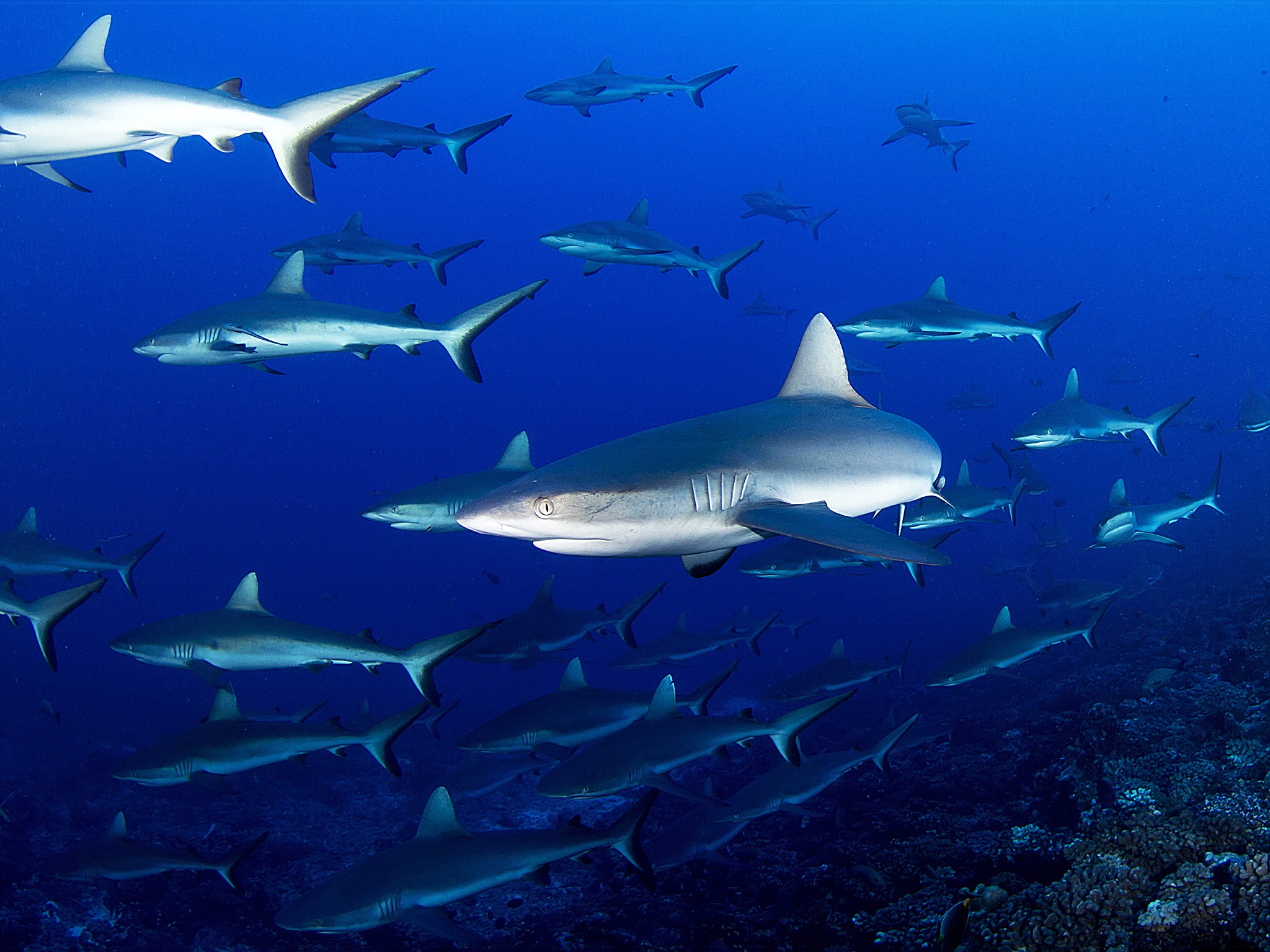
I was staying at Sané and Annabelle's epic Tetamanu Village and was fortunate to catch the magic moment when the sun reflects off the Sharks on an early morning incoming tide - and for you insiders, the first two clips are from the challenging trou aux requins in Apataki.

Notice how the Sharks are barely moving? 
They are literally surfing the current - and here's the according paper courtesy of Yannis, Johann, Serge, Charlie et al, inclusive of how they use a conveyor-belt positioning system to ensure that the groups remain stationary over the most advantageous spots.
Story here.
 
Enjoy! 
 

Saturday, March 31, 2018

Social Interactions of Sicklefin Lemon Sharks - Paper!

Click for detail!

Very nice!

Check this out.
It describes the behavior of Sicklefin Lemons at two provisioning sites in French Polynesia.
And assuming I understand the paper correctly, the observations coincide to a large degree with what we observe here with our Bulls, i.e. that these largely solitary animals develop a rudimentary etiquette when they aggregate at a provisioning site (and possibly equally at some communal feeding event like a Whale carcass) whereby a) dominance is not necessarily determined only by size and sex but rather, also by individual boldness; b) when there are many Sharks, some particularly dominant individuals react to the  increased competition by monopolizing the food source i.e. the bait cage and in our case, the suspended bin; c) as time goes by, "regular" Sharks appear to become more tolerant vis-a-vis other "regular" individuals of the same species whom they appear to recognize and d) the Sharks appear to tolerate conspecifics with equal ranking but tend to avoid more dominant individuals.
French synopsis here!

I really like it,  and the way they did collect the evidence.
We actually had a masters student do something similar a few years back with the Reefies - but it would be really cool if we were able to replicate this with our Bull Sharks that are our real focal species! The problem is the suspended vertical video camera as per the image at the top, as the rig would be unsightly for the tourists and above all, it would likely be eaten in no time - but I'm sure that we'll figure something out!

With that in mind, keep watching this space!
Enjoy the paper!

Monday, June 05, 2017

Tara!


I must say that this has been way cool.

Thanks to the personal initiative by my pote the incomparable Serge, we've just hosted a group of divers from the iconic French expedition schooner Tara - and lemme tell 'ya, trying to manage a good dozen Frenchmen endowed with national hero status has most certainly not been for the faint of heart! But manage we did: they actually behaved impeccably, conditions were squally but otherwise propitious, and the Sharks did perform - so all is good.
And who knows: hopefully, we may have assuaged some trepidations and reservations and maybe even created some more Shark diving aficionados among the researchers!

Click for detail!

From here they are continuing to Suva.
Coinciding with the ground-breaking UN Oceans Conference in New York and World Oceans Day, they will participate in several events with local partners - see here, here and here. This is important stuff, and there is really something for everybody, including the chance to have a look at the vessel - so do make some time and do participate as nothing could be more vital for the future of the SoPac.

Obviously, for us, every day is Oceans Day.
June 8 is a Thursday, and we'll be diving with our Sharks - so, what are you waiting for!  :)

See you at Shark Reef!

Sunday, July 31, 2016

Fakarava - Inverted Trophic Pyramid?

Bingo!

Remember Michael Domeier's comment to this post?
Turns out that the man was prescient - and this literally: being one of the authors, he undoubtedly knew that this was coming!
Watch.


The paper is here - read it!
And here and here are some synopses - and since I find them partially misleading, here's what I understand.
  • Fakarava Atoll has two main passes, Garuae in the North and Tetamanu, where this research happened, in the South.
    Like in other atolls in the Tuamotu archipelago like e.g. the spectacular trou au requins in the pass of Apataki, they are home to aggregations of resident (and semi-resident) Grey Reefie comprising, if memory serves me right, adult females and numerous juveniles/subadults of both sexes. The passes are great Reef Shark habitat because the Sharks can remain quasi-stationary by lazily riding the currents whilst engaging in ram ventilation, and because especially Tetamanu with its comparatively mild currents supports a good numbers of resident Fishes and acts as a migratory corridor for other prey species that regularly enter and leave the lagoon in line with the tides and the seasons.

  • Yet, the researchers postulate that since the pyramid of productivity inside of Tetamanu is inverted, the available prey biomass would not be sufficient to sustain even only the local population of highly resident Sharks. This means that in order for the Sharks to be able to reside there without having to forage farther afield, their food/energy requirements would somehow need to be subsidized.

  • That subsidy happens over several months during the Austral Winter.
    Then, huge numbers of several species of bony Fish successively aggregate in the passes in order to spawn = in essence, as the prey representing the productivity of the adjacent lagoon travels to the Sharks, the Sharks don't have to travel to the prey.
    This opportunity attracts the majority of transient Reefies (= likely the adult males) along with the less resident ones, meaning that the Grey Reef concentration in Tetamanu nearly triples. Still, during that time, the biomass of prey is vastly larger than that of the Sharks and all Sharks have ample opportunities to feed.

  • Once the spawning season is over and water temperatures, and consequently, the Sharks' metabolic requirements increase, the Reefies gradually disperse again, and residency at Tetamanu decreases as even the highly resident individuals are forced to sometimes roam in search of prey.
My takeaway?
  • There is no inverted trophic pyramid in Fakarava Atoll.
    Yes in the passes there are local Shark aggregations and because of that, the trophic pyramid is locally skewed -  but just like in the case of Sala's remote islands, there are external subsidies and the Sharks also roam, meaning that the relevant area one has to consider is far, far larger than the mere area of the passes. And over that whole area that comprises the lagoons but also the outer slopes, the pyramid is clearly normal as the biomass of Sharks is orders of magnitude smaller than that of lower trophic levels.
    Incidentally, that's not that dissimilar from our feed on Shark Reef where the astounding temporary predator biomass is in no way representative for the trophic pyramid of Beqa Lagoon let alone the whole of Fiji!

  • For me, these latest findings mean that until somebody comes up with solid evidence in line with the data collected by Johann et al, I will continue to call BS on Sala's hypothesis of there being inverted trophic pyramids on pristine reefs!
Enjoy Johann's paper!
 

Sunday, November 01, 2015

Feeding Sharks and Rays - Paper!

One of the many stupidities found here!

Johann alerts me to this new paper.
It comes to the conclusion that ecologically, provisioning can have effects at the individual, group and population level, and that those effects are generally neutral to negative.

Well what can I say - probably that's true!
It just so happens that every single one of the authors is a pal of mine - and because I know them, I also suspect that on top of the science that is probably pretty much irrefutable, the paper also has a political agenda, and that is, to obliquely address the mess that is Shark diving in French Polynesia, see the link at the top.

Now don't get me wrong here.
Shark diving in French Polynesia is nothing short of stellar.
But when it comes to the feeding dives, most local moniteurs appear to believe that they're god's gift to Shark diving, meaning that they are entirely impervious to accepting even the most common-sense advice (steel mesh gloves anybody?) - and as a consequence, bites are rife. So far, most of the accidents did involve the comparatively harmless reefies - but now that everybody and his dog is flocking to the new, completely unregulated and multi-user Tiger Shark dive just outside of Papeete, the risk profile has risen astronomically and once again, it's really only a matter of time til things will end up in tears. Same-same for the stupid idea of having snorkeling tourists hand feed the small reefies - seriously, WTF?
It's same old same old, so I'm really not gonna dwell, the more as having been there, the discourse is way too ego-driven and frankly leads to nowhere, meaning that the situation appears pretty much hopeless unless the regulator decides to finally regulate.
Hint hint! :)

But I'm digressing.
I can't really say that I love the paper because its conclusions are pretty much obvious, and because it does not really address the principal cause of most of the enumerated problems = bad procedures. As an example, the much-cited disaster at Stringray City is entirely the consequence of piss-poor management and regulations!

Anyway - worth reading!
My take-away: better procedures and more research into those possibly negative effects - pretty much done on the former (tho always learning and always adapting!), and very much working on the latter, so keep watching this space!

And one last thought if I may.
The problem is not Shark diving - not for the animals and not for the people.
Compared to the overfishing and the habitat degradation, the inconvenience caused by the industry is nothing. And yes there have been many, mostly accidental bites - but as far as I know, during literally innumerable provisioned Shark dives, there has been a grand total of ONE documented fatality. Compare that to the same time spent engaging in ordinary SCUBA and ask yourself the question, which is by far the safer activity? 

Just sayin'!
So, lets please keep things in perspective - and let's also never forget to always mention the industry's enormous contribution to both conservation and research that outweighs any of those possible minor deleterious effects by far!
 

Tuesday, April 21, 2015

Blacktip Reefies vs Surgeonfish!


Love love love this kind of stuff!

Story here - PDF here.
Here in Fiji we may be possibly witnessing something similar - at least, that is our working hypothesis although we're still debating about how to test it. Maybe you remember this paper, and this picture.


It is an old graph of Bull Shark sightings.
In essence, it shows how the Bulls disappear at year end for pupping and mating, and how they then return for the Running of the Bulls in late December/January.

But there's also another detail - see it?
Every March/April, an this usually around the Full Moon, we get a notable temporary dip in the number of Bull Sharks. Our hypothesis is that they are being drawn away by some event that is likely linked to predation - and it just so happens that many Fishes like incidentally those Surgeonfish form spawning aggregations around the Full Moon, this because the associated strong tides favor maximum dispersion of the fertilized eggs. 
Obviously, so far, this is only a correlation and thus merely speculative - but it is a testable hypothesis and if certain things come to pass like we plan them to, we may soon be nearer to solving that riddle!
So keep watching this space! :)

Anway, real interesting observation from Moorea.
Nice job Ornella, Johann and Serge