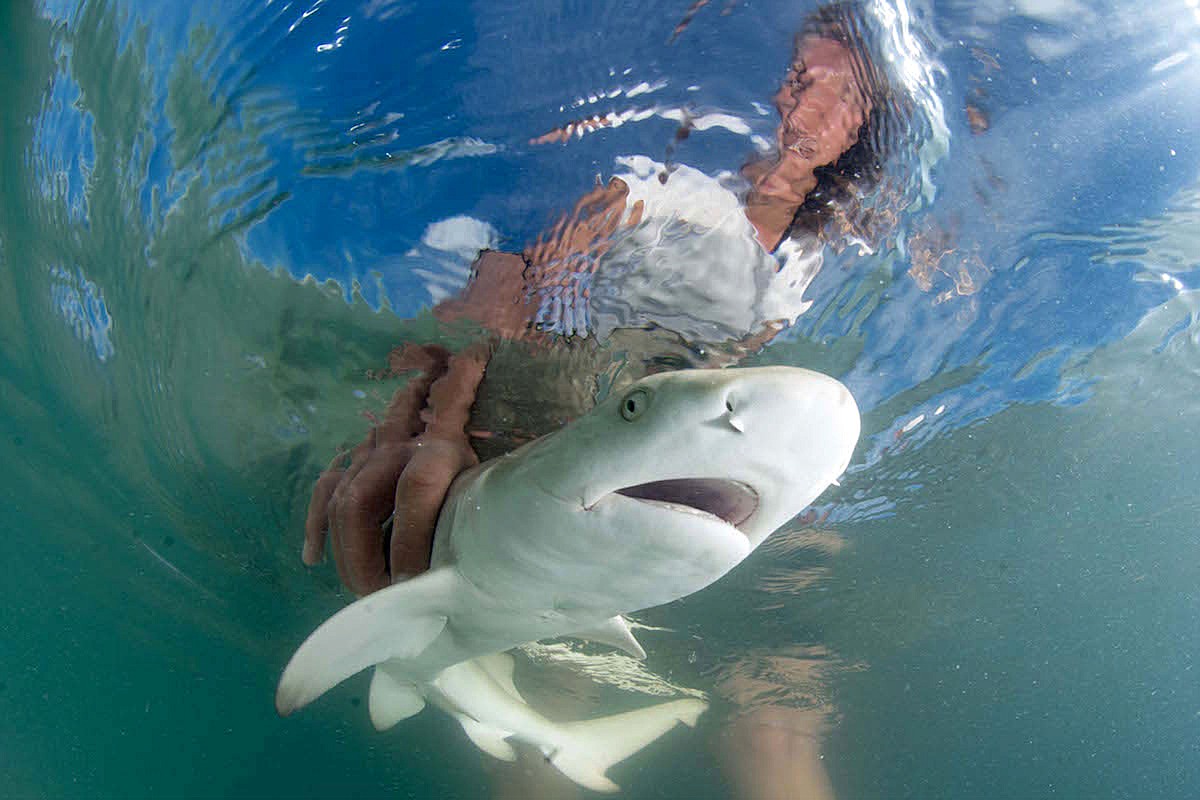
Showing posts with label Sicklefin Lemon Sharks. Show all posts

Monday, December 28, 2020

Baby Lemon vs Barracuda!

 
Wow - watch.
 
 
I guess one could say, such is life out there in the wild.
But I'm particularly happy that the little Lemon made it out alive!
 
Anyway, enjoy!
 

Saturday, March 31, 2018

Social Interactions of Sicklefin Lemon Sharks - Paper!

Click for detail!

Very nice!

Check this out.
It describes the behavior of Sicklefin Lemons at two provisioning sites in French Polynesia.
And assuming I understand the paper correctly, the observations coincide to a large degree with what we observe here with our Bulls, i.e. that these largely solitary animals develop a rudimentary etiquette when they aggregate at a provisioning site (and possibly equally at some communal feeding event like a Whale carcass) whereby a) dominance is not necessarily determined only by size and sex but rather, also by individual boldness; b) when there are many Sharks, some particularly dominant individuals react to the  increased competition by monopolizing the food source i.e. the bait cage and in our case, the suspended bin; c) as time goes by, "regular" Sharks appear to become more tolerant vis-a-vis other "regular" individuals of the same species whom they appear to recognize and d) the Sharks appear to tolerate conspecifics with equal ranking but tend to avoid more dominant individuals.
French synopsis here!

I really like it,  and the way they did collect the evidence.
We actually had a masters student do something similar a few years back with the Reefies - but it would be really cool if we were able to replicate this with our Bull Sharks that are our real focal species! The problem is the suspended vertical video camera as per the image at the top, as the rig would be unsightly for the tourists and above all, it would likely be eaten in no time - but I'm sure that we'll figure something out!

With that in mind, keep watching this space!
Enjoy the paper!

Thursday, November 26, 2015

Shark Bites in Moorea - Paper!


Pretty grim - and these bites are merely superficial! Click for detail.

Bingo!

From the Abstract.
  • Introduction: Shark-based ecotourism is significantly developing around the world, often without appropriate management of risk. This activity involves a risk of accidental bites on divers that can be quite severe or even fatal.
  • Objectives: To determine if ecotourism companies’ liability can be engaged in the context of bites on scuba divers in presence of hand-feeding practices, supporting the legitimacy of financial compensation for the victims.
  • Methods: We analyzed the development from the mid-eighties to 2010 of shark-based ecotourism through artificial provisioning practices in Moorea Island (French Polynesia) and more specifically the features and motivation of two bites on divers by Sicklefin Lemon sharks.
  • Results: The specific practice of hand-feeding can be considered as a facilitating factor for accidental bites on divers, potentially involving the diving operator’s responsibility.
  • Conclusions: Our findings should support the technical work of experts that might be called in such cases.
Didn't I tell you that the last paper had an agenda!
This one, titled Determining the Role of Hand Feeding Practices in Accidental Shark Bites on Scuba Divers is by one of the previous authors, my pal Eric Clua, and by, I believe, anthropologist Frédéric Torrente. It describes the history of the chaotic and now largely defunct Shark diving industry in Moorea along with two of the numerous non-predatory strikes by provisioned Sicklefin Lemons, see pic at top. It comes to the general conclusion that in certain cases, Shark diving operators may bear some responsibility and may even be liable should a client be injured.

Totally agree!
Like I've stated for many, many years, baited commercial Shark diving is not SCUBA diving, and the clients have a reasonable expectation that we operators keep them safe. Yes, we make them sign liability waivers which should hopefully exclude the most frivolous complaints - but when operators are clearly negligent, it is only fair that they be held accountable!

Seriously, WTF? 
But having said that, Elke obviously likes to get real close and undoubtedly bears her share for the fiasco. Having been at the receiving end many a time, I can attest to the pressure those eager image hunters will bring to bear - not easy to handle in an industry where client satisfaction and word-of-mouth recommendations are critical to one's financial survival!

Long story short?
Good one Eric - and for you out there who STILL don't understand what it means to conduct Shark tourism dives, re-read a) these 90-odd posts about our industry and then, b) these 80-odd posts about the need for proper procedures!

Enjoy! :)

Tuesday, September 03, 2013

Shark Bible - fail!

Source.

Check out this pic.

That's a Sicklefin Lemon Negaprion acutidens.
And there's plenty more pictures here - notice anything?
Yes as everybody with two eyes can see, every single one of them features a dark spot on the tip of the snout. THAT, and not some equivocal falcate fins and the like is the principal physical attribute differentiating them from ordinary Lemons - and I'm yet to come across a single ID book mentioning it!
Johann - do you agree?

And this is the illustration from the bible.


Does this in any way look like that Shark?
And what about that kink in the gills - do you see anything confirming it below? And that line originating above the gills - where does it curve down to, and why doesn't the upper Shark feature it?

Source.

Not impressed!

PS - but it's still the best there is, so get it!

Sunday, August 18, 2013

The Shark Bible - review by JSD!

Fiji Bull Sharks - pic by Gary Peart- click for detail!

Finally!

The bible is out.
And JSD has penned a review hat contains a reference to the Fiji Bull Shark - so I really got no choice but post it in its entirety!
So there!
Sharks of the World: A Fully Illustrated Guide (Hardcover) 

It is not every day that a book appears that has the unmistakable authority and quality of a classic; rarer still that such a tome should be the launch publication of a new publisher. Wild Nature Press' Sharks of the World - A Fully Illustrated Guide is such a work. 

We shouldn't be surprised. 
The team at Wild Nature Press has been illustrating and designing elegant natural history books for mainstream publishers for years and has merely transferred its talents to its own publishing house. Nor did this book appear fully formed from the primordial swamp. It evolved from the Collins Field Guide: Sharks of the World of 2005 and has the same authors (Leonard Compagno and Sarah Fowler) and illustrator (Marc Dando), plus the additional taxonomic input of David Ebert. 

The evolution has been successful. 
The new book is considerably larger than the old (compare, say, a Grey Reef Shark with a full-blown Fijian Bull Shark) and this must come as a relief not only to readers who wish to feast their eyes on the endless variations-on-a-theme that are sharks, but also to the wonderfully illustrated animals themselves. Packed with musculature and movement, they are now less likely accidentally to swim off the page. Furthermore, the species described herein have grown to over 500 (there are some 90 recently named sharks). 

The book basically divides into 2 parts. 
After the foreword (by scientist John Stevens) there is a grand tour through the biology and natural history of the animals that deals with every topic you could ask for. Illustrated with occasional photographs and a great many colour drawings, as well as maps, diagrams and charts, the intricacies of shark biology as well as crucial themes such as fisheries, conservation and management, are explained. On page 59 one reaches the raison d'être of what has been: the magisterially presented description of every shark from the known knowns to the known unknowns. Each has its own entry which includes a detailed line drawing and goes on to describe size, distribution (via a map), teeth, identification, habitat, behaviour, biology and conservation status. To enrich this section the sharks are also depicted in full colour plates and also via some photographs (of living sharks). These photographs take us far beyond the usual suspects: consider the Greenland Shark (p. 157), the Caribbean Roughshark (p. 162), the Goblin Shark - I kid you not! - (p. 216), the Blackmouth Catshark (p. 347), or the Snaggletooth Shark (p. 437). 

But there is more. 
Appendices include a glossary, discussion of oceans and seas, techniques of field observation and fin identification, recommendations for further reading, a list of scientific and conservation organisations, online information sources, and index. Phew. 

Only an ignoramus would claim that sharks are not sufficiently interesting to deserve so impressive a treatment.
I would defy anyone to pick up Sharks of the World - A Fully Illustrated Guide and not pause in wonder at any number of beasts swimming far off the beaten track: the yellow-striped Atlantic Weasel Shark, the abyssal Demon and Ghost Catsharks, the frankly ridiculous Winghead Shark, the hopelessly uncuddly Bramble Sharks. And that is long before one considers the over-sensationalised superstars such as the Whale Shark, Bull Shark, Tiger Shark and White Shark. 

 I cannot recommend this book highly enough so I won't. I can, however, wonder at how Wild Nature Press can follow this debut with a worthy successor. If they can make the fascinating this enthralling, perhaps they should set themselves a real challenge. Worms of the World, anyone?

Jeremy Stafford-Deitsch. 
Get it!

Friday, August 16, 2013

Moorea Lemons - one more Piece of the Puzzle!

 (A) Map of the study location. (B) The genetic network of adult lemon sharks. Each individual is indicated by a node labelled by shark ID. Circles and squares indicate females and males respectively and symbol size is indicative of the body length of the shark. Node colour corresponds to the three defined residency groups. Dyads sharing a first-order genetic relationship are connected by a line, with line thickness indicating the strength of the genetic relationship (proportional to R values). (C) Genetic degree (number of first-order genetic relationships an individual has) distribution within the population - click for detail!

Very nice!

I was somewhat underwhelmed, and said so - which led to a personal visit by the very charming Eric Clua, and to a real interesting ongoing dialogue with Johann Mourier. And despite of a toothy (!) public debate between Juerg and Jon and the authors, everybody remains on best terms and is eager to share and discuss. That's how science advances and as Eric stated, everybody agrees that nous jouons dans la même équipe and that everybody profits by sharing ideas and engaging in spirited discussions.

And here is strike two - read it!
The feeding paper did raise the concern that the observed increased residency of some Lemons might lead to increased inbreeding - and from what I understand, this paper comes to the conclusion that it probably does not.
Whereas there are only about two dozen resident adult Lemons in Moorea, the species has evolved patterns to mitigate the according risk of inbreeding insofar as the Sharks will travel to both mate and pup (= migration), and that some individuals will travel to take residence in other islands (= dispersal), all of which is conducive to gene flow. Having said that, the degree of inbreeding of the Lemons in French Polynesia remains never the less relatively high, this likely due to small overall numbers and the relatively high isolation between islands and between archipelagos.

And the take away message after this rather epic 5y investigation?
I believe it boils down to this - and I trust that Johann will correct me if not.
  • Like Juerg's Fiji paper, it once again confirms that provisioned Sharks appear to disperse normally, or as Juerg puts it, that
    Chumming and food provisioning are unlikely to fundamentally change movement patterns at large spatial and temporal scales, and seem to only have a minor impact on the behaviour of large predatory sharks; hence, the creation of behavioural effects at the ecosystem level seems unlikely.
    Obviously, this is the one aspect I'm most concerned about - and I sure hope that Johann will agree with this conclusion!
  • That said, Lemons are not Bulls and French Polynesia is not Fiji.
    There remain some local effects that are a possible cause for concern, foremost of which the observed increased residency that could eventually result in lower numbers of Lemons dispersing which in this generally small population might have a significant negative effect on gene flow and thus the fitness of that local population.
  • The second possibly negative effect is the observed increased aggression.
    I continue to question whether the observed increased brawling among male Lemons is really relevant in view of the animals' quasi magical healing powers. But what is certainly worrisome are the reports of increased strikes on humans, see the testimony by  Moorea Natural Diver Lover in the comments section here.
    To me, they are the direct result of poor procedures, foremost of which the surface feeding mentioned here. However Johann tells me that there's only one remaining operator that feeds the Sharks, so maybe that problem has been resolved - that is, provided that the operator is taking the necessary precautions which is not necessarily a given and certainly worth keeping an eye on!
All-in-all, a really brilliant job, and big kudos to everybody involved!

Sunday, April 14, 2013

New Shark Bible - get it!


And talking of Shark ID.

If you are interested in Sharks, you must get this.
Authored by the brilliant illustrator Marc Dando, by David Ebert, and by the indefatigable Sarah Fowler of inter alia the Shark Trust and the IUCN whose praise I could not possibly sing highly enough, it will be the most authoritative book on the different Shark species for many years to come - this obviously with the caveat that several taxa are under revision and that you must continue to keep abreast of the latest science about the topic.
The pre-publication offer for this book is now open, with special incentives for the first 500 orders received (free postage world-wide and a limited edition shark print of one of the original plates signed by the illustrator). 

Peep inside it here and order online. 
For those of you who know the 2005 Collins Field Guide to Sharks of the World (now out of print from Collins, but still available from Princeton Press): this book is completely new.
It is larger format, with 528 pages and nearly 60 new species illustrated, more detailed, and features photographs as well as Marc Dando’s stunning illustrations. You may think that it’s worth waiting for this book to be discounted on Amazon. Well, it is already discounted, and this offer is as good as it gets! 


Title: Sharks of the World - a fully illustrated guide 
Authors: David A. Ebert and Sarah Fowler
Illustrator: Marc Dando
Publication date: Summer 2013
ISBN: 978-0-9573946-0-5 
Amazon has a cheaper offer, however sans signed illustration.
Enjoy!

Wednesday, September 29, 2010

Lemons in Moorea - two!

This is a Sicklefin Lemon - forget the fins: notice the black dot on the nose? That's how you identify them!

Check this out.

This is another real interesting interview by WhySharksMatter .
David: well done & keep ‘em coming – so far, yer getting 10 out of 10!


Very cool!
Monsieur Clua is of course non other that the co-author of the Moorea Lemon Shark feeding paper and consequently, I continue to sense the same anti-feeding bias.
But at the same time, we learn that there are three dive ops feeding on that site, meaning that as expected, it is a multi-user site with all the resulting problems, and Johann Mourier’s answer on our Facebook stating that The feeding practices implemented by some diving center(for example feeding sharks from the surface) have led to a change in shark's behaviour, with bottom living lemons starting to come on the surface further leads me to believe that the real problem (if there is one) may well be procedures-related as I assumed in my post – and if so: everybody is herewith invited to come see what we do here, FOC, and discuss the possible implications for French Polynesia!

I actually tried to have that conversation there and although we are friends and everybody seemed interested, it was equally clear that nobody believed that the different interests would ever come around a table and agree on anything – I may add, very much like here in Fiji!

Anyway, the info about the value of Sharks was really interesting!
I remember seeing a direct value of approx USD 20,000 per shark per year from the Maldives, one operator in SA reports a value of approx USD 15,000 and the value of Shark tourism to the Bahamas is apparently USD 78m per year. Now, Clua postulates USD 50,000 per Shark per year for Moorea’s Lemons which is great – and also an indication of the price level of that particular corner of paradise!

Here’s the back-of-the-envelope calculation for Fiji.
We turn over FJD 1m with two boats, and it’s fair to assume that the guys down the road turn around half of that with one boat. Let’s also assume that all of it gets re-invested in Fiji, which is what we do.
Add the ancillary revenues as in flights, hospitality, restaurants, cabs, excursions, souvenirs etc and assume that the ratio may well be 2:1 (it is probably higher) – makes FJD 4.5m in total which two small dive ops earn with approx 100 regular Sharks.
Thus, the direct value of one of those Sharks to the Fiji economy is FJD 45,000 or USD 23,000 for every year it lives – as opposed to 300 bucks for its fins, once!
Pretty darn impressive, huh!

Clua also mentions the indirect value of Sharks to the Country citing improved fisheries etc.
Absolutely!

In my conversations with Government, I say this.
Some Sharks (not all: some are clearly mesopredators that would wreak havoc on the lower throphic levels if their population were not held in check), notably the larger predatory ones are probably keystone species that have a profound effect on the health of the reefs, meaning that if they were removed, the reef ecosystems could well collapse.

With Fiji being an island state, it is fair to assume that the principal, if not the only reason why tourists come and visit are its pristine reefs and waters, meaning that if the reefs were to be degraded, Fiji (and French Polynesia, and the Bahamas, and the Maldives, and Palau!) could kiss their tourism industry goodbye!
That’s millions upon millions of dollars, often the country’s principal sector of GDP and source of foreign exchange!

Keep this in mind next time you talk about Sharks, OK?

Monday, July 27, 2009

Fiji's Sharks


The guys over at Underwater Thrills are up to something.

Having seen the results of their last initiative, I'm fully expecting something equally smart, out-of-the-box and of course, conservation-oriented! Leveraging our clients' images? I like it already!

So whilst we're waiting for more details, here's a nice video by one of our good friends and repeat clients, Lawrence Groth (with a "t"!) of Shark Diving International and the Shark Safe Project. This is he, "t" and all - very cool job by Annie Crawley!


Depicted are the two local Shark diving companies and two of our signature Tigers, big and mellow Scarface with her crooked mouth and the much smaller and assertive Adi, or Princess. There's also nice footage of Whitetail, our biggest Sicklefin Lemon and yes, she's got a white blotch on her tail!
The scenes with BAD are those showing Rusi with his signature yellow hood, and the metal crate and pole where we keep the bait. Great footage and also, great choice of soundtrack!
Hat tip: Tafa, equally a client, for having discovered the video.


Monday, April 20, 2009

About our Sharks

Pic: Adi by Michael Aw

More Sharky stuff from our new website.

Welcome to our Shark Diving pages!

This is what has made us world-famous and this is likely the main reason why you have decided to consult our website.
Good choice!

First and foremost, forget everything you may have seen on other Shark dives!
The Shark Dive is like nothing you can experience anywhere else - guaranteed!

Contrary to regular SCUBA diving, there is no pre-determined set of guidelines governing Shark diving as all Shark diving protocols are always highly situation-specific.
Each operator must devise his own set of diving and safety procedures depending on the individual locations, the species mix and other variables, foremost of which very personal considerations - like one's experience and beliefs on the matter in terms of what one is aiming to achieve, how and why. For us, the latter is first and foremost Shark Conservation and Shark Research and the Shark Dive is merely a means to facilitate that goal.

All of that is explained in the following sections "About diving with Sharks" and "The Shark Dive" and also in the pages devoted to Shark Reef Marine Reserve and the Fiji Shark Project. We strongly recommend that you familiarize yourself with the contents in order to be best prepared for this unique and exhilarating experience!

When it comes to our Sharks, you have the chance of seeing the following 8 species:

Whitetip Reef Shark (Triaenodon obesus)
Blacktip Reef Shark (Carcharhinus melanopterus)
Grey Reef Shark (Carcharhinus amblyrhinchos)
Silvertip Shark (Carcharhinus albimarginatus)
Tawny Nurse Shark (Nebrius ferrugineus)
Sicklefin Lemon Shark (Negaprion acutidens)
Bull Shark (Carcharhinus leucas)
Tiger Shark (Galeocerdo cuvier)

We are maintaining an exhaustive database about our Shark dives and as of January, 2009, we dispose of over 2,000 complete data sets. This enables us to run statistical models in order to try and figure out whether there are any recurrent patterns governing the presence, and behavior of our Sharks.
However, weather patterns in the South Pacific are subject to wide year-to-year variations due to the influence of the El Niño Southern Oscillation. It is only fair to assume that this will also influence Sharks as part of the Marine Ecosystem. Many more yearly data sets will have to be collected in order to hopefully once largely take this specific variable out of the equation.

So far, preliminary insights can be summarized as follows.

Our Whitetips, Blacktips and Greys are resident and can be encountered at any time during the year.
Numbers vary between just a few and approx. two dozen depending on variables like weather and tides but also, the presence of other larger Sharks, foremost of which the Tigers.
Whereas the Blacktips are largely confined to the shallowest depths, the Greys and Whitetips are most prevalent at 10m but will occasionally venture down to the Arena at 30m.

The Silvertips, Nurses and Lemons are what could be called "regulars".
They probably live in close proximity to the feeding area (maybe deeper in the Beqa Channel) and turn up shortly after we enter the water. With the exception of the Nurse Sharks which are nearly always there, their appearance is more sporadic and not -yet- predictable.
As with the other Sharks, numbers vary: up to fifteen Nurse Sharks and up to six Silvertips or Lemons. Like the Bulls, these species are confined to the deeper reaches of between 15 and 30m.

Our Bull Sharks are the stars of The Shark Dive and we have devoted a lot of resources in trying to better understand their behavioral patterns (click on image for bigger resolution).
In general terms, they turn up in ever increasing numbers in January and are very consistent through August where numbers start to dwindle in view of their birthing and mating season in October-December where one is likely to see only a few individuals, most of which sub-adults.
Maximum numbers during January-April can be as high as 40 individual Sharks on a single dive and with 47 named Bull Sharks as of January, 2009, we may well be looking at a population size of in excess of 100 individuals.
As with the species above, the Bull Sharks are not residents of the diving area but ascend from deeper water once we start the dive and "call them in" by baiting the ever-hungry Giant Trevally and Red Bass.
We have learned to distinguish between "regulars" that turn up very frequently, and more transient individuals that are individually known but only turn up sporadically. In very general terms, we are however witnessing some sort of "rotation" by all Bull Sharks, whereby individual Sharks will turn up for one week to ten days and then disappear, only to turn up again weeks, or even months later. This may be an indication for the size of their range (probably not a territory, a term that implies that it is defended against conspecifics) or it may be an indication that they are not really bound to any range or territory at all but roam freely throughout the whole archipelago instead.
So far, the data we have collected via our satellite and acoustic tags are not sufficient to precisely interpret this rather surprising behavioral pattern, but they are nevertheless a good starting point for formulating advanced and testable hypotheses .

When it comes to our known five Tiger Sharks, the data collected so far are rather inconclusive.
Preliminary evidence suggests that they are less prevalent during the top Bull Shark period of January through April. The reasons for this are unknown and subject to speculation: it may be due to the overwhelming presence of the Bulls acting as a deterrent, or it may be due to some regular occurrence like their breeding cycle or other seasonal feeding opportunities elsewhere, like the flooding of rivers during the wet season, Turtle aggregations etc. Again, this is pure speculation and would have to be confirmed by e.g. obtaining further insights into their seasonal geographic movements via acoustic and satellite telemetry tools.
Once the Tigers turn up, they will make regular, although sporadic appearances, this probably due to the very large area they are known to patrol. Of interest, they mostly turn up during our second, shallower feed.

All-in-all, we believe that The Shark Dive is well worth a visit year-round.
What is certain is that every single dive is different - but always exciting, intriguing and highly rewarding!

Saturday, April 04, 2009

Swamped!


Impressive, huh?

Actually, this is the very moment when our Bull Sharks are at their most harmless!
This Shark has just taken the bait and is swinging out from the pit whilst munching on a Tuna head - a funny thing actually, as some individual Sharks just swallow the heads whilst others, like Crook, Bumphead and Chopper always engage in this particular behavior. Anyway, with their mouths filled to capacity, they could not be less interested in the (happy) photographer!
As I said, Lill's portfolio will be impossible to beat!

Thing is, we're being swamped!
Whereas only a couple of years ago, a dozen Bull Sharks would have been a great dive, now we're talking 25-30 and on exceptional days, more than 40!
Not counting the Tigers, Silvertips and Lemons who can swing by anytime!

This of course has yet again led to an overhaul of our safety procedures.
Not concerning the customers who continue to be completely separated from, but still very close to the animals - but concerning the feeders! Keeping track of what's going on whilst concentrating on feeding has become next to impossible and we've had to second two bodyguards who are positioned next to the bin and ensure that everybody continues to behave!

All very exciting and loads of fun!

Tuesday, March 03, 2009

Year of the Shark - Fiji: DVD!


Want to spice up your Shark Presentation?

We've produced a short DVD featuring the 8 species that frequent Shark Reef Marine Reserve: Tawny Nurse Shark, Whitetip Reef Shark, Blacktip Reef Shark, Grey Reef Shark, Silvertip Shark, Sicklefin Lemon Shark, Bull Shark and Tiger Shark.

As a Supporter of the Year of the Shark - Fiji, you can now order them at our dive shop: just call 3450 911 0r write to Info@FijiShark.com. We'll give them at cost and it's entirely up to you whether you hand them out for free as part of your Shark Awareness Course or mark them up and sell them instead.

However, please keep in mind that the footage is copyrighted to BAD and that you may not use it for any other purpose.
Vinaka!

Wednesday, December 31, 2008

Some of the usual Suspects

I just found this video of one of our Shark dives.

It has been obviously shot by one of our Clients (nice job!), as witnessed by his stationary position behind the wall of coral. As you can see, there's absolutely no need to go hopping about in order to "get the shot", as the feeders will guide the Sharks towards the cameramen, the more as the Bulls are trained to come in from the left. And don't tell me that this ain't close enough for Joe Diver!

You may also want to notice the stationary position of the feeders and the fact that they are wearing steel mesh gloves that will protect them from any accidental "nicks". Like on this day, the animals are generally mellow, focus exclusively on the feeders and take the bait with great gentleness - but there's always the risk of a mistake. This selective feeding technique also ensures that the viz remains good throughout.

Is this difficult and dangerous?
Yes it is and it takes years to make it look easy! This is nothing you may ever want to try at home!

Among the usual suspects, i recognize Scarface the Tiger Shark lady, Whitetail the Sicklefin Lemon, Whitenose the male Bull Shark with the white tip on his nose, Flop with the bent tip of her tail, Crook with her crooked mouth and a plethora of other Bull Sharks which are more tricky to identify.

Enjoy!

Friday, September 26, 2008

Naughty File!


Sasha has posted the Naughty File, so there!

Thankfully, it has been posted in its correct aspect ratio, thus sparing me more comments about "fat Sharks" and the like - after all, they're big and healthy enough as it is!

When it comes to all that bumping and grinding, the jury is still out on what it could mean.
It may just be the signature of the camcorder scrambling the Sharks' sensory system. But it may also be an attempt to assert dominance. Most powerfully armed animals resolve their conflicts via highly ritualized fights and employ their weaponry only at the very last resort.

Have you ever "stared away" a Shark?
I've found that to be a highly effective tool and in most of the cases, the animals will veer away as soon as eye contact has been established. Sometimes, however, they will react by making a direct beeline for the camera, especially in the case of some specific, very large and thus likely dominant females as Granma, Crook and Bum.
With that in mind, in Bull Sharks (and other Sharks, too), the escalation in asserting dominance could be as follows: Size - Staring - "Beeline" and "Giving Way" - Bumping - Biting. Yes I know, it's once again only a Hypothesis - but we're working on it.....

Keep in mind that I'm generally out there in the very center of the fray and that I could be regarded as just another big something that is equally interested in the food and thus needs to be put in its place - just like in that take at 0.32 where Kinky bites away Whitetail the Lemon Shark, a rare case of documented interspecific aggression..

As to Scarface, our biggest Tiger (4.5 meters - and growing...) , that's another story altogether - yet maybe it is not.
Doug Perrine took this picture on the very day when Scarface and I met for the first time. What ensued is the final take on the file. The way I see it, she had just taken a fish head from a feeder and upon seeing another person "offering" something dark, she came in and had a nibble. Ever since, she regularly glides in and has a real good look and sniff at both yours truly and the housing, but she has never even opened her mouth again. What you perceive as "bumps" is actually me pushing her away whenever I get the feeling that she lingers for too long, just in case she makes up her mind and decides to do something more radical.
Is there "something going on"? I'm convinced there is, some sort of a "squaring off" which however is limited to both of us resorting to a lot of mutual staring. Very intense for sure, as Tiger Shark eyes sure are something completely different from the reptilian glances I get from most other Carcharhinid Sharks.
Very personally rewarding, too.

Anyway, I just wanted to put things into perspective. As the title implies, this is not our normal fare, nor is it by any stretch of the imagination what our much-supervised and -protected clients are bound to personally experience.

Enjoy!