A large group of smart people have gotten together this September and defined some nascent conservation issues for 2010, both threats and opportunities.
The resulting paper is called
A Horizon Scan of Global Conservation Issues for 2010 and you can download it
here, and yes, as you should, you would have to pay for that. Or, you may want to consult the useful synopses posted on
Conservation Bytes and
Planet Earth Online.
It spans a list of 15 topics, some of which surprising like
International Farmland Acquisitions by foreign governments, some somewhat obscure and eclectic like the effects of
Nanosilver in Wastewater, some visionary as in
Synthetic Meat or releasing
Aerosols into the Stratosphere to combat Global Warming to outright scary as in
Artificial Life.
In very general terms, they all illustrate the complexity of our environment and the vast, and often totally unexpected ramifications of our actions upon it.
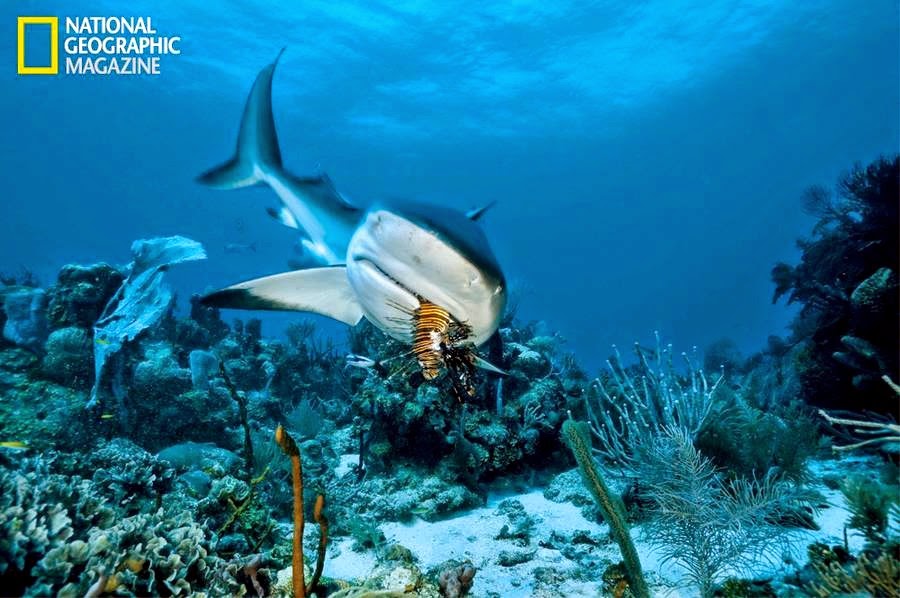
As in the case of the Lionfish invasion of the Western Atlantic.
Likely the progeny of aquarium pets that escaped or were discarded in Florida during the early nineties, they have
completely overrun the Caribbean and are inexorably threatening South America.
 You can check out the progression here.
This what the paper says (links are mine).
Invasive Indo-Pacific Lionfish.
Small numbers of predatory Indo-Pacific lionfish (mainly Pterois volitans) were first recorded in waters along the eastern coast of the United States in 1992 .
The source of introduction is uncertain. The rate of lionfish range expansion was initially slow, but increased markedly after the colonisation of Bahamian coral reefs in 2004.
Lionfish are now established throughout most of the northern Caribbean and have been recorded as far north as Rhode Island and south to Colombia. Where they are established, lionfish are found at densities far exceeding those reported for their native range (e.g. > 390 lionfish/ha in the Bahamas compared to about 80/ha in the Red Sea).
Lionfish grow to a maximum length of about 45 cm, and prey on a wide variety of fish and invertebrates. On experimental reefs in the Bahamas, young lionfish reduced the recruitment of native coral reef fish by nearly 80%; the effects of lionfish on natural reefs are still unmeasured.
Lionfish are protected by venomous spines, and while small lionfish can be eaten by large groupers, such predators are rare throughout the Caribbean.
Lionfish are, however, now being fished and offered on the menu of some Bahamian restaurants. The pests obviously have no "natural" predators in the Caribbean and the local predators that could fulfill the role of regulating their population, like the larger Groupers and the Sharks,
are severely depleted. I fear that despite of the valiant efforts of those who promote
fishing and eating them (nice collection of recipes
here), they are there for good, like, say, the
cane toad in Oz (and alas, in Fiji as well).
Maybe, eventually, the Lionfish populations will somewhat balance out, the more as there is evidence that all individuals are the descendants of very few females and that, at least in theory, after experiencing such a severe population bottleneck, they would eventually have to crash back to their effective population size, like
the Cheetahs. Maybe, some local predators, parasites or pathogens will learn to exploit the new resource and thus keep the numbers in check.
But it sure is a very very long bet and not likely to happen anytime soon, at least not soon enough to be of real practical use.
Thing is that ever since we've "evolved" to become a global nuisance, these migrations and infestations have become so frequent to constitute the norm rather than the exception.
Just think about our animal baggage, be it domesticates, many of which have gone lethally feral, stupidly introduced species like Fiji's ubiquitous and invasive
Minah and
Mongoose, or unwanted followers like the
Norvegian Rat or the
Bedbug. Or the plants, be it agricultural or ornamental, like the Traveller's Palm I'm looking at whilst writing this is Fiji - originally,
endemic to Madagascar!
And recently and as always, mostly unwittingly, we've started meddling on a truly epic scale.
By building canals we've created highways for marine invasions between the Med and the Red Sea and between the Pacific and the Caribbean. By heating up the planet, tropical pests like
disease-bearing Mosquitoes,
Rodents and
Fire Ants and pathogens
are ever expanding (and check out
this example of how anthropogenic marine invasions are affecting Great Britain) and according to the above mentioned paper, there's a risk that as the Arctic melts, it will lose its function as a barrier between the Atlantic and Pacific Oceans, with unknown consequences for those two ecosystems - as in: adios
Deadliest Catch!
Anyway, I'm ranting as usual.
All I wanted to say is that it sure is
complicated and always interconnected - and that we should never forget that Marine, and Shark Conservation are but one facet of a much bigger and alas, equally bleak picture.
OK, back to the Sharks.