Showing posts with label Ecological Footprint. Show all posts

Friday, October 03, 2014

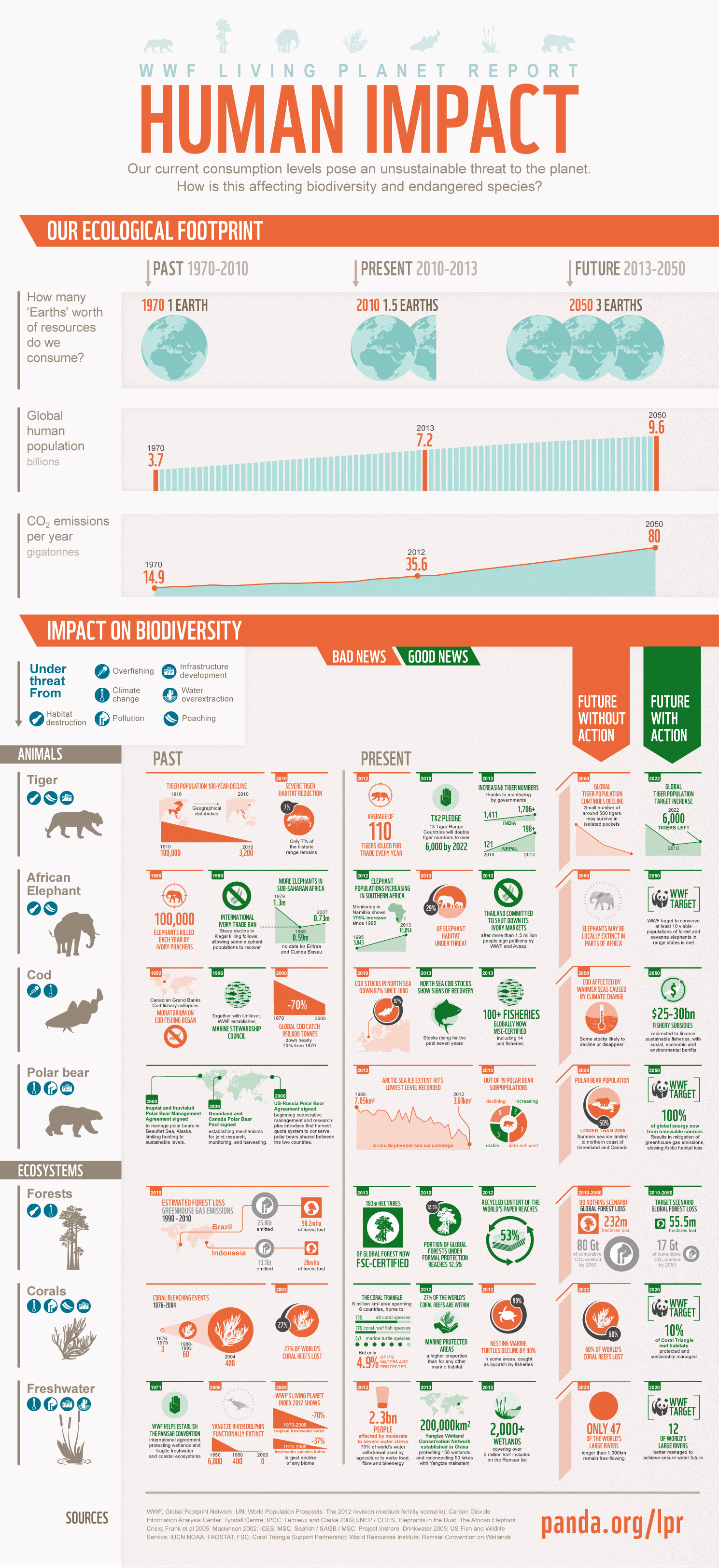
Living Planet Report, 2014!

Click for detail or explore here!

Watch.


From the article.
Currently, the global population is cutting down trees faster than they regrow, catching fish faster than the oceans can restock, pumping water from rivers and aquifers faster than rainfall can replenish them and emitting more climate-warming carbon dioxide than oceans and forests can absorb.
Just great isn't it.
Living Planet Index here, Ecological Footprint here.

Difficult choices here.

Thursday, September 26, 2013

Pacific Islands - running out of Fish!

Forget the romantic past: THIS is a typical Pacific Islands fisherman. Source.

Did you see this?
The coral fishermen of Vanuatu are facing a growing crisis: they are increasingly returning from their fishing expeditions with ever dwindling hauls. 
That‘s because the coral reefs that they travel out to are disappearing at an alarming rate as are the fish stocks near the coast that have traditionally served as the staple diet for people in the region. It‘s a similar story in the other Pacific Islands too. 

A variety of factors are responsible for the phenomenon. 
In addition to environmental pollution, rising temperatures and a creeping acidity in the ocean‘s waters – both a consequence of climate change – have taken a huge toll on the reefs. In fact, the ocean’s chemical makeup has changed more now than it has in 55 million years. That has put incredible pressure on the region’s embattled coral reefs, which have seen their rich biodiversity diminish.
Right.
Once again, the culprit is Climate Change, i.e. "others".

Nothing to do with ever increasing populations and individual ecological footprints, and the unwillingness to tackle the issue.
Nothing to do with overfishing. Nothing to do with the fact that there there is a shift from pure subsistence fishing to small scale commercial fishing whereby individual fishermen are catching many more Fish compared to before. Nothing to do with the fact that starting with those outboard engines and nylon gill nets, small-scale fishing is becoming ever more sophisticated and effective. Nothing to do with the fact that those governments are not in the slightest managing those coastal fisheries, meaning that there are no quotas, no monitoring, no enforcement let alone any prosecution!

Solutions?
  • Address population growth.
    That's the best strategy for both reducing poverty and progressing towards sustainability which is the only long term solution. Contrary to Climate Change where the effects are probably already locked in, those predicted 50% in population growth are by no means inevitable but can be steered with adequate policies, foremost of which national dialogue and education!
  • Manage your coastal fisheries sustainably.
    With populations growing and coral cover receding, the old traditional rules where everybody could just go out and simply catch whatever they could do not apply anymore! Management needs to comprise both MPAs and temporary closures and also management at the species level, the latter especially when it comes to the larger predators that continue to be targeted disproportionately. What it also means is that some stocks must be allowed to recover, meaning maybe slightly less now in favor of much more later!
  • Reduce pollution and protect critical habitat, like the nurseries.
  • Reduce the licenses and quotas of those offshore foreign vessels.
    Those industrial purse seiners should be forbidden altogether, this in favor of smaller and less "efficient" vessels - remember that any Tuna that are not being caught now are gonna be worth much more next year! The idea of forcing those vessels to retain and sell their bycatch is actually not bad - but only provided that the bycatch is legit, meaning that one must implement, enforce and continuously improve bycatch mitigation measures and strictly monitor the fishery - see the shenanigans with the so-called Shark bycatch!
Yeah I know I know.
Not gonna happen anytime soon.
The coastal overfishing is likely to get even worse not better, this because habitats continue to be degraded and because there is a chronic lack of resources for the implementation of any meaningful management measures - and above all, because ultimately, nobody dares to mess with those perceived sacrosanct traditional indigenous rights, see the continued shenanigans by WESPAC!
And when it comes to the offshore fisheries, the dirty business continues unabated. Only glimmer of hope: the PNA - but even there the highly profitable Pacific solidarity is being undermined by the usual liars and cheats.

But then again, who knows.
What is required are good, honest leaders that care about the well being of their people, and have the vision and also the mettle to make decisions that may initially be unpopular but will yield tremendous dividends in the longer term.
Not likely - but not impossible, either!

Anybody come to mind?

Tuesday, February 14, 2012

Marine Conservation - the principal Issues!


Just in case we lose sight of the context here.
Barring cataclysmic cosmic or geological events, these are the biggest threats to marine biodiversity - once again, very simplified.

First and foremost: there are too many people!
We are seven billion now and probably we will get as high as 9 billion, both of which is just not sustainable.
Moreover, billions of people are attempting to attain what they consider to be better life conditions, meaning that their ecological footprints are increasing as they progressively consume more resources and produce more waste. Even if we managed to stabilize or even turn around population growth, this will continue to exert tremendous pressure on biodiversity.
Those are monumental challenges indeed - solutions???
These are the root causes of all that follows.

The biggest anthropogenic threats to marine biodiversity are.
  • Global Warming
  • Ocean Acidification
  • Pollution
  • Habitat Degradation
  • Overfishing including Bycatch & Discards
When it comes to Overfishing.
As far as can be ascertained, anthropogenic extinction rates so far have been substantially lower in the oceans than in terrestrial ecosystems. In fact and despite of our best efforts, there is probably not a single documented case of us having fished a marine Fish to extinction - and should there be one, it would be the exception and not the rule.
This is cause for hope.

But that's of course not the whole story.
Several Fishes have become locally extinct and the populations of many marine Fishes that have been targeted commercially are severely depleted and but a shadow of what they used to be.
There is a line of thought stipulating that those populations have accumulated extinction debt and that they could be driven into extinction by an environmental catastrophe.
That environmental catastrophe could be Global Warming.

Sharks?
They are obviously subjected to the same pressures.
In particular, several larger species are being severely overfished and although to my knowledge this has not been specifically documented, it also stands to reason that Shark populations will be affected by the overfishing of their direct prey or of even lower trophic levels like forage Fishes.
Some of those larger Sharks are also apex predators and keystone species and there is research documenting that their removal can ripple down through the trophic levels via cascading effects, hence exacerbating the ecological consequences of their demise.

This as far as I can see are the principal issues.
The problems are enormous and eminently intractable as documented by the frustratingly slow progress of conservation and above all, by the many conservation setbacks and defeats. Yes there have been many successes - but alas, everything points to the fact that in the big scheme of things, those successes are simply too small and the pace, simply too slow. Especially if we don't get a handle on Global Warming, the future for marine biodiversity looks very bleak indeed.

Solutions?
If we so wish, there is a role for each of us to play - the most basic one being that it behooves all of us who live in relative opulence to reduce our ecological footprint, including limiting our carbon emissions! And those of us who want to do more and get involved in advocacy will find unlimited opportunities to make a difference as e.g. discussed here in the case of Shark conservation.

Orgs I personally like: Shark Foundation and Save our Seas Foundation for sponsoring research; Shark Trust, Shark Savers and Shark Defenders for advocacy; Pew Environment for all of the above.

But please, let us be rational and credible.
Let's please stop the esoteric balderdash and the pseudoscience.

The sooner we do that, the sooner we will be able to effect real, positive change.
Yes?

Monday, February 06, 2012

And the Winner is!


As I never cease to repeat, we're mighty proud of Mangroves for Fiji!
Nice to see that others appreciate it, too, as per this Kutoa Community Impact Award for Best in Green Economic Development that has just come in whilst we were out diving.
Sweet! :)

Of course, we haven't stopped quite yet.
Our tally now stands at 39 hectares or 390,000 Mangrove trees, meaning that our clients are enjoying a carbon free holiday whenever they come diving with us - not quite 100% but already part of their footprint when traveling is being offset, whilst all of our local activities are now completely carbon neutral!

Now, if only more dive ops would adopt the concept and start planting Mangroves somewhere else!

Wednesday, December 01, 2010

One more Big One!


Yes: there's yet another 800 lb conservation Gorilla out there!

This is the immediate consequence of population growth and even more than that, of the fact that everybody wants to increase his ecological footprint. Specifically, all those people in the emerging economies want a "better life", including more and better food - and although this video is about Agriculture, the same obviously applies to Fisheries!