Showing posts sorted by relevance for query helen. Sort by date Show all posts

Tuesday, December 09, 2008

Alas, it's gonna get Hot!


As so often, Helen is spot-on.

By the very nature of who we are and especially, what we do, we're sort of situated at the outer fringes of Fiji's Diving Industry.
Having once memorized that If you had to identify, in one word, the reason why the human race has not achieved, and never will achieve, its full potential, that word would be "meetings" (and "committees"!), I've chosen to be more of an Executive Summary kinda guy and try to avoid those gatherings.

Luckily for us, we're clients of Resort Support.
Nomen being Omen, their dedication extends well beyond the completion of their projects and we would be stupid if we didn't shamelessly take advantage of that.

Stuart is our conduit to the arcane world of Fiji's Diving Politics and Political Correctness (and preternatural experiments involving Hypothermia) and I'm quite content to have him and Andrew handle that in their own Q-Celtic gibberish. DO click that link and then continue, you'll be amazed... I had no idea!

Helen on the other hand is part and parcel of Fiji's equally arcane local Marine NGO scene and keeps me abreast of developments there. Being more of a Hugger, she's also my very own advocatus diaboli and plays an important role in tempering our sharkophilic, and some would say, reckless exuberance. She's also involved with Reef Check and the like and has been coaching our Eroni in several aspects of local Conservation, last of which the Great Butterflyfish Count.

Anyway, Helen was the person I contacted when we were swamped in Crown of Thorns early on this year. Thankfully, the critters have been told to move on but I remember Helen commenting that in her view, this was the harbinger for a bout of Coral Bleaching.
Unfortunately, it seems, she is right. The picture on top, from NOAAs Coral Bleaching Outlook page, bodes ill indeed.

Indo-Pacific Bleaching Outlook:

The area most likely to suffer thermal stress with the potential for severe bleaching during the next 15 weeks is a region spanning Papua New Guinea, the Solomon Islands, and the Far Northern section of the GBR. Less severe thermal stress is expected in a broader region including all of the Cairns section of the GBR. To the west, the model currently predicts a threat of moderate levels of thermal stress from southern Borneo across through Timor-Leste to southern Papua New Guinea and Torres Strait. This level of potential stress then picks up in the central GBR and east extending across Vanuatu and New Caledonia to the east-southeast of Fiji. Some mild stress may be seen around Madagascar. The greatest warming is expected to begin from late January through February.

Weekly maps right here.
Although ENSO predictions are neutral, some characteristics are pointing to a continuation of this year's La Niña. Others have other explanations but the long and short of it is that we're in for hotter and wetter weather in our nick of the Pacific.

Whatever the cause - this sucks!

Monday, April 30, 2012

Great Fiji Shark Count - last Day!


Nice article in the Fiji Times!
I had to laugh out loud when I read the descriptions of this month's Great Fiji Shark Count by Helen and our Nani: encouraging and interesting signify that alas, much of this month has been affected by the floods and then, the really horrible weather and that as a consequence, many operators in the Coral Coast, the Mamanucas and the Yasawas have only been able to properly unleash in the past week or so. But having said that, feedback from the other islands has been stellar and of course Pacific Harbour will contribute a plethora of sightings.

Among them, this totally unexpected find.
We saw it from the boat off Frigate's Passage right under the surface, and due to its spectacular coloration, the ID is pretty much unequivocal, the more as I've seen heaps of them in Cocos.
Check it out, here from the Azores - what a beautiful animal!


But I'm digressing as always.
The next week is devoted to obtaining all the sighting reports from the participants and then Helen and a gaggle of volunteers will embark on the tedious task of analyzing and formatting everything before passing it on to Christine. Expect a first informal analysis at the Dive Fiesta and a proper review in a few months.

Once again, thank you so much to the partners and sponsors.
The latter are are, in no particular order, the Shark Foundation, Ocean Soaps, Shark Savers, Save our Seas Foundation and yes, also the Shark Reef Marine Reserve which is the conservation brand of BAD.
And a huge thank you to Helen, Christine and Stuart - and to Nani, too!

So here's to the GFSC 1.2 in November.
Le roi est mort - vive le roi!

Thursday, June 27, 2013

Shark Feeding - Part deux!

Helen and Fiji Bull Shark - pic by Michael Sealey of Biodiversidad Ibérica

Bless Helen!

Here is the second installment of her post.
I could not agree more - including the fact that there is a local effect, this however not so much precipitated by the bait that is actually all being eaten and mostly leaving Shark Reef in the stomach of the Bulls.which do not reside there. For them, those Tuna heads are just a snack, and not very nutritious at that, and I have no doubt that they continue to prey naturally and fulfill their ecological role in their habitat.
Like I said elsewhere, we are very mindful of our impact and have completely stopped any indiscriminate dumping of bait a long time ago. As a consequence, the composition of the Fishes has changed from a rather low species count of 260 that was being dominated by small scavengers and predators, to now 480+  that is highly representative of any (non-fished) fringing reef along one of Fiji's principal islands.

The effects I detect are more behavioral.
Juerg is writing a paper on the subject, so I don't want to preempt his findings on the subject, the more as I'm yet to see any draft. 
But apart from the obvious conditioning whereby we are actively teaching our Sharks to behave in certain ways, I believe that I'm observing inter-specific aggression all the way to competitive exclusion among the various Sharks. And also believe that we've interfered with the diel patterns of at least the Whitetips that are usually crepuscular but on Shark Reef, leave their hidey holes to come and feed at midday. 
But at this stage, I'm obviously speculating, and Juerg will also need to answer the question of so what - even if there's an effect, does that necessarily mean that it is bad?

Anyway, thank you Helen!
Her endorsement is far from trivial.
For years, Shark provisioning has been the target of much skepticism from researchers and NGOs alike, and only recently do I detect a slight shift in positions away from outright hostile to at least benevolently intrigued. This is largely due to the realization that baited Shark tourism, whilst certainly presenting its specific challenges (especially when conducted poorly!) is never the less  years ahead of the alternative = Shark fishing. 
And recent research is also showing that whilst local, hitherto unqualified and unquantified effects persist, effects at large temporal and spatial scales are negligible. 

Sharks, it appears, are just different.
Whilst bony Fishes show all the typical negative effects of conditioning that lead to the well known numerous bites by Groupers, Moray Eels all the way to those notorious swarms of pesky Sergeant Majors, Sharks simply don't do that - that is, provided that who feeds them does so responsibly, see the reports about beggar Sharks from, say, Tiger Beach!

Long story short?
Come and see for yourselves - this is still the top season for high numbers!

Monday, January 16, 2012

Saving Fiji's Sharks!

At risk: Fiji's Reef Sharks - click for detail

Please read this article by Helen.
Helen is not only a good friend and one of Fiji's most intelligent and most efficient marine conservationists, she is also currently managing the Fiji Shark Sanctuary campaign for CORAL and Pew.

What she highlights is a rather recent and deeply disturbing development.
Owing to its airline connections to Asia and a thriving Tuna processing industry, Fiji has long been one of the principal Shark fin hubs in the SoPac. In the past, the traded annual volume of more than 100 metric tons consisted principally of fins that were being offloaded from the longliners, most of which are foreign distant water vessels that hail from Taiwan. The commercial benefit to the country is practically zero as the crews simply take the money and then sail away, leaving Fiji and its neighbors to deal with the ecological consequences.

This was filmed at a prominent Tuna processing plant in Lami.


This is however not the fishery Helen is talking about.
We are increasingly witnessing incidences where local fishermen are targeting Fiji's coastal Sharks. The driver for this fishery is the demand for the fins by Asian middlemen that have traditionally been associated with the bêche-de-mer trade. Fiji's sea cucumbers are heavily over-exploited, to the point where volumes and thus revenues are plummeting, and this has led the traders who already dispose of a network of excellent connections to coastal communities all across the country to diversify into Shark fins, with devastating consequences for local Shark stocks. The trade extends to most of the remote islands where aggregator vessels are known to sail from village to village and barter for the fins. Prices mentioned are as ridiculously low as one bag of sugar against three bags of fins.

As always, the ultimate losers will be the fishermen themselves.
Each qoliqoli only harbors a very limited amount of Sharks that will be quickly wiped out, meaning that the local fishing grounds will be deprived of their most important keystone species, with catastrophic and practically irreversible consequences for the reef fish communities. In brief, the fishermen are trading tiny short-term profits for very severe long-term effects that could well impact the livelihoods of generations to come.

Solutions?
Possibly education - but with so many people trying to make ends meet, money will always prevail. Ultimately, only a full Sanctuary with draconian laws will save Fiji's local fisheries and preserve the long-term sustainability, and thus the way of life of our coastal communities.

Tuesday, December 03, 2013

Podcasts - thank you Helen!

Helen Scales: unabashedly monstrous - and yes that is a link!

Yeah I know I know...
Three days and STILL no rant - but fear not, evidence is being collated! :)

But not now.
Good stuff has happened in my absence, and it needs to be mentioned first. Case in point, two rather brilliant podcasts on the BBC by the equally charming, witty and erudite Helen about her experience on the Fiji Shark dive. You can listen to them here and here, and the sharky bits are around the 22 and 27 minute marks, respectively.
Very nice, thank you! :)

Enjoy!

Sunday, April 12, 2015

Great Fiji Shark Count - a Message from Helen!


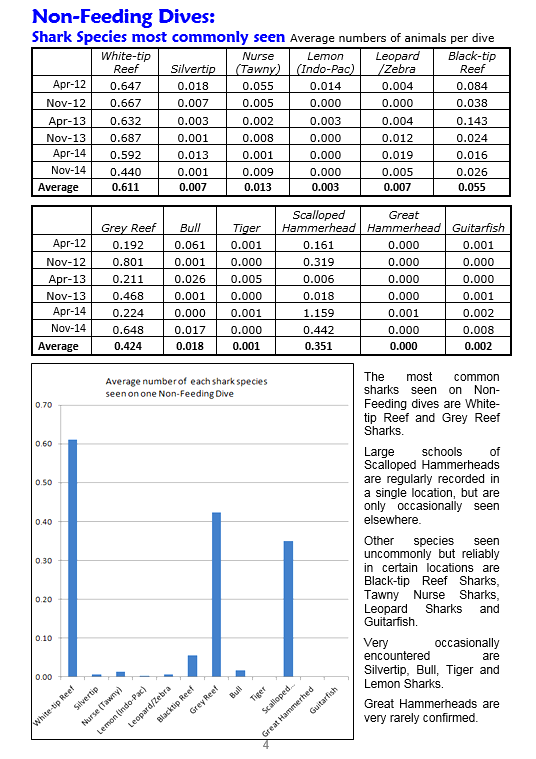
Helen Sykes our irreducible GFSC manager has just issued the following statistics - click on the pictures for detail!

Results of Three Years of the Great Fiji Shark Count
 April 2015 

Over the past three years, dive operators across the Fiji Islands and their diving and snorkeling guests have been recording their Shark, Ray and Turtle sightings over the months of April and November. Thanks to those dedicated divers, we now have some interesting facts to share about Shark populations in Fiji.

The data is analyzed by the number of Shark/Ray/Turtle sightings recorded on every dive by every diver who takes part. This is called number of sightings per observation. Because there are usually many divers on each dive, we have thousands of observations every month.

We have separated dives where feeding was carried out from those where no feeding was done.


From a very enthusiastic start in April 2012, the number of participating dive operators has dropped to our reliable core team, representing operators on Viti Levu, Beqa, Taveuni, Vanua Levu, the Mamanuca and Yasawa islands, and the Lomai Viti / Vatu-i-Ra area. We'd like to thank those operators who have stuck by this project and worked hard to get the data to us in a useful format!

Even though the number of dive operators has decreased, the number of dives and of observations (every diver who takes part makes one observation per dive) has remained in the thousands, with the highest total of 4,278 observations in November 2013.

Highlights:

There have been some unexpected and exciting sightings recorded over the past three years.
  • Guitarfish, previously very rarely recorded in Fiji, have been regularly seen on sites along the Coral Coast. 
  • A Leatherback Turtle was seen during a dive (a very rare occurrence) in the Yasawas in November 2014 
  • Schooling Hammerheads have been regularly recorded on a dive site on the South Coast of Vanua Levu 
  • Mobula Rays have been recorded in the Pacific Harbour/ Beqa region and also in Namena, south of Vanua Levu 
  • Tahitian Rays (Himantura fai) were recorded in the Yasawas 
  • Hammerheads and Guitarfish have only been recorded on non-feeding dives 
  • Rays and Turtles are more common on non-feed dives than on baited feeding dives 
  • The most common sharks seen on baited feeding dives are Bull, White Tip Reef, Grey, and Black Tip Reef Sharks 
  • Some sharks species, including Bull, Grey Reef and possibly White-tip Reef Sharks, exhibit seasonal patterns of higher and lower numbers, which are probably related to breeding behaviour. 
  • So far no significant decrease in coastal shark populations has been seen, good news for those of us fearing that shark-fin fishing was continuing to damage shark stocks, but we can only confirm this one way or the other by continuing these surveys over the long term 
Non-Feeding Dives:

Over the years, across Fiji, divers have seen an average of 1.22 to 2.03 Sharks on every dive, plus one Ray and one Turtle every 5 to 10 dives. Shark sightings varied year by year, but the general trend appears stable or slightly increasing. Ray and Turtle sightings appear to be very stable.


Baited Dives:


You, our Contributors!

Continuity of data is vital if we are to make our case for Shark Conservation, and we'd like to recognise and thank our contributors, especially those who have been with us from the start, and continued every six months. Others have joined us recently, and are welcomed to the ranks. 
Here is our honour list: 

Six Counts 
  • Beqa Adventure Divers 
  • Nai'a Cruises 
  • Dive Tropex Tokoriki 
Five Counts 
  • Waidroka Bay Surf and Dive Resort 
  • Lalati Resort 
  • Taveuni Ocean Sports (Nakia Resort) 
  • Dive Tropex Tokoriki • Wananavu Dive 
Four Counts 
  • Taveuni Dive 
  • Dolphin Bay Divers 
  • Koro Sun Dive
  • Reef Safaris - Barefoot Island 
Three Counts 
  • Matava Eco Resort - Mad Fish Dive Centre 
  • Wakaya Club and Spa 
  • Viti Watersports 
  • GVI - Global Vision International Two Counts 
  • L'Aventure Cousteau Dive Centre 
One Count 
  • Pacific Harbour Fishing Group 
  • Paradise Taveuni 
  • Volivoli Beach 
  • Reef Safari - Shangri La Fijian Resort 
  • Castaway • Adrenalin Watersports 
  • Captain Cook Cruises 
  • Storck Cruises 
  • Reef Safari - Crystal Blue 
Great job Helen, Vinaka vakalevu!
Some ulterior comments from my side tomorrow!

Tuesday, December 20, 2011

Bravo Helen!


Message from SlideShare.

Hey helenthereef,

Congratulations!
Your presentation The King of the Sea: Making Fiji a Shark Sanctuary has been featured on SlideShare's homepage.

Kudos from our editorial team for your effort. Your presentation was chosen from the thousands uploaded to SlideShare everyday from across the world.

– The SlideShare Team

Indeed, Congratulations!
Helenthereef
is of course none other the indefatigable Helen Sykes, our valuable counselor from Resort Support, principal of Marine Ecology Consulting and local manager of the Fiji Shark Sanctuary campaign for CORAL and Pew.

Here is the presentation.
Enjoy!

Saturday, April 05, 2014

Helen about preventing Shark Strikes!


Have you seen this?

Shocking!
To be mentioned in the same article as those preposterous (bravo Megalobomb!) Shark repellent wetsuits is the peak of ignominy! But of course we are highly grateful for the plug, and for the equally honorable mention at 20:00ff in her podcast.
Thank you, very much appreciated!

But Helen has of course fallen into the usual trap.
Because with all due respect (!) for the concerned, those Shark strikes are actually totally irrelevant.
They are so incredibly rare, and the variables influencing them, so numerous and complex that any attempts at ever fully understanding, let alone fully preventing them will always fail. With a very few notable exceptions, those poor people that got bitten and sometimes killed did nothing "wrong" besides being in the wrong place at the wrong time - and nothing we will do will ever fully eliminate that infinitesimally small risk.

Obviously there are situations where the risk can be mitigated.
Wherever adequate and possible, ocean pools and Shark exclusion nets work 100%. Some technical solutions appear promising for protecting relatively small areas. Adequate, mostly common sense behavior and risk management can reduce the number of avoidable strikes, as could e.g. seasonal avoidance or even closures of known aggregation sites, etc.

Personal protection devices, not convinced.
Be it e.g. the Shark Shield or those darn wetsuits, they are ultimately untestable and quite possibly nothing more than placebos - but herein lays the danger insofar as the perceived protection may well lead to riskier behavior by their users.

Anyway.
Ultimately, it's all much ado about nothing.
Like Branson remarks, all the noise is actually counterproductive - and many, more savvy tourist destinations have learned that hushing things up may well be the best strategy. 

Because noise or no noise, cull or no cull, stripes or no stripes - people will continue to get bitten by Sharks.
And that's perfectly normal and as such, perfectly OK.

Friday, September 02, 2011

Onward and Upward!


Behold Beqa Island Trips!
Yes the website needs alot more work, but we have finally opened our second office at the Pearl South Pacific and as of September 1st, we are running trips to Beqa Lagoon. Once again, our newest ecotourism venture originates with our wish to provide for sustainable livelihoods in cooperation with local stakeholders at the grassroots level.

Our flagship product is Beqa Magic.
This trip takes our customers to Lawaki Beach House on Beqa Island for a day of cultural immersion and marine ecotourism.
The resort is located on the fringes of Naceva Village and sister village Naiseuseu who have reserved a substantial portion of their qoliqoli, or traditional fishing grounds for a Marine Protected Area, for which they will now be able to collect a marine park levy like the one for accessing the SRMR. Much like she has done in Waitabu Marine Park, our friend Helen Sykes of Marine Ecology Consulting has graciously donated her time to train several village youth as snorkeling guides who will take the guests around the MPA and earn an income in the process. Nani has worked with the community who will sell local handicrafts and perform the traditional Fijian meke, whereas Lawaki will serve a delicious lovo and copious amounts of Beqa kava. Like in the SRMR, preserving and defending the MPA will henceforth always generate more income than going fishing there.
I must say, we're mighty proud of this venture and really want to thank the villages, Helen but also Christine and Sam of Lawaki for their wonderful cooperation in making this happen!
Vinaka Vakalevu!

Yanuca Beachcomber is a typical beach picnic & BBQ.
It takes our guests to the pristine beach of Batiluva Beach Resort on Yanuca Island and is ideal for families and the Suva weekend crowd.

Finally, a big thank you to the Uprising family!
The MV Forty Freedom is theirs and trusting us to run her is a testament to years of excellent cooperation and personal friendship.
Vinaka, you shall not be disappointed!


Please click to enlarge.

Tuesday, June 25, 2013

Will feeding Sharks teach them to associate People with Food?


That is indeed the question!

Behold Helen Scales' cliffhanger blog post!.
Helen obviously made it, just, or she wouldn't be blogging - but what about the BAD boyz and the other customers on that dive?
Aahhh the unbearable suspense!

Anyway, it has been a real pleasure meeting her.
The term that comes to mind here is Renaissance woman: seriously erudite but not at all geeky, seriously passionate but not at all dogmatic, extremely well documented about the details whilst aware of the big picture, foremost of which the realities of the anthropocene - and seriously witty and charming to boot! Were it not for her decision to associate herself with a bunch of despicable splitters (and here!) I would have really liked her!

But I'm digressing as usual.
With bated breath and whispering humbleness, eagerly awaiting Part 2!

Saturday, January 24, 2015

SRMR - first Management Meeting!

Epic boatload: Elisabeth; SRMR managers Ian, Bati and El Ciro; El Diego and Kira from Projects Abroad; and a whole gaggle of BAD boyz - click for detail!

Great day!

But first things first.
That lady in the bottom right hand corner is none other than Elisabeth Holland, a veritable Nobel Prize laureate! On our boat!
Who would have thought that possible when we embarked on this crazy journey eleven years ago! Needless to say that she is (obviously!) smart and incredibly passionate - but she's also refreshingly humble, very witty and just a genuinely nice person on top of that.
Really nice meeting her - and yes, we are incredibly honored!

And then we had our first management meeting.
Juerg is abroad but will be here next month - but with the freshly coined Director of Fisheries, Aisake "Bati" Batibasaga, El Ciro and Ian we did have a quorum and were able to formulate a first set of immediate initiatives, first of which will be a substantial increase both in the number of fish wardens and the number of patrols. 
We've just received our first baseline report (= detailed Coral cover assessment, and rough assessment of Fish and Invertebrate abundance) from Helen, and there are indications of recent small-scale fishing. In itself, this is not terribly worrisome - but it IS poaching and we need to nip it in the bud.

And after that, there will be other stuff.
No as usual I'm not telling as it's way too early to divulge any details, let alone make breathy announcements - but i can assure you that you will like it! :)

So, keep watching this space!

Wednesday, June 15, 2016

Great Fiji Shark Count - Funds for Christine!


Please have a look at this page.

Christine has been with the GSFC since day one.
Like announced back then, she has so far worked completely pro bono whereas the little donor funding has been completely invested into print materials and necessary admin. Now in it's fifth year, this ground-breaking project has generated an enormous mountain of data from tens of thousands of dives all across Fiji and is rapidly nearing the stage where there is enough information to start discerning long-term population trends.

But for citizen science to be good science, there needs to be verification.
This means that in order to start her analytical work, Christine needs to (finally!) come to Fiji to personally witness and fact check the current, exceptionally tedious data collection process from recreational divers to dive operators all the way to Helen's painstaking verification and then, transcription into Excel spreadsheets.

Alas there are no GFSC funds left.
Nowadays, donors appear to expect instant gratification and with the GFSC being long-term monitoring generating only very sporadic and rather unspectacular interim results, donor contributions have slowly fizzled out. In fact, BAD have financed the last three counts out of cash flow as along with Kerstin's continued research into local Shark fishing, we believe this to be invaluable information for better managing Fiji's coastal Shark populations.

So there you have it - this is the back story.
Please, if you can, do make a contribution towards Christine's research.

Thank you.

Thursday, July 17, 2008

Good on 'ya, Google!

The plight of Sharks continues unabated, as witnessed by these shocking statistics for Shark landings (that is, EXCLUDING finning where the carcass is dumped) for June in Ecuador - the same country already infamous for its ineptitude in managing the Galapagos National Park.
As always, well done to Shark Diver for having found and posted them.

But for once, where there's plenty of shadow, there is some light as well.
Whilst Yahoo's Alibaba portal continues to brazenly ignore the petitions by Conservationists and offers a "choice" of hundreds of sites selling Shark fins, one of its principal competitors has obviously decided to forgo those earnings in favor oft ethical considerations.

As of today, I believe, Google has updated its Advertising Policies that exclude the sale of products obtained from endangered or threatened species to explicitly mention Sharks.
This of course is not only laudable, but smart business sense as well, as anybody loving Sharks should, and probably will completely refrain from conducting any business with Yahoo and its despicable subsidiary but deal on Google instead.

Thank you Helen for he heads-up about this wonderful piece of news.


Sunday, March 18, 2012

Sharks and MPAs!

Our Whitetip Reef Sharks - clearly resident and doing great. Stellar pic by Lill.

Nice to see our intuition confirmed!
It may sound trivial, but recent research finally confirms that Sharks thrive within Marine Protected Areas. There may be more, but these are the two new papers I know about.

Evaluating marine protected areas for the conservation of tropical coastal sharks.
Danielle M. Knipa, Michelle R. Heupel, Colin A. Simpfendorfer

Abstract

Global declines in shark populations have created uncertainty in the future status of many species and conservation efforts are urgently needed.
Marine protected areas (MPAs) are used increasingly as conservation tools around the world, but how they benefit mobile and wide ranging species like sharks remains unclear. To evaluate the degree of protection MPAs may provide for sharks, we used an array of acoustic receivers to examine the movements and spatial use of two tropical coastal species within two MPAs in the Great Barrier Reef Marine Park, Australia. Juvenile pigeye (Carcharhinus amboinensis) and adult spottail (Carcharhinus sorrah) sharks were fitted with acoustic transmitters from 2009 to 2010. Both species displayed long-term use of MPAs, with some individuals detected for longer than 600 days. The mean percentage of time C. amboinensis and C. sorrah spent inside MPAs was 22% and 32%, respectively. MPA use varied seasonally, with C. amboinensis spending a higher percentage of time inside MPAs in summer (mean = 28%) and C. sorrah spending a higher percentage of time inside MPAs in winter (mean = 40%). Although sharks used large areas inside MPAs, most individuals tended to use only half of the available protected space. In addition, all sharks made excursions from MPAs and individuals exited and re-entered at consistent locations along the MPA boundaries.
These results demonstrate that MPAs have conservation benefits for shark populations by providing protection across different species and life stages, and tracking studies can be used to help tailor MPA design to maximize effectiveness.

and

Reef Sharks Exhibit Site-Fidelity and Higher Relative Abundance in Marine Reserves on the Mesoamerican Barrier Reef
Mark E. Bond, Elizabeth A. Babcock, Ellen K. Pikitch, Debra L. Abercrombie, Norlan F. Lamb, Demian D. Chapman


Abstract

Carcharhinid sharks can make up a large fraction of the top predators inhabiting tropical marine ecosystems and have declined in many regions due to intense fishing pressure.
There is some support for the hypothesis that carcharhinid species that complete their life-cycle within coral reef ecosystems, hereafter referred to as “reef sharks”, are more abundant inside no-take marine reserves due to a reduction in fishing pressure (i.e., they benefit from marine reserves). Key predictions of this hypothesis are that (a) individual reef sharks exhibit high site-fidelity to these protected areas and (b) their relative abundance will generally be higher in these areas compared to fished reefs. To test this hypothesis for the first time in Caribbean coral reef ecosystems we combined acoustic monitoring and baited remote underwater video (BRUV) surveys to measure reef shark site-fidelity and relative abundance, respectively. We focused on the Caribbean reef shark (Carcharhinus perezi), the most common reef shark in the Western Atlantic, at Glover's Reef Marine Reserve (GRMR), Belize. Acoustically tagged sharks (N = 34) were detected throughout the year at this location and exhibited strong site-fidelity. Shark presence or absence on 200 BRUVs deployed at GRMR and three other sites (another reserve site and two fished reefs) showed that the factor “marine reserve” had a significant positive effect on reef shark presence. We rejected environmental factors or site-environment interactions as predominant drivers of this pattern.
These results are consistent with the hypothesis that marine reserves can benefit reef shark populations and we suggest new hypotheses to determine the underlying mechanism(s) involved: reduced fishing mortality or enhanced prey availability.

Very cool!
The latter paper is thankfully open access so you can read it in its entirety. There are also excellent synopses, one by Juliet right here and others here, here, here and here. What is particularly interesting here is the deployment of totally non-invasive bait cams and the correlation to the lack of fishing pressure (and thus, increased fish density) within the MPA.
Helen tells me that she has observed that Fish appear to know and take refuge within the confines of her Waitabu MPA, and from my days as roving underwater image hunter, I've learned to recognize whether a particular reef is being visited by spear fishermen by observing the behavior of the Fishes, particularly the Groupers - so it comes as no surprise that the Sharks who would be following their prey would also aggregate within the protected areas where they would be equally sheltered against any fishing pressure, find plenty of prey and thus thrive.

And what about the Shark Reef Marine Reserve?
Well we did set it up in the belief that in order to conserve a species one needs to preserve its habitat - but as always, it's complicated.
The Blacktip Reefs and Whitetips live, mate and give birth to plenty of babies right there so the conclusions of the papers are being fully confirmed.
Maybe even when it comes to the Grey Reefs but even there I'm less confident. From all I know, your typical resident aggregation of Greys consists of mature females plus juveniles and sub-adults of both sexes, whereas I thought that the adult males were non-resident and always roving, thus assuring gene flow - but on Shark Reef, most of the adults are males and then, like right now, we see a lot of juveniles. And in May/June, everybody leaves for a month or so, something we believe is correlated to mating opportunities somewhere else. But in reality, we don't quite know what's really going on there, so the whole scenario certainly warrants more investigation.
But when they are here they sure look perfectly happy!

The Silvertips, Nurses and Lemons?
As I stated somewhere else, they are increasingly being displaced by the assertive and ever more numerous Bulls, likely due to competitive exclusion - so although I'm sure that much like they've done in the past, they would love to turn up much more frequently, I equally fear that the deterrent is currently much too big for us to ever witness an improvement in numbers, MPA or no MPA.

And the Bulls and Tigers?
Mike's hypothesis stipulates much larger home ranges that have been confirmed by Juerg's telemetric studies - but they sure love to come visit for a juicy snack and maybe, even for some good company! :)

Anyway, all very interesting!

H/T: Demian and Rick!

Thursday, May 03, 2012

Fiji: don't mess with the Defenders!

.. and especially, don't mess with the Ueber-Shark-Defender in the center!

Big kudos to Rick and Angelo, and Helen!

I hear that the consultation went really well.
They were able to rally the troops despite a prohibitively short lead time, and from what I hear (we weren't there as it was simply too short notice), the few detractors were faced with a capacity crowd of proponents. From those metrics alone, the result of the consultation could not have been more unequivocal.
There's this report in the Fiji Times and this one on the Shark Defenders page and it really does appear like the interminable process of establishing a Fiji Shark Sanctuary is well on its way towards completion - but it aint over til the fat lady sings, so fingers crossed!

So, it appears, there is some consensus.
Both the tuna fishing industry and the conservationists agree that the coastal fishing for Sharks needs to be stopped. Very much unsurprisingly, opinions differ diametrically about the so-called bycatch by the longline fleets. My personal take on the issue in general is here, and I particularly recommend that everybody familiarize themselves with this excellent document by Pew about the many ways to mitigate the problem, this at least in theory.
The reality: as long as the crews are being allowed to keep and sell the fins, they are actually being encouraged to land as many Sharks as possible. In fact, simple logic would have it that when the owners, the authorities and the observers are not watching, which is most of the time, the crews will be highly tempted to engage in targeted Shark fishing in order to maximize their wages - correct? Or am I missing something here?
And who, please, is supposed to cough up the resources for monitoring a law that would be riddled with loopholes the size of a barn door?

So here's to progress.
It's not in the bank quite yet - but if and when it is, I shall have to eat a big portion of humble pie and publicly congratulate the people behind the frothy awareness campaign!

And guess what, I shall do so gladly!
But not quite yet now!

Saturday, February 04, 2012

The Great Fiji Shark Count - Info!


Let me give you some background information here.

This all actually started with Juerg and Christine Ward-Paige.
Christine did publish this excellent open source paper about the value of having recreational divers count elasmobranchs and in the lively discussion that ensued, Juerg proposed and Christine very graciously accepted to test the concept here in Fiji. Christine has currently another job but she will provide for the scientific oversight and analyze the data under the umbrella of eShark, and this completely on her own time and with no incremental funding! Potential donors: hint hint - funding this will make you shine for many years to come!
Christine thank you!

Fiji is of course the ideal destination for this endeavor.
Thankfully and in spite of the recent highly disturbing developments, we do still have a reasonable number of Sharks and Rays, and even Turtles.
Plus, the dive and tourism industry is tight knit and forward looking, as witnessed by the many past initiatives that were able to unite everybody around a common goal.
In 2008, we had the first tourism-based Great Butterflyfish Count that was repeated in 2009 and then alas fizzled out for lack of funding.
In 2009, Fiji organized the only nation-wide initiative to celebrate the Year of the Shark, the Fiji Shark Conservation and Awareness Project with various government departments, the tourism industry and several NGOs contributing to make this Fiji's first country-wide Shark campaign. 2009 also saw the only nation-wide drive to contribute to the Shark Free Marinas Initiative where to this day, Fiji is one of the principal participants.
In 2010 we took a breather to launch our own initiative aimed at protecting vital habitat and Shark nurseries whilst cleaning up our carbon footprint, Mangroves for Fiji, only to announce mission accomplished late last year.
2011 then saw the rolling out of the Fiji Shark Sanctuary Campaign where a plethora of largely unheralded events further contributed to Shark awareness all the way to the local grass-roots level.
Long story short: there sure is track record!

Enter the local project team.
She won't like me saying it but IMO, Helen Sykes of Marine Ecology Consulting is Fiji's most pugnacious, and thus most efficient and strictly (as opposed to agenda- and money-) goal oriented marine conservation professional for which she has all of my respect - and this despite her being dead-set against the feeding of any wildlife inclusive of Sharks, something that will regularly pitch us in super-heated debates where we pull no punches but always end up smiling as we both understand this to be an excellent means of furthering our knowledge! Anyway, it is great news that she has once again accepted to take the lead in this, like she did for the Butterflyfish Count of which this is the logical crescendo - and let's face it, Sharks are way sexier than Butterfly Fishes! :)
Same-same for Stuart Gow of Resort Support who has been our friend and advisor for many, many years. Among many other things, he is the current Chairman of the Dive Commission of the Fiji Hotel & Tourism Association, i.e. the highest representative of Fiji's dive industry. He is also a Director of Matava and in that incarnation, he has been instrumental in making Fiji Shark Free. Stuart is acting as our web- and spin-master, and having him help us behind the scenes is a phenomenal asset indeed!
And then there is Nani, Arthur and our new marine scientist Chris of BADs conservation brand SRMR that will be assisting in a thousand ways when it comes to keeping up the daily dialogue and coordination among the participants - and yes, yours truly will just sit back, continue hiding behind his computer and rant about others as always! :)

Please also check out our partners.
These are the people who are contributing money, or money and lots of passionate work like Samantha Whitcraft of Shark Savers. Sam is the indefatigable! driver of Shark Savers' Sharks Count program and as such, she has been an invaluable team member who has contributed money, leadership and know how but above all, an inordinate amount of work.
Then there are the pillars of reliability and generosity when it comes to sponsoring Juerg's research (blog here!) in Fiji, the unequaled Shark Foundation and Save our Seas Foundation.
And finally, there is Ocean Soaps, a division of Punjas who already greatly assisted in the Butterflyfish Count.
And I also want to mention the great photographers and friends who have donated images!
Thank you all!

And how about you?
If you so wish and decide to come to Fiji in April, you can partake in the first nation-wide Shark count anywhere!

To do that, follow the instructions here.
And before the usual geniuses start whispering that this is just about BAD making a buck: we have been counting Sharks since 2003 and thus your contribution would be most significant elsewhere! As the dive ops and resorts will start confirming their participation, the list of participants will grow and I urge you to go and help them and not us, always by mentioning that you're coming for the Count!
You can then always book a couple of Shark dives at the end as a treat and reward - and if you prove that you've taken part in the Count, we'll throw in a little something extra for you, how about that! :)

Now to be precise.
The aim is not to find out how many Sharks there are in Fiji!
For that, one would have to try and mobilize everybody everywhere, something that is impossible and would be fraught with immense costs, immense logistical problems and a staggering margin of error!
The aim here is to do a first random sampling and to then regularly repeat the exercise in the same locations. This way, we would be able to establish a first baseline and the starting point of long term monitoring via so-called transects (i.e. your dives, snorkeling excursions and even game fishing trips) which is an excellent scientific tool that will enable us to eventually detect a trend.

And the practical application?
As an example, should the Shark Sanctuary eventuate, the trend would provide for a confirmation (or lack of) of its effectiveness and thus be a great educational tool for policymakers. And should the Sanctuary not eventuate, I fear that the trend will document the rapid decline of Shark stocks and the absolute necessity of immediate conservation measures.
But that is then and it will take several years to make those statements, especially considering the fact that the vagaries of the ENSO will add a good amount of variation and unpredictability, like they have done to our own Shark data.

So, please, give it some thought.
I know it's sort of short notice: but it's cool and fun and above all, it's good solid and innovative science!

See you in April!

Monday, December 02, 2013

David - Teaser-Trailer # three!

Yes this would be a stack of 3m Bull Sharks - fabulous pic by DaMary!

This is just awesome!

Yes of course I'm biased.
So once again, I'm not gonna dwell in superlatives but instead invite you to refer to my assessment of Mr. Diley here - I cannot but fully confirm, and then some! And, do check out this post on David's blog!
Bravo!

Only this.
I fully concur that the letterboxed version is by far the better one so please please pretty please, do edit the movie in Anamorphic! And more importantly: I really want to thank the many people who've kindly agreed to be interviewed and are now providing awesome quotables - in this particular case Ratu Leone and Alfie from Uprising, Manasa, my dive buddy Rusi, the ever formidable Helen and the unequaled MPO. And of course the forever Facebook-status-changing Nani!
Vinaka vaka levu!

So without further ado, here it is!
Enjoy!


AND, here's one more post!

Sunday, September 20, 2009

Honoring Jack

Jack and Helen Randall in 1955 - the year I was born!

Randy is a good man.

He's very much at the forefront of Marine Conservation in Fiji and his FLMMA, the Fiji Locally Managed Marine Area Network is well on its way to ensuring that 30% of Fiji's reefs are being protected.
But that's another story for another day.

The story here is that I had the pleasure of discovering that Randy has published the following moving laudatio of my friend Prof. Dr. John E. Randall, nicknamed Jack, in Fiji's lifestyle magazine Mai Life. Please click on the pictures to read it.


In brief, Jack is the world's most eminent Fish Taxonomist, full stop.
And this by a long long stretch! He has described more Fishes, authored more papers , groomed more authoritative Fish Taxonomists, published more Fish ID reference books and very generally, contributed more to Ichthyology than anyone alive. You would never suspect it as nobody could be more genuinely friendly, witty and modest: but Jack is truly larger than life (and I know he will hate me for having said this).
In fact, he has scoured the Oceans so thoroughly that some of his his disciples have resorted to go and explore the twilight zone in order to have a chance of running across something new!

Well, Jack has obviously the advantage of having been around forever, right from the very beginning of SCUBA and at a time when the Ocean was still largely pristine, unpolluted and teeming with life. Read this!
I had been given my long-john underwear when I was discharged from the army, so I dipped it in a wash basin of latex rubber, hung it up to dry, and may have had the first wet suit.
The first swim fins in those early days of skin diving were shaped like frog feet, and the face masks were perfectly round with narrow hard rubber edges that one had to fit to one's face by careful cutting and sanding.
This was in 1948!

Jack has been with the Bishop Museum for over 40 years now and I sure hope that those guys will never forget the immense contribution he has made to their standing within the scientific community - and prima vista, they do.
Their website praises its Fish collection as follows: it
is dominated by the extensive collections of its most prominent ichthyologist, John E. ("Jack") Randall, who joined the Bishop Museum in 1965. Jack Randall has single-handedly established the Bishop Museum fish collection as arguably the best systematic research resource in the world for Indo-Pacific reef and shore fishes by his selective collecting for over 40 years and his prolific writings on fish systematics,


and Jack informs me that
the Museum’s fish collection compares favorably with other museums in the U.S. (except the USNM and the California Academy of Sciences, which has the combined collection of CAS and Stanford University). Bishop Museum has 2,875 lots of type specimens of fishes, of which 698 are primary types (holotypes, lectotypes, and neotypes).
The American Museum of Natural History in New York has 523 primary types of fishes; the Los Angeles County Museum of Natural History has 226, and the Scripps Institution of Oceanography 205.

Impressed? You better be!


Vinaka Randy, this was most timely and very kind!

Thursday, February 24, 2011

Guam: it's Unanimous!

Stellar pic by Timbo!

From Timbo's Guam & Micronesia Dive Travel blog.

After a lot of emotional testimony from fishermen, school students, shark lovers and an amazing show of support from an international community of ocean loving concerned citizens from well over 100 countries, Guam’s legislators passed Bill 44-31 (scroll down) unanimously today.
The bill is intended to curb the trade of shark fins in the US Territory of Guam.

The bill was sponsored by Senator B.J. Cruz and co-sponsored by Senator Rory Respecio.

But more importantly, Guam becomes the third place in the world to officially ban possession and trade of the fins and also ray parts. A similar bill passed in January in the Commonwealth of the Northern Mariana Islands.

With Palau declaring its waters a shark sanctuary in 2009, Yap having its water a manta ray sanctuary since 2008, Guam and the Nothern Mariana Islands banning fin trade, this creates a huge corridor in the western Pacific stretching 1300+ miles from north to south from Helen Reef in far southern Palau to Farralon de Medina in the northern CNMI and across four countries that now prosecute those involved in the non-sustainable shark fin trade. Hawaii in the east central Pacific, a US state, has the first such law on its books passed last year.

Thus, this is a real regional victory for the western Pacific nations and their marine resources.

Indeed!
Many, many people have contributed to this success but bear with me if I single out Stefanie who once again has invested all her time and energy and spent countless hours in difficult negotiations to ensure the best possible result for the Sharks. And lemme tell 'ya, looks are deceiving: never underestimate the ferocity and sheer determination of a Bavarian pit bull! :)
Girl, you rock!

Full story here, good recap here.
.