Showing posts sorted by relevance for query Tetamanu. Sort by date Show all posts

Sunday, July 31, 2016

Fakarava - Inverted Trophic Pyramid?

Bingo!

Remember Michael Domeier's comment to this post?
Turns out that the man was prescient - and this literally: being one of the authors, he undoubtedly knew that this was coming!
Watch.


The paper is here - read it!
And here and here are some synopses - and since I find them partially misleading, here's what I understand.
  • Fakarava Atoll has two main passes, Garuae in the North and Tetamanu, where this research happened, in the South.
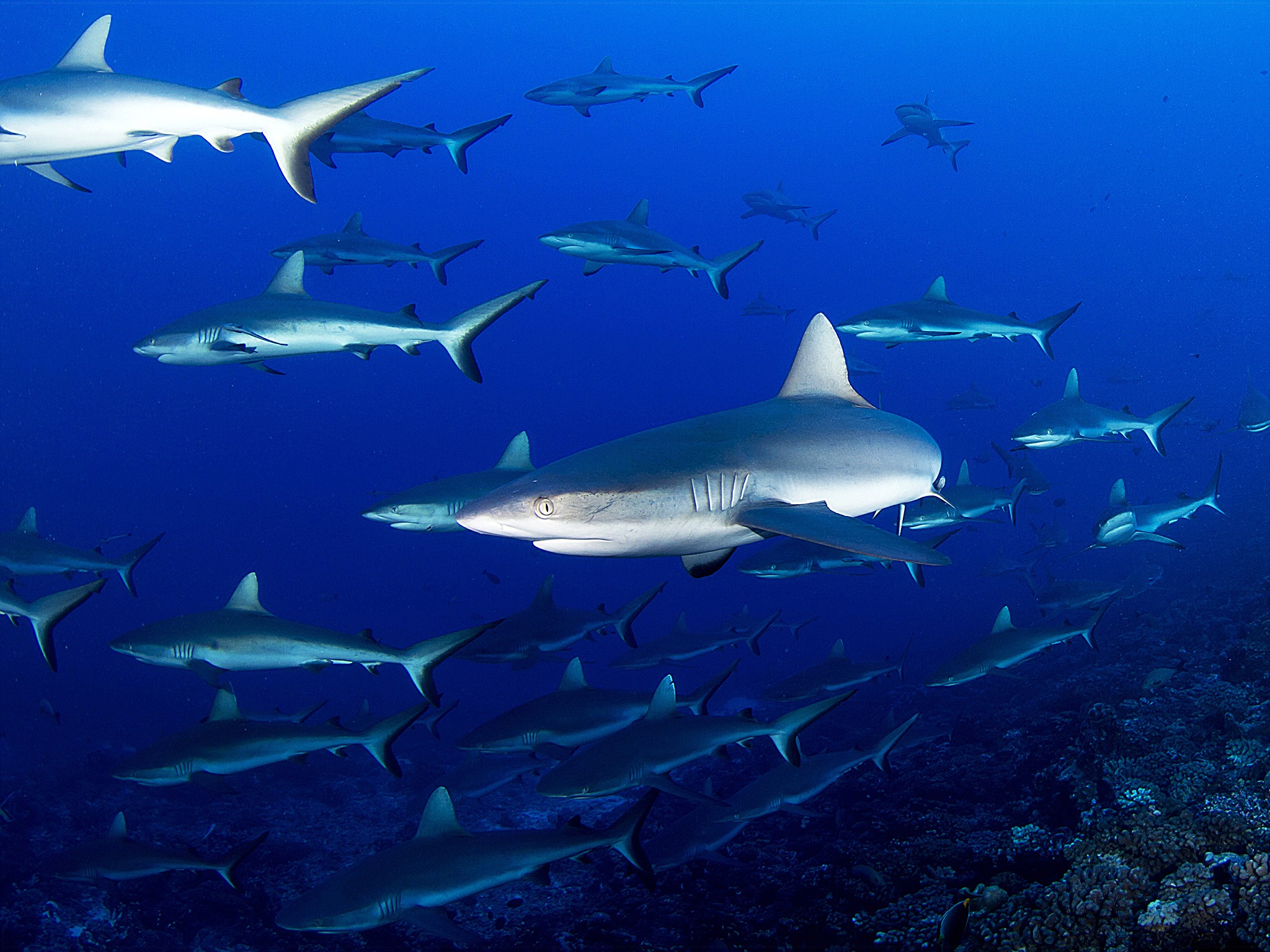
    Like in other atolls in the Tuamotu archipelago like e.g. the spectacular trou au requins in the pass of Apataki, they are home to aggregations of resident (and semi-resident) Grey Reefie comprising, if memory serves me right, adult females and numerous juveniles/subadults of both sexes. The passes are great Reef Shark habitat because the Sharks can remain quasi-stationary by lazily riding the currents whilst engaging in ram ventilation, and because especially Tetamanu with its comparatively mild currents supports a good numbers of resident Fishes and acts as a migratory corridor for other prey species that regularly enter and leave the lagoon in line with the tides and the seasons.

  • Yet, the researchers postulate that since the pyramid of productivity inside of Tetamanu is inverted, the available prey biomass would not be sufficient to sustain even only the local population of highly resident Sharks. This means that in order for the Sharks to be able to reside there without having to forage farther afield, their food/energy requirements would somehow need to be subsidized.

  • That subsidy happens over several months during the Austral Winter.
    Then, huge numbers of several species of bony Fish successively aggregate in the passes in order to spawn = in essence, as the prey representing the productivity of the adjacent lagoon travels to the Sharks, the Sharks don't have to travel to the prey.
    This opportunity attracts the majority of transient Reefies (= likely the adult males) along with the less resident ones, meaning that the Grey Reef concentration in Tetamanu nearly triples. Still, during that time, the biomass of prey is vastly larger than that of the Sharks and all Sharks have ample opportunities to feed.

  • Once the spawning season is over and water temperatures, and consequently, the Sharks' metabolic requirements increase, the Reefies gradually disperse again, and residency at Tetamanu decreases as even the highly resident individuals are forced to sometimes roam in search of prey.
My takeaway?
  • There is no inverted trophic pyramid in Fakarava Atoll.
    Yes in the passes there are local Shark aggregations and because of that, the trophic pyramid is locally skewed -  but just like in the case of Sala's remote islands, there are external subsidies and the Sharks also roam, meaning that the relevant area one has to consider is far, far larger than the mere area of the passes. And over that whole area that comprises the lagoons but also the outer slopes, the pyramid is clearly normal as the biomass of Sharks is orders of magnitude smaller than that of lower trophic levels.
    Incidentally, that's not that dissimilar from our feed on Shark Reef where the astounding temporary predator biomass is in no way representative for the trophic pyramid of Beqa Lagoon let alone the whole of Fiji!

  • For me, these latest findings mean that until somebody comes up with solid evidence in line with the data collected by Johann et al, I will continue to call BS on Sala's hypothesis of there being inverted trophic pyramids on pristine reefs!
Enjoy Johann's paper!
 

Monday, October 04, 2010

Rangiroa: Grey Reefs mating!


Check this out, fantastic!


I’ve done quite a few dives in Tiputa Pass on Rangiroa but never witnessed this, the more as I usually dive there in January when the Great Hammerheads stalk the mating Eagle Rays. Very deep diving, but extremely exciting and rewarding, too – check out the end of the video, those are real submarines!
If I remember correctly, this usually happens in March/April – but Tiputa is a very serious dive in up to 4 knots of current and in order to capture those spectacular images of mating Grey Reefs, one really needs to sit down with a rebreather and have lots of time at one’s disposal. If you are a tech guy, talk to veteran and still gung-ho (and you’ve been warned!) pioneer Yves Lefèvre of Raie Manta Club and possibly, if he buys it, to Denis of Blue Dolphins who has been using rebreathers there forever, and they may be able to help you out.

Tourist SCUBA divers are advised to rather try their luck in Tetamanu, or Fakarava South at the same time of the year.
Tetamanu is, by far, my favorite pass in the Tuamotus as the current is always manageable and there is a profusion of coral and fishes as a consequence – plus, there’s a resident group of Grey Reefs that are easy to approach and can number in the hundreds. And if you stay with Sané and the formidable Annabelle you can get out right out in front of the restaurant and play games with Calin Calin, the giant and very tame Napoleon Wrasse!
And talking of pets: take along heaps of DEET!

As to the subsequent natural predation by the Great Hammerhead, hmmm.
Anyway, great footage!

Hat Tip: Pete Thomas Outdoors

Tuesday, October 28, 2014

Tetamanu - Grouper Spawning and Predation!

Much upgraded since I last was there - Tetamanu Village, the place to stay. Source.

This is one of my very favorite dive sites.
Enjoy!


Friday, May 22, 2015

Grouper Spawning in French Polynesia - must-see!


Johann alerts me to this post.

This is simply sensational stuff.
I've witnessed the Grouper spawning aggregation in Tetamanu ages ago and it remains one of the highlights of my diving career. Last year, a group of French and Swiss researchers and cinematographers did embark on a major mission to document the event, and this is finally the program depicting that expedition. Featuring renown marine biologist and adventurer Laurent Ballesta, it will also document a 24-hour rebreather dive at the height of the spawning cycle when the local Grey Reefies go on a rampage (and here!) among the Groupers.
This being Arte, I expect nothing short of epic - so make sure you don't miss it!

And here's the trailer.
Enjoy - and I mean it!


Expedition Gombessa!


And talking of Laurent.

Tetamanu was Expedition Gombessa 2.
Gombessa 1 was about filming the Coelacanth in South Africa, so far only done from subs or via ROVs. Here's the documentary - and should you speak French, please also watch the making of with Laurent!

Enjoy!


Monday, June 08, 2015

Friday, June 18, 2021

Surfing Reefies - Paper!

Source
.
 
Very cool.
But first, watch.


This is DV footage from 2005, from an old edit.
I was staying at Sané and Annabelle's epic Tetamanu Village and was fortunate to catch the magic moment when the sun reflects off the Sharks on an early morning incoming tide - and for you insiders, the first two clips are from the challenging trou aux requins in Apataki.

Notice how the Sharks are barely moving? 
They are literally surfing the current - and here's the according paper courtesy of Yannis, Johann, Serge, Charlie et al, inclusive of how they use a conveyor-belt positioning system to ensure that the groups remain stationary over the most advantageous spots.
Story here.
 
Enjoy! 
 

Monday, November 24, 2008

The Incredible Shrinking Man

No not the movie - the man!

I first met Susan and Chip on that same memorable trip on Pelagian in 2002.
Back then, Chip was what Obelix insists on defining as "tout juste un peu enveloppé" , a sharp, terribly stressed-out, sat-phone toting and I believe, newly crowned CEO of an up-and-coming biotech company.
They were simply delightful and we all had a great time, fueled by fantastic diving and an equally fantastic, funny and eclectic group of experienced and passionate divers. Bob Halstead's "Old Farts' Diving" at its very best, all the way from eggs benedict (and Valerie's Vegemite) at breakfast to sunset Cohibas with Stan.
The First Law of Liveaboard Diving postulates that every trip will feature a token asshole (the Second Law being that if you cannot spot one, it's likely to be you) and I remember us commenting that this may well have been the first trip without one!

Apart from a cameo appearance on one of our Shark dives, I haven't seen Chip until this year in Vegas - and boy, what a surprise!!! Talk about him being one half of his former self!
Clearly, the man has a will of steel and has gone through hell. But now, he looks slim, trim and fit and most remarkably, not at all stressed-out! Still sharp as a knife and clearly still well grounded within his alpha personality - but what a miraculous change!
(Picture by Erich Cheng 2008)

Now a successful retiree (surely a transitory condition), Chip has intensified his devotion for underwater photography and rumor has it that he may take up a pivotal role in a Shark Conservation Group, undoubtedly much to the benefit of that Group in particular and of the Cause in general.

Having snooped around on his website, I finally got to see that pregnant blue-ringed octopus I found on a seagrass slope somewhere near Samarai, PNG. But there's also an absolutely stunning portfolio of Guadalupe Great Whites and even some killer shots from my two favorite French Polynesian Passes, Apataki and Tetamanu. A self-confessed equipment hog, he clearly is also a master of post-production, as some of the Shark images are simply the best I've ever, ever seen in terms of color and saturation - and trust me, I've seen a few!
Amazing!

Well done Chip and welcome to the toothy, infighting, opinionated but always entertaining world of Shark Conservation!

Sunday, February 14, 2021

The Sharks of Shark Reef!

Our forever unforgotten Rusi with probably Bum or possibly Crook.
 
Behold!
 
 
Obviously the quality is what it is.
But that was in 2007 when most of us were still filming in DV, and when the editing suites didn't quite have all of today's bells and whistles. Plus this is from a DVD we used to sell that had chapters and sub-chapters one could click on, hence the video's disruptive architecture.
 
And before you comment.
The generic Grey Reefie images are obviously not from here but from Tetamanu, much like the generic Blacktip Reefie footage. But then, you can witness Rusi's very first hand feed of a Blacktip, this after 4 years (!) of daily attempts - and once the first one took the bait, all others followed suit and have been hand feeding ever since!

Incidentally, Tootsie who back then was a total asshole continues to visit (!!!) but is now very much a polite elder statesman! 
Same-same for Whitenose who's the first-ever Shark I named back then in 2003 and who still pops by to say hello - much more politely and last time last week! And of the featured Bulls, we still see Long John, Stumpy, Bum, Crush, Crook and Granma, too - and there's even early footage of Valerie and Hook!
 
Or for you in the know.
Check out how much Whitetail has bulked up, and how even back then, she already mysteriously managed to always attract and surround herself with ever new cohorts of juvenile Golden Trevallies - something the other Lemons don't do, the more as having them constantly swim in front of your face must be a total pain! 
And yet, Whitetail continues to do it - maybe because she alone continues to visit some unknown aggregation of juvenile Golden Trevallies, maybe when she goes to give birth, maybe always in her own birthplace like her Atlantic cousins?
So many questions!
 
Or check out Adi who now is a giant but back then was merely a baby!

Anyway, enjoy.
We really cherish and are also really proud of what we've achieved over these many years - and now that the vaccine is looming and there's finally light at the end of the tunnel, we can't wait to see what the future will bring - and yes we got big plans! :)

So Sota tale - hopefully soon!

Wednesday, June 17, 2020

Kleptoparasitism in Sharks - Paper!

Click for detail!

Very nice!

Read this.
Following their epic dives in Tetamanu and the many experiments they have made, the team around Laurent Ballesta have published their observations about the interactions between the Grey and Whitetip Reefies when nailing that Grouper spawning aggregation.
Here's what Johann has posted.

Not surprised about the kleptoparasitism by the Grey Reefies
They are just that bit bigger and bolder than the other reefies, and will thus tend to dominate any competitive exchange, much like described in this paper from Osprey Reef.
And here in the Reserve, they will equally try to dominate the other reefies during the shallow feeds, something we try and counteract by hand feeding selectively so that the Blacktip and Whitetip Reefies always get their fair share.

Anyway, all really very interesting.
Enjoy!

Thursday, June 28, 2018

700 Requins dans la Nuit - awesome!

Source - click for detail! 

Behold!


Yeah that would once again be Laurent in Tetamanu.
All I can say is, epic - and there is also this ridiculously awesome photo essay and also, this book with his best pictures that I can only highly recommend.

Enjoy!

Friday, April 10, 2015

Shark Soup!


Great pic by Vincent Truchet.
Tetamanu, Gruper spawning?

Tuesday, March 14, 2017

Reefies and SCUBA Divers - Paper!

Grey Reefies in Palmyra - source.

Nice!

Reefies and divers can co-exist!
Darcy and Yannis aka the intrepid slayers of the inverted pyramid myth have penned this nice paper where they show that frequent SCUBA diving does not appear to have any notable long-term effects on the behavior of the Reefies of Palmyra. I must say that I'm frankly not terribly surprised considering that a) particularly the Grey Reefies are feisty and generally show no problem approaching divers - this especially considering that b) those divers in Palmyra are mostly researchers who tend to behave themselves!
But nicely hypothesized and nicely tested!

And this is certainly true elsewhere and with other Sharks!
Like a very wise old man once said, it's not WHAT you do, it's HOW you do it! -  and provided that there's not too many divers, and provided that the divers behave in a respectful way, regular diving with Sharks in un-baited conditions is certainly possible, to wit those Shark aggregation hotspots like e.g. Cocos, the Galapagos, Tetamanu and Malapascua where the Sharks appear largely unfazed, or even, gasp, habituated to divers thanks to many years of responsible Shark viewing tourism!

But the contrary is also true. 
Cattle diving multi-user destinations like Ras Mohammad in Egypt or Richelieu Rock in Thailand that were once famous for their Shark encounters have largely lost their Sharks, and it is only fair to speculate that those Sharks have likely fled the masses and the continuous harassment and have relocated to more peaceful locations.

So folks, be nice to those Sharks, and enjoy!
And, do read the paper - story here!