The story, when I first heard it, was spectacular.
The
Coral Triangle is the epicenter of marine
Biodiversity, a region that has been spared during the Glaciations and where many tropical species have found refuge, only to begin re-colonizing the Oceans once it got warmer again.
In fact, if you progress to anywhere from its center, Biodiversity decreases.
As you can see, it stretches from Indonesia all the way to the Solomon Islands. Biodiversity however decreases even within that region, with e.g. the Solomons featuring a lower number of species than, say, Irian Jaya.
Apparently, the fable went, Fiji is an ancient portion of the Triangle that had broken off and subsequently, rafted across the Pacific to its present location.
On its travels, Ark-like, it had carried along a sample of the Triangle's marine opulence, thus establishing a new independent and so far overlooked Biodiversity hotspot. That would have been remarkable insofar as the direction of the prevailing wind and currents, and thus, of larval (and thus marine species)
dispersion in that region is East-to-West and thus opposed to Fiji's assumed tectonic progression.
May the
fabulator have been a prominent member of Fiji's diving community with a vested interest in promoting that destination?
You Betcha!
Having promptly pestered my Taxonomist friends, what really happened seems to be this, and I cite:
Well, there is a fragment of truth in it.
Somewhat east of the Solomons-New Hebrides chain of today’s islands, an intra-Pacific plate subduction zone (Vitiaz trench) developed and gave rise to a string of volcanic islands on the west side of the trench, of which Solomons was at the west end and Fiji was at the SE end. The Ontong Java Plateau was on the Pp east of this island arc and it was moving west toward the subduction zone as was the portion of the Pp with the string of islands. The OJP pushed into the island arc and together they moved onto the continental basins formed by the sequential openings of the Coral Sea-Tasman, New Caledonian, and South Fiji basins. A right angles to the east of the island arch, a vertical [we’re talking Mercator projections] westward subduction zone was forming along the Pp margin which was creating the Tonga Islands. As the linear Solomon New Hebrides-Fiji arc pushed against the other forming-formed basins, the Fiji end got latched onto the north end of theTonga ridge. The north Fiji basin started opening between the New Hebrides and Fiji causing the NH to move west and Fiii to move east carrying a few pieces of the NH with it. Then the Lau basin began opening and split the Tonga ridge into the west Lau ridge, with islands forming, and the east Tonga ridge with its islands.
When the original island arch was continuous, presumably the fishes (and other organisms) had continuous distributions. The separation of Fiji from New Heb on one side and from Tonga on the other allowed many taxa in Fiji to evolve into separate species.
It is more complex that this boiled down scenario conveys, but this is generally what happened. So yes, the island arc formed out on the plate could have had a uniform biota which the geological contortions split up isolating Fiji (and also Tonga, from Fiji)
Thus enlightened (?), I gather that what this means is that Plate Tectonics may have contributed to Fiji's
Endemism but likely not boosted local Biodiversity. Nothing to sniff at by any stretch of the imagination - but certainly, nothing really unexpected, either.
In fact, everybody in the know assures me that Fiji's marine Biodiversity is comparatively low and very much in line with what would have to be expected from its distance to the Triangle's epicenter.
Provided that you believe in Darwinian
Evolution, and I assume you do, you may remember that one of the principal preconditions for
Speciation is Isolation.
With Fiji
haven broken away and gone walkabout, a new basin was opened and
Gene Flow was interrupted as the genetic pool of Fiji stopped cross-breeding with the genetic pool of the Solomons in the West (and Tonga/Samoa, who in turn sit on
their own tectonic micro-express, in the East). Whether owing to different
selective pressures,
Genetic Drift or the
Founder Effect, the thus isolated population then had the chance to evolve into new, genetically distinct
Species endemic to Fiji.
As I said, nothing unexpected: the more remote an Island, the higher the chances for Endemism, marine and not, as witnessed in
Hawaii,
the Marquesas and even tiny
Lord Howe.
Still with me?
I sure hope so!
Thing is,
Island Biogeography and especially, (terrestrial) Island Speciation never ceases to amaze me.
Take for example
Fiji's endemic Iguanas, probably descendants of a
Green Iguana that had
rafted over,
Kon Tiki-like, all the way from the Americas (Australia has
Goannas, not Iguanas) and then speciated into the three endemics. I just love the name of the
latest discovery!
Or take the incredible incubator
Megapodes, some of which exploit the heat of active
calderas. Once
widely distributed throughout the Pacific, their local extinction correlates with the arrival of
Homo sapiens and its bird-killing stowaways and introduced domesticates, alas an
all-to-frequent pattern. Present in Vanuatu and Tonga - but not anymore in Fiji!
Or, you can find such puzzling oddities as
parthenogenetic giant Monitor Lizards having evolved, some say, in order to be able to prey on
Dwarf Elephants on Komodo. Or
Micro-Herps and another tribe of
highly endemic Iguanas in the Caribbean.
And the list goes on and on and on......
Simply fascinating!
Back to Fiji's Fishes, there is indeed an
increasing list of endemic species being discovered.
Take for instance the famous
USP Rabbitfish, or Bicolored Foxface that is common
on Shark Reef. Or the spectacularly yellow, non-aggressive but nevertheless, venomous endemic
Ovalau Fangblenny which is being mimicked by the yellow phase of the non-venomous but Fish-biting
Bicolor Fangblenny. Or the
three hitherto undescribed (and alas, hitherto uncollected and thus, undescribable) Fishes we found on Shark Reef
last February.
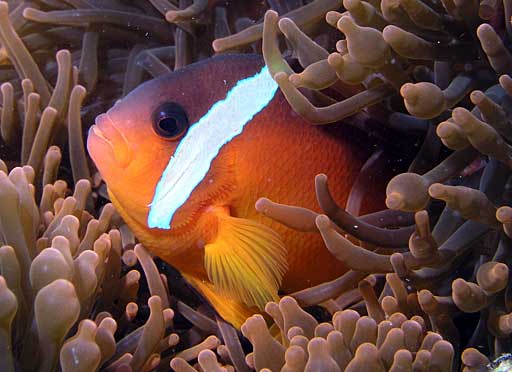
And then, there's the lil fella above, as far as I know the very latest (
described) discovery.
Gerald R. Allen, Joshua Drew and Les Kaufman: Amphiprion barberi, a new species of anemonefish (Pomacentridae) from Fiji, Tonga, and Samoa, pp. 105-114
Amphiprion barberi, a new species of anemonefish fish, is described from 46 specimens, 16.3-85.8 mm SL, collected at depths of 2-10 m from coral reefs of Fiji, Tonga, and Samoa.
It is closely allied to A. melanopus, which is widely distributed in the western Pacific. The two species exhibit significant colour-pattern differences, including a mainly reddish orange body in A. barberi and dark brown or blackish body in A. melanopus. Adults of the new species also possess fewer spinules (11-19 versus 19-26) in the upper-opercular series than A. melanopus. Genetic data presented here confirms the separation of these species.
barberi, I discover, having a very
pertinent connection to the above, Triangle, Tectonics, Biodiversity and all!
Anyway, just
Amazing!
This is Fiji's commonest Anemone Fish - and now, it is revealed that anybody who has ever seen them and not bothered to instantly engage in ecstatic outbreaks of
Eureka! or the like, has been a total and utter
ignoramus! At latest count, that would be everybody and his dog.
And the dog of his dog!
Wanna feel
real stupid? Google
A. barberi, A. melanopus, A. rubrocinctus and A. frenatus and compare the pix!
Hah!
Well, spinules or no spinules, Gerry is
da man when it comes to Damnselfish (
not a typo as anyone having taken pics at the
Take Out will confirm), so who am I to raise my eyebrows and
to bubble prick or picnic skunk the online fish nerds now bubbling happily among themselves about A New Clownfish!!!, as a friend knowingly admonished.
The more as the
Hawaii gang is due back in February!
Having seen the error of our
lumping ways, we shall forthwith swarm out and collect several dozen specimen of just about
Anything!
The commoner the better!
Maybe even the Darn Damsels, serves them right! Wanna bet that we'll manage to find some aberrant
spinule or
vomerine canine or some other equally indisputable and -spensable diagnostic feature?
Watch this space!