Showing posts with label New Scientific Discoveries. Show all posts
Showing posts with label New Scientific Discoveries. Show all posts
Friday, January 06, 2012


Thursday, December 30, 2010
More Bull Sharks in Tonga!

Got this message from not just a pretty face Karen in Vava'u.
This is a photo of 1 of 12 babies that were pulled out of a pregnant mothers belly. The mother was caught up in a net just outside the entrance of the old harbour. Do you know what species of shark it is?
Juerg and I both think that this is very likely a Bull Shark.
Yes it appears not to feature the diagnostic falcate dorsal fin - but that may just be due to the fact that like the tail, it is not yet fully developed, and to the crammed positioning of the fetus within the womb. Compare it to this pic of a small juvenile Bull Sharks from our work in the rivers, and the similarities are certainly striking.

Despite of the fact that 13 Sharks have died, this is actually excellent news.
It now appears highly likely that Vava'u is boasting a breeding population of Bull Sharks! This is quite surprising as Bull Sharks are known to pup in rivers and with the exception of a few more or less extinct volcanoes, the islands of Tonga consist of either raised limestone or small coral keys, and consequently feature no rivers whatsoever.
The Old Harbor in Vava'u is a shallow murky bay that may experience a bit of runoff when it rains but is essentially pure sea water.
The entrance is a known site for annual spawning aggregations of groupers and it is also the location where Karen, Paul and myself stumbled upon two subadult Bull Sharks in 2007. Like this time, one was subsequently caught in a net and I was able to purchase the jaw that provided for the ultimate verification of the species. Having alerted Juerg, he then published this paper documenting the first ever record of Bull Sharks for Tonga.
 This is the jaw of that subadult specimen of approx 120cm. Of interest, these upper teeth appear notably narrower than those of the adults, maybe indicating a more piscivorous diet like in the case of subadult GWs.
At the time, we thought that these may be just strays.
Now, it increasingly looks like the Old Harbor may be a nursing area for a local population of Bull Sharks. This is further confirmed by one of the local dive master who having experienced our Shark Dive, now claims that he had come across Bull Sharks in the past but had so far identified them as Bronze Whalers.
All very interesting indeed, and certainly worthy of further investigation!
This is a photo of 1 of 12 babies that were pulled out of a pregnant mothers belly. The mother was caught up in a net just outside the entrance of the old harbour. Do you know what species of shark it is?
Juerg and I both think that this is very likely a Bull Shark.
Yes it appears not to feature the diagnostic falcate dorsal fin - but that may just be due to the fact that like the tail, it is not yet fully developed, and to the crammed positioning of the fetus within the womb. Compare it to this pic of a small juvenile Bull Sharks from our work in the rivers, and the similarities are certainly striking.

Despite of the fact that 13 Sharks have died, this is actually excellent news.
It now appears highly likely that Vava'u is boasting a breeding population of Bull Sharks! This is quite surprising as Bull Sharks are known to pup in rivers and with the exception of a few more or less extinct volcanoes, the islands of Tonga consist of either raised limestone or small coral keys, and consequently feature no rivers whatsoever.
The Old Harbor in Vava'u is a shallow murky bay that may experience a bit of runoff when it rains but is essentially pure sea water.
The entrance is a known site for annual spawning aggregations of groupers and it is also the location where Karen, Paul and myself stumbled upon two subadult Bull Sharks in 2007. Like this time, one was subsequently caught in a net and I was able to purchase the jaw that provided for the ultimate verification of the species. Having alerted Juerg, he then published this paper documenting the first ever record of Bull Sharks for Tonga.
 This is the jaw of that subadult specimen of approx 120cm. Of interest, these upper teeth appear notably narrower than those of the adults, maybe indicating a more piscivorous diet like in the case of subadult GWs.
At the time, we thought that these may be just strays.
Now, it increasingly looks like the Old Harbor may be a nursing area for a local population of Bull Sharks. This is further confirmed by one of the local dive master who having experienced our Shark Dive, now claims that he had come across Bull Sharks in the past but had so far identified them as Bronze Whalers.
All very interesting indeed, and certainly worthy of further investigation!
Wednesday, July 28, 2010
One more Darn Damsel!

Cribrarula exmouthensis rottnestensis anybody?
Thought so!
Thing is, when I started collecting Cowries, my trusted field guide featured one Genus, Cypraea and two species of Sieve Cowries, cribraria and cribellum.
Now, Cypraea has been elevated to the rank of Family and there's a plethora of Genuses, among which Cribrarula - and as to what happened to the species, what can I say: there's a whole array of cribraria all the way to Cribrarula cribraria cribraria zadela; Cypraea cribellum has become Cribrarula esontropia cribellum; and the above-mentioned West Australian Sieve Cowry has slowly morphed to its current nomenclature from no less than Cribrarula (Cribrarula) cribraria occidentalis f. rottnestensis!
Are you still following me?
The whole fiasco appears to be the brainchild of one Herr Doktor and avid conchologist (as opposed to malacologist) Felix Lorenz.
May this taxonomic orgy be in any way related to the fact that shell collectors are suckers for punishment and will consequently have to obtain a specimen of each species, race and variation? And that Herr Doktor Lorenz just happens to own a website where a gem rottnestensis fetches 150 bucks, and a Cribrarula exmouthensis magnifica, a whopping 800? Honi soit qui mal y pense!
And before you ask: guilty as charged! I own one of each - and a zadela!
Enter Gerry Allen and Joshua Drew - yes, as in barberi!
I spare you a repetition of the litany about Biodiversity, Endemism, Speciation, Continental Drift, Isolation, Splitters and Lumpers: it's all here should you care to be confused further.
Anyway, they've done it again.
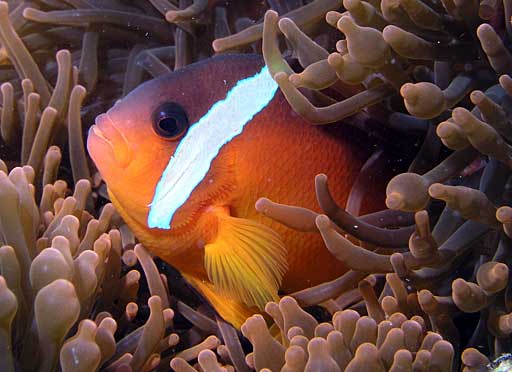
Gerald R. Allen, Joshua Drew and Douglas Fenner: Amphiprion pacificus, a new species of anemonefish (Pomacentridae) from Fiji, Tonga, Samoa, and Wallis Island, pp. 129-138
Amphiprion pacificus n. sp. is described on the basis of four specimens, 30.9-48.3 mm SL, from Wallis Island and Tonga in the western Pacific. Underwater photographs also reveal its presence on coral reefs of Fiji and Samoa.
The new taxon is nearly identical in appearance to A. akallopisos from the Indian Ocean. Both species are generally pinkish brown, grading to orange or yellowish on the lower half of the head and side and possess a white stripe on the dorsal midline of the head extending from just anterior to the eye to the dorsal fin origin, continuing along the base of the dorsal fin to the caudal fin base. However, genetic results indicate that A. pacificus is more closely related to A. sandaracinos from Western Australia and the Indo-Malayan region, forming a moderately supported clade that is well differentiated from A. akallopisos.
Aside from genetic differences A. sandaracinos differs from A. pacificus in having a uniform orange colouration and the white forehead stripe extends onto the upper lip. There also appears to be modal differences in the number of soft dorsal and anal rays (usually 19 versus 18 and 13 versus 12 respectively for A. pacificus and A. sandaracinos).
Great!
So now we got ourselves a Pacific Skunk Anemonefish to complement the Orange Skunk and the Skunk Clownfish proper! Meaning, another identical Fish featuring modal differences in ray counts and forming a moderately supported clade!
Sure puts a whole new twist on the meaning of skunked!
As my guru laconically comments, we are going to see more of these very similar, geographically isolated populations described as new species, as the DNA guys seek recognition for their research.
Gee - can't wait!
All of which leaves me in a conundrum.
Am I gonna continue to follow the tribulations of a bunch of guys gallivanting off to some remote locations in search of ubiquitous and long described Fishes that may, or may not feature slight modal differences - or shall I rather be incredibly impressed by people like John, Richard and Rob that strap on their rebreathers and come up with unequivocal and spectacular discoveries from completely new habitats?
Take a wild guess!
Thought so!
Thing is, when I started collecting Cowries, my trusted field guide featured one Genus, Cypraea and two species of Sieve Cowries, cribraria and cribellum.
Now, Cypraea has been elevated to the rank of Family and there's a plethora of Genuses, among which Cribrarula - and as to what happened to the species, what can I say: there's a whole array of cribraria all the way to Cribrarula cribraria cribraria zadela; Cypraea cribellum has become Cribrarula esontropia cribellum; and the above-mentioned West Australian Sieve Cowry has slowly morphed to its current nomenclature from no less than Cribrarula (Cribrarula) cribraria occidentalis f. rottnestensis!
Are you still following me?
The whole fiasco appears to be the brainchild of one Herr Doktor and avid conchologist (as opposed to malacologist) Felix Lorenz.
May this taxonomic orgy be in any way related to the fact that shell collectors are suckers for punishment and will consequently have to obtain a specimen of each species, race and variation? And that Herr Doktor Lorenz just happens to own a website where a gem rottnestensis fetches 150 bucks, and a Cribrarula exmouthensis magnifica, a whopping 800? Honi soit qui mal y pense!
And before you ask: guilty as charged! I own one of each - and a zadela!
Enter Gerry Allen and Joshua Drew - yes, as in barberi!
I spare you a repetition of the litany about Biodiversity, Endemism, Speciation, Continental Drift, Isolation, Splitters and Lumpers: it's all here should you care to be confused further.
Anyway, they've done it again.
Gerald R. Allen, Joshua Drew and Douglas Fenner: Amphiprion pacificus, a new species of anemonefish (Pomacentridae) from Fiji, Tonga, Samoa, and Wallis Island, pp. 129-138
Amphiprion pacificus n. sp. is described on the basis of four specimens, 30.9-48.3 mm SL, from Wallis Island and Tonga in the western Pacific. Underwater photographs also reveal its presence on coral reefs of Fiji and Samoa.
The new taxon is nearly identical in appearance to A. akallopisos from the Indian Ocean. Both species are generally pinkish brown, grading to orange or yellowish on the lower half of the head and side and possess a white stripe on the dorsal midline of the head extending from just anterior to the eye to the dorsal fin origin, continuing along the base of the dorsal fin to the caudal fin base. However, genetic results indicate that A. pacificus is more closely related to A. sandaracinos from Western Australia and the Indo-Malayan region, forming a moderately supported clade that is well differentiated from A. akallopisos.
Aside from genetic differences A. sandaracinos differs from A. pacificus in having a uniform orange colouration and the white forehead stripe extends onto the upper lip. There also appears to be modal differences in the number of soft dorsal and anal rays (usually 19 versus 18 and 13 versus 12 respectively for A. pacificus and A. sandaracinos).
Great!
So now we got ourselves a Pacific Skunk Anemonefish to complement the Orange Skunk and the Skunk Clownfish proper! Meaning, another identical Fish featuring modal differences in ray counts and forming a moderately supported clade!
Sure puts a whole new twist on the meaning of skunked!
As my guru laconically comments, we are going to see more of these very similar, geographically isolated populations described as new species, as the DNA guys seek recognition for their research.
Gee - can't wait!
All of which leaves me in a conundrum.
Am I gonna continue to follow the tribulations of a bunch of guys gallivanting off to some remote locations in search of ubiquitous and long described Fishes that may, or may not feature slight modal differences - or shall I rather be incredibly impressed by people like John, Richard and Rob that strap on their rebreathers and come up with unequivocal and spectacular discoveries from completely new habitats?
Take a wild guess!
Friday, May 29, 2009
More tiny Stuff!

I blogged about the Snake but I completely missed the Seahorse!
Both are among the "top 10 new species described in 2008" - and I also learn that in 2007, scientists managed to document a whopping 18,516 previously unknown species!
Whow!
Well, the tiny guy above is the Satomi Seahorse Hippocampus satomiae (go wonder: shouldn't it be satomis or satomii?), apparently the smallest of them all (smaller than a "regular" pygmy as in bargibanti?).
But wait, that's not all: there's two more slightly bigger ones from 2008 - and they have already described two more this year!
And what about the pygmies that are regularly found by Fiji's liveaboard vessels, as in this post (and this one) by our friends of the Fiji Aggressor 2? Are they severnsi?
Only one way to find out!
And after the cruise, come and check out our Sharks!
No magnifying glass required - guaranteed!
Both are among the "top 10 new species described in 2008" - and I also learn that in 2007, scientists managed to document a whopping 18,516 previously unknown species!
Whow!
Well, the tiny guy above is the Satomi Seahorse Hippocampus satomiae (go wonder: shouldn't it be satomis or satomii?), apparently the smallest of them all (smaller than a "regular" pygmy as in bargibanti?).
But wait, that's not all: there's two more slightly bigger ones from 2008 - and they have already described two more this year!
And what about the pygmies that are regularly found by Fiji's liveaboard vessels, as in this post (and this one) by our friends of the Fiji Aggressor 2? Are they severnsi?
Only one way to find out!
And after the cruise, come and check out our Sharks!
No magnifying glass required - guaranteed!
Wednesday, December 03, 2008
Eureka! barberi!
 Photo Scott W. Michael
The story, when I first heard it, was spectacular.
The Coral Triangle is the epicenter of marine Biodiversity, a region that has been spared during the Glaciations and where many tropical species have found refuge, only to begin re-colonizing the Oceans once it got warmer again.
In fact, if you progress to anywhere from its center, Biodiversity decreases. As you can see, it stretches from Indonesia all the way to the Solomon Islands. Biodiversity however decreases even within that region, with e.g. the Solomons featuring a lower number of species than, say, Irian Jaya.
Apparently, the fable went, Fiji is an ancient portion of the Triangle that had broken off and subsequently, rafted across the Pacific to its present location.
On its travels, Ark-like, it had carried along a sample of the Triangle's marine opulence, thus establishing a new independent and so far overlooked Biodiversity hotspot. That would have been remarkable insofar as the direction of the prevailing wind and currents, and thus, of larval (and thus marine species) dispersion in that region is East-to-West and thus opposed to Fiji's assumed tectonic progression.
May the fabulator have been a prominent member of Fiji's diving community with a vested interest in promoting that destination?
You Betcha!
Having promptly pestered my Taxonomist friends, what really happened seems to be this, and I cite:
Well, there is a fragment of truth in it.
Somewhat east of the Solomons-New Hebrides chain of today’s islands, an intra-Pacific plate subduction zone (Vitiaz trench) developed and gave rise to a string of volcanic islands on the west side of the trench, of which Solomons was at the west end and Fiji was at the SE end. The Ontong Java Plateau was on the Pp east of this island arc and it was moving west toward the subduction zone as was the portion of the Pp with the string of islands. The OJP pushed into the island arc and together they moved onto the continental basins formed by the sequential openings of the Coral Sea-Tasman, New Caledonian, and South Fiji basins. A right angles to the east of the island arch, a vertical [we’re talking Mercator projections] westward subduction zone was forming along the Pp margin which was creating the Tonga Islands. As the linear Solomon New Hebrides-Fiji arc pushed against the other forming-formed basins, the Fiji end got latched onto the north end of theTonga ridge. The north Fiji basin started opening between the New Hebrides and Fiji causing the NH to move west and Fiii to move east carrying a few pieces of the NH with it. Then the Lau basin began opening and split the Tonga ridge into the west Lau ridge, with islands forming, and the east Tonga ridge with its islands.
When the original island arch was continuous, presumably the fishes (and other organisms) had continuous distributions. The separation of Fiji from New Heb on one side and from Tonga on the other allowed many taxa in Fiji to evolve into separate species.
It is more complex that this boiled down scenario conveys, but this is generally what happened. So yes, the island arc formed out on the plate could have had a uniform biota which the geological contortions split up isolating Fiji (and also Tonga, from Fiji)
Thus enlightened (?), I gather that what this means is that Plate Tectonics may have contributed to Fiji's Endemism but likely not boosted local Biodiversity. Nothing to sniff at by any stretch of the imagination - but certainly, nothing really unexpected, either.
In fact, everybody in the know assures me that Fiji's marine Biodiversity is comparatively low and very much in line with what would have to be expected from its distance to the Triangle's epicenter.
Provided that you believe in Darwinian Evolution, and I assume you do, you may remember that one of the principal preconditions for Speciation is Isolation.
With Fiji haven broken away and gone walkabout, a new basin was opened and Gene Flow was interrupted as the genetic pool of Fiji stopped cross-breeding with the genetic pool of the Solomons in the West (and Tonga/Samoa, who in turn sit on their own tectonic micro-express, in the East). Whether owing to different selective pressures, Genetic Drift or the Founder Effect, the thus isolated population then had the chance to evolve into new, genetically distinct Species endemic to Fiji.
As I said, nothing unexpected: the more remote an Island, the higher the chances for Endemism, marine and not, as witnessed in Hawaii, the Marquesas and even tiny Lord Howe.
Still with me?
I sure hope so!
Thing is, Island Biogeography and especially, (terrestrial) Island Speciation never ceases to amaze me.
Take for example Fiji's endemic Iguanas, probably descendants of a Green Iguana that had rafted over, Kon Tiki-like, all the way from the Americas (Australia has Goannas, not Iguanas) and then speciated into the three endemics. I just love the name of the latest discovery!
Or take the incredible incubator Megapodes, some of which exploit the heat of active calderas. Once widely distributed throughout the Pacific, their local extinction correlates with the arrival of Homo sapiens and its bird-killing stowaways and introduced domesticates, alas an all-to-frequent pattern. Present in Vanuatu and Tonga - but not anymore in Fiji!
Or, you can find such puzzling oddities as parthenogenetic giant Monitor Lizards having evolved, some say, in order to be able to prey on Dwarf Elephants on Komodo. Or Micro-Herps and another tribe of highly endemic Iguanas in the Caribbean.
And the list goes on and on and on......
Simply fascinating!
Back to Fiji's Fishes, there is indeed an increasing list of endemic species being discovered.
Take for instance the famous USP Rabbitfish, or Bicolored Foxface that is common on Shark Reef. Or the spectacularly yellow, non-aggressive but nevertheless, venomous endemic Ovalau Fangblenny which is being mimicked by the yellow phase of the non-venomous but Fish-biting Bicolor Fangblenny. Or the three hitherto undescribed (and alas, hitherto uncollected and thus, undescribable) Fishes we found on Shark Reef last February.
And then, there's the lil fella above, as far as I know the very latest (described) discovery.
Gerald R. Allen, Joshua Drew and Les Kaufman: Amphiprion barberi, a new species of anemonefish (Pomacentridae) from Fiji, Tonga, and Samoa, pp. 105-114
Amphiprion barberi, a new species of anemonefish fish, is described from 46 specimens, 16.3-85.8 mm SL, collected at depths of 2-10 m from coral reefs of Fiji, Tonga, and Samoa.
It is closely allied to A. melanopus, which is widely distributed in the western Pacific. The two species exhibit significant colour-pattern differences, including a mainly reddish orange body in A. barberi and dark brown or blackish body in A. melanopus. Adults of the new species also possess fewer spinules (11-19 versus 19-26) in the upper-opercular series than A. melanopus. Genetic data presented here confirms the separation of these species.
barberi, I discover, having a very pertinent connection to the above, Triangle, Tectonics, Biodiversity and all!
Anyway, just Amazing!
This is Fiji's commonest Anemone Fish - and now, it is revealed that anybody who has ever seen them and not bothered to instantly engage in ecstatic outbreaks of Eureka! or the like, has been a total and utter ignoramus! At latest count, that would be everybody and his dog. And the dog of his dog!
Wanna feel real stupid? Google A. barberi, A. melanopus, A. rubrocinctus and A. frenatus and compare the pix!
Hah!
Well, spinules or no spinules, Gerry is da man when it comes to Damnselfish (not a typo as anyone having taken pics at the Take Out will confirm), so who am I to raise my eyebrows and to bubble prick or picnic skunk the online fish nerds now bubbling happily among themselves about A New Clownfish!!!, as a friend knowingly admonished.
The more as the Hawaii gang is due back in February!
Having seen the error of our lumping ways, we shall forthwith swarm out and collect several dozen specimen of just about Anything!
The commoner the better!
Maybe even the Darn Damsels, serves them right! Wanna bet that we'll manage to find some aberrant spinule or vomerine canine or some other equally indisputable and -spensable diagnostic feature?
Watch this space!
The Coral Triangle is the epicenter of marine Biodiversity, a region that has been spared during the Glaciations and where many tropical species have found refuge, only to begin re-colonizing the Oceans once it got warmer again.
In fact, if you progress to anywhere from its center, Biodiversity decreases. As you can see, it stretches from Indonesia all the way to the Solomon Islands. Biodiversity however decreases even within that region, with e.g. the Solomons featuring a lower number of species than, say, Irian Jaya.
Apparently, the fable went, Fiji is an ancient portion of the Triangle that had broken off and subsequently, rafted across the Pacific to its present location.
On its travels, Ark-like, it had carried along a sample of the Triangle's marine opulence, thus establishing a new independent and so far overlooked Biodiversity hotspot. That would have been remarkable insofar as the direction of the prevailing wind and currents, and thus, of larval (and thus marine species) dispersion in that region is East-to-West and thus opposed to Fiji's assumed tectonic progression.
May the fabulator have been a prominent member of Fiji's diving community with a vested interest in promoting that destination?
You Betcha!
Having promptly pestered my Taxonomist friends, what really happened seems to be this, and I cite:
Well, there is a fragment of truth in it.
Somewhat east of the Solomons-New Hebrides chain of today’s islands, an intra-Pacific plate subduction zone (Vitiaz trench) developed and gave rise to a string of volcanic islands on the west side of the trench, of which Solomons was at the west end and Fiji was at the SE end. The Ontong Java Plateau was on the Pp east of this island arc and it was moving west toward the subduction zone as was the portion of the Pp with the string of islands. The OJP pushed into the island arc and together they moved onto the continental basins formed by the sequential openings of the Coral Sea-Tasman, New Caledonian, and South Fiji basins. A right angles to the east of the island arch, a vertical [we’re talking Mercator projections] westward subduction zone was forming along the Pp margin which was creating the Tonga Islands. As the linear Solomon New Hebrides-Fiji arc pushed against the other forming-formed basins, the Fiji end got latched onto the north end of theTonga ridge. The north Fiji basin started opening between the New Hebrides and Fiji causing the NH to move west and Fiii to move east carrying a few pieces of the NH with it. Then the Lau basin began opening and split the Tonga ridge into the west Lau ridge, with islands forming, and the east Tonga ridge with its islands.
When the original island arch was continuous, presumably the fishes (and other organisms) had continuous distributions. The separation of Fiji from New Heb on one side and from Tonga on the other allowed many taxa in Fiji to evolve into separate species.
It is more complex that this boiled down scenario conveys, but this is generally what happened. So yes, the island arc formed out on the plate could have had a uniform biota which the geological contortions split up isolating Fiji (and also Tonga, from Fiji)
Thus enlightened (?), I gather that what this means is that Plate Tectonics may have contributed to Fiji's Endemism but likely not boosted local Biodiversity. Nothing to sniff at by any stretch of the imagination - but certainly, nothing really unexpected, either.
In fact, everybody in the know assures me that Fiji's marine Biodiversity is comparatively low and very much in line with what would have to be expected from its distance to the Triangle's epicenter.
Provided that you believe in Darwinian Evolution, and I assume you do, you may remember that one of the principal preconditions for Speciation is Isolation.
With Fiji haven broken away and gone walkabout, a new basin was opened and Gene Flow was interrupted as the genetic pool of Fiji stopped cross-breeding with the genetic pool of the Solomons in the West (and Tonga/Samoa, who in turn sit on their own tectonic micro-express, in the East). Whether owing to different selective pressures, Genetic Drift or the Founder Effect, the thus isolated population then had the chance to evolve into new, genetically distinct Species endemic to Fiji.
As I said, nothing unexpected: the more remote an Island, the higher the chances for Endemism, marine and not, as witnessed in Hawaii, the Marquesas and even tiny Lord Howe.
Still with me?
I sure hope so!
Thing is, Island Biogeography and especially, (terrestrial) Island Speciation never ceases to amaze me.
Take for example Fiji's endemic Iguanas, probably descendants of a Green Iguana that had rafted over, Kon Tiki-like, all the way from the Americas (Australia has Goannas, not Iguanas) and then speciated into the three endemics. I just love the name of the latest discovery!
Or take the incredible incubator Megapodes, some of which exploit the heat of active calderas. Once widely distributed throughout the Pacific, their local extinction correlates with the arrival of Homo sapiens and its bird-killing stowaways and introduced domesticates, alas an all-to-frequent pattern. Present in Vanuatu and Tonga - but not anymore in Fiji!
Or, you can find such puzzling oddities as parthenogenetic giant Monitor Lizards having evolved, some say, in order to be able to prey on Dwarf Elephants on Komodo. Or Micro-Herps and another tribe of highly endemic Iguanas in the Caribbean.
And the list goes on and on and on......
Simply fascinating!
Back to Fiji's Fishes, there is indeed an increasing list of endemic species being discovered.
Take for instance the famous USP Rabbitfish, or Bicolored Foxface that is common on Shark Reef. Or the spectacularly yellow, non-aggressive but nevertheless, venomous endemic Ovalau Fangblenny which is being mimicked by the yellow phase of the non-venomous but Fish-biting Bicolor Fangblenny. Or the three hitherto undescribed (and alas, hitherto uncollected and thus, undescribable) Fishes we found on Shark Reef last February.
And then, there's the lil fella above, as far as I know the very latest (described) discovery.
Gerald R. Allen, Joshua Drew and Les Kaufman: Amphiprion barberi, a new species of anemonefish (Pomacentridae) from Fiji, Tonga, and Samoa, pp. 105-114
Amphiprion barberi, a new species of anemonefish fish, is described from 46 specimens, 16.3-85.8 mm SL, collected at depths of 2-10 m from coral reefs of Fiji, Tonga, and Samoa.
It is closely allied to A. melanopus, which is widely distributed in the western Pacific. The two species exhibit significant colour-pattern differences, including a mainly reddish orange body in A. barberi and dark brown or blackish body in A. melanopus. Adults of the new species also possess fewer spinules (11-19 versus 19-26) in the upper-opercular series than A. melanopus. Genetic data presented here confirms the separation of these species.
barberi, I discover, having a very pertinent connection to the above, Triangle, Tectonics, Biodiversity and all!
Anyway, just Amazing!
This is Fiji's commonest Anemone Fish - and now, it is revealed that anybody who has ever seen them and not bothered to instantly engage in ecstatic outbreaks of Eureka! or the like, has been a total and utter ignoramus! At latest count, that would be everybody and his dog. And the dog of his dog!
Wanna feel real stupid? Google A. barberi, A. melanopus, A. rubrocinctus and A. frenatus and compare the pix!
Hah!
Well, spinules or no spinules, Gerry is da man when it comes to Damnselfish (not a typo as anyone having taken pics at the Take Out will confirm), so who am I to raise my eyebrows and to bubble prick or picnic skunk the online fish nerds now bubbling happily among themselves about A New Clownfish!!!, as a friend knowingly admonished.
The more as the Hawaii gang is due back in February!
Having seen the error of our lumping ways, we shall forthwith swarm out and collect several dozen specimen of just about Anything!
The commoner the better!
Maybe even the Darn Damsels, serves them right! Wanna bet that we'll manage to find some aberrant spinule or vomerine canine or some other equally indisputable and -spensable diagnostic feature?
Watch this space!
Saturday, October 04, 2008
One last one...

Yes, I know, I've signed off - but this was just too good to give it a pass.
Talking about DEMA -well, sort of-, the 2008 Ig Nobel prizes have just been awarded, among which this inimitable insight.
Apparently, lap dancers earn the most when they're, you know, most fertile!
The Ig Nobel-winning experiment probing human nature has been featured in New Scientist: can women somehow signal when they are at their peak fertility? Most other female mammals do so openly, but men don't consciously recognise any such signal from women.
To investigate, University of New Mexico psychologists Geoffrey Miller, Joshua Tybur and Brent Jordan asked women working as lap dancers to report their nightly tips, and whether they were on hormonal contraceptives or menstruating naturally.
The two groups of women received similar tips when they were in non-fertile parts of their cycle, but when the naturally menstruating women reached their fertile days they earned significantly more (Evolution and Human Behavior, vol 28, p 375).
In the 18 subjects Miller studied, average earnings were $250 for a five-hour shift. That jumped to $350 to $400 per five-hour shift when the women were their most fertile, he said.
"I have heard, anecdotally, that some lap dancers have scheduled shifts based on this research," he said.
You may want to keep that in mind, lest what should have staid in Vegas comes knocking at your door some years down the line!
Talking about DEMA -well, sort of-, the 2008 Ig Nobel prizes have just been awarded, among which this inimitable insight.
Apparently, lap dancers earn the most when they're, you know, most fertile!
The Ig Nobel-winning experiment probing human nature has been featured in New Scientist: can women somehow signal when they are at their peak fertility? Most other female mammals do so openly, but men don't consciously recognise any such signal from women.
To investigate, University of New Mexico psychologists Geoffrey Miller, Joshua Tybur and Brent Jordan asked women working as lap dancers to report their nightly tips, and whether they were on hormonal contraceptives or menstruating naturally.
The two groups of women received similar tips when they were in non-fertile parts of their cycle, but when the naturally menstruating women reached their fertile days they earned significantly more (Evolution and Human Behavior, vol 28, p 375).
In the 18 subjects Miller studied, average earnings were $250 for a five-hour shift. That jumped to $350 to $400 per five-hour shift when the women were their most fertile, he said.
"I have heard, anecdotally, that some lap dancers have scheduled shifts based on this research," he said.
You may want to keep that in mind, lest what should have staid in Vegas comes knocking at your door some years down the line!
Sunday, September 28, 2008
A new Species of Giant Grouper?

A recent scientific blog is featuring this video of Ratu Rua -pictured here by Michael Aw- one of our Giant Groupers, claiming that it is a newly discovered species, the "Pacific Goliath Grouper", a sister species of the critically endangered Atlantic Ocean former "Jewfish", and now Goliath Grouper Epinephelus itajara.
Well, maybe there is indeed such a distinct species inhabiting the Eastern Pacific. After Andrea Marshall's stunning discovery of a second Manta Ray, anything is possible.
But Taxonomy is often a matter of judgment and Scientists can generally be divided into "Lumpers" and "Splitters". The latter are often newbies lacking a track record of bona fide descriptions and are eager to finally put their name to a new discovery. I remain skeptical.
When it comes to Sharks, one famous -or infamous- such case was the attempt to split the Grey Reef Shark, Carcharhinus amblyrhinchos into Carcharhinus menisorrah (or proper Grey Reef) and Carcharhinus wheeleri (or "Short-nosed Blacktail Shark) in the 70ies, this based on the observation that the latter Indian Ocean Grey Reefs have a slight white edging to their first dorsal fin and apparently never engage in the typical agonistic display of the Grey Reefies in the Pacific.
It was finally resolved that they are all but one species and in fact, you can see both color morphs on Shark Reef.
But back to the grouper.
A Goliath Grouper looks like this.
It was filmed in Fernando de Noronha, thus in the Atlantic Ocean, but apparently, the "new" Grouper looks identical in body form and markings , the classical case of a Cryptic Species Complex.
In fact, the new Pacific "species" has been named Epinephelus quinquefasciatus, this in reference to its five color bands which are identical to those of the Goliath Grouper above.
Ratu Rua looks nothing like it.
She is uniformly mottled dark with a slight light edging to her fins, a reminder of the much more striking edging when subadult (the juveniles are yellow with irregular black bars).
Like our other three large groupers, she is clearly Epinephelus lanceolatus, the Giant or Queensland Grouper.
Want to know more?
Check out this page from our latest fish count in February!
Well, maybe there is indeed such a distinct species inhabiting the Eastern Pacific. After Andrea Marshall's stunning discovery of a second Manta Ray, anything is possible.
But Taxonomy is often a matter of judgment and Scientists can generally be divided into "Lumpers" and "Splitters". The latter are often newbies lacking a track record of bona fide descriptions and are eager to finally put their name to a new discovery. I remain skeptical.
When it comes to Sharks, one famous -or infamous- such case was the attempt to split the Grey Reef Shark, Carcharhinus amblyrhinchos into Carcharhinus menisorrah (or proper Grey Reef) and Carcharhinus wheeleri (or "Short-nosed Blacktail Shark) in the 70ies, this based on the observation that the latter Indian Ocean Grey Reefs have a slight white edging to their first dorsal fin and apparently never engage in the typical agonistic display of the Grey Reefies in the Pacific.
It was finally resolved that they are all but one species and in fact, you can see both color morphs on Shark Reef.
But back to the grouper.
A Goliath Grouper looks like this.
It was filmed in Fernando de Noronha, thus in the Atlantic Ocean, but apparently, the "new" Grouper looks identical in body form and markings , the classical case of a Cryptic Species Complex.
In fact, the new Pacific "species" has been named Epinephelus quinquefasciatus, this in reference to its five color bands which are identical to those of the Goliath Grouper above.
Ratu Rua looks nothing like it.
She is uniformly mottled dark with a slight light edging to her fins, a reminder of the much more striking edging when subadult (the juveniles are yellow with irregular black bars).
Like our other three large groupers, she is clearly Epinephelus lanceolatus, the Giant or Queensland Grouper.
Want to know more?
Check out this page from our latest fish count in February!
Monday, August 11, 2008
The proper Way

I've recently ranted about frivolous and heartless science and about Shark "experts" proffering ludicrous opinions instead of doing what is to be expected from proper scientists, and that is, to use the Scientific Method:
Apart from "our" very own Juerg and his research on Shark Reef, here are some institutions and individuals who do serious research on the topics of the past rants:
 Mexico: Dr Leonardo Castillo from Mexico's National Fisheries Institute has begun equipping thousands of Sharks with satellite, radio and plastic tags to better understand the cause for a recent spate of incidents on the Mexican Pacific Coast. I look forward to his explanations after the results have come in, as it should be. Much more tedious than taking a quick trip to Mexico in order to give a few interviews - but oh so much more credible!
Greenland Sharks: Canada's three Oceans are frequented by up to 41 species of Sharks.
 GEERG, the Greenland Shark and Elasmobranch Education and Research Group is currently conducting Research on 3 of them, the Greenland, Basking and Blue , and planning research on the four Lamnids Great White, Shortfin Mako, Porbeagle and Salmon Shark. As far as I can discern, no frivolous killing involved.
The Canadian Shark Research Laboratory conducts research on some of the same Sharks, mostly by examining catches by local fishermen.
Both websites are a treasure trove of information, along with a nifty interactive Shark identification key.

And then, there's of course TOPP, the herculean effort of trying to tag, and thus record the movements of the Pacific Predators, be it cetaceans, fish, Sharks, birds or reptiles. It never ceases to intrigue and amaze me, be it by its sheer scope or by the wealth of information it regularly unveils.
Plenty to discover, plenty to learn.
Enjoy!
- ask Questions
- make Observations
- develop a Hypothesis (that is, a theoretical Explanation)
- make Predictions and then
- collect, analyze and interpret the necessary Data (that is, the Evidence, often via Experiments) in order to verify or falsify (that is, to test) that Hypothesis.
- only then, publish the results (as a Model or Theory) and have them re-tested, often by peers.
Apart from "our" very own Juerg and his research on Shark Reef, here are some institutions and individuals who do serious research on the topics of the past rants:
 Mexico: Dr Leonardo Castillo from Mexico's National Fisheries Institute has begun equipping thousands of Sharks with satellite, radio and plastic tags to better understand the cause for a recent spate of incidents on the Mexican Pacific Coast. I look forward to his explanations after the results have come in, as it should be. Much more tedious than taking a quick trip to Mexico in order to give a few interviews - but oh so much more credible!
Greenland Sharks: Canada's three Oceans are frequented by up to 41 species of Sharks.
 GEERG, the Greenland Shark and Elasmobranch Education and Research Group is currently conducting Research on 3 of them, the Greenland, Basking and Blue , and planning research on the four Lamnids Great White, Shortfin Mako, Porbeagle and Salmon Shark. As far as I can discern, no frivolous killing involved.
The Canadian Shark Research Laboratory conducts research on some of the same Sharks, mostly by examining catches by local fishermen.
Both websites are a treasure trove of information, along with a nifty interactive Shark identification key.

And then, there's of course TOPP, the herculean effort of trying to tag, and thus record the movements of the Pacific Predators, be it cetaceans, fish, Sharks, birds or reptiles. It never ceases to intrigue and amaze me, be it by its sheer scope or by the wealth of information it regularly unveils.
Plenty to discover, plenty to learn.
Enjoy!
Sunday, August 10, 2008
Tiny

Readers of The Song of the Dodo know that Islands are often homes to very large (as in the Dodo, the largest pigeon, on Mauritius or Dragons on Komodo) or very small animals.
Case in point: the latest herpetological discoveries from the Caribbean.
 A small island off the coast of Dominica harbors the World's smallest lizard whilst Barbados, the smallest snake.
So far, that is - as always in science, new discoveries are bound to loom.
 Like this one: researchers report the discovery of more than 100,000, hitherto unknown Western Lowland Gorillas (the kind mostly kept in Zoos) from two areas in the northern part of the Congo. Yes, they remain threatened by habitat degradation, the hunt for bush meat and Ebola, but it triplicates the estimates for the species nevertheless.
Alas, no such good news for Sharks.
But still, a good day for anybody interested in Nature.
Case in point: the latest herpetological discoveries from the Caribbean.
 A small island off the coast of Dominica harbors the World's smallest lizard whilst Barbados, the smallest snake.
So far, that is - as always in science, new discoveries are bound to loom.
 Like this one: researchers report the discovery of more than 100,000, hitherto unknown Western Lowland Gorillas (the kind mostly kept in Zoos) from two areas in the northern part of the Congo. Yes, they remain threatened by habitat degradation, the hunt for bush meat and Ebola, but it triplicates the estimates for the species nevertheless.
Alas, no such good news for Sharks.
But still, a good day for anybody interested in Nature.
Subscribe to:
Posts (Atom)