Showing posts sorted by relevance for query Blue Water White Death. Sort by date Show all posts

Monday, September 10, 2012

Ron Taylor - a Tribute.

Happier times; Ron (standing, left) with Valerie, Douglas David Siefert in yum-yum-yellow and friends, PNG 2003 - please click for detail

As we mourn his passing, we must celebrate Ron's amazing life.

Douglas David Seifert has written this tribute.
Over the past decade or so, Doug has been one of Ron and Valerie's closest friend with whom he has undertaken countless dive expeditions to the four corners of the Oceans. As Ron became severely ill two years ago, Doug and Emily have resolved to make Australia the principal turntable for their travels, in order to find time to go and visit, extend  counsel and comfort, and simply be there, as only true friends will do. As we speak, they are with Valerie in Sydney.
For that, they have my ever lasting gratitude and respect - thank you so much!


Ronald Josiah Taylor (1934 – 2012)
A Tribute
© 2012 by Douglas David Seifert World Editor, DIVE Magazine

Ron Taylor, Australian icon of ocean exploration, scuba diving pioneer and innovator, visionary underwater filmmaker and marine conservationist, left this world behind early Sunday morning as he made the ultimate plunge into the eternal sea of night.

In 2003, the Order of Australia was awarded to Ron Taylor “For service to conservation and the environment through marine cinematography and photography, by raising awareness of endangered and potentially extinct marine species, and by contributing to the declaration of species and habitat protection.”
Born in 1934, appropriately under the star sign of Pisces the fish, Ron first submerged into the seas off Botany Bay, Sydney in 1951, when he found a mask someone had lost at the Brighton Le Sands meshed baths. “The underwater world became clear and I was hooked,” as he confided.

At first, he was a breath-hold skin diver, eventually becoming proficient as an underwater hunter with a speargun from 1953 forward.
At this time, he was employed as a photo engraver in Castlereagh Street, Sydney.In 1955, Ron built his first underwater breathing apparatus from parts purchased from a World War Two surplus shop, based upon an oxygen demand regulator used in high flying aircraft, along with flexible gas mask twin hoses; a fire extinguisher bottle was used for the air supply tank and compressed air obtained from a local engineering firm. The creation worked but was limited due to the small volume of air it could carry for the very short duration scuba dives. Eventually, manufactured scuba equipment made its way to Australian shores and Ron was able to spend greater amounts of time exploring the underwater world.

 In 1956, he became a member of the St. George Sea Dragons Spearfishing Club in Sydney and ultimately won four consecutive Australian National spearfishing championships between 1962 and 1965. He reached the apex of the sport in 1965 when he represented Australia at the World Spearfishing Competition held in Tahiti, French Polynesia, and took the top honor as the World Spearfishing Champion.

Over time, competitive spearfishing began to lose its appeal to Ron, because in addition to joining the St. George Spearfishing Club in 1956, he had also discovered the satisfactions of hunting sea life for the camera.
He was lent a 16mm Bell and Howell movie camera and built his own underwater housing for it from Perspex, a harbinger of the dozens of Taylor-made, custom-built underwater housings he would construct for all of his cameras over the next fifty years. The film length for that original camera was 50 feet, which would run for 80 seconds in total, but due to limitations of the spring winding mechanism, the maximum the camera would run was 25 seconds before shutting down. Ron learned early on to be very selective in his choice of subject and in camera technique. It was at this time, Ron also became aware that non-divers – also known as the rest of the world – were keenly interested in sharks and he began to specialize in photographing sharks for the camera.

In 1960, Ron bought his own Bolex camera, built another housing and began making films for theatrical release.
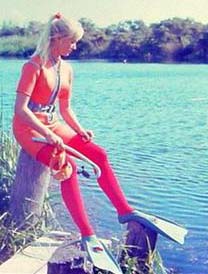
He also attended the Heron Island Dive Festival where a beautiful blonde skin diver named Valerie Heighes caught his eye. She had won the Miss Heron Island competition and he convinced her to model underwater for his camera, the beginning of a collaboration of filmmaker Ron and on-camera personality Valerie that would endure as a tried and true formula for the next fifty-two years.

By 1962, Ron’s first film, Playing With Sharks was released in cinemas by Movietone News.
The film was followed by Shark Hunters, shot in black and white, and sold to Australian and American television, cementing his reputation as a top-notch underwater filmmaker with a penchant for capturing sharks on film. In December of 1963, he and Valerie married and the following month, Ron won his third Australian National Spearfishing Championship at Kangaroo Island, South Australia. His film Skindiving Paradise was commissioned and released by the Queensland Government Tourist Board.

 In 1965, Ron Taylor filmed the underwater sequences for Revenge of a Shark Victim, a 16mm documentary for TCN9 television.
In the process of filming, Ron became the first man in the world to film a great white shark underwater and the first man to photograph a great white shark underwater without the use of an anti-shark cage. The resulting image, taken from a single still frame of that film, has been seen the world over for nearly forty years as the embodiment of the fearsome great white shark, a triangle of pointed snout, vast, open, outstretched jaws framed with triangular pointed teeth and featureless, jet black eyes. This iconic image was captured a decade before the movie Jaws gave movie-goers and swimmers a second thought.


 The year also saw the release of Surf Scene a diving and surfing documentary that played on a festival circuit as the newlywed Taylors barnstormed around coastal Queensland and New South Wales, Australia, four walling a town with posters promoting the film’s showings where the collected admissions paid for gasoline and food and film stock as the Taylors tried to make a career out of filmmaking and following their passion for the sea.

At the same time, Australia’s premiere underwater hunter became completely and irrevocably disenchanted with competitive spearfishing and gave up the sport completely, though he remained a highly skilled spearfisherman the rest of his days but took only enough to put upon the table fish enough to feed himself and his wife, with no waste.

In 1969, American department-store heir and filmmaker Peter Gimbel hired the Taylors take part in the production of Blue Water, White Death, a milestone cinema verite documentary that lived up to its subtitle: “The Hunt for the Great White Shark”. 
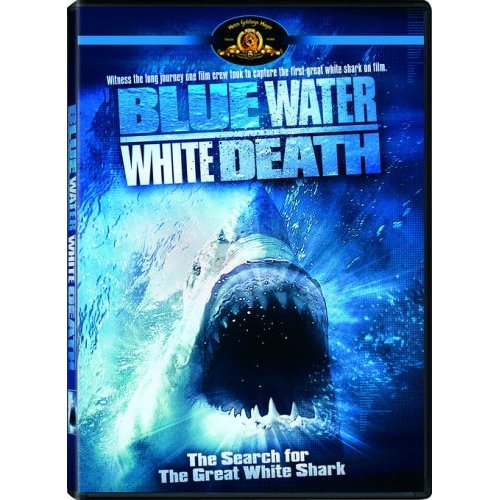
Valerie was employed as a safety diver and on-camera talent; Ron as cameraman. On this six month odyssey, the Taylors, working with Gimbel and cinematographer Stanton Waterman travelled around the Indian Ocean on a chartered whale catcher, from Durban, South Africa, and encountered vast schools of oceanic whitetip sharks feeding upon the carcasses of sperm whales killed by the then-active South African whaling industry. They filmed the shark aggregation at night and they filmed it most memorably by leaving the safety of anti-shark cages. The footage remains, to this day, the most dramatic underwater shark footage ever seen. The producer’s hope was a great white shark would appear at the whale carcass but the virually mythological shark remained elusive, so the production moved up the east coast to Mozambique, to the Comoros and to Sri Lanka, having great adventures along the way, providing a lively travelogue, but not meeting their objective. Eventually, after a hiatus, and at Ron Taylor’s suggestion, the production moved to South Australia where they finally found the great white shark. The film broke all box office records for a documentary film and was second grossing film of the year after only Love Story. The film was a lost classic for decades following Gimbel’s death until the original print was found and re-mastered and re-released in theatres and on DVD in 2007.

Following the worldwide success of Blue Water, White Death, in 1970 and 1971, the Taylors embarked upon filming the 39 episode television series Barrier Reef and the following year, their own television documentary series, Taylor’s Inner Space, which consisted of 13 half hour episodes filmed around Australia.


Their work in Blue Water, White Death attracted the attention of Hollywood and in 1974, Ron and Valerie were promptly hired to shoot the live action great white shark sequences for Jaws.


Other film work for Hollywood features followed, with Ron in great demand for original shark footage for Orca, Gallipoli, The Last Wave and all the underwater photographic work for The Blue Lagoon, starring Brooke Shields and Chris Atkins, as well as numerous television works such as pieces for National Geographic, Wild, Wild World of Animals TV series, resulting in specials and features such as Sharks, Silent Hunters of the Deep and Operation Shark Bite.

 During this time, Ron’s innovations into the world of experimentation with sharks included the development of a revolutionary, stainless steel, chain-mail inspired, anti-shark suit, as featured in the May, 1981 cover story of National Geographic Magazine.
 In the 1980’s, Ron Taylor’s productions of The Wreck of the Yongala and The Great Barrier Reef, both educated viewers about Australia’s irreplaceable underwater heritage concerning the Yongala, Australia’s most dynamic wreck dive and the Cod Hole, a sanctuary for the large and charismatic giant grouper called Potato Cod that could (and thanks to the Taylor’s efforts still can be) found only at one specific location on the Great Barrier Reef. These films, in addition to intense lobbying at great personal cost (threats and denouncement by fishermen and politicians) by Ron and Valerie Taylor, led public opinion towards the then-new concept of marine conservation and forced reluctant Queensland politicians to protect Australia’s unique marine heritage.

 Ron Taylor’s footage and presentation of marine life in Australian waters has been instrumental in allowing the Australian public to see and appreciate and ultimately to protect their rare and precious marine legacy and to demonstrate why animals such as the grey nurse shark and the Australian sea lion need be legally and morally protected against imminent extinction.

 Throughout the 1980s and 1990s, Ron Taylor worked on both Hollywood feature films, such as The Year of Living Dangerously, Honeymoon in Las Vegas, Return to the Blue Lagoon and The Island of Dr Moreau while continuing to make conservation-conscious, educational awareness focused wildlife features such as In the Realm of the Shark, Shadow Over the Reef and Shark Pod.
At the same time, Ron and Valerie themselves became the focus of documentaries made about their lives in the sea, their contributions to scuba diving, exploration and conservation in the features The Sea Lovers and In The Shadow of the Shark.

 In 2000, the Taylors were inducted into the International Divers Hall of Fame ceremony held in Grand Cayman.
The Taylors have jointly been awarded with the Australian Geographic Society Lifetime of Conservation Award and the Australian Cinematographers Society Hall of Fame, among their numerous honors. The years 2000 – 2011 were filled with dozens of scuba diving expeditions where Ron filmed some of the rarest and most dramatic creatures of the sea: Sperm Whales off the Azores Islands of the North Atlantic, Blue Whales off Indonesia; Great Hammerhead Sharks and Tiger Sharks in the Bahamas; the myriad of strange and often unidentified creatures of the shallow reef and sand slopes of Indonesia, among others.

Ron is survived by his loving wife and collaborator of over fifty years, Valerie.
His legacy is an awareness and appreciation of the ocean and its inhabitants unknown in Australia and throughout the rest of the civilized world fifty years ago. His story, of the journey from an unsurpassed marine hunter to a passionate conservationist putting himself on the line has led the way to a renaissance in thinking and understanding for three generations to the current state of conservation awareness in Australia so admired around the world.

Ron Taylor has inspired every major underwater image maker and cinematographer working today and will be admired not only for his flawless technical ability as a filmmaker, but for the quiet, unassuming, grace of a gentle man working with subtle dedication to make the underwater world a better place and a lasting environment for the next generation and generations to follow.
There has never been a better friend or dive buddy, a more patient listener or down to earth conveyer of underwater exploration.

Also posted on Wetpixel.

Please also read the eulogies by David Diley, Alex the Sharkman, Richard Theiss and Patric Douglas
Thank you.


Tuesday, February 14, 2012

Out of the Cage!


Ron and Val, Stan, Peter Gimbel.

Blue Water White Death.
And yes,that would be in 1971, forty-one years ago!
You can read Valerie's diary here, starting approx half-way down the page.
Epic!


Tuesday, September 30, 2008

The Daredevils


Valerie just sent me this lovely pic of our Bulls she took in March and a short post reminds me that she and Ron have been part of the underwater world for more than 40 years.

They are my Heroes and we've been best friends forever, and ever since 2002 when we sat down on the upper deck of Pelagian to discuss the first draft of the Fiji Project, they've been enthusiastic mentors of Shark Reef Marine Reserve and regularly pop in to gauge its progress and discuss its future direction - and of course, to have a great time with the Sharks!

They are the kindest and most generous people ever, always willing to share their limitless experience and unique insights garnered from a lifetime of interacting and trying to protect Sharks - and yet, nobody could be more modest, humble and self-effacing, and quite unaware of the huge influence they have had in touching the lives of so many, yours truly included. To me, that is the ultimate sign of true greatness.

And whenever you should marvel at some "feat" by one of the Shark people out there, keep in mind this: in all likelihood, Ron and Val have already done the very same thing decennia ago!
Have a look below and you'll understand what I mean - the difference being that back then, there was no such thing as hi-tech, foolproof gear and safety divers ensuring quasi total protection, and no World Wide Web and YouTube enabling an instant replay for the masses at large. It was adventure, exploration and daring pure and simple, sometimes reckless, always intriguing - but always springing from a deep knowledge, unbridled curiosity and deep love for the Blue Wilderness.

Truly, nobody, and I really mean: NOBODY out there comes even close!

And yet, do you really know who they are?

Here's a "curriculum" from one of the websites.
Yes it's long - but so are their life and the list of their achievements!
It doesn't even mention all of their successes in Conservation, be it the protection of Great Whites, Southern Right Whales and Grey Nurses in Australia or the countless other initiatives where they act as vocal mentors and supporters, e.g. in Komodo or with us in Fiji.

OK, enough ..... Check this out and be amazed!

Ron Taylor was born in March 1934 and Valerie in November 1935. They married in December 1963. Ron began his diving in 1952, Valerie a few years later in 1956.

Like most others at the time, Ron was interested in spearfishing and conservation was not an active movement in Australia until the late 1960's. Ron Taylor had another interest, underwater photography.

He spent almost as much time with his cameras as he did with a spear gun. In 1960 Valerie began spear fishing, eventually winning several Australian championships for ladies in both spear fishing and scuba.

Ron's first award for photography came in 1962, from Encyclopedia Britannica, for a news film titled, Playing With Sharks. Ron Taylor's introductory underwater 16mm film, Shark Hunters, was filmed with diving partner Ben Cropp and showed the first underwater scenes of Grey Nurse sharks and a search for a shark repellent. It was an enormous hit.

Ron received the Underwater Society of America award, the NOGI statuette for Education and Sports, in 1966.
In 1965 Ron won the World Spear fishing Championship held in Tahiti, the first and only Australian to do so. It came after winning the Australian championship for four years in succession at a time when competition was keenest.

By 1966 they had realized that they could capture the underwater world on film and cause it no harm.

The Taylors then began winning honours for their films. While Ron shoots film and video, Valerie concentrates on stills. Over the years the Taylors have produced and worked on numerous feature films and TV documentaries. Barrier Reef, Taylor 's Inner Space and Blue Wilderness were all television series made by the Taylor 's. Blue Water White Death, Jaws, Orca, The Blue Lagoon, Return to the Blue Lagoon, Honeymoon in Vegas are some of the feature film they were involved in. Wild,Wild World of Animals included Taylor Shark sequences; TV specials include Operation Shark Bite; The Wreck of the Yongala; Sea Lovers; In the Realm of the Shark; The Rescue, a Disney feature; In the Footsteps of Mawson; Blue Wilderness; Shadow over the Reef; Mysteries of the Jungle Sea; the tiger shark sequences in The Island Of Dr Moreau. They concentrated on working with sharks because the footage sold well, and they had to make a living.

In 1967 (on the Belgian Expedition) Ron devised an idea of a diver wearing a full length chain-mail suit over a wet suit as possible protection against shark bite. It was more than a decade before the suit was actually made and tested. The result appeared as a National Geographic Magazine cover picture. Although the idea worked well, it was not financially practical, nor necessary, for the average diver.

In 1967 the Taylor's accompanied the Belgian Scientific Expedition to the Great Barrier Reef as advisors and underwater cinematographers, for a period of six months. They worked between Lady Musgrave Island and Lizard Island. It was the first major scientific expedition filming underwater in Australia, and in 35mm. Ron had began filming on this expedition with his own Eclair 16/35 mm movie camera, in a housing he had recently constructed.

In 1969 the Taylors formed their company, Ron Taylor Film Productions Pty Limited. In the same year they co-filmed the feature film, Blue Water, White Death (a Must-Buy!!!) - which was 'an extremely exciting adventure' swimming with hundreds of sharks in bottomless water in the Indian Ocean. Ron and Valerie appeared as themselves being two of the four main characters along with Stan Waterman and Peter Gimbel in this feature length documentary. Filmed in Techniscope which is half-frame 35mm later 'blown-up' to Cinemascope for the release prints. They were responsible for bringing this film crew to South Australia to search and film the great white shark when efforts to find a White shark failed in South African waters and the film was without an ending. They got such an ending in Australia - the film was a hit pre-Jaws.

In 1969 Valerie began underwater stills photography.
Ron built the underwater housings for her cameras which were, at the time, far in advance of anything available in stores. With her art experience Valerie quickly become one of the world's top female underwater photographers, a position she holds to this day.

During 1970-71, they did the 2nd unit underwater filming and directing for the 39 episode Australian TV series Barrier Reef for the same company with Lee Robinson that had success with "Skippy - The Bush Kangaroo".

In 1972-73 they produced Taylor's Inner Space, a series of 13 TV films, showing their encounters with the marine life of Australia and The Coral Sea. These films were sold throughout the world with considerable success.

Meanwhile Valerie's stills had featured in other leading international book publications, Readers Digest, Stern, Life. Valerie was contracted to shoot stills in the Virgin Islands for Time-Life's American Wilderness series of books, and had a major cover and feature in National Geographic with a Great Barrier Reef story obtained after a year of constant work.

During 1974 with Rodney Fox they successfully did the live shark action underwater sequences in Australia for the first Jaws movie.
(Check
here - the "small person" was a professional jockey (!) who got a crash course in diving by the Taylors before being dumped into that flimsy and completely inadequate cage!)

Ron and Valerie have since done the underwater filming on many features and documentaries, such as "Orca," and The Blue Lagoon starring Brooke Shields and Christopher Atkins in Fiji November 1979. Both the Taylors have won numerous awards for their underwater photography and videography.

In 1979 Ron finally had his idea of a suit of chain mail made in the USA.
Valerie had to wear it when it was found the suit was too small for Ron.
Another television special features Valerie testing the effectiveness of the suit against shark bite, was titled "Operation Shark Bite."

In 1981 while on a dive trip the Taylor's discovered mining claims on several Coral Sea Islands. They brought this to the attention of the Federal Government and saved these remote bird breeding islands from what would have been disastrous for hundreds of thousands of birds and turtles. Valerie was honored in 1981 by the Underwater Society of America where she received the NOGI award for Arts, and joined Ron as the first husband and wife team to be awarded a NOGI.

1982 saw the release of Wreck of the Yongala, a 47 minute TV film, showcasing what was then the most spectacular of all shipwrecks in shallow water (less than 33 meters deep). The film was instrumental in having the Yongala (and its marine life) made a protected area from fishing.

Also in 1982 the Taylor's lobbied directly and by the media both the Queensland Government and National Parks to make the Potato Cod of Cormorant Pass near Lizard Island known today as The Cod Hole protected.

Valerie has been bitten twice and nipped once by sharks, without permanent injury, she considers such encounters as part of the lifestyle. Three times in 30 years is 'not too bad under the circumstances'.

Four months of 1982 was spent in the Persian-Arabian Gulf, where the Taylors filmed the underwater scenes for six educational films featuring marine life that existed before it was later largely destroyed in the war. On the 4th October 1986, Valerie was in Holland where she was appointed Rider of the Order of the Golden Ark, by his Royal Highness, Prince Bernhard of the Netherlands. This award was for work in marine conservation.

Later in Sweden she finalized the picture selection for a coffee table book, The Realm of the Shark, a biographical account of their professional lives between the 1950's, until the 1990's. In January 1991, they went to Antarctica. Ron later produced a one hour film In the Footsteps of Mawson. In April that year, they joined Jaws author Peter Benchley, and Stan Waterman, filming once again white Sharks, but in Western Australia. This TV special documented the decline of the species world wide. Twice during 1991, Valerie Taylor was a guest of Jean Michel Cousteau, first on board their boat Alcyone during the filming of their special on white sharks and later when Valerie swam with spotted dolphins in the wild. The Taylors supplied some of their pictures to help illustrate the Cousteau coffee table book Great White Shark.

In January 1992, they returned to South Africa for filming on the National Geographic Blue Wilderness series. This time they tested an electronic shark repelling barrier, and also inadvertently became the first people to film white pointer sharks underwater without a cage, a necessity when the arranged cage was lost in a storm.
Shadow over the Reef,
an adventure diving with giant whale Sharks was filmed at Ningaloo Reef, Western Australia in 1993. This film was instrumental in preventing the test drilling for oil inside the Ningaloo marine park.

In February 1996, Ron shot an entire white shark documentary protected only by a Shark Pod repeller.

In April 1997 Valerie won the prestigious American Nature Photographer of the year award for her stunning photograph of a whale shark swimming with mouth open alongside her nephew Jono Heighes at Ningaloo Marine Park. The award sponsored by The American Press Club. Valerie, is also an accomplished artist, a talent that set her off on her first career as a comic strip artist with The Silver Jacket.

The Taylor's documentary film, Shark Pod was also completed in 1997, featuring their successfully trials with the electronic device (invented in South Africa by the Natal Sharks Board) against White pointer, Tiger, Great hammerhead and other shark species. The Shark Pod film received The Jury Award at the Antibes Underwater Festival, France, a high honor and judged by their peers.

After over 50 years in the "business," Ron and Valerie's fame keeps rising.

The Taylor's latest series of three TV films In the Shadow of the Shark is the story of their diving lives. It has been sold to Channel Seven in Australia and to more than 100 countries. Ron and Valerie have also authored three coffee book tomes, The Underwater World of Ron and Valerie Taylor, The Realm of the Shark, and Blue Wilderness (which won the 1998 Gold Palm Award for images at the 25th World Festival of Underwater pictures in Antibes France) and Valerie has also been working on her second children's book entitled, The Mermaid Who Loved Sharks.

In 1997, Valerie was awarded the American Nature Photographer of Year. The following year, she received the Golden Palm Award at Antibes, France, and in 2000, she became an inaugural Member of the Women Divers Hall of Fame. Valerie was also honored with two distinguished National titles - the senior Australian Achiever of the year 2002, the country's second highest national award and the Centenary Medal. She was also knighted by Prince Bernhard at the Palace in Holland for her work in the field of conservation. In 2003 Ron became a Member in the Order of Australia.

Valerie and Ron have been honored by the Wild Life Conservation Society of Australia for their work in conservation and at a ceremony in Parliament House NSW, Valerie Taylor was also made the Patron of the National Parks Association of NSW, Australia.

2002 Pelagian Voyage of Discovery, with Ron & Val, Stan Waterman, Bob & Dinah Halstead, Douglas D. Seifert, Chip & Susan Scarlett, Capt. Thomas Ridenour and Lam

Saturday, January 05, 2013

Best Shark Movie, ever!

Ron and Val on the set - source.

I'm sure this is a breach of copyright and somebody will have it taken down shortly.

But for now, here it is.
Filmed in 1969 and released in 1971, this is the real deal. 
Those were of course completely different times and some of the scenes will make you cringe - but those are the original pioneers, this is real adventure and exploration, and the feats are nothing short of heroic. 
And the epic OWT scene will forever remain unequaled
And did you notice: no BCDs, in thousands of fathoms of water!

Enjoy!


Friday, February 17, 2012

This is it!

Epic GW pic taken from footage by Ron Taylor approx 1965

No, no red meat today! :)

Thank you Alex!
The Sharkman has uploaded the epic OWT scene from Blue Water White Death.

Shot in the late 60ies, it remains to this day my favorite Shark footage, ever.
This is at the very beginning of Shark diving when a very few, very brave and also, very crazy adventurers went exploring and started experimenting with the different species. BWWD is the first ever documentary featuring GWs after Ron Taylor took the very first footage from a boat in the mid 60ies - but it is this scene where Ron, Val, Stan and Peter ventured out amid hundreds of Oceanic Whitetips and even approached them whilst they were feeding on the whale that will forever be imprinted in my memory.

Alas, I fear that I'm probably wasting my breath here.
The old-timers remember but I'm not hopeful that the younger generation will ever comprehend the scope of what those guys dared and what they did achieve by pure will power and guts.

It will never be repeated as there will never be as many OWTs in one place again.
Valerie and even normally totally unfazed Ron who was nearly knocked unconscious remember this as their scariest dive and consider OWTs to be the most dangerous Shark, as do many other experienced pros.
Yes they did kill a Shark - not nice, but those were completely different times.

Enjoy.


Sunday, April 14, 2013

Scavenging on Whales - new GWS Paper!


Nice!
I've been so busy with the Fischer fiasco and according complete vindication of Domeier that I've been remiss in not posting about this paper.

Check this out.


So there you have it.
Of course, ever since the Blue Water White Death team bought a Whale carcass off Durban in their search for GWS, we knew that they scavenge on Whales - but it's nice to see such an in-depth analysis of the phenomenon. Great also to see Neil concede the first authorship to Fallows - tho why such a staunch crusader against Fischer's SPOT tagging would align himself with a prolific SPOT tagger like Neil leaves me somewhat perplexed.

Obviously, with N=4, much remains conjecture.
Although the insight about selective feeding is not completely new (but now further confirmed), the other hypotheses are certainly plausible and warrant further investigation.. Personally, I was intrigued by two observations in particular
  • The initial predilection of the calorically poor fluke and caudal peduncle.
    This reminds me of Gary's account (and video!) of how he got jumped by a GWS when outside of the cage many years ago in SA. The Shark went for his fins, prompting the speculation that they may be first targeting the locomotion, much like Makos are reported to do when attacking Billfishes.
    Maybe this is yet another clue verifying that hypothesis.
  • The lack of intra-specific aggression, and the pecking order.
    I've always described our baited dives as an artificially induced communal scavenging event, and I can confirm that our observations fully match that pattern. Somewhere, I've read that Sharks are not known to bite conspecidfics when competing for food whereas they will certainly exclude and when necessary, even attack other species. I see that daily on our dive but have also heard the same from other foraging events on Whale carcasses, namely from a well documented event in New Caledonia where dozens of Tiger Sharks retreated from a Whale carcass upon the advent of two GWS.
    If my intuition is correct, those chummed and baited GWS dives may thus offer a great opportunity to further record such inter- and intra-specific interactions.
    From what we can discern here, when it comes to rank, size certainly plays a very high role - but in addition to it, there are definite individual character traits, foremost of which assertiveness/boldness that break the general pattern whereby particularly assertive Sharks (usually males) will barge in ahead of the rather placid large females. And one other factor may even be desperation, whereby some possibly particularly hungry and thus desperate subadults will try and dash in and steal a Tuna head, only to then abscond precipitously followed by a whole gaggle of competitors!
Anyway, just a hint.
All-in-all, a very charming little paper that will hopefully once lead to more and stronger insights.about GWS life history and their functions within their ecological niche.

Oh - and I've learned a new word!
Post-prandial torpor = food coma! Didn't know Sharks had that, too!
Nice!

Monday, December 03, 2007

Must Buy!

I did not realize it then - but that red cruise ship sinking in Antarctica on November 23 had previously been the Lindblad Explorer.


That's the ship where I first met Ron and Valerie Taylor 30 years ago.
There was Bengt Danielsson from the Kon Tiki, big Mike McDowell was the Cruise Director, Jeremiah Sullivan was in charge of diving and Ron would take down a fat american lady to dive on (!) the anchor chain, where she would spend a grand total of 20 minutes happily snapping away at passing fish. She had just bought herself a new underwater housing and was complaining that the strobe, a brand-new, state-of-the-art Oceanic 2001, wasn't working.
Ron, then at the very top of his game, smiled his ever patient, humble smile and asked: "Did you switch it on?"
Of course she hadn't.

I adored Ron. Of course, like everybody else, I fell in love with Valerie.
I did my first wreck dive on the Coolidge, barely escaped a tribal war in Kiriwina, bought a trolling lure on Tikopia, got stitched up by a sword seller in Suva and later harrassed by the gay manager of Fiji's Mana Island Resort.
A memorable trip. Still beats me why I ever went back to Fiji.

Valerie then cooked me the first of her delicious dinners in their lovely home in Sydney (the last one being when she and Brenda Adkison torched my kitchen in Pacific Harbour) and we've been best friends ever since. They are the most wonderful, humble, loving people ever.
Ron and Val have been involved in the Fiji Shark Project ever since we discussed its outline on the back deck of Pelagian during the 2002 Voyage of Discovery, one of many memorable expeditions we've since done together.
I owe them my first lessons in underwater photography ("get close") and videography ("aim and press the red button"), thousands of insights into shark behaviour ("tiger sharks are sweet") and our very best marketing endorsement.


But above all, I owe them my first introduction to the wonderful world of the Shark.
Their epic movie "Blue Water White Death" showcases some of the most dramatic, jaw-dropping shark footage ever filmed, never to be repeated again. It has been finally released on DVD after having been lost in CBS' vaults for several decennia.

A must buy!

Ron and Valerie will be with us in February for the running of the Bulls.

Wednesday, August 04, 2010

Tiger Sharks eating a Whale!

Pic from here, story here.

Get a whale carcass and the Tigers are there in no time!

This is a dead Sperm Whale off Port Douglas.
First posted by Patric, it's a bloody cool encounter!


As always, I'm struck by how deceptively placid the Sharks appear, and how tolerant of the cameraman - kind of reminds me of the Oceanic Whitetip scene in Blue Water White Death!
Well... I said kind of!

Plus, that's obviously not just your ordinary Shark grabbing whack.
As my friend Pete informs me, Shane Down is a veteran underwater cinematographer with extensive experience in interacting with those animals - and I may add, endowed with a pair of humongous cojones! Believe it or not, the guy is on snorkel!

Needless to say: Do Not try this at home!!!

Wednesday, September 11, 2013

Adopt a Bull Shark - epic T-Shirt!


Behold!

This is the real deal.
As donations have slowed down considerably, Sam has unearthed this one-of-a-kind rarity. It's an original crew t-shirt from the 1975 production of JAWS that has been signed by Ron and Valerie who have donated it to Shark Savers. It was later signed by author Peter Benchley's wife Wendy, and by Stan Waterman who acted as the associate producer and underwater photographer for the iconic film Blue Water, White Death.

You can now purchase it on the AABS Indiegogo page.
Not cheap-cheap - but there are more perks attached, and if you care for Sharks, this is really a once-in-a-lifetime opportunity! And, you can be assured that every last penny Shark Savers get will go directly to Shark conservation, with zero deductions for bureaucracy.

Vinaka!

Wednesday, May 30, 2012

South Africa - Great White Research and other Stuff!


No this time I'm not going to rant.
But I could!

I could rant about some disgruntled GW cage operators.
I could state that they didn't quite have the guts to openly take on Mr. Fischer & Mr. Boyd and that they have instead enlisted the help of some local Kraut who has quickly morphed into a monster, true to the meaning that Fanaticism consists in redoubling your effort when you have forgotten your aim. I could also speculate that apart from having the usual inflated opinion of self, the guy may suffer from a medical condition called, obviously only in German, Querulantenwahn.

Be it as it may, several open letters and public warnings later, the genie is now out of the bag.
Prompted by the dire warnings of the Querulant and by a totally unrelated Shark strike, the surfers and water recreationists have latched on to the issue of chumming (debunked here) and I wish the cage operators the best of luck. Were I so inclined, I could state that they they will now reap what they have sown, that justifying baited Shark dives smack in front of a major town was always a stretch and that the delicate balance has now been irrevocably upset. Talk about having shot themselves in the foot!
But fear not, I shall not do that!

I could also rant about the couch farting fireman.
I could tell you he has been described to me as somebody who has done a Shark dive and now thinks he knows something about something, that his two brain dead petitions have achieved precisely zero as anticipated, and that he has gone as far as to accuse Fischer of having caused the death of several Sharks 1,500 miles away. Wow!
And I could mention the proud rolling out of his ludicrous Hartzell tag, to be placed with a pole into the center of the dorsal fin that will be inevitably shredded as soon as the gizmo will start collecting flotsam like any other trolling lure.
And it got a GPS antenna no less - I mean, seriously!
But I shall not - tho I'm still holding my sides!

And what about that Facebook group.
I could tell you how several of us blue bloggers were initially intrigued, only to be quickly dismayed by the rubbish posted there, and have stopped bothering. I could also elaborate why I believe that it represents the very worst of social media and that I consider it to be nothing more than the appalling circular echo chamber of, to cite a friend, a bunch of dipshits with an opinion and a keyboard, among which even a barlafüs da Milan who vocally demonstrates his utter scientific ignorance and lack of decorum by publicly rubbishing his peers. Soci, ma indova ta l'é truvad al tó dottor: alla Pavesi?
Notable exception: Michelle Wcisel who has taken it onto herself to gleefully, and charmingly deconstruct the deluge of stupidities posted there. Were I so inclined, I would tell her not to waste her time by engaging with morons and instead devote her energy to further researching and protecting Sharks, that Einstein was correct and that stupidity cannot be cured. PS: it sure looks like she has come to the same conclusions - kudos! :)
But as I said, I shall not do that.

Fischer?
I really got nothing to add there - maybe apart from the fact that I could wonder about the exact relationship between the non-for-profit OCEARCH and the for-profit Fischer Productions, and about possible US tax implications of that synergy. And I could state that I don't believe for a minute that OCEARCH will fund the next five years of GW research in SA.
But again, I shall not - and we shall see!

Leaves the local research community, and the authorities.
I could talk about the utter fiasco in terms of outreach, this by the authorities but especially, by Alison Kock and Shark Spotters. They had obviously known about the project for months and were ideally suited for engaging and informing the public about the unequivocal advantages of researching the philopatry of the South African GWs, for conservation but especially in terms of improving public safety. I could add that enlightened opinion pieces are great - but that it is more important to walk one's talk!

But I shall do none of that.
All I shall do is to invite you to read this interview with the concerned researchers. Without in any way wanting to approve of the way this has been handled, it addresses and convincingly rebuts many of the raised arguments and it finally sheds a light on the research aims.

Still, for my liking, this remains too vague.
Scientific research does not consist in slapping on some tags in order to then "see what happens". Especially in this specific case where the protocols, albeit substantially improved, are still highly invasive, it behooves the researchers to be much more specific and to explain which previously formulated hypotheses are being tested, and why the chosen invasive methods are best for achieving those specific aims.

Concerning the posting of the tracks.
There is clearly a downside to publicizing that information without simultaneously enacting supporting conservation measures. This is part of a larger ethical debate I shall be posting about soon. *Doch doch Dirk, auch ein blindes Huhn... :)

And here endeth the non-rant!

Comments policy.
This is not a chatroom.
But everybody is welcome to post a comment - this once and within the length limits dictated by Blogger, after which I shall feel free to delete whatever I wish.

* PS: post about philopatry, tracks etc here.