Showing posts sorted by date for query conditioning sharks. Sort by relevance Show all posts

Saturday, May 08, 2021

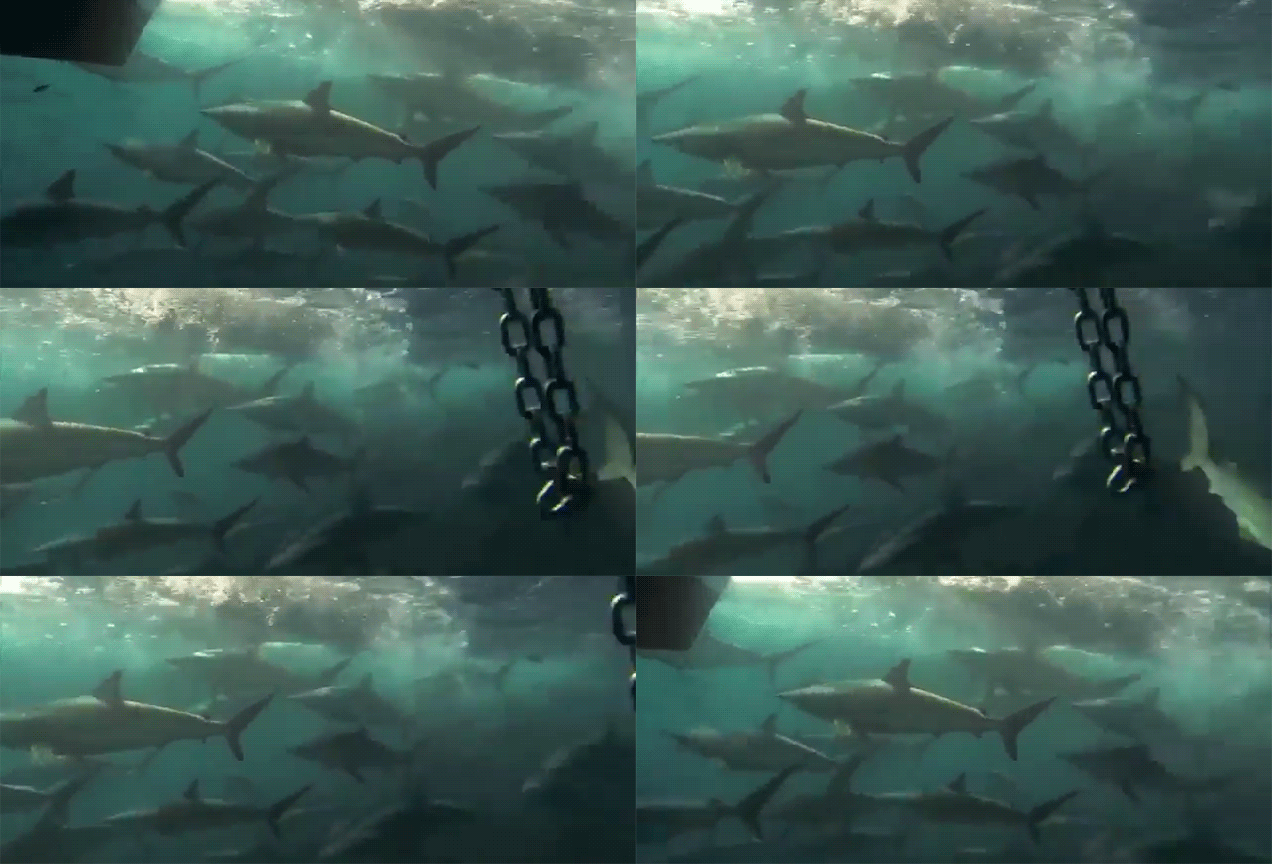
Feeding and Conditioning Sharks - Video!


Bingo.
 
Remember this? 
And I cite,
Let's not forget the impact of the thousands upon thousands of people who feed and condition Sharks and other Fishes on a daily basis, i.e. the fishermen and spearos!
Case in point:

 
And this is being repeated, mutatis mutandis, countless times wherever there are fishermen = all the time and everywhere!
Do you really believe that the incremental effect of a few dozen Shark feeding operators is in any way relevant to the health of Elasmobranch populations? 
Now watch, and listen = it's exactly like I said back then, and the impact of our industry is absolutely irrelevant.


Story here.
Just gotta love it how they then complain about a problem they themselves have created! 
And, here's another one- see what I mean?
 
Anyway.
Let's go Shark diving - sustainably!
 

Monday, August 06, 2018

Emerging Challenges - Really?

Mentioned in the paper: Guadalupe cage breach.

Hmmmm.

Take a look at this.
Austin and Charlie are certainly good guys and good researchers, and quite knowledgeable about the Shark diving industry, too; and with that in mind, I can most certainly refrain from delving in the nether regions of stuff like the infamous Kardashian Index (and here - anybody come to mind? Hint: "cites me") let alone level accusations of sesselfurzing or ultracrepidarianism, the more as the paper, albeit being a bit lean, is certainly nothing terrible.
And yet I am once again irritated.

First things first: those issues they mention are valid.
In fact we've continued talking about them (= that would be 120+ posts: enjoy!) ever since that blog post 10 years ago, and at last count we've also enabled 16 peer-reviewed research papers, many of which are investigating the effect we're having on the Sharks but also their environment. And finally, we're also a founding member of an association of operators who  practice and promote safe and sane, sustainable Shark diving and are clearly the best in the industry.
 
So yes, granted, there are challenges.
But we as an industry are on top of them and are continuously evolving and improving - and the only thing that is emerging here, is that terminally irritating fad whereby there appears to be grant money for all those people = mostly scientific lightweights, to come sticking their noses into our business unbidden!

So at the risk of repeating myself.
A. We are not the problem.
Commercial and recreational overfishing, climate change, ocean acidification, pollution and habitat destruction are.
Instead, we are certainly a part of the solution - even the worst ones among us! But yes we always need to learn, evolve and improve - and this ideally via self regulation. And if not, then regulation is certainly both opportune and necessary!

B. When it comes to the whole fucking never-ending controversy about provisioning.
People who feed and condition Sharks are called fishermen - not a few dive operators: so please do focus on them and not us! And anyway, this is one of the safest underwater activities by far = with one single fatality during thousands upon thousands of baited dives, it is orders of magnitude safer than ordinary SCUBA!
Yes there are effects on the animals, the principal one being conditioning - but they are largely short-term, localized and sublethal, and in no way comparable to the threats Sharks face otherwise! But yes there too we need to minimize our impact - and guess what, most of us largely do!

C. And finally, to those researchers and NGOs.
We did not ask for this - and all this incessant nagging and lecturing by people who ultimately have no clue about, and zero investment into our industry is frankly becoming terminally irksome. There is now a whole cabal of  researchers whose academic niche (and thus career and thus income) is predicated upon being considered ecotourism experts, or whatever, and who appear to be operating with questionable agendas and also appear to desperately want to meddle instead of waiting to be asked.
So, thank you gents - I know you mean well.
But now, if I may: could you please refocus your attention and notoriously scarce time on more pressing issues than whether Shark provisioning may also, gasp, condition and feed some Fishes!, and revert to doing research that actually helps us save some Sharks?

Thank you.

Sunday, June 10, 2018

The Impact of GWS Cage Diving - Paper!


Bingo, and I cite,
"Best practice" among cage diving operations apparently consists in just teasing, but never actually handing any bait to the Sharks.
Were I a Shark hugger, I would immediately object that letting the Sharks waste precious energy on fruitless "hunts" is to be rejected as it is likely harmful to the animals.
Yup that would be yours truly a whopping ten years ago!
And now Charlie has concluded his investigation and comes to the following conclusion (emphasis is mine)
Although sharks are enticed to the cage-diving vessels with baits, industry regulations do not allow operators to feed white sharks and strict limits on the amount of bait and berley are now in place in South Australia and at other white shark cage-diving locations (Bruce, 2015).
Energy burden from the increased activity is, therefore, not rewarded by regular bait provisioning.

Some baits can, however, be consumed when sharks approach the baits using high speed or stealth (Huveneers et al., 2015).
The baits used in SA are composed of gills and stomach lining of southern bluefin tuna and are not as energy-rich as white shark’s natural prey while at these sites (e.g. pinnipeds). Whether the infrequent consumption of these baits provide sufficient energy to compensate for the increased energy expenditure associated with sharks interacting with the operators would depend on the calorific value of these baits and the frequency of white sharks successfully feeding on the baits, both of which are currently unknown (Brunnschweiler et al., 2017).
Spending time interacting with cage-diving operators might also distract sharks from normal behaviours such as foraging on natural, energy-rich prey like pinnipeds.
Combined, these suggest that the increased energy expenditure associated with cage-diving interactions might not be compensated for by either bait or natural prey consumption.

One could, therefore, argue that white sharks should be able to feed on some bait to compensate for the energetic losses resulting from interacting with cage-diving operators.
Bioenergetic models (e.g. Barnett et al., 2016) would, however, be necessary to accurately assess the likely effect of cage-diving on white shark energy balance and whether such compensation is necessary or beneficial. Beyond the potential for short-term energy intake, other aspects of food provisioning (e.g. quality of food, potential for changes in foraging behaviour) would also need to be considered.
Good one - and obviously, totally not surprised!
This is now the second paper (re-read this!) stating that NOT feeding is probably not a good idea - and whereas I concur that further investigation into the precise energy balance, etc may be beneficial, we should really not caught up in minutiae and finally do the right thing.

So what's it gonna be?  
Now that the evidence is in, will the regulators in Australia and elsewhere do the right thing and allow for proper feeding of those Sharks - or are they going to continue cow-towing to those in the populace who will contend that it would lead to more Shark attacks, and the like?
Remember that when it comes to feeding and conditioning Sharks, 99.999% is being perpetrated by the fishermen and not us - so assuming that it really is a big problem (spoiler = it aint: these are the real problems, with overfishing being the principal threat to Shark populations) let's maybe first look there! !
Anybody taking bets?

Anyway, enjoy Charlie's paper!
To be continued no doubt!

Monday, March 06, 2017

Are we killing them with Kindness?


No we are certainly NOT!

Check this out.
I would have never thought that I would have to say this about a paper co-authored by Juerg and Adam, ever - but I find it pretty much shite, and pretty useless to boot. Alas!
To me it smells like some student needed some grades and was told to compile some lists - and like many such meta-analyses, the result is everything and nothing, however very unfortunately with a subliminal anti-industry message at its core, as very much evidenced by the stupid title.
Mind you, methinks that had it not been for my friends, it would have been even worse; plus, there is nothing inherently inaccurate about its findings, and the recommendations are probably formally correct - but it still annoys the heck out of me.

But maybe it's just me.
Thing is, it fatally reminds me of the overwhelming hostility displayed by most researchers and NGOs when we embarked into the Fiji Shark Project 13 years ago.
There was no specific criticism - just a widespread aversion against messing with nature, something that has continued hounding us til today whereby some quarters continue to try and nitpick on what we do despite of the clear benefits the SRMR has brought to Fiji and its Sharks.
Yes of course any wildlife tourism will have an effect (dooh!), and of course those effects need to be analyzed and mitigated which is precisely what we've been doing and also blogging about (yup those would be 100+ posts, and counting!) for years - but to even hint that we may be the problem is just simply unconscionable.
 
Who is killing them are first and foremost the fishermen and hunters, and the people who destroy and pollute their habitat, and humankind that emits too much CO2 etc etc - and far from being complicit, marine ecotourism is one of the factors that is counteracting that unholy trend and slowing down the biodiversity loss by creating alternative income and employment opportunities, and by instilling a sense of awe and love in the public!
Or am I missing something here?

Which brings me straight over to this opus - press release here.
First and foremost, it's always nice to see one's work being publicly acknowledged along with the honorable mention of the GFSC; also, being one of the (recalcitrant) industry representatives who have been consulted, I'm partially responsible for the final product.

This has been in the making for a very long time indeed.
I did blog about it here and very much stand by what I said then, i.e.
Nice to have academia and the NGO intelligentsia look into our industry and hopefully give us some valuable unbiased pointers for improvement - but any such code will only succeed if there is considerable industry buy-in. And for that to happen, any such rules will not only have to reflect some eco wish list but also be flexible and above all, factually and economically practicable!
So how does this rate by those metrics?
I can say that it is much improved compared to its initial versions where there clearly was a don't mess with nature undertone as per the above, and where the overall gist was much more geared towards the need for regulation (re-read this!).
I can also say that I did submit it for review to GSD and got back a polite average score of 7 out of 10 - but I can also equally unequivocally state that nobody was highly impressed let alone enthused, and that most certainly none of us is now gonna run and follow the suggestions to e.g. (re)define his business core values or get certified by some tree-hugging agency, or the like.

And on a more personal note.
Despite of clear improvements, Tool 7 remains highly irritating because of its largely negative bias.  Precautionary approach my ass! And, we have actually chosen (!) to hand feed as provided that it is done responsibly, we find it highly selective and actually safer than the alternatives. And no, we're absolutely not gonna change our feeding times = opening hours on a daily basis - I mean, seriously!
 
And then I find other stupidities like e.g. that fucking flash photography ban which is apparently vital when snorkeling with Whale Sharks but not with equally surface-dwelling Mantas and Baskers, or when cage diving with GWS - let alone with the other Sharks at depth whose pupils will be comparatively more distended????!

But now it's me nitpicking.
Overall the guide is quite nice - and nicely presented which will make the donors happy! :)

Long story short?

A. Although this is well meaning and certainly not terrible, the Best Practice Guide is also not great.
With that in mind, I very much doubt that there will be the abovementioned substantial industry buy-in, the more as I don't see any mechanism for encouraging adherence e.g. via an own rating system or failing that, by using one's outreach to strongly endorse and promote Rick's SSD. Yes Project AWARE I'm looking at you!
The good ones among us don't need your help but very much conduct their own research as evidenced by the bylaws of GSD whereby research is a precondition for membership; and failing some form of gentle coercion (and again, I'm looking at you PADI!), the bad operators will simply refuse to cooperate as e.g. already evidenced by their obvious boycott of SSD.
All of which obviously begs the question, cui bono = and could those resources have been invested into something more useful?

B. We are not the problem.
Instead, even the worst ones among us are a part of the solution, see above! But yes we always need to learn, evolve and improve - and this ideally via self regulation. And if not, then regulation is certainly both opportune and necessary!

C. When it comes to the whole fucking never-ending controversy about provisioning.
People who feed and condition Sharks are called fishermen - not a few dive operators! And anyway, this is one of the safest underwater activities by far = with one single fatality during thousands upon thousands of baited dives, it is orders of magnitude safer than ordinary SCUBA!
Yes there are effects on the animals, the principal one being conditioning - but they are largely short-term, localized and sublethal, and in no way comparable to the threats Sharks face otherwise! But yes there too we need to minimize our impact - and guess what, most of us largely do!

D. And finally, to those researchers and NGOs.
We did not ask for this - and all this incessant nagging and lecturing by people who ultimately have no clue about, and zero investment into our industry is frankly becoming terminally irksome. There is now a whole cabal of incidentally mainly female researchers whose academic niche (and thus career and thus income) is predicated upon being considered ecotourism experts, or whatever, and who appear to be operating with questionable agendas and also appear to desperately want to meddle instead of waiting to be asked.

Anyway.
When it comes to the global Shark diving industry in general, there are now one excellent paper and one good one (both, incidentally, by experienced Shark divers!) and several that are not, see e.g. here and also here, with links.

And now there is this.
That's plenty enough, thank you very much.
And now, please, why don't you just fuck off - because we actually got work to do, salaries to pay and tourists to wow!
 
No hard feelings, love you all! :)
 

Friday, December 18, 2015

Cristina - Shark Love?

Watch what happens at 1:45ff...


Amazing isn't it.
A pal writes,
The romantic in me says it's LURVE. 
The cynic says the shark is assuming that position to have ectoparasites removed - and simply following what it takes to be the ecto-parasite-removing creature when it retreats. I think this shows how we, as hug-loving mammals, are hard-wired to misinterpret what is presumably going on - and hence how easily the idiots (Ritter, Treadwell et al) can go off the transcendental deep end. 
Yes and no!
Clearly, those are conditioned Sharks that as a minimum have been habituated to humans insofar as they appear to have lost their natural fear of them. This is one of the known side-effects of provisioned Shark dives that when they are conducted responsibly, leads to less agonism = defensive aggression - the flip side being that the resulting familiarity can lead to the well-known problems with those infamous beggar Sharks, hence the need for good protocols.

So yes those Sharks may well want to get cleaned.
Jimmy did show me equally amazing footage of Lemons snuggling up to divers at the Tiger Beach cleaning station, and equally only being rewarded with a friendly rub. Both Jimmy and Cristina have removed squillions of hooks, and the Sharks may indeed regard, and thus seek them out as some sort of cleaner organism as a consequence.

But maybe it's something else?
Specially in the case of Cristina that induces a trance-like state (not tonic!) by stimulating the Sharks' snout, the Sharks may simply come in for the resulting, obviously pleasurable sensation. Does that equal LURVE and affection and the like? Methinks not, it may be more akin to us, ahem, visiting a brothel - but it is totally amazing nevertheless!

And now?
Does this mean that we should all swarm out and start giving Sharks affection, or whatever, by conditioning them to come in and get petted?

Certainly not!
Back then in 2008, Patric asked
Is it not enough to "witness" these animals in all their grace and elegance? Do we need to touch them and ride them as well? Do photographers really need to shoot inside a Tigers mouth? Do we need to throw pokey-sticks at them? Where does it end, where do we call the game and set the safety goal posts?
And for me, the answer is crystal clear.
Like I never cease to repeat, Shark dives need to be regarded as wildlife encounters and subsequently, conditioning needs to be kept at an absolute minimum = limited to attracting otherwise shy species, and ensuring the necessary degree of safety. All else is just simply unwarranted and often disrespectful showmanship that benefits only the human, with only more risks for the animal.

Cristina and Jimmy of course get a pass.
Mind you, this not because of what they do but because of who they are!
The other molesters, not so much - but once you've logged thousands of Shark dives, devoted your life to Shark conservation but above all, removed hundreds of hooks, you too will be entitled to some rather superfluous, and clearly not reciprocated Shark LURVE - petting, scratching, hugging and kissing included!

In diesem Sinne - happy Shark diving!

Thursday, December 03, 2015

Oslob - killing the Golden Goose?

Forbidden interaction - pulled directly from the website of an operator no less! This is just fucking stupid!

Oh FFS - have you seen this paper?
And I cite.
Compliance to the required minimum distance from the shark was investigated during the 1,082 complete focal follows. During 907 focal follows (84%) at least one snorkeler or boat-holder was observed being less than 2 m away from the whale shark, inconsistent with the code of conduct (Table 2). On average there were 1.9 snorkelers or boat-holders (S.D. = 2.6) and 0.2 scuba divers (S.D. = 0.9) within 2 m of the whale shark recorded every 5 min. The maximum number of snorkelers and boat-holders around a single shark was observed on 7 September 2013 when 19 people were recorded within 2 m of a whale shark and, respectively, on 10 December 2012 when 10 scuba divers were closer than 2 m from the shark.

Data on the number of guests within 10 m of sharks was missing from 62 focal follows in 2012, the remaining 1,020 focal follows showed that in 56.1% of the surveys the maximum number of snorkelers allowed per shark (i.e., 6) was exceeded. The maximum number of snorkelers and boat-holders within 10 m of a shark was 33. Records of the number of scuba divers within 10 m of a shark only started in July 2013. During these 406 focal follows, the maximum of 4 scuba divers was exceeded on 79 occasions (19.5%). Twenty-one scuba divers within 10 m of a shark was the highest number of divers recorded per shark.

From May 2012 to January 2013, researchers systematically counted the amount of active touches from guests and feeders on sharks. A total of 4,832 active touches were recorded over 545 focal follows. Feeders pushing away sharks with their feet or petting the sharks with their hands accounted for the majority of these active contacts (97.6%); while guests were observed touching sharks 117 times. During the 2013 and 2014 survey seasons, feeder touches were no longer systematically counted, because of the lack of reaction observed in the whale sharks. On 114 occasions guests were recorded to actively touch whale sharks during this same period...

The assessment of the compliance to the code of conduct revealed very low adherence to the regulations in place in Oslob.
Most worrying was the decreasing trend of compliance from 21.4% in 2012 to only 3.4% compliance in 2014 in terms of minimal distance to the whale shark. Our numbers are conservative because only people within 2 m of the shark were included in the count, whereas the code of conduct regulating the whale shark watching activities in Oslob dictates a minimum distance of 5 m from the side and tail of the sharks, which means that the real compliance might have been even lower. Free swimming, snorkelling guests tended to have lower compliance than guests holding on to the boat while watching the shark underwater. Snorkelers can control the distance to the shark by either actively approaching the animal or swimming away to keep the required distance; nevertheless 85% of snorkelers were too close to the shark in 2014.
Seriously, WTF?
I've been a staunch supporter of Oslob's highly controversial Whale Shark feeding encounters, but this only provided that there are good interaction protocols, and that the rules are being followed - and this is just highly disappointing, and pretty darn stupid to boot.
One may question the usefulness of certain prescriptions - but if so, they can be changed. Simply ignoring them is reinforcing the arguments of the many detractors and will undoubtedly precipitate some unwelcome reactions by the Authorities.
C'mon people!

And the other effects?
Yup, there's conditioning by positive reinforcement, leading to a higher tolerance towards people by the WS, more vertical feeding etc etc. This deviates from the behavior of non-fed, non-conditioned "wild" WS - but that's all one can say at the moment, meaning that the concerns by the researchers about possible associated risks to the WS' well-being are so far undocumented and thus merely speculative.
So far, not to worry.

But the non-compliance sucks big time.
I say, follow the bloody rules or you may spoil it for everybody.
 
This is not rocket science - so just fucking do it!

Sunday, February 22, 2015

Shark Strike in the Azores - Debate!


Oh for crying out loud!

Have you seen this?
Spare yourselves the 40 bucks - in essence, the article recounts how a Blue Shark bit the fin of a pal of the authors, and this thusly.
An Unprovoked Attack by a Blue Shark Prionace glauca (Chondrichthyes: Carcharhinidae) on a Spear Fisherman in Terceira Island, Azores, Northeast Atlantic

On July 24, 2013, near a shallow water rocky reef approximately 50 m from the coastline, a 48-year-old spear fisherman was surprised by a blue shark that bit his right flipper. The incident occurred on the South coast of Terceira Island, Azores, Portugal, Northeast Atlantic, where a shark attack or conflict is a very rare phenomenon, having only 3 minor incidents previously recorded...

Late afternoon the spear fisherman entered the water and swam away from the adjacent fishing port, now converted into a leisure summer area, toward the tip of the adjacent rocky reef. 
There, he saw a school of Atlantic Bonito, Sarda sarda (Bloch, 1793) and immediately dove to place himself in a position suitable to target one of the fish swimming in front of him. As he descended to a depth of approximately 10 m, he felt his right foot being pushed and turned his head to see an approximately 2.1 m total length blue shark biting his flipper...

At the same time, he reported that at least 5 more similar-size blue sharks were close by, and he was able to chase the first specimen away simply by touching it with his left leg. The sharks disappeared, and the victim continued to fish in that same area with no further sightings.
And then the authors have the audacity to attribute the incident to Shark feeding as follows.
These offshore, mainly pelagic species do have coastal habits when in close proximity to oceanic islands, as happens to be the Azores. Moreover, they are attracted by tourist operators with feeding stimuli and may be already in the process of associating these stimuli with humans, namely, divers. Contrary to well-known coastal sites where this practice is common and local sharks seem to have residential habits while becoming conditioned by specific diving sites, Azorean targeted species roam vast areas and far away from the open water zones where they are mainly attracted.

In spite of the fact that some of the most dangerous species are seldom seen in the Azores, we believe that this practice of proximity and feeding stimuli to open water nonresident sharks is potentially dangerous and may well lead to more, possibly very serious, accidents in Azorean waters in the future.
In our opinion, close proximity of large predatory vertebrates to humans may well lead to accidents that sometimes may even be lethal. Apex predators, when accustomed to being enticed with food by humans, either for tourist purposes or from simple curiosity, are known to increase attacks.
Changes in shark behavior due to touristic activities such as “shark diving” were also documented by Hammerschlag et al.

We do think that care and common sense must surely prevail in these cases, while dealing with situations than can easily get out of control and lead to serious risks and overwhelming panic situations, which, if nothing else, will inevitably affect tourist activities as a whole.
Not so fast, says Juerg.
Here is his reply, unabridged.
Shark Attacks and Shark Diving 

To the Editor:
It is with great astonishment and concern that I read the letter to the editor by Barreiros et al in which the authors report an attack by a blue shark on a spear fisherman in the Azores.
Whereas the first part of the article accurately details the circumstances of the accident, Barreiros et al, in the second part,devise a far-fetched and illegitimate connection with shark div ing, in particular with shark feeding.

Shark-induced human injuries are among those inter actions between humans and wildlife that arguably receive the most media and public attention.
The general arguments of shark feeding critics are that 1) luring or feeding sharks over a period of time has the potential to condition them and that this conditioning could lead to sharks associating the presence of humans with food; and by insinuation, 2) make them aggressive toward humans. This in turn could lead to 3) an increase in accidents (eg bites)at shark feeding sites when no food is provided. Concern also exists that 4) regular shark feeding at ecotourism sites may increase the risk of shark attacks on ocean users in surrounding areas.

The first argument is beyond scientific controversy.
There is ample empiric evidence that elasmobranchs can be conditioned and are capable of learning to associate, for example, specific locations with food rewards. Recent studies looking at long-term trends in shark abundance at such sites have found numbers,at least of certain species, increasing over time,which further supports the quite unsurprising conclusion that sharks can learn to associate specific locations with food. It is this very capability shark diving operators capitalize on to set up profitable and sustainable businesses. No empiric evidence exists that would support the other 3arguments.

If shark feeding critics implicitly deduce them from the first argument,one has no other choice than to assume that what critics mean is not sharks “associating” humans with food, but “regarding” them as a food source. This could be viewed as semantics, but they are the very arguments on which authorities have based the implementation of legislation on shark feeding bans.
For example, in 2 highly publicized cases in 2002, Florida and Hawaii banned the practice of shark feeding while diving or snorkeling in their respective state waters.

Barreiros et al use a certainly tragic but single shark accident to fire an unsubstantiated broadside at the nascent shark diving industry in the Azores.
If shark feeding critics are serious about their assertion that sharks regard humans as food, then it is time to come up with fact sand figures. In doing so, the results of the respective studies will add to the objectification of the public discourse about feeding sharks as a tourism attraction. If shark feeding critics continue to refuse to address the respective questions by applying the scientific method, then their arguments remain what they currently are: tendentious and uninformed.

Juerg Brunnschweiler, PhD ETH Zurich, Zurich, Switzerland
And this is the riposte by the authors.
In Reply to Shark Attacks and Shark Diving

To the Editor:
 In his letter, Dr Juerg Brunnschweiler expresses both astonishment and concern regarding our paper when stating that it “devises a far-fetched and illegitimate connection with shark diving, in particular with shark feeding.”

We do not agree with Dr Brunnschweiler’s comments, because 1) our paper is not a “criticism” of either shark diving nor shark feeding but yet a description of an attack that might have had some kind of connection with the growing industry of shark diving in the Azores; 2) we clearly expressed a legitimate concern that, contrary to shark species with residential habits, the blue shark that caused this attack has pelagic habits and roams coastal areas of oceanic islands, and is the only species targeted by the Azores commercial shark diving companies; 3) the possibility—although rare—of interactions with humans and eventual attacks are real and may cause collateral damage to man upstream and downstream areas of maritime tourism in the Azores; and 4) panic and disproportionate fear, something that is worldwide associated with sharks, are critical issues and may lead to other types of accidents.

We understand and respect the diving operators’ will to capitalize on this specific niche of tourism. 
However, we think that it is our duty and even a responsible obligation to describe well documented events and discuss them within the scientific community. Throughout the world, many accidents presenting several degrees of gravity do occur. However, it is known that many remain unreported, either because they occur in remote areas or because there are many types of political pressures to avoid their knowledge precisely not to harm some types of touristic initiatives. That is one of the reasons why Dr Brunnschweiler’s comment when asking for “facts and figures” is so difficult to achieve.

And yet,in his last paragraph, DrBrunnschweiler expresses a very inelegant affirmation when he doubts our ability to use the “scientific method.”
We are certain that he knows perfectly well that we did use it, but numbers do not appear—and probably that will remain as it is for a long time simply because (and may we add, fortunately) shark attacks are rare.

Our arguments are precautionary and cautious.
Enticing predators and especially apex predators with food will lead to conflicts between humans and wildlife, and these happen all the time and in many places. This is not the first time that the description of an attack with a discussion on possible causes is criticized, and we thank Dr Brunnschweiler for doing precisely that. Discussing these aspects, however, may well lead to more caution and common sense when dealing with these types of animals. That will certainly improve human-wildlife relations, reduce conflicts, and certainly diminish high degrees of intolerance toward wildlife—and that will ultimately be of great help in protecting precisely these animals, including sharks.

In conclusion,we would like to add that, apparently, Dr Brunnschweiler expressed his legitimate concern for the industry of shark diving. We express our deep concern on behalf of the welfare of both humans and sharks.
Deep concern huh.
My take?
  • First, there is ONE scenario whereby the authors would be correct.
    That is, if some fool had been feeding Blue Sharks on that reef 50 meters away from the adjacent fishing port, now converted into a leisure summer area. I've said it before: location matters, and establishing a Shark feeding dive right in front of a tourist area would be utterly reckless and negligent, and the authors would be absolutely correct in asserting likely causality and being deeply concerned.
    But I don't think that's the case as every single picture of Blue Sharks from the Azores has been clearly taken in open ocean.
And if so, the assertion by the authors that they did use the scientific method is just plain ludicrous. Yes n=1 really does generally not allow for any deep insights, and Shark strikes are rare and thus elude science - and in fact, had they attributed the strike to the alignment of Mars and Jupiter, their finding would have had the exact same degree of veracity!
With that in mind, it would have been perfectly OK had they simply reported the incident - but once they started to speculate about the likely cause, then the scientific method would have mandated to examine all the possible scenarios and not simply jump to conclusions and blast what is obviously their pet hate, and this without a single shred of evidence.
So there.
  • Blue Sharks are big, bold and potentially dangerous.
    Yes they do not figure prominently in the Shark attack statistics - but that is both a figment of those statistics and also due to the fact that they are epipelagic and that there are usually not a lot of people perambulating in the open ocean. But as those gruesome shipwreck tales from WWII amply illustrate, large epipelagic Sharks will certainly investigate and eat people and thus, the surprise of the authors that a Blue Shark would approach, investigate and nip their pal is rather naive.

  • Incidentally, that's also not how a conditioned Shark would approach a person.
    As anybody that dives with fed Sharks can attest, they don't sneak in and then take a nip - that's typical of wild Sharks. Sharks that expect to be fed approach openly from the front and linger waiting for a handout.
  • But what were those half-dozen Sharks doing there in the first place?
    As the authors assert, the species is known to frequent coastal areas of oceanic islands so that's hardly surprising. In this case, it appears plausible that they may have been following their prey = those Atlantic Bonito, an equally epipelagic species that may in turn have been coming to the coast to feed.
  • Or maybe not.
    Maybe the cause for the presence of those Sharks was that the reef is frequently being used by spear fishermen. Or maybe it was the proximity to that fishing port. 
    Because let us never forget who feeds and conditions the Sharks: fishermen! 
    Spear fishermen produce fish blood and vibrations, attract Sharks and are frequently victims of Shark strikes. Fishermen feed Sharks with millions upon millions of baited hooks, clean their catch and discard bycatch, and specifically those Blues have been following fishing boats into port since time immemorial.  
    If there has to be talk of conditioning, that it is THAT the authors should have been focusing on, not a few people baiting with tiny scraps!
  • And what about the assertions that apex predators, when accustomed to being enticed with food by humans, either for tourist purposes or from simple curiosity, are known to increase attacks and that enticing predators and especially apex predators with food will lead to conflicts between humans and wildlife, and these happen all the time and in many places.

    Welcome to the fucking old tired "don't feed the Bear" argument!
    Yes "they" happen - but so far, when it comes to those big Sharks, that is simply not the case! Whereas accidental bites on feeders do happen, strikes let alone fatal ones on participating tourists are exceedingly rare, and any correlation (let alone causality) between Shark feeding and Shark strikes on the public at large is completely speculative and not at all supported by the evidence.


    In fact, and yes I'm repeating myself, people who feed large Sharks are acutely aware that it is dangerous and are exerting tremendous caution and common sense - and as a consequence, the danger of those activities is significantly smaller than interactions with other marine life (including smaller Sharks) that are being viewed as more harmless; and it is orders of magnitude safer than "normal" diving! 

  • In fact, if anybody had to be reprimanded, then it would have been the victim, for being totally reckless: for potentially attracting Sharks to a tourist area, for spearfishing at dusk when predators are known to feed and above all, for not immediately leaving the water but instead continuing to spear fish after having been nipped!

  • And finally.
    That will certainly improve human-wildlife relations, reduce conflicts, and certainly diminish high degrees of intolerance toward wildlife—and that will ultimately be of great help in protecting precisely these animals, including sharks.


    What a load of sanctimonious horse shit!
    Fishermen target Sharks for money - not because they hate them for biting people! That argument is frankly so stupid to be embarrassing!
    Want to save those Blues? Take a boat to Vigo and tell those fishermen to stop targeting the Azorean Blue Shark nurseries - or at least stop wasting people's time and patience with BS, and work on making a stock assessment and on implementing a management plan for sustainable Blue Shark fishing in the Azores!
    That's how real scientists contribute to Shark conservation!

  • And one very last remark: how the fuck did this manage to get a pass by the peer review?
Long story short?
It's exactly like Juerg states: this is not science but total bullshit, nothing more than a completely unsubstantiated broadside against the nascent Shark feeding industry in the Azores, and this clearly not based on the evidence but driven by one's uninformed prejudices.

And yes I can leave it at that.
Not impressed and once again, rather pissed off!

Thursday, December 11, 2014

NZ GWS Tourism - new Rules!

Source.

Here we go.

Read this.
With baiting and decoys forbidden, one has to wonder how the operators will manage to attract the Sharks to the cages - the flip side being that the Pāua divers will henceforth have a hard time substantiating their claims that Shark diving is conditioning the animals and making them more dangerous!
With that in mind - good decision!

Here's to somebody having learned the obvious lessons, and to no more access for those US Shark pornographers!

PS - Controls on commercial filming. Hear hear!
PPS - Permit of Shark Dive New Zealand here, of  Shark Experience here - note Article 7 about termination if the operators do not adhere to the Code of Practice and Schedule 3 about the requirement of special permits for any commercial film productions!

Wednesday, September 17, 2014

Oslob - the Data!

Remember the despicable Ecoterrorists? Source.

Bingo!

Read this.
I must say that is a great collection of important data, and kudos to the authors for having invested all that energy and time into collating them. I must equally say that the conclusions are rather lousy.

Correct me if I'm wrong, but this is what I read.
  • All whale sharks come and go.

  • All but a very few are males = the females are likely somewhere else = maybe more pelagic?

  • All but a very few that don’t feed are immature, which in combination with the above is consistent with observations made elsewhere = immature male WS form natural aggregations.

  • Some feed, some don’t = this is voluntary behavior, hence the statements that the results of the present study show a significant difference in residency patterns between provisioned and non-provisioned individuals suggesting behavioural modification is quite possibly only partly correct. The increased residency may simply be an individual trait = some immature WS may be simply more resident than others, and since they choose to stay there anyway, they also choose to feed. 

  • The increase in daily individuals is consistent with observations elsewhere, i.e. here in Fiji  where it is however not an indicator for increased residency. Methinks that eventually, the number of daily WS will stabilize as over a determined density, some WS will start feeling uncomfortable and/or start missing out on handouts and leave. And I equally speculate that they will leave once they become adult, see below.

  • Those WS that reside longer are smaller (= younger?) and

  • Those that feed stay longer = possibly conditioning - or may younger WS simply be more resident anyway?

  • I cannot see any evidence that provisioned WS are faring worse than the control group = no difference in propeller strikes. The difference to the WS in Holbox may be due to the fact that the Holbox ones may be more pelagic and thus encounter less vessels? 
Long story short? 
So far, this paper alone does not constitute compelling evidence that provisioning those Sharks is a bad thing. The provisioned Sharks are not being described as having more propeller scars, and there are no statements that they may be otherwise physically impaired.

Leaves the increased residency.
Should it become 100% AND permanent, then those Sharks would be likely prevented from mating = the feeding would have a negative effect at the ecosystem level.
But this is way to early to make that assumption. In fact, methinks that like any other Sharks, those WS will eventually leave what appears to be their immature aggregation site once they become adults, migrate normally and eventually join the females at their mating sites. The latter has certainly been shown for all other places where Sharks are being provisioned. If so, it will be then very interesting to see whether any Sharks will return after the mating season!
But so far, we simply don't know - meaning that we'll have to wait before making any ultimate pronouncements!

The provisioning?
Per se, it appears to have little to no effect - but of course the poor interaction protocols where too many people are being poorly monitored and where, maybe, the total interaction time is too long, see here, need to be reformed. But again, that's a consequence of the protocols, not the feeding - re-read this!
Not easy - but certainly not impossible either!

Or am I missing something here?

Tuesday, July 01, 2014

To Feed or not to Feed!


Yawn - right? :)

But this is really rather good.
It's a collection of interviews about the ever controversial topic of provisioned Shark dives - and to my great surprise, it's overwhelmingly pro-industry, and even the reservations by some are well informed and as such, absolutely legit.
So bravo Scuba Diver - considering some of the moronic comments fielded in support of the WA Shark Cull, this was certainly timely!

Oh and they did interview yours truly.
True to her job description, Alice Grainger the charming editor did some brutal editing, and the result is uncharacteristically concise, this probably much to the relief of the readers.

No such luck for you!
Here's the interview, unabridged.

What has you experience been with the provisioning shark dives you run at Beqa?
How do you approach the controversy surrounding this divisive issue?

Let me try to address the second question first.
It touches on two aspects – one ethical and one factual.

Ethical considerations.

Some people oppose provisioned shark dives for ethical reasons, stating that they are inferior to natural encounters, and that they demean the animals.

This may surprise you – but I don't advocate Shark feeding!
On the contrary, I'm very much of the opinion that nothing beats the awesome experience of witnessing Sharks doing their natural thing, like in, say, Palau, Malapasqua, the Sardine Run, Ningaloo, Fakarava or Cocos!

But of course those predictable natural aggregations are rather rare.
Plus, some of those Sharks are very shy, meaning that the encounters, although highly rewarding, can be very brief indeed. Other than that, encountering Sharks in the wild is difficult for some species and all-but-impossible for others, meaning that in most cases, anybody wanting to showcase them to paying customers will have to resort to some form of baiting.

This is what we do in Fiji - not because we are “for” it but because it is a necessity and because we believe that it is neither harmful to the Sharks and their habitat nor to the humans, a fact that is increasingly being corroborated by recent research, see below.

Factual considerations.

People who oppose baited shark dives claim that they are harmful to the sharks and their environment, and that they teach sharks to associate humans with food, which in turn will lead to increased shark strikes on people.

When presented with such opinions, it is best to look at the evidence – and the evidence looks as follows.
  • Shark feeding appears unproblematic at the ecosystem level.
    All present research into those baited Shark dives appears to concur that those dives have little to no effect at large spatial and temporal scales. It appears pretty clear that far from becoming dependent on the handouts, those provisioned Sharks continue to fulfill their ecological roles and also continue to follow their normal life cycles as in e.g. mating, pupping and migrating.

  • There's no geographical correlation between Shark feeding and Shark strikes.
    In brief and with maybe the exception of South Africa, the overwhelming majority of Shark strikes occurs in locations where there are no Shark feeding operations - which is even more surprising if one considers that most of those dives have been established in locations that are known for their healthy Shark populations! And even if there were some correlation, it certainly does not equate causation!
But of course there are some big caveats.
  • There are certainly effects at small spatial and temporal scales.
    Shark feeding often aggregates the animals, and this can have local consequences. Documented examples of those local effects include increased aggression among sharks, competitive exclusion of other species by dominant sharks, or those postulated local behavioral changes and marginally increased residency of Great Whites in South Australia. Those effects however are strictly localized, and none of them has been shown to impinge on the fitness of those provisioned sharks, nor do they unduly alter their environment.

  • Conditioning via positive reinforcement likely happens.
    Sharks are certainly smart and it is absolutely plausible to assume that they may have learned to associate the boat noise with a subsequent feeding opportunity - and should food be presented at the surface, it is equally plausible to assume that they could be popping up next to other boats in the area! Those are certainly considerations any responsible shark diving operator has to keep in mind.

  • Location matters.
    Many Shark dives have been being established where there are already Sharks, meaning that objectively speaking, the risk profile is unlikely to change - but perceptions matter and like in the case of population centers like, say, Cape Town or Playa del Carmen in Mexico, the diving activity and associated increased publicity of sharks can lead to conflicts with the other local ocean users. Consequently, as a rule, the feeding locations need to be as remote as possible and should definitely not be established e.g. right in the middle of population centers or right in front of popular beaches etc.

  • Feeding protocols.
    Like I often state, the problem is not what one does, it is how one does it! Shark provisioning creates its own risks, and those risks need to be managed - meaning that all protocols should be chosen in function of minimizing the impact on both the animals and the habitat, and on maximizing the safety for the participants but also the public. E.g., everybody will hopefully agree that creating humongous chum trails or dumping indiscriminate amounts of bait to create feeding frenzies is probably a bad idea. Or as another example, we here go to great lengths to condition the Bulls never to come to the surface, lest we get accused of endangering other aquatic recreationists. In brief, we need to be in a position to demonstrate that we are always striving to conduct our dives in the most responsible way possible.
Which brings me straight to the first question. 

From the outset, our principal aim was to further shark conservation and research, for which we established the Shark Reef Marine Reserve in Fiji in close cooperation with local stakeholders and the relevant authorities. 
When it comes to the tourism component, we want our customers to experience being in the presence of such awesome animals with a maximum of enjoyment and a minimum of risk, as provisioned shark dives will always remain inherently dangerous undertakings – meaning that we do not allow interactive encounters or what has been dubbed “extreme shark diving”. Instead, we treat them to a carefully choreographed show where they remain essentially spectators, and endeavor to instill a sense of awe and appreciation that will hopefully motivate them to become shark conservation advocates. 

Our experience has been overwhelmingly positive. 
In ten years of operation, our protocols have led to zero incidents with our customers, and only very minor ones with our staff that operate in the front lines, this owing to the fact that the feeders wear protective gloves, dispose of bodyguards and generally follow very rigid safety protocols. The clients appear happy, the reef and the sharks are thriving, and the local community and the authorities are highly supportive, meaning that we are really very satisfied.

Yeah I know I know - same old same old.
But maybe worth repeating, lest we get too complacent!

Thursday, May 22, 2014

Shark Feeding - attack the Unknown!


And attack she did, and know she did little!
And I cite.
Evidence indicates sharks have the capacity to become conditioned. 
As a result, shark ecotourism has the potential to create an association of humans with food, ending in increased attacks.
Right.
Have you seen this crap?
Sarah the student from Wellington has perused a random selection of irrelevant papers (and none of those that are relevant, see the links below!) - and now she thinks she knows something about something and has posted her opines on the university weblog site.

So there, for the umpteenth bloody time.
  • There's no geographical correlation between Shark feeding and Shark strikes.
    Re-read this. In brief and with maybe the exception of SA, the vast majority of Shark strikes occurs in locations where there are no Shark feeding operations (like specifically Western Australia!)  - which is even more surprising if one considers that most of those dives have been established in locations that are known for their healthy Shark populations!
    And even if there were some correlation, it certainly does not equate causation!

  • Shark feeding appears unproblematic at the ecosystem level
    All present research into those baited Shark dives appears to concur that those dives have little to no effect at large spatial and temporal scales. It appears pretty clear that far from becoming dependent on the handouts, those provisioned Sharks continue to fulfill their ecological roles and also continue to follow their normal life cycles as in e.g. mating, pupping and migrating.
But of course there are some big caveats.
  • There are certainly effects at small spatial and temporal scales.
    Shark feeding often aggregates the animals, and this can have local consequences. As an example, take the increased aggression of those Lemons in Moorea; or the observed competitive exclusion (and here!) of other Sharks in Fiji and possibly SA and TB; or those postulated local behavioral changes and marginally increased residency in Southern Australia.
  • Conditioning via positive reinforcement does likely happen.
    E.g., Sharks are certainly smart and it is absolutely plausible to assume that provisioned Sharks may have learned to associate the boat noise with a subsequent feeding opportunity, a fact that is being exploited by several operators - and if the food is being presented at the surface like in the case of GWS cage diving, it as equally plausible to assume that they could be popping up next to other boats in the area!
    But "turning up" does not equate "attacking"!
  • Location matters.
    Many Shark dives have been being established where there are already Sharks, meaning that objectively speaking, the risk profile is unlikely to change - but perceptions matter and like in the case of population centers like, say, Cape Town or Playa, the diving activity and associated increased publicity of Sharks can lead to conflicts with the other local ocean users. Consequently, as a rule, the feeding locations need to be as remote as possible and should definitely not be established e.g. right in the middle of population centers or right in front of popular beaches etc.
  • Feeding protocols.
    Like I often state, it is often not about the what but about the how.
    Shark provisioning creates its own risks, and those risks need to be managed - meaning that all protocols should be chosen in function of minimizing the impact on both the animals and the habitat, and on maximizing the safety for the participants but also the public. E.g., everybody will hopefully agree that creating humongous chum trails or dumping indiscriminate amounts of bait to create feeding frenzies is probably a bad idea. Or as another example, we here go to great lengths to condition the Bulls never to come to the surface, lest we get accused of endangering other aquatic recreationists.
    In brief, we need to be in a position to demonstrate that we are always striving to conduct our dives in the most responsible way possible - but provided that (!) we we act responsibly, yours truly and every single Shark diving operator I've ever talked to have made the observation that the Sharks become positively tame, meaning that the risk of a bite is lower not higher!
And then, there's this.
Anyway.
These stupid allegations are likely to hound us til the end of time - but it's disheartening to see them parroted by a young academic that is obviously a Shark-lover!

To be continued no doubt!

Wednesday, January 15, 2014

NZ - does Shark Diving endanger the Public?


Have you seen this?
And I cite.
About 10 to 15kg of berley was used in a cage dive, he said, which was less likely to attract sharks than the half-tonne of offal dumped by commercial fishermen.

Fishing operators cleaning their catch at the entrance to Half Moon Bay were more likely to attract sharks into the harbour, he said.
Bingo.
Let me once again cite myself.
Fishermen do not only feed Sharks by presenting them baited hooks; many of them attract and often end up feeding Sharks when they drag in struggling fish and when they subsequently clean their catch and throw the scraps into the ocean. Spear fishermen are notorious for attracting, and even conditioning Sharks when they shoot fish and often find themselves embroiled in a competitive struggle over their prey. These people number in the hundreds of thousands and if anybody should be examined for possibly causing an increase of Shark attacks on the public, it should be them - not the few dozen operators conducting baited Shark dives!
Plus,
  • Great Whites are fully protected in New Zealand.
    If that protection is to make any sense, one must assume that consequently, less adult GWS are being killed and that the juveniles and subadults have a better chance of reaching the stage where they switch from a fully piscivorous diet to seasonal preying on Pinnipeds. If so, the number of Sharks sighted in the vicinity of those Sea Lion colonies may well be on the increase. As Stewart Island is slowly being recolonized by New Zealand Sea Lions, its attractiveness for GWS may equally be on the rise.
  • Shark feeding appears unproblematic at the ecosystem level
    All present research into those baited Shark dives appears to concur that those dives have little to no effect at large spatial and temporal scales. It appears pretty clear that far from becoming dependent on the handouts, those provisioned Sharks continue to fulfill their ecological roles and also continue to follow their normal life cycles as in e.g. mating, pupping and migrating.
  • There's no correlation between Shark feeding and Shark strikes.
    Re-read this. In brief and with maybe the exception of SA, the vast majority of Shark strikes occurs in locations where there are no Shark feeding operations - which is even more surprising if one considers that most of those dives have been established in locations that are known for their healthy Shark populations!
    And even if there were some correlation, it certainly does not equate causation!
But of course there are some big caveats.
  • There are certainly effects at small spatial and temporal scales.
    Shark feeding often aggregates the animals, and this can have local consequences. As an example, take the increased aggression of those Lemons in Moorea; or the observed competitive exclusion of other Sharks in Fiji and possibly SA and TB; or those postulated local behavioral changes and marginally increased residency in Southern Australia.
  • Conditioning via positive reinforcement does likely happen.
    Those GWS are certainly smart and it is absolutely plausible to assume that they may have learned to associate the boat noise with a subsequent feeding opportunity - and with the food being presented at the surface, it as equally plausible to assume that they could be popping up next to other boats in the area!
    The assertion that they may be following the boats ashore is however likely to be humbug - provided, that is, that nobody throws bait overboard on the way home!
  • Location matters.
    Many Shark dives have been being established where there are already Sharks, meaning that objectively speaking, the risk profile is unlikely to change - but perceptions matter and like in the case of population centers like, say, Cape Town or Playa, the diving activity and associated increased publicity of Sharks can lead to conflicts with the other local ocean users. Consequently, as a rule, the feeding locations need to be as remote as possible and should definitely not be established e.g. right in the middle of population centers or right in front of popular beaches etc.
  • Feeding protocols.
    Like I often state, it is often not about the what but about the how.
    Shark provisioning creates its own risks, and those risks need to be managed - meaning that all protocols should be chosen in function of minimizing the impact on both the animals and the habitat, and on maximizing the safety for the participants but also the public. E.g., everybody will hopefully agree that creating humongous chum trails or dumping indiscriminate amounts of bait to create feeding frenzies is probably a bad idea. Or as another example, we here go to great lengths to condition the Bulls never to come to the surface, lest we get accused of endangering other aquatic recreationists.
    In brief, we need to be in a position to demonstrate that we are always striving to conduct our dives in the most responsible way possible.
And then, there's this
  • Obtaining the required Social license and stakeholder involvement are crucial.
    The local stakeholders need to become an integral part of these projects - and this not only through regular awareness, education and consultations but also by letting them partake in the financial windfall, both indirectly but very much also directly. Only this will ensure crucial local support when the inevitable problems will arise.
  • Get in the research.
    The best argument against many of the intuitively plausible reservations of our detractors are strong scientific data. As an example, when people got bitten by Bull Sharks in Cancun and everybody tried to blame the Shark feeding operations in Playa, the operators there had the data showing that they were only feeding females whereas the Bull Shark population in Cancun was only comprised of males. Or in our case, our Bull Shark data show conclusively that we are neither causing residency nor any dependency on our handouts, see above.
Long story short?
I ignore the precise circumstances of those cage dives in Stewart Island. Intuitively, I am inclined to assume that they are being conducted responsibly, and that the location is sufficiently remote.

But there appears to be a problem of perception.
If I am correct in speculating that the islands may be attracting more GWS, it follows that  the risk for the Pāua divers may be on the increase. With that in mind, it may be wise to engage in some preventative measures, as in increased dialogue and data sharing with the fishing community all the way to maybe helping fund protective gear like Shark shields etc. And it may also be smart to re-engage with the authorities and the stakeholders, and ensure their support by developing a code of practice everybody can agree with!

But again, I don't know the precise circumstances.
Maybe all of that has already happened, and the current blowback is merely some noise by troublemakers.

But if not, some of the above may be useful.
Good luck!