Showing posts sorted by date for query Great Fiji Shark Count. Sort by relevance Show all posts

Friday, September 12, 2025

Are Fiji's Sharks protected?

Click for detail!
 
Short answer?
I wish - but no, not really! 😞
 
The massive pressure on our marine resources during the pandemic could, and indeed should have led to a moment of reflection and new beginnings.
But instead, we're very much back to business as usual where instead of tackling the ever increasing problem of widespread poaching and over-fishing, and according severe threats to our marine biodiversity, the local marine conservation mafia is back playing their usual games of smoke and mirrors.
 
Granted, Fiji's marine conservation ecosystem is highly complex (but then again, once you understand it, maybe not so much), highly non-transparent and replete with misinformation in a seemingly never-ending cycle of collective frittering away of other people's hard-earned money on bogus short-term projects with zero actual benefit to Fiji's imperiled marine biodiversity, nor the to communities depending on it. 
Think NGO/Consultancy Complex (read it!) and you'll understand where I'm coming from!
 
Everybody knows this but most continue to play the same old tired game of musical chairs (hint: Ma'afu Street!) as that's how they earn their living, the more since there is zero institutional memory, and any degree of accountability for one's past failures is non-existent.
 
Needless to say that I despise all of that: most of those people and orgs, the brazen squandering of resources on junkets and talkfests, the parasitical mooching and profiteering, the verbose bloviating and above all, the total lack of due diligence and subsequent dissemination of all that unbearable BS.
 
And in the meantime, our marine biodiversity continues to deteriorate ever faster, with little improvement in sight. 
In fact, after more than 20 years of playing by the same old tired playbook, and despite of many, many millions in donor funds having been pumped into this space, I would argue that Fiji's marine habitats and Fish stocks are more threatened than ever
 
And then, there's those pathetic bloody influencers, or whatever. 
They parachute into our tourism and conservation space, talk to some random uneducated charlatan, and then compound the problem by making idiotic and highly misleading public pronouncements on their various socials where they get uncritically parroted by their followers.
Talk about Dunning-Kruger on steroids!
 
Be it as it may, this cannot remain unanswered.
 
So there. 
Don't worry - I'm not going to point fingers, at least not more than strictly required.
But like in my last post about Shark ecotourism, I feel that it is necessary to set the record straight once and for all - the more as like there, in the future I can then simply reference this post instead of having to explain the exact same facts over and over and over again. 
Not that I really believe that it will change much - but hey, hope springs eternal.
 
But I'm digressing as always,
So back to the matter at hand: whether Fiji's marine biodiversity in general and Sharks in particular are adequately managed and/or protected. 
Spoiler alert: they are not! 

And this is why.
As a bare minimum, the two essential elements of successful marine protection are
  • Some official Legislation, usually specifying what is being protected, where and when; and the penalties for transgressions.

  • And then, the all-important Implementation = Monitoring, Enforcement and Prosecution

A. Legislation 

Fiji's current marine biodiversity management and/or protection has been enacted under a variety of laws, foremost of which the 
  • Fisheries Act (1941), 
  • Offshore Fisheries Management Act (2012), 
  • Offshore Fisheries Management Regulations (2014), 
  • Customs (Prohibited Imports and Exports) Regulation (1986) 
  • Endangered and Protected Species Act (2017)
  • and various international agreements to which Fiji is a signatory like CITES, the CMS and the rules and regulations of the WCPFC 
To make an example, once we realized that our voluntary village MPA, the Shark Reef Marine Reserve, was actually not legally enforceable (see below), we advocated legalizing it via a Regulation under the Fisheries Act (1941), resulting in the Fisheries (Shark Reef Marine Reserve) (Serua) Regulations 2014 that established Fiji's first legislated National Marine Park. 
 
This is a small piece of legislation tailored specifically to the SRMR that inter alia bans any fishing, defines the penalties for non-compliance and confers BAD authority for its day-to-day monitoring, management and policing in a ground-breaking marine PPP.
Subsequently, 4 more such legislated Marine Parks have been established (i.e. "gazetted" because in order to come into force, any new law most be published in the Government Gazette) under this template, comprising 2 reefs managed by resorts, one reef channel in Kadavu harboring a notable Grouper spawning aggregation, and one village reef.
 
And what about Fiji's other 700+ declared village MPAs/LMMAs/tabus etc. that ought to be the backbone of Fiji's 30x30 commitment? 
 
Sadly, they are not much more than paper parks.
Much like when we initially established the SRMR together with Galoa village in 2004, they are merely the result of private voluntary commitments by stakeholders (= mostly a village or group of villages) to somehow manage (= mostly: not fish) a determined marine area. 
 
These voluntary MPAs are however not gazetted, not recognized under the Fisheries Act, and thus not legally enforceable - which begs the question, FLMMA: what were you thinking?
 
Therefore they are, if at all, only binding at the community level insofar as the villagers agree to voluntarily abide by their rules. 
In the past, the neighboring communities would have respected those village tabus, meaning that the protection used to be quite effective at the local level. 
This however with one important caveat:  those fishing bans were merely declared in order to preserve the food source. Instead of proper species-specific biodiversity management and conservation, the result were a multitude of unspecific "village fish pantries" - and consequently, some of our most prized Fishes like the Napoleon Wrasse or the Bumphead Parrotfish are rapidly disappearing from our waters.
But in terms of preserving a degree of local food security, those systems certainly used to work quite well.
 
Not so anymore. 
When everybody in tourism lost their job during the pandemic, many did turn to fishing, resulting in widespread over-fishing and poaching, and the severe depletion of all prized Fish stocks pretty much Fiji-wide - see e.g. our latest post-pandemic surveys here.
And as seafood prices have soared in line with the wiping out of the stocks, the poaching is ever-more lucrative, increasingly being professionalized and continues largely unabated, with a whole flotilla of high-powered vessels raiding even the most remote village LMMAs and tabus pretty much completely unchallenged.
 
The crux is this. 
Unless explicitly forbidden by law (e.g the regulations for those 5 legislated marine parks), anybody in Fiji can fish anywhere for own consumption (= when using legal gear e.g. hook & line, or if spearfishing, see Fisheries Act 13 (1) a). 
All poachers know of this loophole and when caught will always claim to be fishing privately and for own consumption; and anybody preventing them from doing so will ultimately find themselves on the wrong side of the law and be convicted for vigilantism and/or piracy!
 
Which brings me straight to the
 
B. Implementation 
 
Here, I can keep it short and sweet.
  • In theory, the bans in those 5 legislated MPAs can be legally enforced.
    However in practice,  
    • whereas we have the manpower, boats and cash flow to monitor and enforce the fishing ban in the SRMR and are able to deter and/or apprehend some poachers, I ignore whether, and to what extent the other designated MPA managers have the resources to do so.  
    • as poaching is increasingly being perpetrated by professional teams, they know exactly how to evade capture and use any legal loopholes to their full advantage. E.g., the law mandates that poachers must be apprehended in the act, a nearly impossible feat when dealing with the ubiquitous night-time spear fishing on SCUBA! 
    • and when it comes to the prosecution, Fiji's courts are hopelessly backlogged and understaffed, and prosecuting poachers is not a high priority. Consequently, none of the poachers we have apprehended has so far been sentenced. 
  • As stated above, all those other 700+ declared MPAs are not legally recognized and can thus not be legally enforced beyond checking for compliance with the general rules of the Fisheries Act (like compliance with gear restrictions, fishing moratoria or prohibited species, etc), and checking for licenses of the commercial fishermen. 

  • Other enforcement mechanisms based on traditional indigenous protocols, whilst probably quite effective in the past, are rapidly being eroded as especially the younger generation of villagers have no qualms in defying the will of the community in favor of earning a quick buck.

  • Finally, the desperate lack of adequate resources in the Ministry is also preventing the effective enforcement of other provisions of the Fisheries Act that impact our Sharks. 
    E.g., our critically important riverine and estuarine Elasmobranch nurseries (of Bulls, Hammerheads, Lemons, Wedgefishes, Ocellated Eagle Rays, etc.) are severely threatened by widespread illegal gill netting. But the compliance = enforcement team of the Ministry only comprises less than 10 field officers tasked with monitoring compliance with every single Fisheries regulation throughout the whole of Fiji which is pretty much mission impossible!

C. And what about the Sharks? 

Fiji does protect some marine species.
E.g., all Sea Turtles are protected via moratoria under both the Fisheries Act (1941) and the Offshore Fisheries Management Regulations (2014); or the Napoleon Wrasse is protected under the Offshore Fisheries Management Regulations (2014); or all Cetaceans are protected via the declaration of Fiji's entire EEZ as a Whale Sanctuary under the Fisheries Act (1941); or there is a yearly seasonal fishing ban for most Groupers and Coral Trout, equally under the Fisheries Act (1941).

No such luck for our Sharks.
Nada, not even a measly NPoA - and this even as those are considered quintessential nothing-burgers = long on bureaucratic jargon but short on binding rules, enforcement, and actual population recovery in most countries that have them!
 
And this not for lack of trying!
Many years ago, our industry was collectively working with Pew and the Coral Reef Alliance on declaring Fiji a Shark and Ray Sanctuary. 
But the campaign got hijacked by a gang of local con-$$$ervationists who as so often were only interested in delaying the proceedings in order to milk it for a maximum of junkets, conferences and per diems. And then, the death knell came when the chief Shark Angel and Fat Paul conspired to literally barge in, very much uninvited, for a disastrous television show/campaign dubbed Operation Requiem (think: Whale Wars with Sharks) that completely alienated the authorities who then officially pulled the plug on the whole undertaking.
Yes, this pompous shit. Recognize the squeaking sharkette?

And the bloody show?
Nixed because it was too fake even for Discovery - plus Paul had to quickly interrupt his interventionist bluster when he got indicted and then skipped bail in Germany, requisitioned the rapid response craft to heroically hide from Interpol in some remote corner of Ha'apai! 
And thus the ghastly sharkette never got around to putting her life on the line, and to this day keeps happily, and not at all expertly squeaking away on Shark Week!
 
We later tried to introduce a comprehensive and forward-looking Shark and Ray Management & Protection Regulation, but to no avail as that topic appears irrevocably tainted - this very much also owing to a prominent then USP Professor of Marine Studies and now doyen of our latest, greatest marine NGO publicly declaring that If we protect the Sharks, they will eat all the Fish!
 
Yes you really can't make this shit up - but that's what really happened!
And so it goes!
 
But back to the Sharks.
There are also positives, as there is now a whole, albeit disjointed host of laws and regulations that can be invoked when trying to protect most of our Shark species:
  • Principally in order to achieve compliance with CITES
    • the Endangered and Protected Species Act (2017) bans the domestic trade, and via a catch-all clause about the possession and control, maybe also the catching and killing of all CITES I & II - listed Elasmobranchs;   

    • all CITES-listed Elasmobranchs may quite possibly also be protected via the capture and killing provisions in the Offshore Fisheries Management Regulations (2014)  
    • and the Customs (Prohibited Imports and Exports) Regulation (1986) bans the export and import of Shark fins (but probably not of other highly prized Elasmobranch fins like those of the critically endangered Wedgefishes!) 
  • And finally, the Offshore Fisheries Management Act (2012) and its associated regulations restrict the use of fishing gear and activities impacting Sharks, including prohibitions on Shark finning and the catch, sale, and possession of protected Shark species, this principally in order to be in compliance with the rules of the WCPFC.
Like I said, it's complicated!
 
Long story short, however, Fiji's Sharks are still being (quite possibly legally) caught, killed and consumed - and where there is legal protection, the enforcement is generally weak.
Rather than being a fin fishery like in the past, this has now morphed into a food fishery where as the prized Fishes are being fished away, people are preferentially targeting the smaller reef Shark species and very disturbingly, the juveniles in the critical nurseries; this because small Sharks taste better than the bigger ones owing to the fact that they have accumulated less urea = ammonia in their meat.
 
That said, the situation is by no means catastrophic.
The fin ban, and the international trading ban under CITES and its local derivative laws prevent the establishment of any sizeable targeted commercial Shark fishery - and consequently, I strongly doubt that our Sharks are presently threatened at the population level. 
And whereas the illegal gill netting in the nurseries is a serious concern, there are simple remedies - but more of that later.
 
Got it so far?
Yes, that sure is a lot of detail that transcends the scope of an Instagram post, long as it may be! 
But that's the reality on the ground - and if you want to lecture others about this topic, you need to first inform yourselves by talking to people in the know! 
Above all, beware of those pied pipers prating from atop Mt. Stupid!
 
D. And what about the Conservation Achievements of the Shark Diving Industry?
 
So here goes - now comes the juicy part 😁 (= toothy grin).
 
Long story short?
None of us are Fiji's Shark guardians and protectors
That distinction belongs to Government as they are the only ones empowered to act Fiji-wide.
Yes we at BAD sure try our best, and there is also our legislated Marine Park which we're tasked to look after, which is certainly a great proof-of-concept - but it is very small-scale and although every bit helps, it is probably not terribly relevant for Shark protection at the population level. 
 
That said, we sure count for something.
Shark diving is a highly visible and also lucrative niche product of Fiji's tourism industry that in 2011 has been shown to contribute USD 42.2m to the Fijian economy - and with that in mind, it stands to reason that this may have played a role in the enactment of the most recent Shark-positive laws. Or at least, that our existence and economic contribution may have prevented the establishment of a proper targeted Shark fishing industry. 
 
However, methinks that Fiji's current Shark management and conservation legislation is principally the consequence of what has happened at CITES and the WCPFC - and therefore, it would probably be quite inappropriate if we were to engage in any self-congratulatory victory laps.

But back to the operators. 😁
Fiji's provisioned Shark dives were pioneered more than 30 years ago by Aqua Trek Mana in the Mamanucas, at the now defunct Supermarket shark feeding site where a local Shark wrangler would literally physically manhandle some poor unsuspecting Reefies - all very rough and impromptu, and certainly not in any way conservation-oriented. 
But that was then - and very much like had to be expected, it inevitably all ended in tears.
 
Shark diving in our area was pioneered in the late 90ies by Aqua Trek Beqa who established the baited shark dive at Shark Reef. 
Like all such dives back then, it was all rather sketchy and testosterone-fueled, and consequently, quite terrifying despite there being far less Sharks (but far more big Fishes) than nowadays. There was a small fee, some of which was being paid to a (wrong) village in exchange for access to the reef. 
 
However, the site let alone the Sharks and Fishes were not in any way protected. 
On the contrary, whenever the village demanded Fish for some function, the dive staff would happily oblige. In addition, whenever some absolute genius would (much to the delight of the staff!) declare that there were too many Giant Trevallies, dozens of them would be "culled" in order to "thin the herd" akin to what was being claimed to be "best practice" in the African safari parks. 
And did they then at least duly recycle those poor Trevallies by feeding them to the Sharks - or did they instead pile them into the back of the company pickup truck to then go sell them in Navua? 
Take a wild guess!
 
Yes once again, you just can't make that shit up can you.
But that was then - at least for the most part.
 
We then took over Shark Reef in 2004 (long, long complicated story) and added the science and conservation components along with much more stringent safety protocols, thus establishing Fiji's first proper Shark ecotourism experience - and incidentally, a globally recognized alternative to the status quo in marine conservation.
 
Yes we did - not you! 😒
You know who you are! 
 
In fact, we only opened shop once we had signed the conservation agreement with the (correct) village. 
Contrary to before, the new deal stipulates that a fee is being paid not in exchange for access but in exchange for the village not fishing there - this the more as we conduct our Shark dive in government waters and not inside the village's traditional fishing grounds.
And we switched to feeding expensive Tuna heads that get consumed quasi exclusively by the Sharks instead of the previous mountains of offal and Fish carcasses from the Fish processor in Lami that made the reef look like a bloody underwater bone graveyard - and consequently, Fish biodiversity that was heavily skewed towards small predators, scavengers and detritivores was able to rebound from less than 200 to now more than 500 species, indicative of a healthy coral reef assemblage!
And we also weaned the staff off their addiction to culling - cold turkey!
 
But enough of that. 
Disbursements to principally Galoa but also other communities so far: FJD 500k+. Plus paid millions in wages. Plus contributed many more millions to the Fijian economy in terms of taxes but also direct purchases and investments. Plus generated even more millions in income for all the ancillary businesses like accommodations, restaurants, tours and transfers, souvenir shops and airlines. Plus trained dozens of young dive professionals mostly recruited among local school dropouts, many of which from Galoa. Plus sponsored the training of dozens of honorary fish wardens. Plus welcomed, entertained and mesmerized thousands of tourists. Plus engaged in several marine restoration initiatives. Plus published dozens of peer-reviewed papers and scientific reports.
And the list goes on and on. 
 
When it comes to our four principal industry peers.
Following our lead, all now claim that they have entered into some conservation deal with local communities, that they protect their site, that they are saving the Sharks, that they have pioneered this or that - and obviously, that they are the very best!
 
Really? 
  • Last time I checked, none of them operate out of a legislated (= gazetted) MPA- and consequently, none of their sites are currently legally protected against poaching 
  • I however understand that the one in the Yasawas is actively pursuing legal protection via a different mechanism (I hear, a foreshore lease). They also conduct research and reef restoration, etc. and actively engage with the local communities that are said to largely respect the fishing ban. 
  • The others, well what can I say. Lemme keep it as neutral as I can.  
    • Now that the Fish have been conveniently aggregated in those Shark diving sites: is there any monitoring, training of fish wardens, deterrence via vessel inspections & enforcement of the Fisheries Act - anything at all?
      Any, gasp, night patrols?
    • Or may the staff still be taking advantage of absentee owners and regularly poach there?
    • Or the neighboring communities, every single day, on their way to and from Pac Harbour and Navua? 
    • And do they employ any marine scientists = any scientific monitoring and/or research, let alone publications? 
    • Any reef restoration?
      And no, I'm not talking about the idiotic fad of transplanting some random Acropora without having addressed the causes for why it is not (anymore) there in the first place!
    • Any marine conservation beyond the infamous old greenwashing tropes of raising awareness and changing perceptions?

    • How about some real education imparted by a real scientist? 
    • Fees disbursed, people trained? 
    • Questions questions! 😁
And so it goes.
In the big scheme of things, not to worry.
Judging from the many, many enthusiastic reviews and lack of major incidents, everybody in the industry does a really good job at providing an exhilarating and safe experience to our tourists.
 
The conservation and research, meh.
They cost a lot of money, require very specialized skills and knowledge, and heaps of commitment, patience and perseverance as everything is tedious and success is by no means guaranteed - and with that in mind, it's perfectly fine to decide not to incur that expense and to merely focus on the tourism side of the business like many of our peers do world-wide.
 
But folks, can you then please stop the charade. 
Stop pretending to be what you are clearly not, the more as the customers always end up finding out the truth and will quickly call you out - as in flagging somebody's, and I cite, 2h bro science talk 😂, and the like. 
If you don't know what yer talking about, do yourself a favor and get yourself an education - e.g. by reading our scientific papers or by consulting this blog. 
You're welcome!
 
And even better: how about walking all that breathy talk!
See below! 
  
E. And the Way Forward? 
 
Fiji's Shark Diving Industry is not broken and needs no fixing
The operations are all profitable and based on the customer feedback, they are quite well run and above all, very safe indeed. Yes would be nice if we all loved each other and worked together - but since we all operate our own sites, it's not an objective necessity and definitely not gonna happen any time soon.
So please, spare us the advice, relax and enjoy the experience! 
 
But what about those non-legislated dive sites?
C'mon folks - you can do better than that! They are literally our most important business assets that feed you and your family, and it behooves us to take care of them - if only from a business perspective!
Get your sites legally protected - and then bloody get off your lazy ass, fork out the money and go patrol them! 
 
That said, this is obviously a much bigger issue.
The pandemic has clearly shown us that when you obliterate the Fish stocks, the poor Sharks really suffer - and consequently, our focus needs to shift away from species protection to habitat protection, as in how can one protect the Jaguar if one doesn't protect the Jungle. 
 
With that in mind
  • We need to find ways to properly implement and enforce the laws we already have on our books, e.g. 
    • We need to stop directing all those conservation funds to those leeching NGOs and multinational agencies who keep on brazenly frittering them away on overhead, lavish junkets, conferences, committees and per diems, only to come up with all those useless projects and management plans that all fail miserably because there are no long-term commitments nor the required authority let alone the funding for their implementation.  
    • Instead, the bulk of the funding needs to be directed to the implementing authorities, e.g. the compliance team of the Ministry of Fisheries, or as wages for the honorary fish wardens, but also for technical equipment ranging from measly laptops, torches and weather gear all the way to vessels and coastal radars, etc!  
    • And how about educating, but also calling out our hopelessly uniformed media and idiotic local influencers that keep on glorifying the killing of our charismatic, and often threatened megafauna like the Giant Groupers, Bumphead Parrots, Turtles and large Sharks! 
  •  Let's find ways to legalize those 700-plus voluntary MPAs and/or LMMAs, which would 
    • greatly empower our local communities and our army of fish wardens who instead of engaging in the current questionable vigilantism, would then greatly enhance Fiji's fisheries management, monitoring and enforcement.
    • incidentally, also benefit our industry peers, but more importantly
    • create a huge swath of protected marine habitat that would benefit our Sharks, and
    • go a long way in achieving Fiji's 30x30 commitments, at least when it comes to protecting our coastal habitats!
  •  Let's try and close the most glaring loopholes, e.g. 
    • Now that a coalition of local scientists along with the Fiji Shark Lab have succeeded in listing all our riverine and estuarine Elasmobranch nurseries as ISRAs: let's get them legally protected, e.g. via legislated MPAs for the core areas, plus legislated seasonal fishing bans further afield.
    • Let's confer to the Ministry of Fisheries full authority over the whole seafood value chain, this including the currently largely unregulated domestic trade very much inclusive of all those shady outlets plying their trade on Facebook!
      This would also enable Fisheries to mandate that the traders finally submit the data about the local commercial fishing industry which would greatly help in managing those stocks! And how about reversing the burden of proof and also force them to prove that the seafood they sell has not been poached! 
    • Let's also put Fisheries in charge of all legislation concerning our marine resources instead of the current fragmentation across several Ministries 
    • Finally, how about delegating the authority for all marine conservation inclusive of its enforcement to an independent agency like the LTA - and by the same token, let's find ways to streamline the enforcement by alleviating the burden on the judiciary with a regimen of spot fines, much like what has incidentally already happened with respect to enforcing the traffic rules.
Any takers?
Like I keep preaching: Less idle talk, more action on the ground! 
 
But above all.
Let's go Shark diving - sustainably! 

PS: This is a great start, and very much in line with what we've been advocating for - well done Madam Minister!
 
Comments policy: please post here and not on FB and/or Instagram. Stupidities and trolling will be censored = my blog my rules!

Sunday, February 16, 2020

Great Fiji Shark Count - Paper!


Yeah I know I know.
39 dive operators doing 30,668 dives and making 146,304 shark observations on 592 dive sites, and then collating, triaging and analyzing those data is a lot of effort - and the concrete results are comparatively lean. BUT, it was always meant to be long term monitoring in order to detect trends and not a population census, and 5 years are really not that long - so there. 
In any case, thank you and congratulations to everybody involved, be it the participating dive ops, the tourists = citizen scientists, the donors, the project management and finally, the scientists: this has been quite impressive.

The good news?
Compared to other places, our Sharks populations appear to be faring OK - but despite of the recent fin export- and import ban, there is equally still ample room for improvement, especially when it comes to the continued fishing in the Shark nurseries.

As always we shall see.
Fiji's Shark Commitments are due by the end of this year..
Having looked, I notice that last year's mandated progress report is overdue which is not good - but methinks that as always, there will be some frantic last-minute activity to push matters over the finish line, the more as there is simply no way that Frank will accept any failures in an initiative he very much personally and publicly chaired.
So, our fingers are crossed and we continue to be hopeful - at least for now.

But back to the paper.
We have terminated the GFSC as it is just too much work and the management team was frankly getting increasingly frustrated at the lack and quality of participation and data. Also, this is merely a pre-print pending the tedious peer review process - but the raw data will not change, and this is now a great baseline from which one will be able to measure any future developments, be it progress or lack of.

So consider this an important intermediary step.
Should we get the feeling that matters have changed be it for the better or the worse, we will most certainly organize a recount and report about developments. And in the meantime, we here have already initiated new efforts to monitor some important sub-populations about which we shall be reporting shortly.

In the meantime, enjoy the paper.
To be continued no doubt.

Sunday, June 09, 2019

World Oceans Day - Ocean Championship!


And I cite.
Today is World Oceans Day
ARE YOU AN OCEAN CHAMPION?

At Shark Diver, we receive a lot of inquiries from individuals looking for opportunities to help in the area of shark or ocean conservation. There are so many ways to apply the diverse amount of talents out there that people possess. So this year, we decided to show our support for those who are making a difference toward protecting the oceans we love and their inhabitants, by awarding them with the experience of a lifetime!

Today, on World Oceans Day, we officially begin the Ocean Championship, a competition for conservationists of all ages who are working to preserve anything and everything ocean related.
Your focus could be saving sharks, saving dolphins, protecting coral reefs, cleaning the beaches, or bettering the ocean in general. What is your passion? Social media awareness is nice, but it doesn’t always get the job done. We are looking for enthusiastic, motivated, and driven individuals who are working hard to make a direct impact. Are you working with legislators to enact protection laws? Are you working with businesses to reduce or eliminate plastic usage? Are you planting mangroves? Have you started a major ocean/beach cleanup effort? The sky is the limit. We want to know how you are making a difference. Do you know what you’d like to do, but just haven’t put your idea to work yet? What are you waiting for? Get going! We want to hear from you.


Here’s one example of conservation efforts at work: Beqa Adventure Divers created a national marine park called the Shark Reef Marine Reserve through their bull shark diving operation in Fiji. Regular surveys and fish counts are conducted in an effort to help in the long-term survival of endangered species. Their findings led to the expansion of a vitally protected area now called the Fiji Shark Corridor which runs approximately 30 nautical miles along the southern coastline of Fiji’s beautiful main island of Viti Levu.

Yes, some efforts take a lot of time. 
And yes, some efforts take a lot of money. But many major efforts begin with just one thing. Love. If you love the ocean and its incredible inhabitants, let’s see what you can do or are doing, so that generations to follow will be able to love it too.

This competition will yield two big winners!

Winner number 1, picked by Shark Diver, will receive a 5-day inclusive Great White Shark Diving Adventure at Guadalupe Island, Mexico where you will cage-dive with great white sharks! No SCUBA certification is necessary. Spend 5 days with Shark Diver’s owner learning about the magnificent great white shark, which finds the volcanic island of Guadalupe a mating ground and plentiful food location.

Winner number 2, selected by our sponsor Beqa Adventure Divers, will win a shark adoption through their My Fiji Shark shark adoption initiative, plus a full week of diving at the Shark Reef Marine Reserve in Fiji to ‘meet’ their shark. (SCUBA certification required)

Both are unique and unforgettable experiences!

Get inspired! Do something! Stop talking about it and take action… be an Ocean Champion!

Shark Diver hopes to make this an annual event. Good luck!

CONTEST RULES:

Ocean Championship is open to any individual to enter.
All submissions must be sent to oceanchampionship@gmail.com.
Entries are subject to being published on SharkDiver.com and FijiSharkDive.com and/or all participating sponsor’s social media pages or websites. Finalists will be asked for verification of all documents submitted and may be asked for references for contact. Airfare to and from San Diego/Fiji is not included.


Enter by May 1st, 2020.
Winner will be announced on World Oceans Day, June 8th, 2020.
So there.
When Martin contacted us with his stellar initiative, we were more than happy to contribute. As detailed above, the winner of our prize will be selected by us and receive
  • A free adoption of one of our Shark Stars through our My Fiji Shark initiative, and

  • One week of diving with us.
    This usually comprises 5 days of two-tank diving in the Shark Reef Marine Reserve and two days of two-tank coral and/or wreck dives. Diving is FOC but exclusive of the daily Marine Park Levy of FJD 25.00 and the cost of any rental gear or other extras like Nitrox fills, etc.
Having said that, there is a high probability that as time progresses, we will announce further perks and prizes - so keep watching this space!
As to what we like and want to reward
  • Obviously, Shark conservation!
    But please, something tangible on the ground and not merely the dreaded raising awareness by posing for selfies and posting dreadful home videos, or misguided petitions for finning bans and the like! And no, contrary to what some quarters would have you believe, petting, riding and otherwise molesting Sharks is not Shark conservation - especially not in bikini!
    What we are looking for are initiatives that actually reduce Shark mortality to below sustainable levels - e.g. read this!

  • And because the Sharks cannot survive if we fish away their prey and obliterate their habitat, we'd also like to see more holistic projects like implementing effective sustainable fisheries management or the establishment of well-enforced MPAs, etc - but please, spare us the fashionable but misguided fads!

  • And please, show us the track record even if what you do is still work in progress and there is only partial success - but mere breathy announcements do not count!
There you have it.
Wishing you the very best of success - and hopefully, see you next year in Fiji's first National Marine Park!

To be continued!
 

Friday, February 01, 2019

Martin about Shark Feeding!

Ring a bell? Click for detail - source.

Read this.

Very nice, and thanks!
The part about Shark feeding mostly echoes what we've been asserting for now many years, to wit this rather random collection of posts. And check this out, too - or if you really got too much time on your hands, feel free to peruse this about Shark feeding in particular and this about our industry in general!
Yes it is complicated - but then again, maybe not so much!

And the conservation aspect?
Yes some of us very much including Martin's Shark Diver are deeply embedded into conservation, and there is even a global alliance of Shark diving operators whose members must have a track record of being active in both conservation and research.

But I would argue that we are the exception.
Yes nowadays everybody is "Eco", and everybody is raising awareness and dispelling the myth, and all of that nonsense.
But the Shark diving industry is obviously a business where one needs to make a profit - and whereas those breathy pronouncements that one is doing it For the Sharks are cheap, pun intended, actually devoting resources to conservation (and research) is costly and time consuming - even if in the long term, protecting one's principal business asset would obviously be a great business strategy!

And all those awareness-raising media?
I will even concede that even when prima facie it's all about personal vanity and $$$, the heart is often in the right place. But as per the comment of JoySeaGal, I can categorically assure you that when advocating Shark conservation with the Authorities, those narcissistic media count for less than nothing! 
Oh and incidentally, this is how you do it correctly = this is strategic, intelligent, focused, targeted and with zero personal ego involved!

Anyway.
Ultimately, one has to look at real track records.
Ultimately, the only thing that counts are tangible benefits for Shark populations - and there, the overall impact of Shark diving operators is rather dismal, especially when compared to the awesome potential.
Alas!

But I'm digressing as always.
Thank you Martin - and yes I will gladly confess that we are mighty proud of our achievements.
Shark tourism is certainly not the be-all and end-all solution to Shark overfishing, and much remains to be done, also in Fiji - but we're certainly working on it, and we're even collecting funds for implementing some forward-looking local remedies.

In diesem Sinne - let's go Shark diving!
And please, Adopt Your Shark Now, the more as Valentine's Day is beckoning!
Hint hint!

Vinaka Vakalevu.

Wednesday, December 28, 2016

Everything you need to know about Shark Diving in Fiji!


Nice! :)

Kudos to Sam for having listened and above all, understood!
She was here during the very low season when the pregnant bulls go to the rivers and the others abscond for mating, so thank you for still having found it worthy of a piece on Singapore's online dive mag GoodVis. With Singapore being Fiji Airway's newest destination in Asia, this could not have come at a better moment.
Much appreciated!
 
With five full years finally in the bag it's time for some data analysis and publishing of results - so keep watching this space!


Wednesday, November 09, 2016

Great Fiji Shark Count - WWF!


Great!

Read this.
Just as we were resigning ourselves to forever having to pay for the GFSC out of our own pocket, here comes the welcome support by the WWF. As you may remember, WWF and partners are developing a Shark RAT, and the GFSC is definitely going to be part of the mix both in terms of actual data but also as a template for similar undertakings in equally data-poor regions.

Welcome aboard folks - much appreciated!
 

Wednesday, November 02, 2016

Great Fiji Shark Count!


Wow.

We've just started count # 10.
And once this November count is done, we'll have collected a full five years of invaluable data and will finally be in a position to do some in-depth analysis and publish a first set of conclusions. Remember, this is not a census but long-term monitoring in the hopes of documenting trends in Fiji's populations of Sharks, Rays and Turtles - and with thousands upon thousands of records, document we certainly did!

Honestly, I didn't think we'd come this far.
Fiji's diving industry is characterized by a remarkably high turnover of expat owners and dive shop managers, and participation volatility has been according; donors that have given enthusiastically at the start did eventually lose patience, and funds have fizzled out; personal issues and personality clashes have been at times highly disruptive.
Yes it has also been lots of fun, and good tourism - but challenging! :)

But we've persevered - and here we are!
So, count count count - and then it will be up to the management team to dazzle you with facts, maps and trends! If I look at our own data that are definitely documenting a creeping loss of Bull Sharks, I'm not at all confident that the findings will be all positive - but let's first see what has happened Fiji-wide; and if warranted, we'll be finally able to advocate for the according remedies based on facts and not mere hearsay.

To be continued - and that's a promise!

PS: Fiji Times here!
 

Wednesday, June 15, 2016

Great Fiji Shark Count - Funds for Christine!


Please have a look at this page.

Christine has been with the GSFC since day one.
Like announced back then, she has so far worked completely pro bono whereas the little donor funding has been completely invested into print materials and necessary admin. Now in it's fifth year, this ground-breaking project has generated an enormous mountain of data from tens of thousands of dives all across Fiji and is rapidly nearing the stage where there is enough information to start discerning long-term population trends.

But for citizen science to be good science, there needs to be verification.
This means that in order to start her analytical work, Christine needs to (finally!) come to Fiji to personally witness and fact check the current, exceptionally tedious data collection process from recreational divers to dive operators all the way to Helen's painstaking verification and then, transcription into Excel spreadsheets.

Alas there are no GFSC funds left.
Nowadays, donors appear to expect instant gratification and with the GFSC being long-term monitoring generating only very sporadic and rather unspectacular interim results, donor contributions have slowly fizzled out. In fact, BAD have financed the last three counts out of cash flow as along with Kerstin's continued research into local Shark fishing, we believe this to be invaluable information for better managing Fiji's coastal Shark populations.

So there you have it - this is the back story.
Please, if you can, do make a contribution towards Christine's research.

Thank you.

Friday, May 15, 2015

Citizen Science - Comments by Christine Ward Paige!


Thank you Christine!

Remember this post?
It did generate a spirited debate where I once again reiterated my personal distaste for the all-pervasive duplication and lack of coordination in Shark research, and the resulting frustration of both the donors and the divers alike. Once again, the gist of my post is not that I believe that Ryan's initiative is a bad thing in itself - what I bemoan is that lacking the necessary coordination with other data bases, it further fragments the global effort which ultimately leads to worse, not better science.
Now Christine has attempted to chime in, but her comment was truncated due to the space limitations of the comments section of Blogger.
Here it is in its entirety.
 
Hi all,
A few comments from my experience…
  1. If people are taking their (limited) time to submit data, the goal should be to get as much useful information efficiently.
    In 2004, I started collecting a lot of information, but quickly found that there were too many missing records for many of the variables that were being collected, such as sex, behaviour, habitat, depth, etc. Generally, if a question will generate >5% missing data then it is removed from the analysis and therefore a waste of time to collect in the first place. Data for data sake is not my goal. People are busy and donating their time, so I only aim to collect data that I can use.

  2. To reiterate Mike’s point, I think we can safely move beyond collecting data on single species groups, such as sharks.
    I started with just sharks and rays as proof that recreational divers could provide useful data that the scientific community and governments would accept and use to inform conservation and management strategies. And they have! I was told that the results of the eManta_eShark survey (paper was in review at the time) were used in back room conversations at CITES COP 2013 and were influential for at least 2 countries in voting to list mantas on Appendix II. Similarly, the Bahamas protected their sharks following a paper that was published in 2010 that used the REEF.org data – recreational diver generated dataset - which showed the uniqueness of the Bahamas shark populations.
    Note: The REEF.org dataset is the most valuable dataset that I use and I could not do my work without it. It is the template that I used to create eShark and allows me to fill the gap that Johann M identifies, which is the accuracy of reports. However…

  3. I think we – those coming from the scientific side of things - need to be careful not to suggest that scientific divers are perfect, or that recreational divers are not good at identification.
    Way back when, when I started this work, many scientists said I couldn’t use recreational diver data because they couldn’t identify/count them properly …something about them “worrying about keeping their masks on their face”, which is so ridiculous in my opinion. So, I tested the shark scientists, fish biologists, recreational divers, and the general public on their shark identification abilities – covering people from around the world. Let's just say that the only person that got 100% on the test had never dived in their life and was only half way through their undergraduate degree - she just loved sharks.
    In fact, throughout my interviews, I have been amazed at the accuracy of not only the identifications (photo verification), but of people’s memories. Many people have photos that correspond with their observations. I’ve used these dated photos to verify memory accuracy. Especially for the rare observations, some people could remember the exact month when an observation took place more than 5 years earlier. However, I always err on the side of my memory ability, which is really not very good. These inaccuracies, whether by recreational divers, dive masters/instructors or scientists, can be managed with good survey design, reasonable assumptions, awareness of limitations and responsible analysis.

  4. When (the late) Ransom Myers and I developed the idea of using divers to census shark and ray populations, an important first step was to ask the dive community about potential concerns for data.
    I specifically asked this question when I was at DEMA and ADEX with Project Aware, which enabled me to cover a wide variety of perspectives and regions of the world. The most important concern raised was that I was creating a dataset that included the location of species that were vulnerable/endangered and still targeted. So, although I think scientists should be open to collaboration, and I certainly am, I think it is irresponsible to make these data freely available or open source and I think we need to be careful who we share it with.
    To get around this, I provide data summaries to different people or groups that request it - e.g., I give (almost) monthly summaries to Shark Guardian on their progress in Thailand - and have contributed data to OBIS, which is open source, but the data are shared according to OBIS recommendations for sensitive species (10x10 degree cells - you can't even tell what country they are in!) so that the lat/lon and seasonality cannot be used by people that aim to do harm to these populations.

  5. I agree with you Mike – more collaboration would be valuable.
    I am always on the lookout for other groups that share the my mission and are aligned with eShark. There are a few, including REEF.org, eBird.org, Marine Debris Tracker, and Redmap –Australia that are great and run by very good scientists that know how to use the data. Three of these I featured on eOceans.org for an Oceans Day event in 2014. I didn’t have time to organize this event again this year…

  6. I am encouraged by the number of different citizen science surveys now available – we have come a long way since those naysayers of 2004, some of which have actually gone on to create their own diver surveys now!
    But I do appreciate and share Mike’s comments and concerns about diluting and frustrating the people that want to contribute in the best way they can. Of course people cannot contribute to all the existing surveys – I can barely keep track of them all at this stage.
The advice I have for potential contributors is to look at the goals and results of the organization running the survey and ask:
  • i) Do they have publications to support their motivation to collect the data?
  • ii) Do they have the scientific and statistical expertise to use the data?
  • iii) Do they specifically state who will use the data, or do they just generally say ‘collecting for science’?
  • iv) Does the organization intend to use the data responsibly and keep it protected from people that may wish to exploit it, or do they have it open source/freely available?
I personally value locally collected data that feeds into a larger picture, which is why Shark Guardian and the Great Fiji Shark Count are so effective and both received awards from Project Aware for their efforts.

Anyway, this is my two cents.
Thanks Mike for prompting me to comment.

Friday, April 17, 2015

Shark RAT? Guest Post by Ian Campbell!

Shark research, management & conservation intelligentsia meeting in Townsville, see below!

Are you intrigued? :)

Here goes.
Ian Campbell is currently working for WWF’s Global Shark and Ray Initiative running the sustainable management component. He is also a Shark diver and a member of the SRMR management team.
From NGOs to the public and private sector, Ian has over 20 years’ experience in fisheries policy, ecology and fishery management working extensively within both the UK and internationally. Previous employment has included overseeing the reform of the EU’s Common Fisheries Policy for the Pew Charitable Trusts, fisheries observer on blue-fin tuna vessels, inshore fisheries management and as a commercial diver in the offshore sector.
Ian holds a Bachelor’s degree in Applied Marine Biology from Heriot-Watt University and a Master degree in Environmental Science from the University of Strathclyde.

This is an important initiative.
Having just returned from a meeting with major stakeholders, see at top, I've asked him whether he wouldn't mind submitting a guest post presenting it to the wider public.
Here is Ian's post.

Shark divers – An underused resource?

Everyone who is even remotely interested in sharks (and rays, don’t forget these charismatic shark pancakes of wonder) is abundantly aware of the pressures they are facing.
Fishing pressure, habitat loss, unsustainable consumption, or even fanciful claims of being “evolved for extinction” everywhere you look they are under the cosh. The pressure that sharks are under have probably best been summed up by the 2014 paper (and here - notice the part about research and data collection?) led by the IUCN Shark Specialist Group which concludes that almost a quarter of all sharks and rays (over 1,000 species assessed) are faced with the very real threat of extinction. Remember, this is not the claims of an environmental NGO, but an independent assessment of the current state of shark and ray populations by 128 experts from 35 different countries. Here’s a simple chart highlighting the different levels of threat.


As you can see, despite what you may hear from some campaigns, not all sharks are threatened, and some are in worse shape than others, but, for WWF, one of the biggest areas of concern is the shaded grey area on the left side of that chart. From all the 1,042 species assessed, 487 are “data deficient”.

Basically, virtually nothing is known about almost half of all sharks and rays.
Effective management and designing plans to reduce mortality is virtually impossible when faced with this lack of basic understanding. Imagine trying to balance your budget without knowing how much money you have in your account to start with, or the amount of interest you are receiving or paying out.

There are a number of conservation initiatives out there which lay claims to conserving sharks, from finning bans to fin trade bans (there’s a difference), from sanctuaries to species protections and from policies to plans. Some of these are more useful than others, but if any of them are to be truly effectual then one thing is key to them all: DATA!

Without a basic understanding of shark and ray populations both around the coast and in offshore waters, then making decisions for the long-term survival of these species is little more than a best guess. Yet there are a multitude of areas rich in information, but not necessarily being channeled in the right direction.

Divers, fishermen, market traders, even shark and ray researchers produce data every day, yet it is surprising how little of it actually makes its way to ministerial departments or independent bodies to assist with informed decisions for conservation. WWF are seeking to bridge this gap. We are developing a project in collaboration with some of the world’s leading shark researchers to create standard methodologies to maximize the benefits from untapped resources.

In 1999, the Food and Agriculture Organisation produced guidelines for countries to undertake a step-by-step process to developing long-term, sustainable shark management plans (known as National Plans of Action, NPOA).
This process seems relatively simple. Firstly, collect data on sharks and rays in the form of a Shark Assessment Report. Then use this data to develop your NPOA. While this does sound simple, and has been done in places like Australia, the EU and NZ (to varying degrees of vigour), the Pacific Islands have had to get by using the limited resources at their disposal. There are some NPOAs currently in existence in the region, such as the Cook Islands and Samoa. Other countries have draft versions waiting government endorsement, such Fiji and Tonga, while some countries such as Palau want to declare shark sanctuaries. These efforts for conservation & long-term planning are great, although all of these measures have one oversight in common. They are built on a lack of data. None of the countries have produced Shark Assessment Reports, so cannot fully know the issues within their territorial waters. This is not the fault of the Pacific Islands, gathering data can be time consuming for departments with limited resources, and the analysis requires specific technical expertise. Organizations such as the FFA and SPC are providing a great service, although their remit extends way beyond just looking at sharks.

So here is where WWF are stepping in.
As mentioned, we are collaborating with shark expertise far and wide to develop our shark ‘Rapid Assessment Tool-kit’ (or shark RAT). The main function of this is to design ways to collect and analyze data on coastal and pelagic sharks that can then be used to produce a Shark Assessment Report. The very basic baseline data in this report can in turn used by governments to develop conservation strategies that are then based on some sort of understanding.

Where is this data going to come from?
Well, there are a lot of sources we will be exploring from genetic and socioeconomic surveys at landing sites to extensive underwater video surveys, but one untapped goldmine is the information collected by divers. In Fiji, there is the Great Fiji Shark Count which is starting to produce comparable info. At present, this isn’t incorporated into management plans, so it’s high time it is.

There are also other things dedicated shark divers can be doing.
Ever been on a surface interval that seems to go on for ages? Sat at the bar for the post-dive drinks to talk about what you saw? How about these hours are spent helping screen underwater video footage that shows what happens at your dive site when no-one is in the water? Pretty much every diver would be able to recognise whether a shark or ray was in shot, and a huge number would even be able to say what species it was. Collecting and screening this type of data would take a massive burden off an already overstretched ministry or fisheries/shark specialist.

Obviously, we are well aware of the multitude of challenges that lay ahead for the project to be fully successful, and some methodologies that may look good on the page may fail spectacularly when introduced to the real world. But we have to try. Improved management for sharks and rays is the only thing that is going to directly reduce mortality. Not shark fin soup campaigns, or putting all your eggs into “ending finning” and certainly not cavorting in swimwear near sharks.

Last week WWF held a 3 day workshop where 12 of the best minds in their respective fields (I’m not including myself, I just took notes and provided the tea and coffee) provided input and direction.
As well as academic researchers from the fields of genetics, citizen science and eco-tourism, we had input from FFA, SPC and SPREP. Everyone we have spoken to has been enthusiastic and willing to support us. The people in attendance will now provide advice and recommendations to the project. Professor Colin Simpfendorfer, the co-chair of the IUCN Shark Specialist Group also gave us a name, although how serious he was is up for debate. WWF now convenes the Pacific Rapid Assessment Tool-kit Scientific Advisory Committee, or PRAT-SAC. Maybe the first thing we need to work on is the name?

The project is embryonic and there is a lot of hard work ahead, but with a little direction, continued enthusiasm and, more importantly, collaboration, then slowly we’ll restore the balance for sharks and rays

Here's to that - thanks buddy, appreciate!

Sunday, April 12, 2015

Great Fiji Shark Count - a Message from Helen!


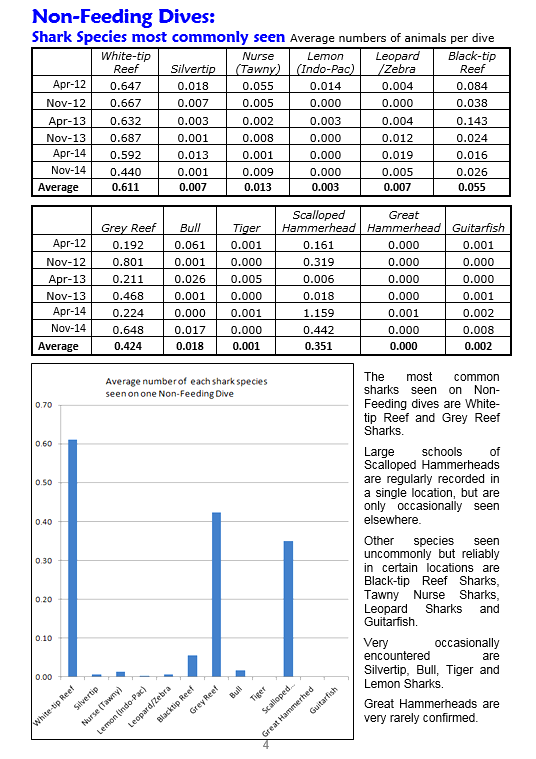
Helen Sykes our irreducible GFSC manager has just issued the following statistics - click on the pictures for detail!

Results of Three Years of the Great Fiji Shark Count
 April 2015 

Over the past three years, dive operators across the Fiji Islands and their diving and snorkeling guests have been recording their Shark, Ray and Turtle sightings over the months of April and November. Thanks to those dedicated divers, we now have some interesting facts to share about Shark populations in Fiji.

The data is analyzed by the number of Shark/Ray/Turtle sightings recorded on every dive by every diver who takes part. This is called number of sightings per observation. Because there are usually many divers on each dive, we have thousands of observations every month.

We have separated dives where feeding was carried out from those where no feeding was done.


From a very enthusiastic start in April 2012, the number of participating dive operators has dropped to our reliable core team, representing operators on Viti Levu, Beqa, Taveuni, Vanua Levu, the Mamanuca and Yasawa islands, and the Lomai Viti / Vatu-i-Ra area. We'd like to thank those operators who have stuck by this project and worked hard to get the data to us in a useful format!

Even though the number of dive operators has decreased, the number of dives and of observations (every diver who takes part makes one observation per dive) has remained in the thousands, with the highest total of 4,278 observations in November 2013.

Highlights:

There have been some unexpected and exciting sightings recorded over the past three years.
  • Guitarfish, previously very rarely recorded in Fiji, have been regularly seen on sites along the Coral Coast. 
  • A Leatherback Turtle was seen during a dive (a very rare occurrence) in the Yasawas in November 2014 
  • Schooling Hammerheads have been regularly recorded on a dive site on the South Coast of Vanua Levu 
  • Mobula Rays have been recorded in the Pacific Harbour/ Beqa region and also in Namena, south of Vanua Levu 
  • Tahitian Rays (Himantura fai) were recorded in the Yasawas 
  • Hammerheads and Guitarfish have only been recorded on non-feeding dives 
  • Rays and Turtles are more common on non-feed dives than on baited feeding dives 
  • The most common sharks seen on baited feeding dives are Bull, White Tip Reef, Grey, and Black Tip Reef Sharks 
  • Some sharks species, including Bull, Grey Reef and possibly White-tip Reef Sharks, exhibit seasonal patterns of higher and lower numbers, which are probably related to breeding behaviour. 
  • So far no significant decrease in coastal shark populations has been seen, good news for those of us fearing that shark-fin fishing was continuing to damage shark stocks, but we can only confirm this one way or the other by continuing these surveys over the long term 
Non-Feeding Dives:

Over the years, across Fiji, divers have seen an average of 1.22 to 2.03 Sharks on every dive, plus one Ray and one Turtle every 5 to 10 dives. Shark sightings varied year by year, but the general trend appears stable or slightly increasing. Ray and Turtle sightings appear to be very stable.


Baited Dives:


You, our Contributors!

Continuity of data is vital if we are to make our case for Shark Conservation, and we'd like to recognise and thank our contributors, especially those who have been with us from the start, and continued every six months. Others have joined us recently, and are welcomed to the ranks. 
Here is our honour list: 

Six Counts 
  • Beqa Adventure Divers 
  • Nai'a Cruises 
  • Dive Tropex Tokoriki 
Five Counts 
  • Waidroka Bay Surf and Dive Resort 
  • Lalati Resort 
  • Taveuni Ocean Sports (Nakia Resort) 
  • Dive Tropex Tokoriki • Wananavu Dive 
Four Counts 
  • Taveuni Dive 
  • Dolphin Bay Divers 
  • Koro Sun Dive
  • Reef Safaris - Barefoot Island 
Three Counts 
  • Matava Eco Resort - Mad Fish Dive Centre 
  • Wakaya Club and Spa 
  • Viti Watersports 
  • GVI - Global Vision International Two Counts 
  • L'Aventure Cousteau Dive Centre 
One Count 
  • Pacific Harbour Fishing Group 
  • Paradise Taveuni 
  • Volivoli Beach 
  • Reef Safari - Shangri La Fijian Resort 
  • Castaway • Adrenalin Watersports 
  • Captain Cook Cruises 
  • Storck Cruises 
  • Reef Safari - Crystal Blue 
Great job Helen, Vinaka vakalevu!
Some ulterior comments from my side tomorrow!