Showing posts sorted by relevance for query philopatry. Sort by date Show all posts

Monday, June 18, 2012

Deciphering Philopatry - good or bad Science?

Great HH with one of Neil's new tags.

Want to go and catch yourself some Salmon Sharks?
Nothing could be easier: go fishing in the Northern Gulf of Alaska in November - and bingo! And if you believe that the fishermen have not long discovered the TOPP tracks - think again!

As Juerg writes in his correspondence to Nature.

Two faces of marine ecology research

The ecology of animal movement is one field that would benefit from sound evaluation of the risks, benefits and ethics of its important research findings (Nature 484, 415 and Nature 484, 432–434; 2012 read it!).

Scientists can now track the complex horizontal and vertical movements of a wide range of marine species, including tuna, sharks and turtles. These results reveal biodiversity hotspots and inform conservation policies by providing insight into animal behaviour and ecology. However, they also guide fishing operations towards resource-rich locations — putting further strain on both target and by-catch species.

Too many species face severe stock depletion because of intense fishing, pollution and other anthropogenic pressures. The detrimental implications of marine ecological research results must be acknowledged.

Juerg Brunnschweiler
Swiss Federal Institute of Technology (ETH Zurich), Zurich, Switzerland.

But there is of course also this.

It is possible, by marrying electronic tag data with oceanography, to gain a sufficient understanding of ecosystem function to enable more effective management of ocean resources.
Specifically, this study shows that when bluefin tuna enter the Gulf of Mexico, they are going to specific locations, where cool, productive water in “cyclonic eddies” makes its way along the continental slope. So during April and May, when they are spawning, bluefin tuna are relatively concentrated – whereas yellowfin tuna remain disbursed broadly throughout the Gulf.

This suggests that it would be possible to protect the bluefin, which are accidentally caught on longlines intended for yellowfin, by restricting fishing in those specific areas where the bluefin are spawning; but that such restrictions need not reduce yellowfin catch rates since they are more uniformly distributed.

Or this.

Great white sharks are found in waters all around New Zealand. National Institute of Water and Atmospheric Research (NIWA), and Department of Conservation (DOC) scientists are investigating the long distance movements of great white sharks inside and outside New Zealand’s territorial waters to improve our understanding of their species’s migratory patterns.
It will assist with designing management measures to reduce shark bycatch in fisheries.

Niwa principal scientist Malcolm Francis said despite the process sounding rough, the safety of the sharks was at the heart of the project.
As part of a wider study which began in 2005, it is hoped the research would return population figures and migratory behaviour of the protected species to assess how many sharks were being killed in fishing nets and lines.

Yes it looks like we got ourselves an ethical debate!
But maybe not so much - and whilst you're pondering, here's a rather epic video about that GW tagging in New Zealand.
Enjoy!


So what about those tracks.
As Bob Hueter already stated in 1998,

I consider the issue of philopatry and natal homing in sharks to be the most important issue in shark biology today, and I challenge all shark researchers to test this hypothesis rigorously in their respective research areas.

Nearly every type of shark research can play a role in this, for the ramifications of philopatry, if true for most shark species, would be profound. It certainly would affect our views of shark evolution and genetics, and it would shape new perspectives on the physiology and ecology of shark species. It would fundamentally affect studies of shark population dynamics, and perhaps most importantly, it would drastically change conventional views of shark fisheries science for the management and conservation of shark populations.

Hundreds of thousands of dollars and thousands of tags later, we now know this.
Sharks and Fishes are not randomly distributed throughout the oceans. Instead, they frequent well determined seasonal, behavior-, gender- and age-related hotspots and travel between these focal points on well determined marine highways.
Or as Hueter and Heupel write in 2004 (read it, this is seminal stuff!)

Many shark species are highly migratory, some covering thousands of miles of ocean in a single year.
However, with the emerging evidence of philopatry in various shark species, it would be wise from a conservation and management perspective to not view this group of marine fishes as oceanic nomads, but rather as more sophisticated, long-distance travelers with a number of discrete homes in the sea. How precise those homes are will need to be established with further research and analysis.

For us Shark conservationists, those data about philopatry are absolutely vital.
As I've tried to show here, many Sharks continue to fall victim to incidental catches despite of being protected, something that can be countered by establishing seasonal localized fishing bans; and like in the case of Playa or, say Vietnam, those localized and seasonal measures may be easier to achieve than trying to enact blanket protection of a species year-round and country wide.

This I believe is also the next step after having established those Shark sanctuaries.
With the big announcement hopefully looming, we're consequently already mulling the next big project that is hopefully going to lead to the full protection of the Shark nurseries, and thus of the valuable big pregnant females during the birthing period.
Keep watching this space!

But what about those published tracks?
Are those publications, maps, interactive websites and apps not simply showing the way for anybody wanting to go and kill the animals? And there is of course also the Anthropogenic Allele Effect, specifically the possible impact of poorly regulated tourism on the animals once newly discovered hotspots are being publicized - like e.g. here!
Like Juerg appears to assert, I fear that this is very much the risk!

Solutions?
Like I said, maybe it's not that difficult.
  • Research and data per se are neither bad nor good; and if the track record is any indication, nobody is going to ever be able to stop scientific progress whatever the associated risks. That's just how things roll in science.

  • But the risks are real - re-read the examples in Nature.

  • Hence the inevitable conclusion, that whoever conducts the research cannot just disassociate himself from the possible consequences. Instead, it behooves the researchers to be fully accountable for their actions, and to be instrumental in mitigating the potentially negative implications of their queries. Obviously, this is easier said then done - but shying away from one's ultimate responsibility won't do, either!
But to come back to the topic of this post.
The data derived from telemetry studies (nice synopsis here!) are vital - but posting those tracks can only happen, if at all, with the utmost of circumspection.
It's exactly like in the case of Fish spawning aggregations where the ichthyologists have learned the hard way that it is better not to publish the exact locations: I say, unless there is unequivocal, robust and above all, fully enforced local management and/or protection, those data should be withheld and only shared with the relevant authorities and like-minded researchers, and this only in the aim of enacting adequate conservation and management measures.
And even once those measures have been enacted, it should be amply sufficient to publish large scale maps and keep the fine scale and exact GPS coordinates a secret.

Or am I missing something here?

Monday, December 16, 2013

Natal Philopatry in Lemon Sharks - Paper!

Time for some Hi-Fives! Source.

Now THIS is real science!
No wonder as starting with the Grand Mufti himself, the list of authors reads like the who's who of Shark research - and with the data spanning a whopping 17 years, this is nothing short of epic!

All I can say is, I'm deeply impressed!
Looks like Lemon Sharks not only go back and give birth in the same nurseries (= reproductive philatropy) like the Moorea Blacktips, but that those nurseries are the very where they themselves were born (= natal philopatry or natal homing), like e.g. Salmon or Turtles! This has immediate implications for conservation insofar as it mandates special efforts to protect those nurseries.
Nice synopses here, here and here - and here's a video.

And the Bull Sharks?
Mark has already published evidence for reproductive philopatry of Bull Sharks in Australia, and one of the aims of our new research projects with Projects Abroad will be to check whether this is equally the case for our Fiji Bull Sharks.
So keep watching this space!

Anyway, great job!
Enjoy!


Thursday, November 08, 2012

Paper: Philopatry in Blacktip Reef Sharks!

Blacktip Reef Shark, by Johann Mourier.

Excellent job!
I must say, this paper is as good as it gets.

And totally fascinating and unexpected as well!
Turns out that contrary to being strictly confined within rather limited reef habitats, (some) Blacktip Reefs in Moorea are embarking on a rather perilous inter-island crossing to Brando's Tetiaroa in order to give birth in the nursery there - and vice versa!  Is that because they were born there? Very possibly, the more as it appears that the females always visit the same nursery!

I'm literally off to DEMA so this will have to be short.
But once again, the paper demonstrates the importance of investigating philopatry for formulating good Shark conservation measures.

Bravo Johann!

PS no more posts for the next two weeks!

Wednesday, May 30, 2012

South Africa - Great White Research and other Stuff!


No this time I'm not going to rant.
But I could!

I could rant about some disgruntled GW cage operators.
I could state that they didn't quite have the guts to openly take on Mr. Fischer & Mr. Boyd and that they have instead enlisted the help of some local Kraut who has quickly morphed into a monster, true to the meaning that Fanaticism consists in redoubling your effort when you have forgotten your aim. I could also speculate that apart from having the usual inflated opinion of self, the guy may suffer from a medical condition called, obviously only in German, Querulantenwahn.

Be it as it may, several open letters and public warnings later, the genie is now out of the bag.
Prompted by the dire warnings of the Querulant and by a totally unrelated Shark strike, the surfers and water recreationists have latched on to the issue of chumming (debunked here) and I wish the cage operators the best of luck. Were I so inclined, I could state that they they will now reap what they have sown, that justifying baited Shark dives smack in front of a major town was always a stretch and that the delicate balance has now been irrevocably upset. Talk about having shot themselves in the foot!
But fear not, I shall not do that!

I could also rant about the couch farting fireman.
I could tell you he has been described to me as somebody who has done a Shark dive and now thinks he knows something about something, that his two brain dead petitions have achieved precisely zero as anticipated, and that he has gone as far as to accuse Fischer of having caused the death of several Sharks 1,500 miles away. Wow!
And I could mention the proud rolling out of his ludicrous Hartzell tag, to be placed with a pole into the center of the dorsal fin that will be inevitably shredded as soon as the gizmo will start collecting flotsam like any other trolling lure.
And it got a GPS antenna no less - I mean, seriously!
But I shall not - tho I'm still holding my sides!

And what about that Facebook group.
I could tell you how several of us blue bloggers were initially intrigued, only to be quickly dismayed by the rubbish posted there, and have stopped bothering. I could also elaborate why I believe that it represents the very worst of social media and that I consider it to be nothing more than the appalling circular echo chamber of, to cite a friend, a bunch of dipshits with an opinion and a keyboard, among which even a barlafüs da Milan who vocally demonstrates his utter scientific ignorance and lack of decorum by publicly rubbishing his peers. Soci, ma indova ta l'é truvad al tó dottor: alla Pavesi?
Notable exception: Michelle Wcisel who has taken it onto herself to gleefully, and charmingly deconstruct the deluge of stupidities posted there. Were I so inclined, I would tell her not to waste her time by engaging with morons and instead devote her energy to further researching and protecting Sharks, that Einstein was correct and that stupidity cannot be cured. PS: it sure looks like she has come to the same conclusions - kudos! :)
But as I said, I shall not do that.

Fischer?
I really got nothing to add there - maybe apart from the fact that I could wonder about the exact relationship between the non-for-profit OCEARCH and the for-profit Fischer Productions, and about possible US tax implications of that synergy. And I could state that I don't believe for a minute that OCEARCH will fund the next five years of GW research in SA.
But again, I shall not - and we shall see!

Leaves the local research community, and the authorities.
I could talk about the utter fiasco in terms of outreach, this by the authorities but especially, by Alison Kock and Shark Spotters. They had obviously known about the project for months and were ideally suited for engaging and informing the public about the unequivocal advantages of researching the philopatry of the South African GWs, for conservation but especially in terms of improving public safety. I could add that enlightened opinion pieces are great - but that it is more important to walk one's talk!

But I shall do none of that.
All I shall do is to invite you to read this interview with the concerned researchers. Without in any way wanting to approve of the way this has been handled, it addresses and convincingly rebuts many of the raised arguments and it finally sheds a light on the research aims.

Still, for my liking, this remains too vague.
Scientific research does not consist in slapping on some tags in order to then "see what happens". Especially in this specific case where the protocols, albeit substantially improved, are still highly invasive, it behooves the researchers to be much more specific and to explain which previously formulated hypotheses are being tested, and why the chosen invasive methods are best for achieving those specific aims.

Concerning the posting of the tracks.
There is clearly a downside to publicizing that information without simultaneously enacting supporting conservation measures. This is part of a larger ethical debate I shall be posting about soon. *Doch doch Dirk, auch ein blindes Huhn... :)

And here endeth the non-rant!

Comments policy.
This is not a chatroom.
But everybody is welcome to post a comment - this once and within the length limits dictated by Blogger, after which I shall feel free to delete whatever I wish.

* PS: post about philopatry, tracks etc here.

Thursday, June 13, 2013

Shark Conservation and Research in Fiji - new Volunteer Program!

Our new partners in crime! :)

And now, to some really great news!

Behold!
Projects Abroad has just unveiled their latest, and I may add, greatest program and I invite you to check it out here.
I say, awesome!

This has been quite a process.
We've been pondering and negotiating about this for a very long time indeed as we wanted to make absolutely certain that our involvement would result in good science enabling us to further expand on our ongoing conservation projects.
In practice, that meant 
  • obtaining the cooperation and oversight of reputable researchers, along with adequate funding
  • formulating relevant research projects instead of the all-too-common volunteer fluff
  • putting into place a stable local long-term project management structure where we would retain an important role in terms of project oversight and leadership
  • ensuring adequate accountability in terms of progress, timeliness, budgetary discipline, communication etc, the lack of which has so often fatally crippled similar ventures, especially in the SoPac
  • and last but by no means last, avoiding any undue interference by any of the usual outside interests!
All of which I'm happy to say has been achieved!

Projects Abroad have been nothing short of stellar.
This is largely due to the Project Manager who brings to the table the rarest of combinations, i.e. a profound knowledge and passion for marine conservation paired with rock-solid project management skills, business sense and pragmatism. And, she's a dive instructor and highly experienced Shark diver with years of experience working in our industry! How much better than that can it get!
She will be in Fiji supervising the logistical setup and initial implementation of the various projects, and we could really not have asked for a better partner!

And the projects?
More will be revealed in due course - but in general terms, here's what we will be focusing on, this in parallel with the GFSC and in view of eventually helping to formulate robust data-based Shark conservation plans
  • Bull Sharks: nurseries, early life stages from riverine to reef-dwelling, reproductive and possibly natal philopatry, parentage analysis, population assessments, etc
  • MPAs: long term effects on Elasmobranch abundance and species composition
In addition, notable activities will consist in
  • Mangroves: continuation and expansion of MFF - where incidentally, excellent new developments are looming!
  • Shark and marine conservation outreach
  • eventually, cooperation with selected tertiary education institutions, NGOs and even government entities - when and where appropriate and mutually beneficial
Long story short?
If you're interested in making a hands-on contribution to cutting-edge and important Shark research and marine conservation projects under the guidance of some of the word's leading experts (!), this is the program for you - and this pretty much regardless of your previous experience as there will be a useful role for everybody, from total newbie to fully fledged university graduate!

Incidentally, this is not an alternative to the High School and College summer programs with our long-term partner Broadreach where activities are centered around attending Shark courses and diving within the SRMR, and vice versa!
Where theirs is education within the framework a summer camp, this is about partaking in ongoing research and conservation projects where activities are not centered around the SRMR - but don't worry, you will be given the opportunity to do a bit of epic Shark diving as well! :)


Sunday, June 22, 2014

More GWS on the East Coast!


This is becoming ever more frequent.


And here is the paper - read it!
GWS sightings on the US East coast are on the increase, prompting  the researchers to speculate that after nearly 20 years of protection, the NW Atlantic population may finally be rebounding, much like what appears to be the case wherever they have been protected elsewhere.
Great synopsis by NOAA here, stories here and here.

And did you notice?
Remember Fischer's continuous reference to the unknown location of the nurseries, all the way to publicly speculating that Lydia may be on the way to giving birth in Turkey? Of course she did not and is back more or less exactly where she was tagged (= philopatry rules), the more as the Mediterranean population is believed to be completely distinct.

Surprise surprise - the nurseries are already known! 
No (obviously!) nothing to do with Fischer, and I cite
YOY and juvenile white sharks, which were more prevalent in the New York Bight region during summer, would have access to a wide variety of demersal and pelagic teleosts and elasmobranchs for prey [24]. The waters less than 50 m deep on the broad continental shelf in the New York Bight area may represent primary nursery habitat for YOY white sharks [24]. The seasonal peak in the presence of neonate-sized sharks suggests that parturition may occur near this area between May and August.
W.C. Fields anybody?
Which begs the question, how does all that unremitting bullshit reflect on the standing of the likes of Skomal and Hueter?

Anyway.
Read the paper - great stuff and a cause for hope!

Wednesday, July 03, 2013

Philopatry - Debate!


Now, David has picked up the topic over there at SFS.
I understand and condivide his frustration with some of the anti-tagging fanatics, of which Dr. Schmidt's frothy circular echo chamber remains the most egregious example - but of course that's not the whole story.

Opinions?
Post them there, not here!

Wednesday, March 12, 2014

Keeping British Waters for the British!

Lydia track. Source.

Bingo.

Lydia has taken a turn away from the UK.
Looks like for once, UKIP's ever controversial immigration spokesman Mr. Batten will have it his way and keep the infamous Cornish coast entirely uncontaminated by unwanted illegal immigrants - and undoubtedly, much safer for it!

Sorry Richard (and David!).
They may be nomadic - but philopatry rules! :) 

Story here!

Sunday, April 13, 2014

Hooking Great Hammerheads?

Is this cool? Source.

Watch this.


David disapproves.
This is an old and extremely thorny debate.
GHH are protected in Florida, but catch-and-release is perfectly legal - but ever since the publication of Austin's paper, we know that the post-release mortality rate is unacceptably high, meaning that anglers should actively endeavor to avoid hooking that particular species which is obviously easier said than done.
This is also the gist of this article in the Huff Post featuring quotes by both Austin and Neil, and where Kim Holland doubles up by asserting that in many cases, we know that even a moderate amount of handling will result in death even if you don't actually see it happen immediately in front of you.

So far so good.
So what about this - posted by the very same people who have published that paper and are lecturing the recreational anglers?


To say it mildly, this is a tricky one.
Do those mortality rates also apply to GHH that are being hooked by researchers - and if so, can David's passionate defense of research really be regarded as a sufficiently convincing blanket justification for angling for this unusually fragile, protected species?
Yes of course research into philopatry is extremely important (and in some aspects, controversial) - but in this specific case, there exist other, way less invasive protocols (and here) that may well yield very similar data!
With that in mind, would it not be appropriate to sacrifice some of the higher resolution and longer battery life of SPOT tags in favor of e.g. PATs that can be set on the fly either underwater of from the boat after the GHH has been teased to the surface?

Tricky tricky - thoughts?

Comments policy.
Read this. Not everybody's opinion is equivalent, and I shall only post cogent arguments about this specific matter, not attempts at engaging in the usual frothy tirades against researchers in general and/or OCEARCH in particular, etc.
My blog my rules!

Sunday, December 09, 2012

Shark tagging - Progress!


I was happy to read this, and I cite.

MCSI's Dr. MICHAEL DOMEIER AND DR. OSCAR SOSA-NISHIZAKI (Director of CICESE) PERFORM THE WORLD'S FIRST IN-WATER SPOT TAGGING OF AN ADULT WHITE SHARK.

New methods developed, tested and implemented by MCSI involve a device to prevent gut hooking, soft fishing gear to prevent skin abrasions and constant forward movement to fully irrigate the gills.

Sharks tagged in this manner, including the largest white shark to ever be SPOT tagged, were far more vigorous upon release than our previous method that lifted the sharks from the water. We strive to constantly improve our methods to do what is best for the sharks and the scientific community. We have many to thank, but those who deserve special mention include veterinarian Dr. Erik Madison, Mr. Keith Poe and Davidson Boats.
Stay tuned for updates...and apologies for the long FB absence during our expedition.

Cool!
I ignore the details but will just blindly speculate that this is happening somewhere in Baja and aimed at unraveling the mysteries of what those adult GWS females may be doing there - and incidentally, whatever happened to the van Sommeran tag saga? Dead and forgotten, and buried under a mound of evasive verbal diarrhea? Much like the larmoyant and equally totally pulled-from-the-arse fable of Spots?

But I'm digressing as always - sorry!
The fact is that it appears that Shark tagging is advancing in leaps and bounds, and this in the right direction! I was already quite impressed by the better protocols and hardware adopted by the OCEARCH team - and this, i.e. keeping the Shark submerged clearly eliminates one of my biggest grievances. And there might be more: having been alerted to this page and noticed the name of the developer, may we be witnessing the deployment of SPOT tags (click on Finmount) via one single bolt = much less invasive and much more likely to fall off cleanly? Dunno - but sure hope that's the case!
And there's also a preventer against gut hooking!

And my harebrained suggestion that receivers may follow the tags?
Maybe not so harebrained after all - and here!

Leaves the question about the risk of publicly posting those tracks.
A prominent researcher who very graciously decided to address my concerns writes

Fishers already know where and when to find the fish they want to catch, commercial fishers wouldn’t make a living and sport fishers would take up golf if they didn’t.
The reality is that the scientific community and fisheries managers are constantly playing catch-up when it comes to knowledge about exploited species and their overlap with fisheries. It is the fishers that spend the most time on the water and generally have the most intimate knowledge of the behaviour of the fish in their patch. If this information is ever voluntarily shared with management agencies or fishery scientists its generally only in retirement.
 The beauty of satellite tags is that they allow us to connect the dots, those scraps of information contained in CPUE data, biological samples and conventional tag returns, and making this information widely available in a way that engages a broad cross section of society certainly appears to generate a much deeper appreciation of the animals and how strongly biologically connected even distant seascapes are.

Absolutely true - and yet I remain concerned! 
I totally subscribe to the notion that the research about philopatry is vital. But by publishing the tracks, especially when they reveal the oceanic highways and hotspots of a whole population like e.g. here on the TOPP pages that display location and time frame - aren't we inviting the fishermen to also concentrate their efforts in those locations and at those times?

Probably it's species- and situation-specific. 
E.g. I'm not really concerned about those GWS tracks as those Sharks are simply too few to warrant a specific targeted fishery, especially considering the distances and vast territories that would need to be covered - but those Salmon Sharks and Makos may be another matter altogether, the more as they appear to be much more coastal! Like in the case of Fish spawning aggregations where we've learned to keep the locations secret, maybe the risk/reward analysis of outreach vs fishing is too much skewed towards the risk of further depleting already highly fragile populations.

Just saying - opinions?

Saturday, June 15, 2013

Census of the GWS in Gaansbai - Paper!

Really???  Source

Hah!
Looks like the Megalobomb is human after all - did I just detect a soft spot for the researchers at DICT?
Read her latest post and check out the paper!

Where is the critical analysis?
That is, apart from whinging about the dismal number of GWS! Talk about the lady being totally jaded  - where I come from, 900-odd big Sharks from one single location is actually totally awesome!
Especially considering that previous white shark population estimates suggest that white shark numbers are small relative to other apex predators which is a statement I totally support see below!

Mind you, the paper is quite nice.
I was actually impressed - especially by the meticulous data collection, and by the various programs used for the analysis that are really quite epic. Boy things sure have changed since I did my few semesters of Biology courses back then in the 70ies!

BUT - of course, there has to be a but! :)
I'm slightly underwhelmed by the conclusions and also by the infographic, and this is why.

1. Mark-recapture

And I cite
A common bias in many mark-recapture studies is capture heterogeneity.
In our study we attracted sharks by bait, thus some individuals may have become ‘trap happy’ or ‘trap shy’ over time. This may lead to bias on estimates, but the effects of baiting on individual sharks remains undetermined. To address this, future work should focus on the effects of shyness or boldness in individual white sharks and assess whether they are more or less likely to appear close to a baiting vessel over time as well as incorporating such heterogeneity in behaviour in population size estimation.
Indeed!
This is also one of the principal flaws of the controversial (= flawed) Chapple paper, ie that over time, individual Sharks may develop gradual repulsion or special affinity for the vessels - but much more than that: some Sharks may never approach the bait, decoy or vessel to start with, let alone come to the surface for a picture of their fin, and this despite of very much being in the vicinity!
I don't know about those GWS - but when it comes to our Bulls, I could tell you stories about several known individuals that have been visiting for years and not once approached the feeder. And Juerg's paper also teaches us that whilst we're feeding, there are several individuals in the vicinity that we never get to see, quite possibly because they don't like approaching humans or also, because other individuals may out-rank them and thus monopolize the feeding area.

Long story short? 
The postulated bias is highly likely, is likely to result in numbers that are too low and the effect, whilst unknown in its magnitude, could potentially be highly significant = there may be significantly more GWS than postulated!

2. Population Size and Conservation Status.

And then there is the whole rare vs endangered controversy.
Yes, globally, there are likely not a lot of GWS  - but isn't that what is to be expected simply from their position atop the trophic web? Think about the famous pyramid - the volume at the top is tiny!
Also keep in mind that albeit being temperate water Sharks with a potentially enormous range, they have not at all colonized all available habitats, likely because philopatry is largely preventing them from straying too far from their established hot spots and migration corridors. Thus there are no reliable reports about established populations around South America or in the Eastern Atlantic (and David, don't you start...), with the only exception, i.e. the the Med having likely been colonized by a possibly single Aussie female that had lost its way.

And what about the number of GWS in their known ranges?
We don't dispose of reliable population estimates about most of them, namely the Med (likely very small); the NW Atlantic (more and more sightings but no census); the NE Pacific (currently in revision when it comes to California, but with no published census for the Mexican population), the NW Pacific (where there is little literature apart from sporadic reports of sighted and killed GWS from Japan, Taiwan and Vietnam - tho in view of the status of Asian fisheries, the situation is likely to be grim); Australia that boasts two populations but no published census (tho after so many years of protection, they may well be on the upswing); and New Zealand where research is still very much in its infancy.
And finally, South Africa where the present paper smells like the start of a country-wide revision of previous assumptions.

So yes, indeed, we don't know whether globally, they are 3,000, 5,000 or 10,000 - with my money being on the latter!

And if so, what does that mean?
Does rarity automatically imply that the animals are endangered?
To a certain degree, the answer is yes, and this for the rather trivial reason that smaller populations are generally more prone to be effected by risk - which is quite possibly why the IUCN has classified them as vulnerable despite of not really disposing of much supporting data.

Further conclusions, at least at this point in time, are however problematic.
Thus, comparisons to terrestrial species whose massive population declines and partial extinctions are amply documented, or that are trapped in a population bottleneck like the Cheetah are highly questionable. 
We simply don't know, and I've also not seen any plausible guesstimates about the global rate of depletion of GWS or about the carrying capacity of their global habitats - back then and especially now that the latter are likely equally depleted, see the comments about bottom-up effects! 
There are simply not enough data allowing us to make any such assertions, let alone proffer that this already threatened species may be closer to extinction than we previously thought!

I say, be careful with such statements!
Only because one local census results in numbers that are 50% lower than previously assumed, this cannot just simply be extrapolated for global populations! Just think of the California numbers that are likely to be trebled, or think about the dramatic increase of GWS sightings on the East Coast of the US!
I don't believe for a picosecond that Michelle Wcisel has stated that it was possible that the great white could be one of the most endangered species in the world - but the ingress to the infographic is certainly highly misleading, to the point that the sharktivists are already sharing it as the latest fact, see the image at the top!
It is not!

Anyway, just my 2 cents as usual.
But read the paper and make up your own mind!

PS: Michael Domeier's take here.
In all fairness and at the risk of committing sacrilege by posting a dissenting opinion, the paper does not claim to be anything else than a census for Gansbaai - hence if there are principally subadults, than that's what has been counted.
The question about the numbers of YOY, juveniles and adults becomes only relevant once somebody will publish a paper about the entire GWS population of SA.. Incidentally, that's another major flaw of the Chapple paper where the only animals that were actually recorded, and this in only two of the known aggregation sites were adult GWS.

PS2: more lousy journalism here!

Sunday, April 21, 2013

Reef Sharks - new Papers!

Grey Reef aggregation - likely in Apataki's Trou aux Requins - stellar pic by Chip!

Great stuff!

This first paper is about Grey Reefies.
It's by the authors of the Fiji Shark tourism paper and really a nice piece of research - and kudos to Gabe on the first authorship!
Rather surprisingly, it caused quite a kerfuffle on Patric's blog - but as I said there, Patric's comments are a tad harsh, the more as that particular species is not a frequent target of the long liners. 
But the general gist, i.e. that publishing data about philopatry carries some inherent risks is of course correct. I did blog about it here and came to the conclusion that such data should be used for conservation and management purposes and only be shared widely if there is robust and above all, fully enforced local protection - something that certainly pertains to Palau, especially for the popular and highly visited stretch between Siae's and New Dropoff!

Nice re-cap here
And yes Patric - Palau lays east of the Philippines (not north, south or west)! 
And... ? :)

This paper is about Blacktip Reef Sharks.
Inter alia, this one is by the authors of that Lemon Shark paper who continue their observations and in-depth analysis of the Shark Population of French Polynesia as part of the ORP and CRIOBE.
It investigates the genetic makeup of the Blacktip population in several of those islands and describes that it is highly fragmented, meaning that gene flow (= Sharks traveling between populations) is low. The conclusion it draws is that in order to protect Sharks, it is better to establish Shark Sanctuaries rather than to try and protect them via MPAs.

Well, yes, that is certainly true in general - the bigger the better!
On the other hand, as a staunch lumper, I cringe at the recent trend of splitting everything. There are several ignominious examples from Avian, Amphibian and freshwater Fish taxonomy where the designation of many sub-species hast resulted in a plethora of tiny local populations, and subsequently, in the squandering of scarce public resources in the quest of preserving every single one of them - and this fatally reminds me of those occurrences. 
With Shark conservation being as difficult as it is, I'd be quite happy to see progress at the species-complex level - the more as otherwise, most of those tiny populations would succumb to the requirement of prioritizing one's resources by applying conservation triage!
But yes those Sanctuaries are great - at least for as long as Shark fishing remains so poorly managed!

And what about the implications for us here in Fiji?
The first one is that with such high residency levels, the Shark Corridor offers a substantial degree of protection much like in the case of our Bulls.

Other than that, we don't know - yet!
In Juerg's research, we've so far concentrated almost exclusively on the Bulls. But we have also recorded many observations about the other species, and our data base undoubtedly contains the answers to several of the same questions - that is, if somebody had the time to analyze them! But fear not, Juerg's next paper is already in the works, and it will contain much more info about the other species!
Of interest and contrary to all other Grey Reef aggregation sites I have visited, the SRMR harbors more males than females who however also appear more transient much like the Bulls and also leave for what we believe is the mating season in mid year. 
The Blacktips on the other hand appear to be very much resident, and it will be interesting to explore whether the females go walkabout to some nursery area like those in Moorea - which is highly likely as contrary to the Whitetips that appear to give birth in situ, we see zero small juveniles!

Anyway, I'm digressing as always.
Read the papers - it's great stuff, and kudos to the authors on a job well done!

Thursday, February 28, 2013

Judas Conservationist?


OK, I'll own that! :)

Lemme try and re-iterate where I stand.
  • The finning bans were the big Shark conservation idea of the 80ies.
    Then, their purpose was to limit the number of Sharks a vessel would catch by forcing it to land, and thus transport the entire animals, i.e. reserve space in the cargo hold for Shark meat at the expense of the much more desirable target species, usually Tuna. Nowadays, the Tuna are scarce, the Tuna quotas strictly regulated and the fins much more valuable, meaning that those vessels are more than happy to target and transport Sharks. In terms of conservation, finning bans are now obsolete but remain a valid animal welfare concern. It must also be said that most countries (but not all RFMOs) have already enacted finning bans, meaning that the issue has now shifted away from advocacy towards enforcement and prosecution.
    In brief, advocating only finning bans has become utterly useless as a means of Shark conservation.
  • The next big thing were Shark MPAs all the way to national and supranational Shark sanctuaries.
    The way I see it, the advocates of those solutions are quickly running out of potential real estate. It must also be said that going forward, nothing is preventing those governments to repeal those legislative measures, meaning that with the exception of those countries where Shark tourism is well established and making a substantial contribution to GDP like in Palau and the Bahamas, those Sharks may be living on borrowed time.
    This is one of the reasons why despite strongly advocating those sanctuaries, I assert that they are merely stop-gap measures in view of subsequent effective and efficient management measures.
The problem we face is.
  • The efforts to reduce consumption are having an effect - but probably only locally and not sufficiently to impinge on global Shark fishing volumes.
    This is a supply limited fishery and demand would have to drop precipitously before a single Shark less would be killed - and chances for that to eventuate are slim indeed. At best, this is a long-term strategy, spanning generations - and we simply don't have that time. As an example, after decennia of advocacy by passionate and intelligent people, many of which have now embraced the cause of Sharks and Mantas, there remains enough demand in Asia to kill the last Rhino, Elephant and Tiger - and the advent of a wealthier Asian middle class is making things worse and not better!
  • Most global Shark fisheries are completely unsustainable, un-managed, undocumented and unenforced and the trade lacks any transparency and appears dominated by criminal elements.
    In brief, the status quo is essentially a free-for-all that is leading to the rapid depletion of local, if not global stocks of commercially exploited Shark species. There are already signs that like with other Fishes, once the valuable species have disappeared, the industry is targeting previously less desirable species or moving on to previously unexploited locations, but also habitats and depths. Ultimately, as many locations will become completely depleted, this will eventually end up exerting tremendous pressure on established Shark sanctuaries.
  • There are however an increasing number of relatively well managed and relatively sustainable Shark fisheries, this however exclusively in developed countries where governments dispose of the resources for adequate data collection, monitoring, enforcement and prosecution. Yes, granted, they are not perfect - but that can be improved, and they are light years ahead of the free-for-all in most waters and hence, a huge step in the right direction!
    Chances for the establishment of equally sustainable Shark fisheries in the developing world (where the bulk of Shark fishing takes place) are practically nil - that is, unless there is a radical change of paradigm.
  • As a consequence, most of the large, commercially valuable Sharks are threatened with extinction.
    It must however be said that this is not uniformly so, meaning that despite of their global conservation status, there is great variation among local populations - this quite possibly even in the case of those widely distributed pelagic Sharks where new research (paper here) is revealing surprisingly strong philopatry.
Solutions?
In the end, it has to be sustainability.
If fully implemented, it preserves Shark populations and does not reduce biodiversity and harm the environment. Implementation for Shark fisheries is difficult but for some smaller, shorter lived and more fecund species, it is certainly possible, this even in commercially viable volumes.

To the Shark conservation orgs.
Please do re-read this post and the links - I am convinced that this is the way forward, the next big trend in Shark conservation. Obviously it is quite a shift away from the past sometimes successful strategy of  only advocating bans, closures and prohibition. It may also be disturbing to many among you as it defines Sharks as being merely another marine resource - which is what they have alas become, like it or not.

Yes you can continue to operate as before.
You can continue with the awareness and with changing perceptions and the like - but please, at least do it where it counts, i.e. in those developing countries where the Sharks are being slaughtered!
And granted, there are other solutions, as in providing for alternatives - tourism being the principal one.
But let there be no doubt that those projects will always remain localized and small-scale and not adequately counterbalance the pressure exerted by the fishermen, commercial as well as increasingly subsistence-scale.
In essence, those projects will be nice - but in the big scheme of things, they will not change anything.

Advocating smart sustainability will.
Helping establish premium markets for sustainably managed and legally traded Shark products will.

Others are looking into this.
I can't elaborate - but trust me, I'm not being disingenuous here!
You can position yourselves at the forefront of this trend and continue to be relevant - or you can try and oppose it and then find yourselves trying to catch up later. Much like what happened when Pew started advocating those sanctuaries - I'm sure you understand.

Please, do think about it.

Sunday, September 28, 2014

Shark Nets in Western Australia?

Shark barrier in Old Dunsborough - source.

Read this.
And this.

Yes they are planning to install up to 20 nets.
And I cite.
The state government is now considering installing shark nets on a number of metropolitan beaches as well as others in the South West and further up the coast north of Perth. 
According to a review of the Dunsborough Beach Enclosure Trial compiled by the state government, no by-catch was recorded as part of the net trialled in Dunsborough. 

A spokeswoman for the Premier told Fairfax Media that while the net announced on Friday was not the same type of net used in Queensland and New South Wales, it was made up of a mesh type netting. The state government's review said the planned net for Busselton would be more of a "beach enclosure" deployed to create "an impenetrable barrier to sharks".
So calm down people.
Before going out and pandering to the whacks by lamenting about wildlife traps and the linke, do your bloody due diligence. This is good news as it a) keeps the Sharks out and people within the enclosures safe whilst b) not harming the Sharks and the Fishes, see links under the picture at top and below.
Capisc?


If you want to rant, rant about this
Rogue Sharks are as real as Megalodon, Sharknados and Godzilla. 
But if a large Shark should linger in some spot, which they certainly do, evacuate the area til, being migratory, it moves on. No need/sense to remove, let alone kill it.
That simple.

And then, there's this.
Philopatry teaches us that those Sharks, far from being distributed randomly/evenly, favor determined locations. Identify those locations (which are but a few and may be determined by telemetry and/or past sightings and/or past strikes) and tell people to stay away during the GWS season which is only relatively short anyway.
Once again, not rocket science!

Thursday, April 19, 2012

Hammerheads in the Rewa!

Releasing juvenile scalloped hammerheads back into the estuary after taking length, weight, and other measurements. Photo Credit: Kelly T. Brown

Nice to see Kelly looking at Fiji's rivers!

This ties in directly with what we found in 2009.
The result were a university report by Victor and then a proper peer-reviewed paper in 2010, plus
this feature on MaiTV. In essence, what Juerg and his co-authors have discovered is that most rivers harbor juvenile Bulls and that several feature juvenile Hammerheads in the estauaries.

This is really important information.
With the Sanctuary looming (fingers crossed!), Sharks in Fiji will hopefully be protected from targeted fishing - but with such a large percentage succumbing to incidental catches, we really need to get more information about Shark philopatry and hotspots, of which the nurseries are obviously one of the most important examples.


Juvenile HH, possibly Scalloped, caught and killed incidentally by fisherman, Navua River

Once we can determine the specific locations and time frames, we can then concentrate on establishing local seasonal fishing bans (prohibiting all fishing or maybe only specific gear etc), something that is much easier to attain compared to full no-take MPAs.

With that in mind, Kelly's research is a great beginning.
So best of success and also, best of luck in securing the necessary funding for making this an ongoing undertaking!


Friday, August 30, 2019

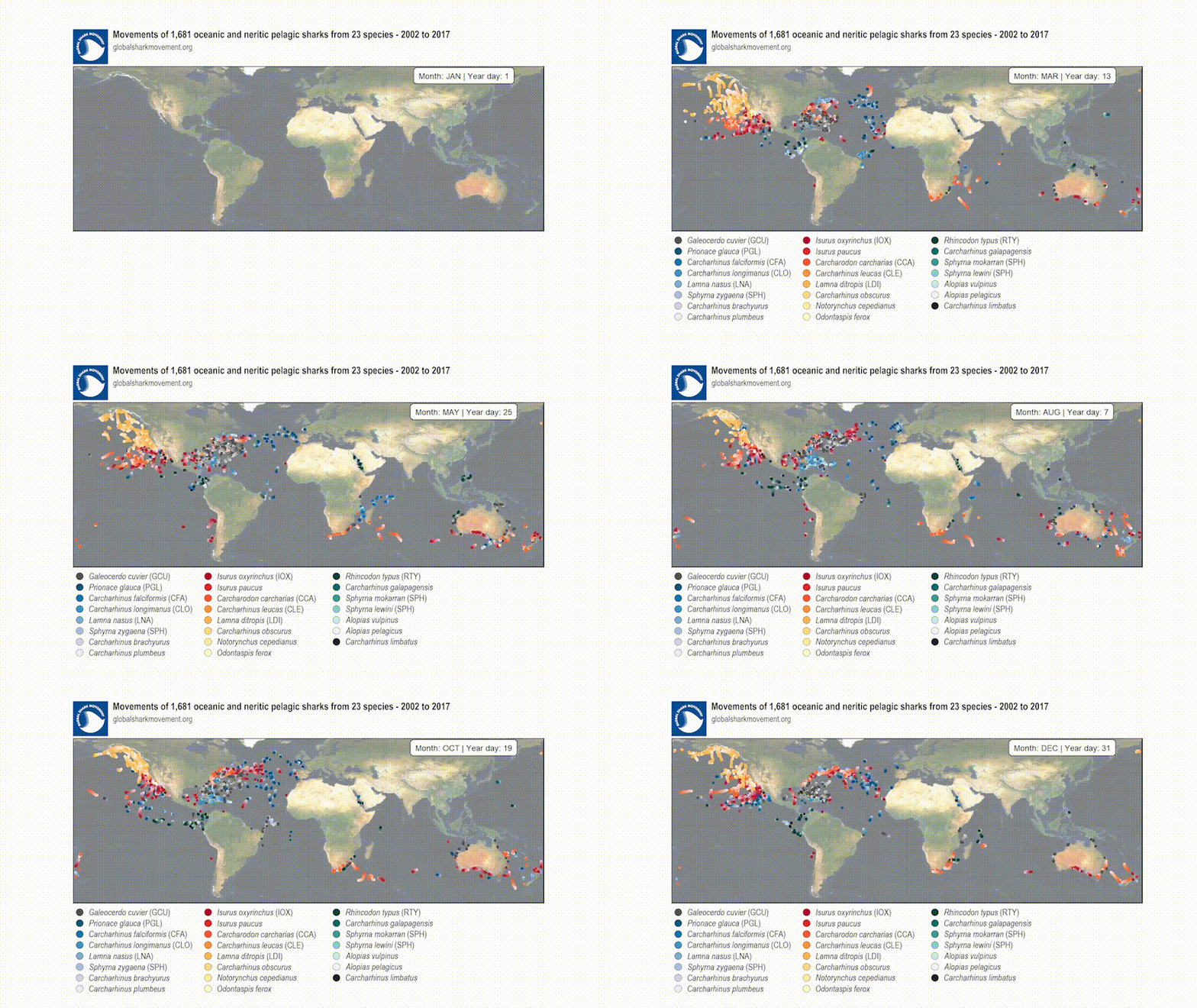
High Seas: Sharks vs Fishing - Epic Paper!

Posted with kind permission - thank you! Click for detail!

Story here, here and here!

This is really beyond phenomenal - especially the tracks!
Just look at the GIF at the top - I mean, seriously, how bloody awesome is that!
Philopatry anybody? 

And the overlap with the fishing fleets?
Having spent countless hours looking for birds when trolling offshore, I know all too well that the prey is not distributed evenly but instead comes in patches, and that consequently, predators converge - and it only stands to reason that as we are supplanting the Sharks as the top predators on the high seas, their footprints will increasingly overlap with that of our commercial fleets, leading to high mortality rates both due to targeted Shark fishing but very much also due to (more or less) unvoluntary bycatch - see this rather recent report about the status of pelagic Elasmobranchs in the SoPac.
Earlier papers e.g. here and here - and here is also an important paper describing the grotesque irony of those fisheries being increasingly unprofitable, story here.
Anyway, huge kudos to Nuno and David - this has truly been a titatic endeavor!

Solutions?
Possibly the postulated well-placed (and well-enforced!) pelagic MPAs but that sure ain't gonna be easy (and here!) - and read this about the need to better identify, and then include those few remaining marine predator refuges! And what about the continued Climate Change-induced poleward shifts (and here!): shift accordingly?
Detail detail! :)

Yeah I know I know.
That's a lot of links - but they are simply a must as things are complicated!

Enjoy the paper and the links!