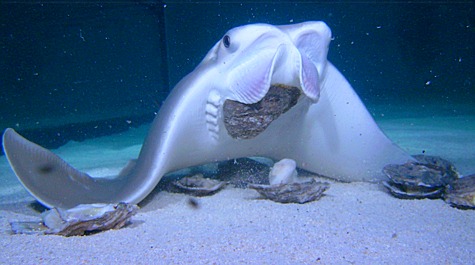
Showing posts with label Cownose Rays. Show all posts

Thursday, June 15, 2017

Cownose Ray Hunting - Moratorium!


Back to the exploding Cownose Rays, and I cite,
The cruelty at play, at times, gives the dolphin slaughter in Taiji, Japan, a run for its money.
Read this.
It summarizes brilliantly the whole fiasco in the Chesapeake Bay starting with Myers' fatally flawed paper all the way to the decision to ban those horrible killing contests.
And I cite again,
The story that unfolded across the Chesapeake Bay is one that should give reason to pause: people were quick to read into unrelated research; to scapegoat; to find blame where they wanted. It’s a lesson about the dangers of oversimplifying science. But there is nothing simple about coastal ecosystems, where a multitude of species and processes interact—many of which have yet to be discovered.
Which begs the question, have the lessons been learned?
And more specifically, have those Shark NGOs, educators and awareness raisers removed all references to the paper from their propaganda educational materials - and will they forthwith finally inform themselves and refrain from all the unhelpful hyperbole?

Yeah I know I know.
To be continued!

Tuesday, February 16, 2016

Exploding Cownose Rays? Not so fast!

Bingo.

Remember those exploding Cownose Ray populations?
Proudly announced in 2007 as the first scientific evidence for Shark-mediated trophic cascades, the paper is a favorite argument of some quarters within the Shark conservation movement, and a frequent topic of increasingly critical posts on this blog, e.g. here, here and here.

Enter myth-buster Dean Grubbs, and I cite.
The lack of temporal correlations coupled with published diet data suggest the purported trophic cascade is lacking the empirical linkages required of a trophic cascade. 
Furthermore, the life history parameters of cownose rays suggest they have low reproductive potential and their populations are incapable of rapid increases. 
Hypothesized trophic cascades should be closely scrutinized as spurious conclusions may negatively influence conservation and management decisions.

Like I said, bingo.
The article is here, and required reading - and no, I really got nothing to add!

Actually, there IS something to add, so there.
Spurious conclusions is likely a euphemism for a load of horseshit. From what I can see, Grubb did not conduct any new field research but merely re-examined the info available at the time, and his findings are pretty much devastating in terms of the methodology and the illicit conclusions by Myers et al. 
Which obviously raises questions about the peer review process but also about the value of NGO-sponsored research (eg here) and according agendas and conflicts of interest.
And now, I can certainly leave it at that!

Enjoy.
And then, throw those exploding Cownose Rays into the same incinerator as the Oxy Myth! Like I said back then,  the theory of correlations between trophic levels is sound - but much more when viewed bottom up! 

Synopses here and here - extensive blog post here!

Sunday, August 23, 2015

A Fever of Stingrays - Video!

Betcha those are our Sharks - source.

Yup - calling this a fever may well be correct!

But then again, maybe not!
These are Cownose Rays - yes they do have a stinger but taxonomically, lumping them in with the  proper Stingrays would not be accurate!

But I'm digressing.
Enjoy!


Friday, December 19, 2014

Shooting Cownose Rays!

Source.

Watch.


How fucking pathetic, and I cite.
Most killing contests are in June, when the rays have returned from the Gulf of Mexico to the Chesapeake to mate and give birth. The biggest rays are pregnant females, and they are the contestants’ prime targets.
“It’s the luck of the draw when a man shoots it and it’s a female: A lot of the times before they get to the scale, the pups are already coming out,” said Bowe. “They try to retain the pups inside to get more weight.”

“They want to kill them while they’re still pregnant,” said Grubbs, the Florida State research biologist. “They’re getting a two for one in their mind,” he said, echoing a sentiment expressed on tournament chat boards.
“I’m a hunter and a fisher,” he added, “and I can tell you, it takes zero skill to kill a cownose ray.”
This is as bad as it gets.
Yes it may be perfectly legal - but ethically, it remains a total abomination. And the propaganda by the apologists is, alas, the direct consequence of the fable about exploding Ray populations that continues to be uncritically parroted by the Shark conservationists.
Populations of Elasmobranchs don't explode, and the habitats in the Chesapeake Bay have not been degraded by the Cownose Rays but by us.

What The Fuck!

Saturday, January 15, 2011

Doug Perrine about eating Cownose Rays!


I've said it before, Doug Perrine is Royalty.
Not only is he one of the nicest guys around, not only is he one of the pre-eminent underwater photojournalists - he is also a staunch and at the same time, extremely well documented marine conservationist.

Case in point, his comment to this article in NGM.
Surprise surprise, when he posted it, he got the following reply Your comment has been saved. Comments are moderated and will not appear until approved by the author - and it very much appears like the author may still be pondering. I wonder why? :)
Doug is referencing this seminal paper (longer synopsis here), probably the first such study that documented how removing Sharks could trigger trophic cascades (another example here).

As a caveat, it must be said that this does NOT apply to all Sharks!
It only applies to determined species in determined habitats where they act as apex predators and keystone species - other, generally smaller species of Sharks like e.g. Spiny Dogfish are considered mesopredators and may in fact profit from the removal of apex predators!

But I'm digressing as always.
Here is Doug's comment, unabridged - let's see if Jeremy Berlin will eventually have the guts to approve its posting on NGM. Anybody taking bets?
Bravo Doug!

Jeremy Berlin’s short and intriguing article in the January issue of NGM, “Eat a Ray, Save the Bay,” left me hungry for more information.

What are these “shellfish” that the rays are “gobbling?”
Are they, by any chance commercially important species of mollusks and crustaceans that have been in severe decline for years due to over-harvesting and habitat destruction by humans?
Any chance that humans have also been “gobbling” these species?


And what about the grass beds that the rays are “roiling?”
Would these, by any chance, be the same grassbeds that have been in decline since humans first settled around Chesapeake Bay, as a result of pollution, poor watershed management, mechanical destruction by dredging (for some of those unnamed “shellfish”) and boat propellers, etc.?


Why is it that “predators like coastal sharks have declined?”
Does it have anything to do with the rapacious, cruel, and obscenely wasteful fishery for shark fins to supply a nutrition-free status-enhancing soup ingredient for Chinese celebrations?

Have the unidentified “area officials” considered the alternative of rebuilding healthy populations of predators in order to ensure a resilient and balanced ecosystem?
When the writer refers to “the observed spike in cownoses, though untallied,” may I presume that the meaning is that there are no reliable population estimates for this species either before or after the sharks and shellfish were both overfished, and certainly not before the entire ecology of the Bay was drastically altered at human hands?


Are the “area officials” aware of the life history characteristics of elasmobranchs (sharks and rays), such as extremely low fecundity, slow growth, and delayed maturity, which make them notoriously poor candidates for a commercial fishery?
Can they name a single truly sustainable fishery for any species of elasmobranch? May I suggest an alternative to the moniker “Chesapeake ray?”
How about “scapegoat ray?”


One final question: when did National Geographic Magazine start promoting resource exploitation schemes clearly developed by commercial fishermen and their allies in local government without consulting scientists with expertise in the field?

In China, bamboo forests have been destroyed for agriculture and development and pandas are gobbling the remaining bamboo.
Can we expect to see panda recipes in National Geographic soon?


As I said: Royalty!