Friday, February 16, 2007

We are not Aquatrek

We were recently copied on a press release by our local competitor, Aquatrek Beqa.

In that remarkable piece, they eloquently claim to have set up a Marine Park, to have trained "fish wardens" patrol it, to have established a scientific data base about their dive and to conduct scientific research there.

Sound familiar?

To top it off, they claim that we've been the victims of an accident.

The truth is: not a single one of those assertions is true!

In terms of conservation and science, Aquatrek have nothing to show for. And now, they are obviously trying to take credit for our own achievements, and to slander us in the process.

For too long, we have sat back and allowed those lies to remain unchallenged.
Now is the time to set the record straight.

For a passionate in-depth analysis of Aquatrek's press release, please click here

Thursday, February 08, 2007

Beqa Adventure Divers scoop diving award.

2006 AON Fiji Excellence in Tourism Awards

On Friday the 8th February, the who's who in the Fiji tourism world gathered at the Sofitel Resort on Denarau Island for the 2006 AON Fiji Excellence in Tourism Awards Gala Dinner.

The Fiji Police Band welcomed the crowd with a mix of music, ranging from traditional Fijian tunes to the Macarena; most bizarre though highly entertaining.

The 2006 AON Fiji Excellence in Tourism Award winners were announced throughout the evening and Beqa Adventure Divers were honoured to be the recipients of the Diving Award for their services to the diving and tourism industry in Fiji.


Sunday, January 14, 2007

MV Predator Survey

The requirements to operate commercial vessels in the Fiji Islands are very demanding. There are various licenses required, one of which is a survey license. The Fiji Islands Maritime Safety Authority (FIMSA) require commercial vessels to undergo surveys every 6 months, with the annual survey requiring the boat to be aslip for hull inspections.

December 2006 brought about annual survey time for our main dive boat, MV Predator. Having the boat aslip means we can really get a good look at the hull and give her a good scrub from top to bottom. We've opted to not use any antifouling paint on the hull of Predator, prefering to scrub her clean on a regular basis. Both engines underwent a full overhaul under the watchful of eye of David, our technician.

After spending a day working on her, it was survey time. The FIMSA representative inspected the integrity of the hull before boarding Predator. The safety of passengers onboard are top priority, so items like life preservers, fire extinguishers, EPIRBs, life rafts are all checked to be in working condition.

With the safety equipment all ticked off, it's now time for the sea trial and down into the water we go. With the surveyor onboard, we cruise the Qaraniqio River back to our base at Lagoon Resort while he checks that both engines are in tip-top shape.

No matter where you go diving in Fiji, if you're in any doubt as to the boat's safety, be sure to ask to see the licenses that are required to be available onboard. Survey License, Safe manning Certificate, Coastal Trading License and of course the Captain's License.

Monday, January 01, 2007

Happy New Year!!

With Fiji's position right on the International Date Line, we were some of the first people to welcome in 2007. There were all sorts of parties going on, the street party in Suva, beach parties in Pacific Harbour and then the big blow-outs at the Tiki Bar/Arts Village and The Pearl South Pacific.

The heavens were smiling on us and we were blessed with some fine weather throughout the day and into the night. The dive team couldn't party too hard though, we had a trip running on the 1st January and wow, what a way to start off '07.
Beautiful blue skies and 30m visibility greeted us at daybreak. Waiting for the bull sharks to return can be nerve-racking; wondering which day will be the day. Well, January 1st, 2007 was the day and over 15 different individuals graced us with their presence for over 45 minutes. Many of the females bore wounds from their mating season, it's truly remarkable how these wounds will be completely healed and invisible in a matter of weeks. We're looking forward to some great shark diving in the months ahead!!

Saturday, December 16, 2006

The Running of The Bulls!!!

You read correctly, the team at BAD are waiting with bated breath for the running of the bulls; not the 4-legged variety though.

Late December into early January are the months when the mature bull sharks will return in droves from their annual birthing/mating migration. This year they departed our local waters in September whereupon we were left witnessing mostly juvenile sub-adult bull sharks and the odd adult straggler who, for whatever reason, decided not to leave Shark Reef with the other adults.

Joining us this year to meet the bulls on their return are the team from The Bull Shark Tagging Programme, Juerg Brunnschweiler and Gary Adkison. If you have questions regarding bull sharks, or other shark species for that matter, the New Year period would be a great time to pick the brains of two highly respected figures in the shark world. If you would like more information on how to join Juerg and Gary and learn more about the research at Shark Reef Marine Reserve, contact us here...

Award winning film about sharks.

In an effort to protect sharks, Rob Stewart teams up with renegade conservationist Paul Watson of the Sea Shepherd Conservation Society. Their unbelievable adventure together starts with a battle between the Sea Shepherd and shark poachers in Guatemala, resulting in pirate boat rammings, gunboat chases, mafia espionage, corrupt court systems and attempted murder charges, forcing them to flee for their lives.

Through it all, Stewart discovers these magnificent creatures have gone from predator to prey, and how despite surviving the earth's history of mass extinctions, they could easily be wiped out within a few years due to human greed.

Stewart's remarkable journey of courage and determination changes from a mission to save the world's sharks, into a fight for his life, and that of humankind.

Read about Sharkwater and Stewart & Watson's battle for survival....

Tuesday, December 12, 2006

Amazing pictures of breaching Great White Sharks!

I stumbled upon this link whilst browsing for shark pictures. The pictures are copyrighted and cannot be downloaded - but they are simply stunning! To see these amazing pictures, click here

More breaching Great White Sharks on the web page of our friend Klaus Jost, right here....

Great News: Full protection for Great White Sharks in New Zealand!

White pointer sharks will now be fully protected within the 200 nautical miles of New Zealand and from fishing by New Zealand-flagged boats, further a field, in a change in legislation announced by the Ministers of Conservation and Fisheries today.

The species, also known as the great white shark, will be protected under The Wildlife Act meaning it will be illegal to hunt, kill or harm a white pointer shark within New Zealand’s Exclusive Economic Zone (EEZ – 200 nautical mile limit around NZ). It will also be illegal in New Zealand to possess or trade in any part of a white pointer shark.

New Zealand is a signatory to the Convention on the Conservation of Migratory Species of Wild Animals and has an obligation to prohibit the taking of white pointer sharks.

More about this fantastic achievement here

Great Barrier Reef sharks on the edge

Sharks living around the coral reefs of Australia’s Great Barrier Reef (GBR) face imminent “ecological” extinction unless urgent action is taken to protect them from fishermen and poachers, according to the first study of the animals’ survival on the GBR.

Densities of grey reef shark (Carcharhinus amblyrhynchos) and whitetip shark (Triaenodon obesus) are down by as much as 97% in parts of the GBR that are fished compared to areas where fishing vessels are banned. So says Howard Choat, who carried out the study with colleagues at James Cook University in Townsville, Australia. Fishing vessels are banned from “no entry” zones, which make up only 1% of the Great Barrier Reef World Heritage Area.

Read more about the plight of the sharks here

Sunday, November 05, 2006

Meet Juerg Brunnschweiler, our resident Bull Shark specialist

Juerg M. Brunnschweiler is a PhD student at the Department of Ecology, Institute of Zoology, University of Zurich, Switzerland. His main research interests are behavioural and ecological aspects of sharks. In 2003 he initiated the Bull Shark Tagging Programme with the long-term goal of understanding movement patterns, habitat use and population dynamics of bull sharks.

Learn more about Juerg's studies here...

The Legend of DAKUWAQA the Shark God who protects our feeders

One of the best known gods in Fijian legends is the fierce sea-monster Dakuwaqa. He was the guardian of the reef entrance of the islands, fearless, headstrong and jealous. He frequently changed himself into the form of a shark and travelled around the islands fighting all the other reef guardians.

One day he set out for the Lomaiviti group and after emerging victorious from this area he decided to set out for Suva....

(Photo: Michael Aw)

Monday, October 30, 2006

If you want to learn more about sharks.

The following selection of shark books represents a cross section of the popular literature available on elasmobranch fishes. They are not all necessarily recommended reading but are included to give the reader a somewhat subjective outline of their content. Many of the books are comprehensive enough to warrant inclusion in more than one area but to avoid repetition they are listed where their content is most note worthy. More here...

Thursday, October 26, 2006

Fiji Sharks heading to DEMA

Bula.

It's nearing that time again. The world's biggest professional dive show, DEMA will be held in Orlando from the 8-11th November, 2006.

This year the show is at the Orlando Convention Center and Beqa Adventure Divers are pleased to be returning once again. We will be showcasing some incredible shark images and letting everyone know what's going on for the coming year. If you are going to DEMA, be sure to stop by booth #790 and check in with us.


In conjunction with The Shark Foundation, Switzerland, we are very pleased to be sponsoring 2 seminars; Shark Diving and Eco-tourism: A Conservation Success Story. These presentations are from 1-2pm on Thursday the 9th and Friday the 10th. All are welcome to come and learn of the conservation work and research that is happening in Fiji.

DEMA is going to be a great time to catch up with good friends and hopefully meet some new ones, so stay tuned for live updates and photos from the DEMA show...

Some news from France on Aqua-web from Denis Jeant

Le World Challenge de BBC World a pour objectif de récompenser les projets qui font une réelle différence en matière de communautés locales.

Le World Challenge de BBC World 2006 est organisé par BBC World et le magazine généraliste américain (Usa) Newsweek, en partenariat avec la société Shell, dont les objectifs sont de trouver des individus ou des groupes dans le monde qui ont développé des projets innovants dans le domaine.

(photo by Michael O'Neill)

Voter vous permet de soutenir un des douze projets qualifiés (voir ci-dessous). La cloture des votes aura lieu à 17h00 GMT le 19 novembre 2006.

Le gagnant recevra de la compagnie Shell un premier prix de 20 000 dollars US pour développer son projet.

Les deux prix suivants seront de 10 000 dollars US. Un représentant de chacun des trois projets finalistes sera envoyé à la Haye, aux Pays-Bas pour assister à la cérémonie de remise des prix.

Bite-Back : MAKING WAVES IN SHARK AND MARINE CONSERVATION

Formed in 2002, Bite-Back continues to be the UK's only organisation dedicated to the protection of sharks by reducing consumer demand for its meat and fins.

With the law of supply and demand at its cornerstone, Bite-Back works together with restaurants, fishmongers and retailers to remove shark products from menus and fish counters, effectively lowering the trade in this threatened species.


Since its launch, Bite-Back's ongoing success has seen the organisation take on more mainstream marine conservation issues including campaigns to significantly reduce the trade in other threatened species; lowering levels of oceanic pollution and; protecting fragile coral reefs. Each campaign has been developed to empower the public to become more resolute in its commitment to conserving the oceans, at a local level, through awareness, education, motivation and inspiration.

Read more about this UK conservation body here...

The Sharkman meets Ron & Valerie Taylor

Hello Ron & Valerie.

Welcome to SHARKMAN’S WORLD

Sharkman: In 95% of all Shark related material, your names can be found. How long have you been Interested in Sharks?

Ron: I have been interested in sharks ever since I can remember because I heard stories of people being attacked by sharks along our coastline and my parents used to take me swimming in the ocean when I was very young

Read more of the interview with Ron & Valerie...

US Singer Supports Shark Trust

Nikki Capra, a singer/songwriter based in the US, contacted the Shark Trust office generously offering to donate a portion of her new album (The Astronaut) sales to the Shark Trust. We are very excited about working with Nikki in this way as not only is she a very talented musician but she is genuinely lovely too. Check out her website to read more about her and see her section on sharks or go to her myspace account. Both sites have downloadable tracks and lots and lots of information, pictures, tour dates and poetry from the songstress.


And just to give you a little taster of what you can expect...:

From The Shark Trust Website
http://www.sharktrust.org/

Wednesday, October 25, 2006

IN Depth - Fiji, DIVE UK Magazine article

By Simon Rogerson

For British divers, Fiji represents the ultimate escape: it lies some 2,000 miles northeast of Australia and 12 hours ahead of Greenwich Mean Time. That's about as far from Britain as it is possible to be, but the journey is not as punishing as you may believe - two sets of ten-hour flights via California or the Far East, and you're there. The question is… where are you going to stay? The most important thing is to choose a resort or boat where the diving programme suits you. Simon Rogerson reports on some of the establishments available to visiting divers, each with its own distinctive character.

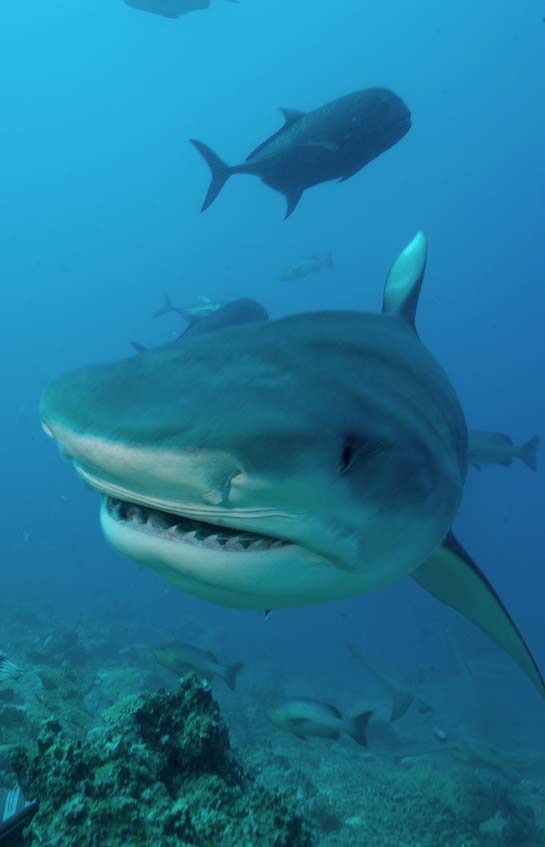
Located on the southern side of the main island of Viti Levu, divers are drawn to two specific attractions - soft coral and extremely big sharks. Just a ten-minute ride offshore by fast catamaran is Shark Reef Marine Reserve, a multi-tiered site where several types of shark are baited up from deep water. On a single dive, it is possible to see bull, lemon, nurse, black-tip, silver-tip grey reef and even tiger sharks.

Read more...

How Sharks Survive Frigid Water

Cool site LiveScience, has some cutting edge articles...

Salmon sharks spend much of their lives in ice-cold waters in the North Pacific. How do they stand it?

New research points to a special protein that may help them survive the frigid conditions.
Researchers attached satellite tags to 48 female salmon sharks in Prince William Sound, Alaska, to track their movements over three years. They also examined the sharks’ physiology to uncover how they endure winter waters dipping to 36 degrees Fahrenheit.

Salmon sharks maintain a 70-degree body temperature through high metabolic rates and internal heat exchanges. This study, by researchers at Stanford University, shows that salmon sharks also have an enhanced set of proteins that help their hearts contract at cold temperatures.

But even with these mechanisms in place, many of the sharks still bask in warmer surface waters during the winter, and others leave the region all together.

While most of the tagged salmon sharks spent their summers around North Pacific coast, half of them migrated south to California and the subtropics once cold winter temperatures set in. Some even went to Hawaii.

The researchers suggest that this previously unknown behavior is influenced by the two major driving forces of shark’s life: food and sex.

Prince William Sound is full of salmon and herring during the summer, but only herring in the winter, so these sharks may have left to look for food. Or they may be seeking warmer waters in which to give birth.

The findings will help ecologists improve ecosystem models for Prince William Sound. This type of satellite tracking, researchers say, could be used to create a map of shark habitats worldwide, a task that may prove critical to their protection.

This study is reported in the Oct. 7 issue of the journal Science.

Michael Aw coming to Fiji

Without a doubt this is the definitive shark dive adventure in the world – imagine predictably close encounter with Tiger shark, Bull shark, Silver-tip, Grey Reef, Tawny Nurse, White-tip, Sicklefin Lemon shark, Blacktip Reef Shark all from one site in the wild.

If you love sharks and serious on preserving them, be sure to join this tour to Shark Reef – a marine protected area dedicated to protect sharks in Beqa Lagoon, Fiji...

Read more about what Michael thinks on his website here...